
Research library
The Bodyvault research library: training, sleep, food and recovery, explained
The studies behind training, food, sleep and recovery, read and summed up in plain words. Each of the 304 papers below links to the original, and the most asked-about topics have their own illustrated explainer.
304
papers read, checked and summed up
102
meta-analyses and systematic reviews
89
randomised and laboratory trials
13
in-depth explainers with charts
- Strength training 46
- Activity and cardio fitness 48
- Food and protein 47
- Sleep, HRV and recovery 62
- Meals and blood sugar 20
- Wearables and accuracy 10
- Women’s health and the cycle 20
- Supplements 35
- Lab tests 16
Explained in depth
The questions people search for most, answered from the studies, with charts you can share.
Strength training
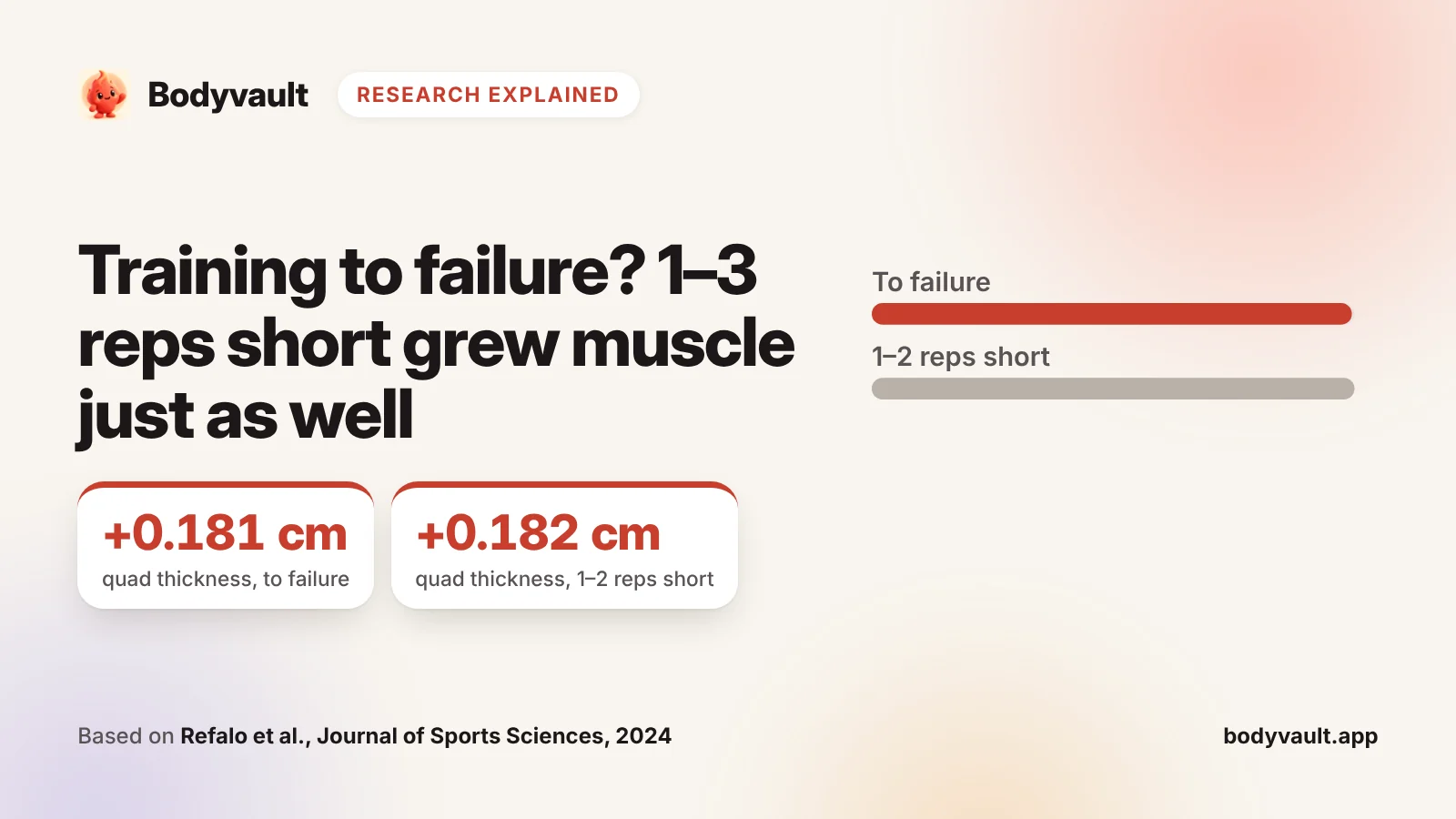
Training to failure: do you need it to build muscle?
Sets closer to failure tend to build more muscle, but stopping 1–3 reps short matched failure in head-to-head trials. Charts on reps in reserve and strength.
Strength training
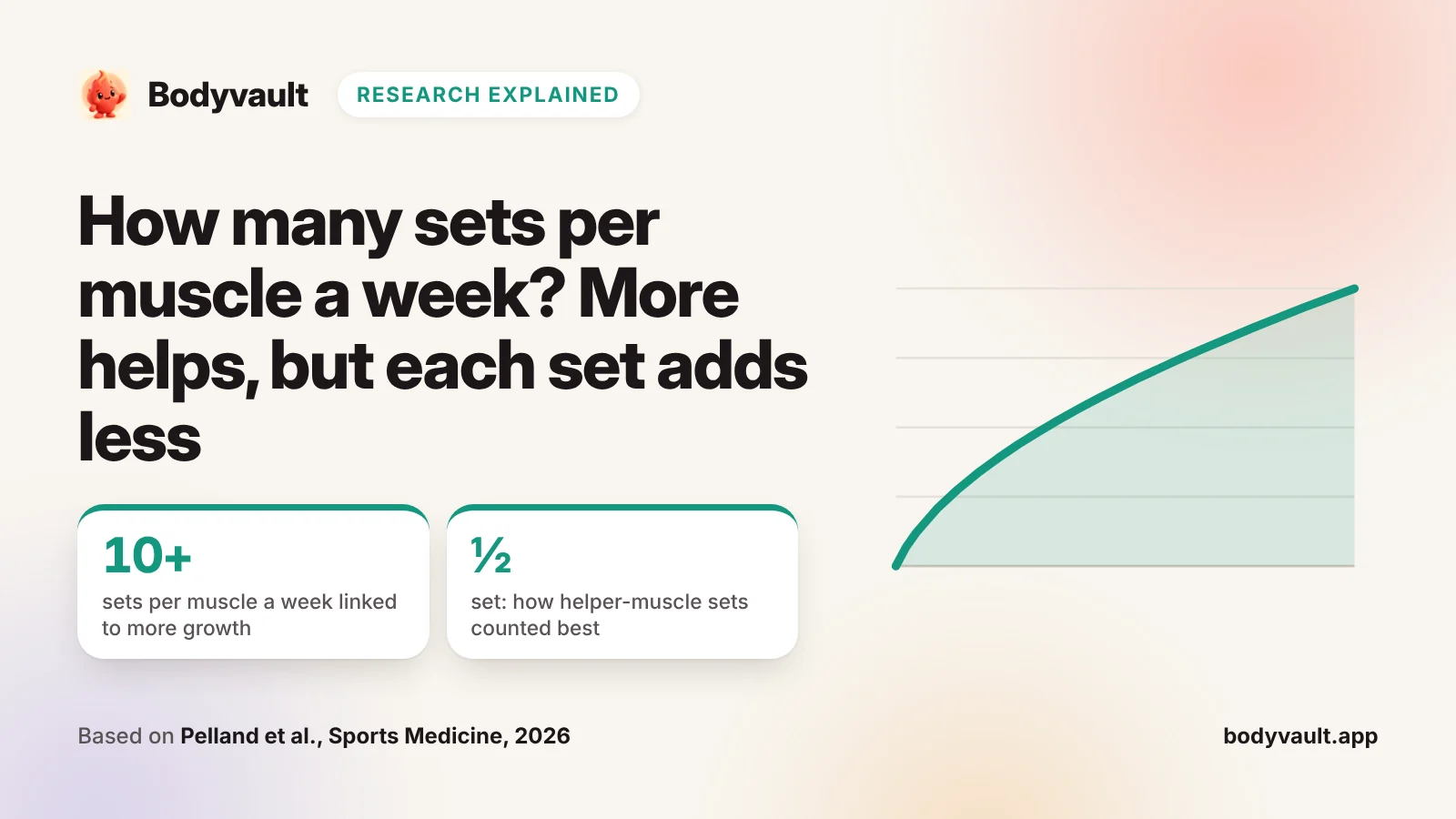
How many sets per muscle per week? What 67 studies show
More weekly sets build more muscle, but each set adds less. What 67 studies show about volume, why helper sets count as half, and why strength needs fewer sets.
Strength training
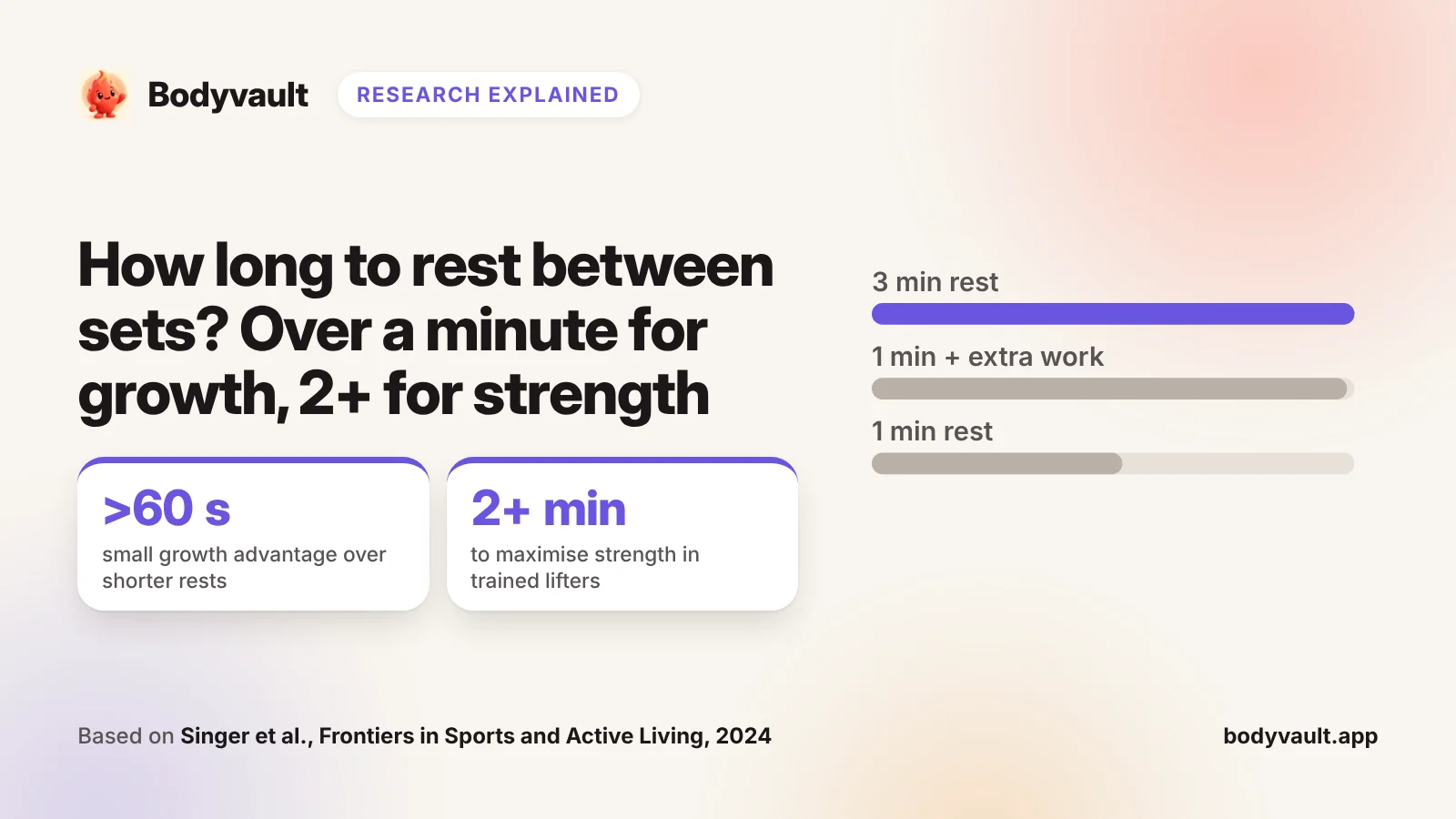
How long to rest between sets: what the research says
Resting over 60 seconds gave slightly more muscle growth, with no clear gain past about 90 seconds. For heavy strength work, rest 2+ minutes. Charts inside.
Nutrition
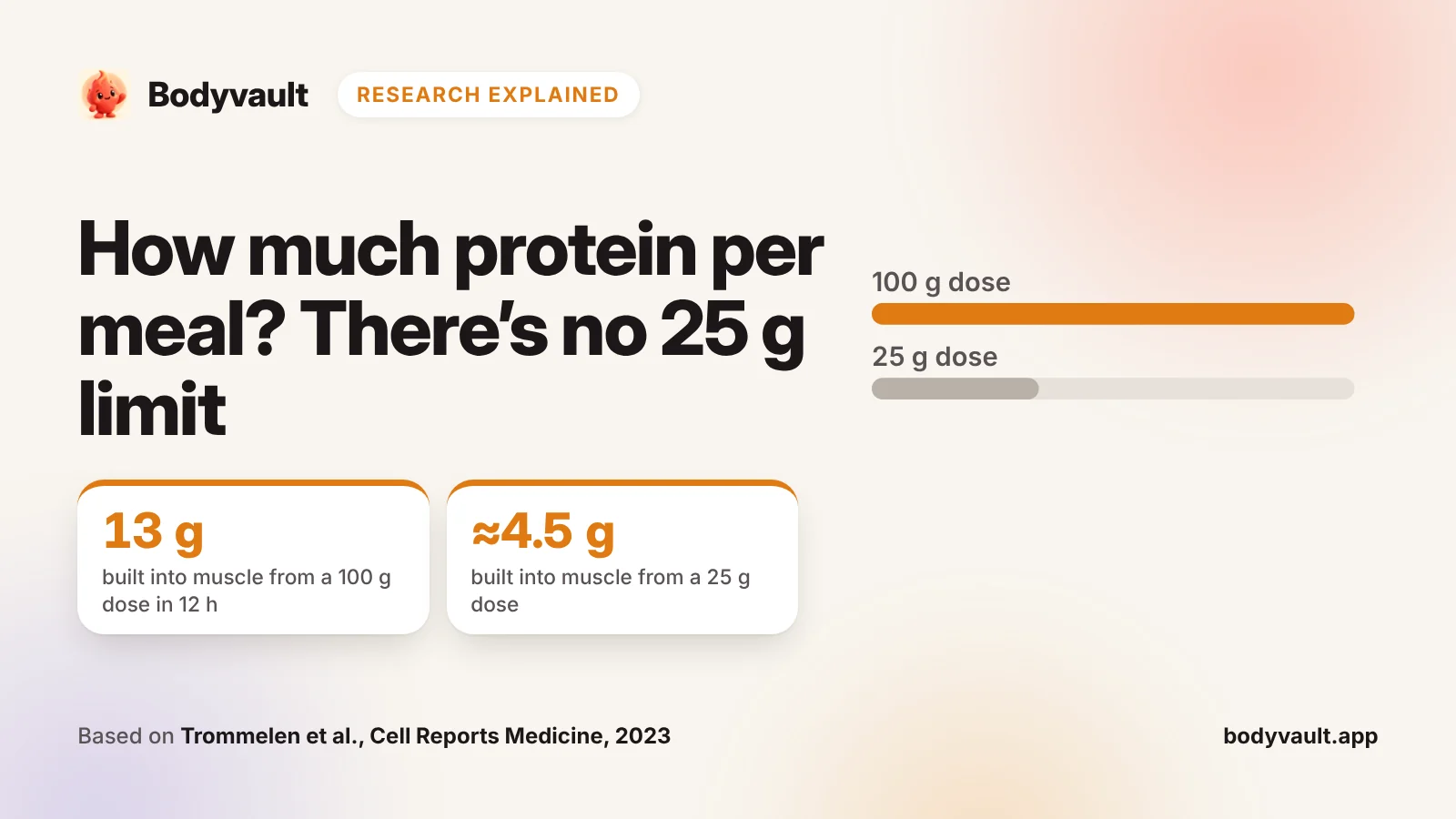
How much protein per meal? What the research actually says
Is there a 25–30 g limit on protein per meal? A 2023 trial found 100 g kept building muscle for 12 hours. Per-meal targets, spreading it out and daily totals.
Supplements
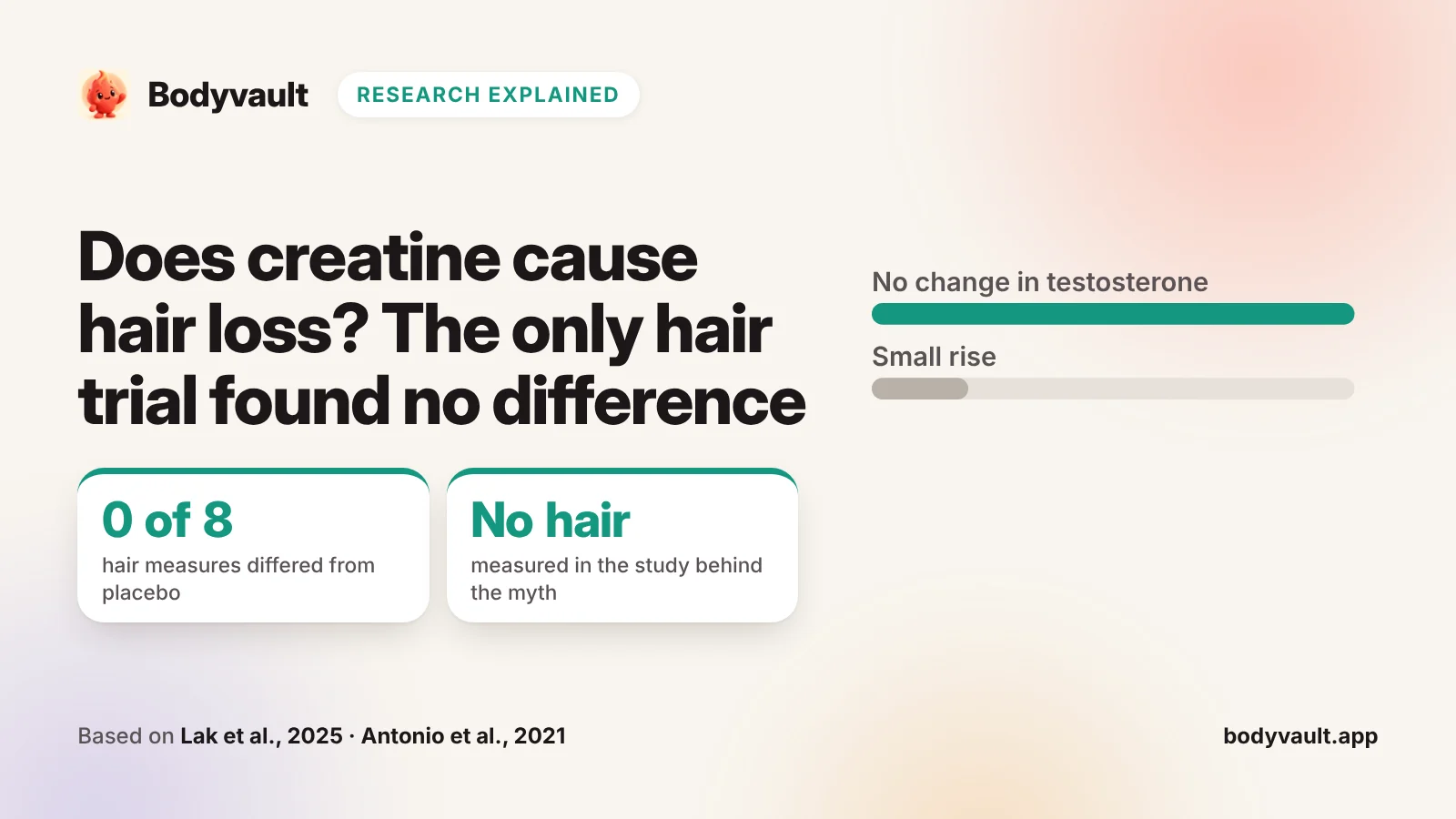
Does creatine cause hair loss? What the research shows
The creatine hair-loss worry traces to a 2009 study that never measured hair. The only trial that did found no difference from placebo. Plus kidney blood tests.
Sleep
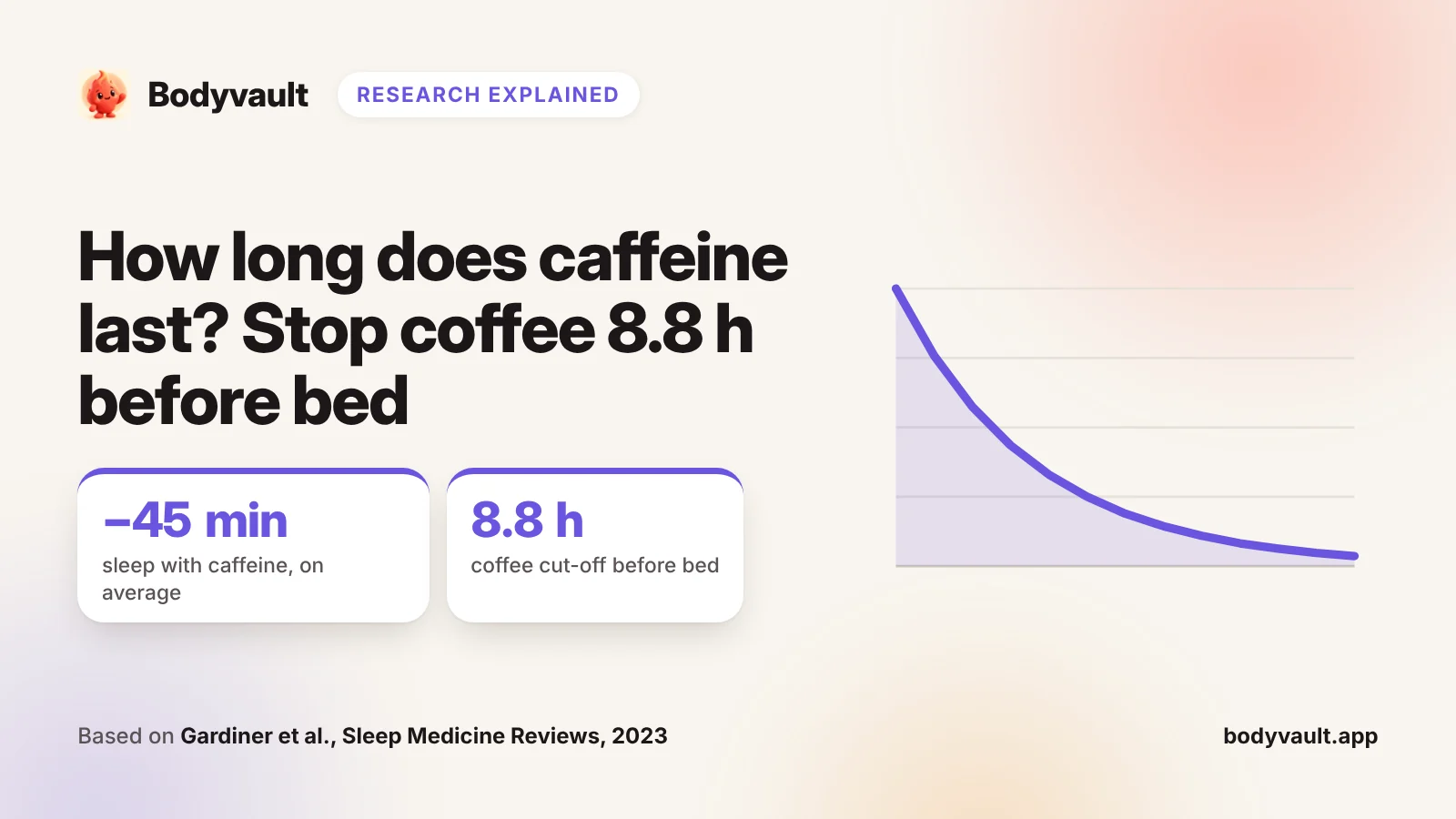
How long does caffeine last? Caffeine and sleep, explained
Caffeine’s half-life averages about 5 hours. In a 2023 meta-analysis it cut sleep by 45 minutes, with a coffee cut-off of 8.8 hours before bed. Charts inside.
Recovery
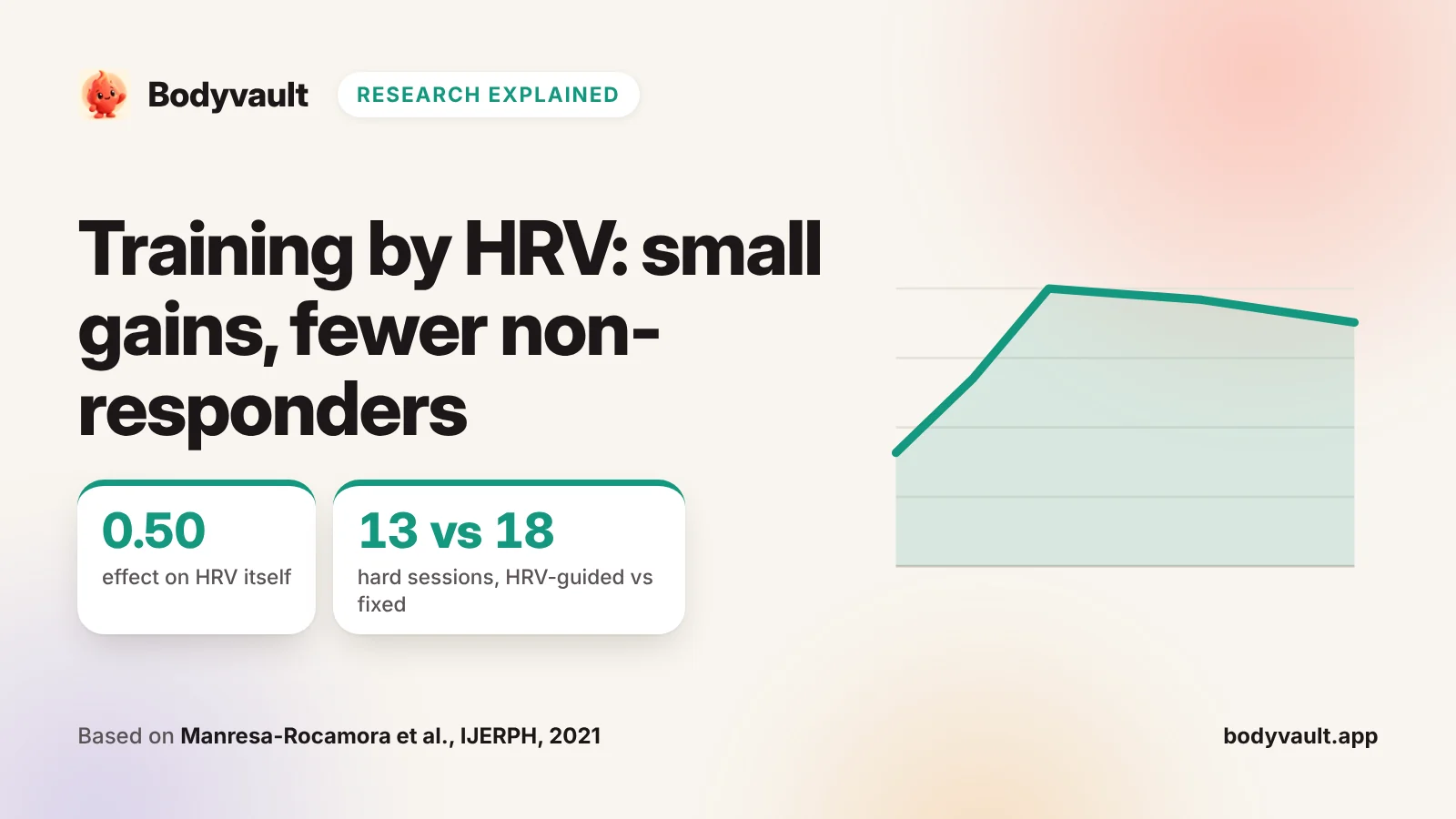
HRV-guided training: does training by your HRV work?
Training by daily HRV gave small, uncertain extra fitness gains in trials, but fewer people failed to improve. How the studies worked and how to use HRV well.
Activity
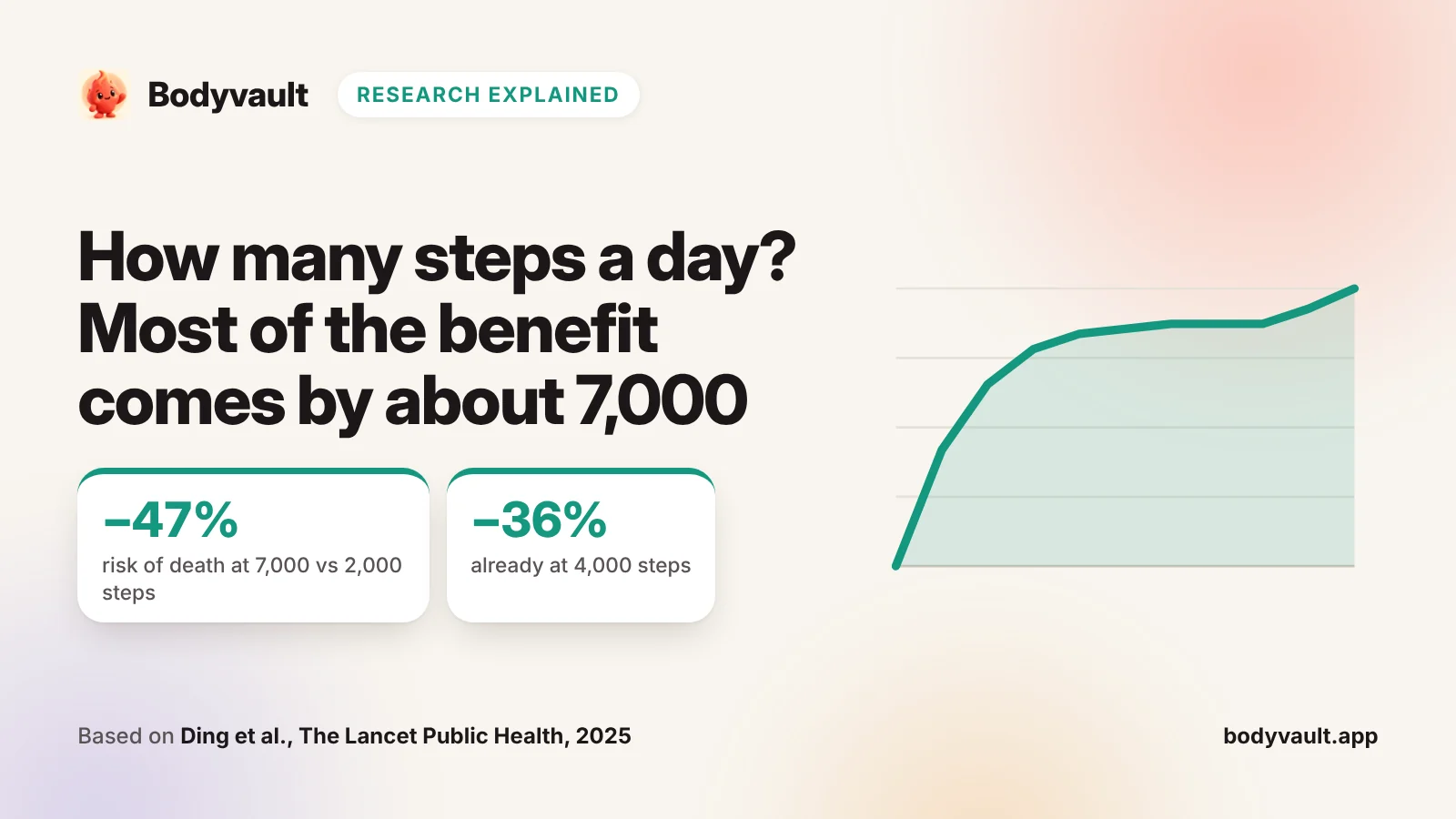
How many steps a day do you need? What the research says
In a 2025 meta-analysis, 7,000 steps a day was linked to a 47% lower risk of death than 2,000, with most of the benefit before 10,000. Charts, age and caveats.
Cardio fitness
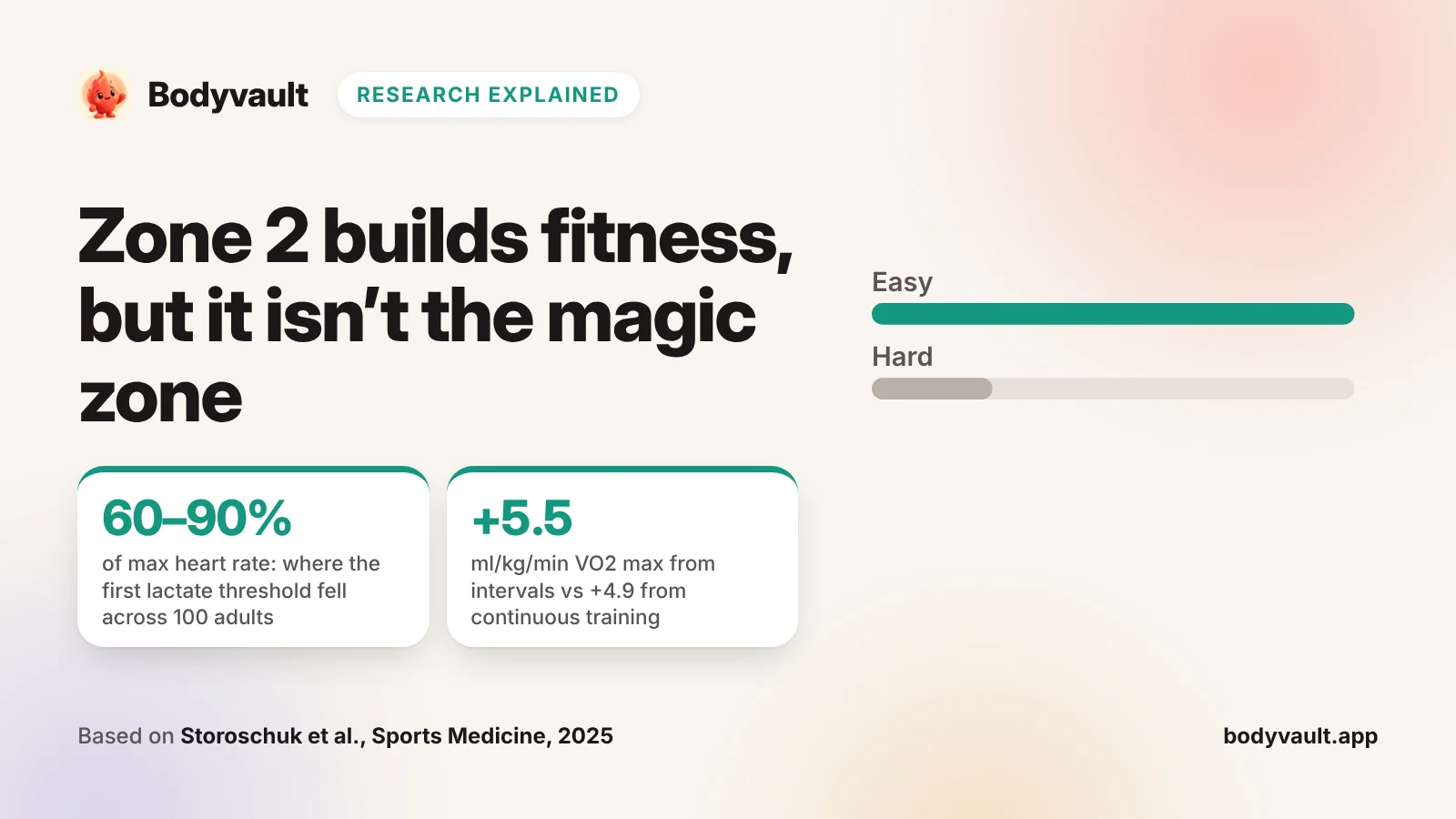
Zone 2 training: what the research actually says
Is zone 2 the best way to build fitness? A 2025 review found no evidence it is optimal. What zone 2 is, how it compares with intervals, and how to mix both.
Recovery
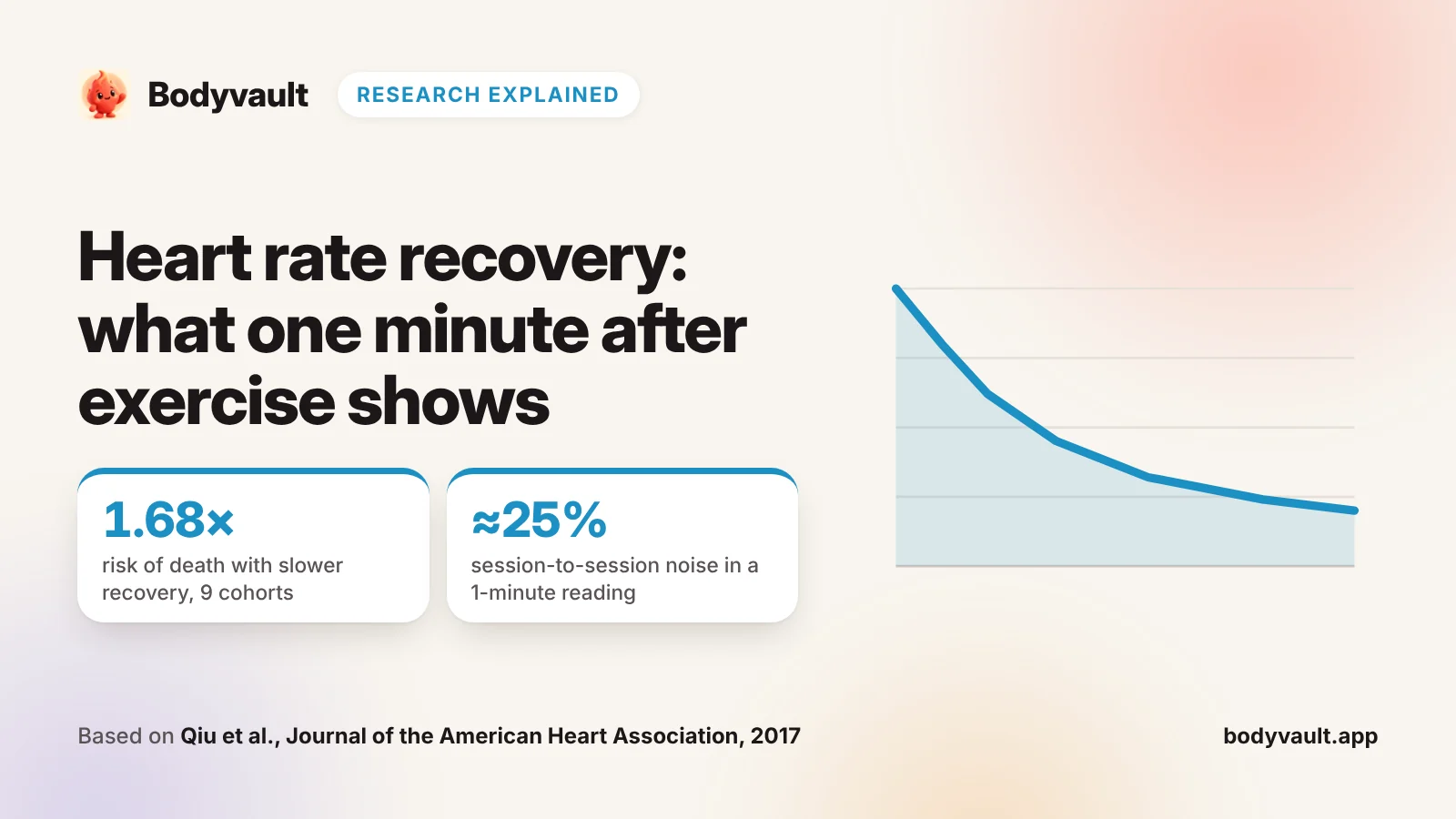
Heart rate recovery: what one minute after exercise says about fitness
Heart rate recovery is how fast your heart rate falls after exercise. What studies link it to, why 12 bpm is not a universal cut-off, and how to track it well.
Metabolic health
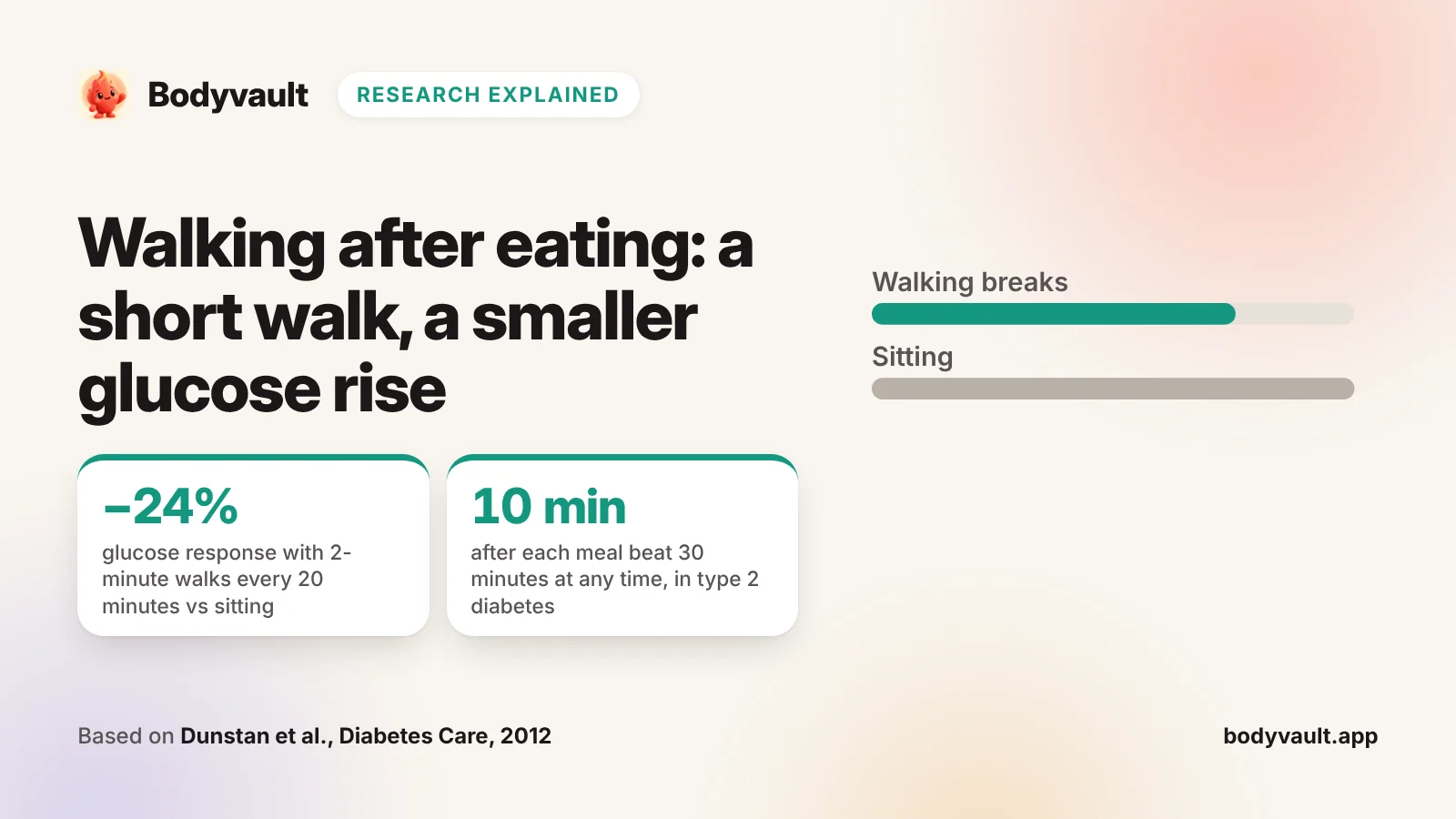
Walking after eating: what the research says, and how long to walk
In lab trials, light walking after meals gave a smaller rise in blood glucose than sitting. How long to walk, when to start, and who these studies included.
Wearables
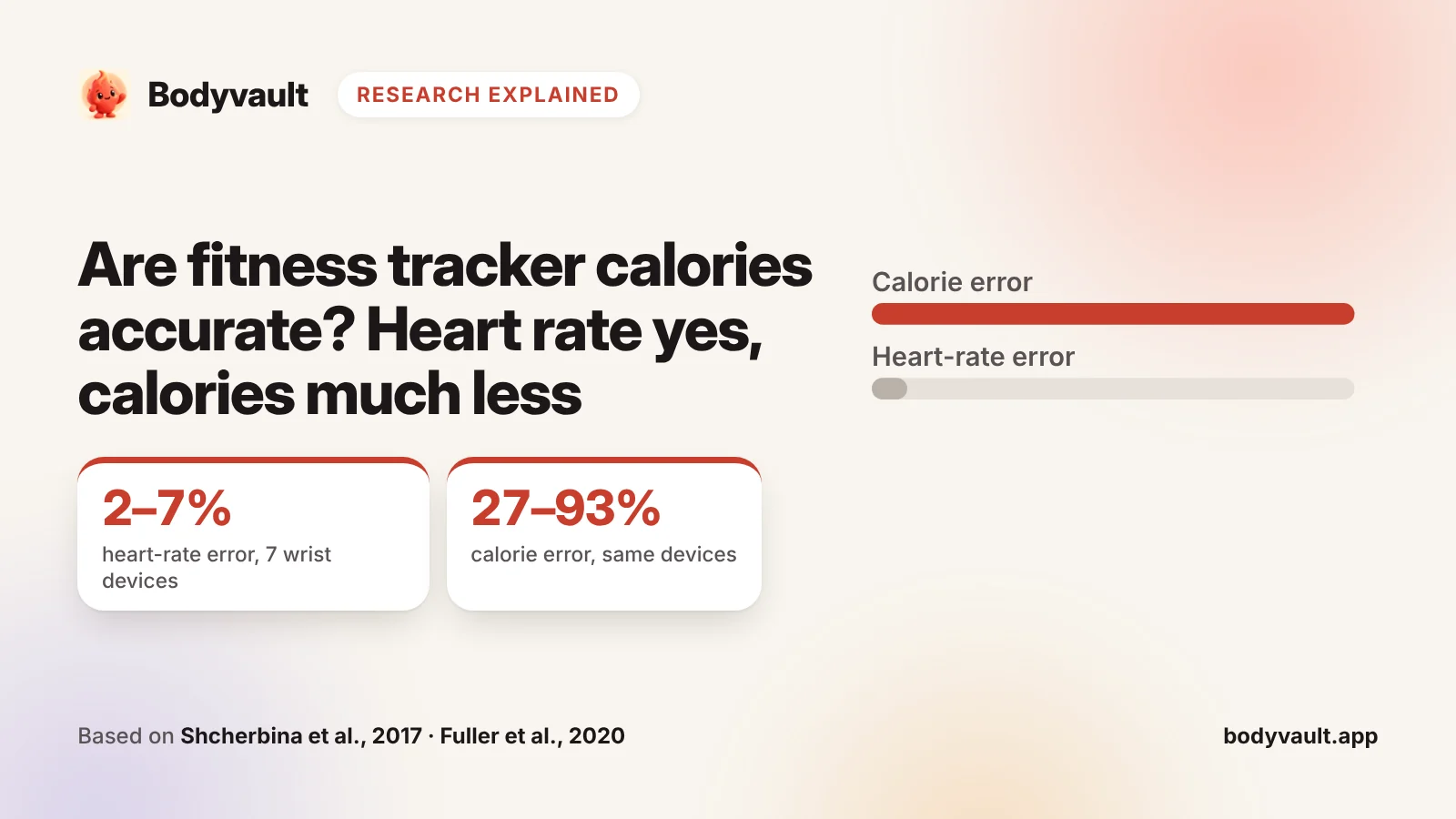
Are fitness tracker calories accurate? What validation studies show
Wrist trackers measure heart rate well, but in lab tests their calorie estimates were off by 27–93%, and few came within 3%. What that means for you.
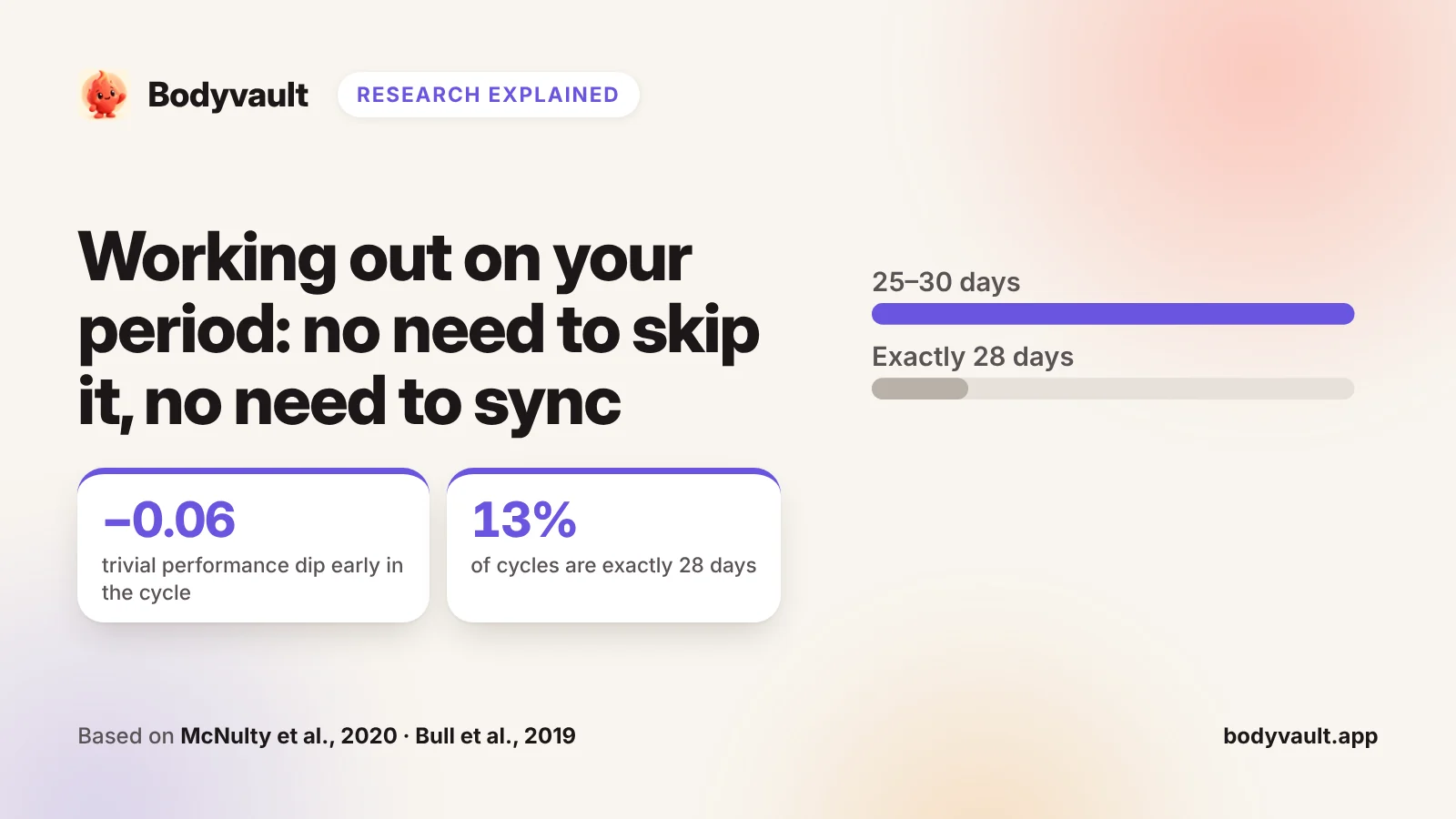
Women’s health
Working out on your period: what research says about cycle syncing
Performance was at most trivially lower around your period, and phase-based training isn’t evidence-based. Why symptoms matter more than the calendar.
How to read the evidence
Not all studies carry the same weight. Pooled analyses of many trials sit at the top; a single observational study can suggest a link but not prove a cause. Each paper below is labelled with its type.
- Meta-analyses and systematic reviewsMany studies pooled and weighed together
- Randomised trialsOne change, compared with a control group
- Cohort studiesLarge groups followed over years: associations
- Cross-sectional and lab studiesA snapshot, or a mechanism under controlled conditions
- Guidelines and position standsExpert bodies summing up the evidence for practice
Strength training
How much to lift, how often, how hard and how long to rest.
Explained in depth: training to failure, sets per muscle per week, rest between sets
-
The Resistance Training Dose Response: Meta-Regressions Exploring the Effects of Weekly Volume and Frequency on Muscle Hypertrophy and Strength Gains
Pooling 67 studies, this analysis found that more weekly sets per muscle generally meant more muscle growth, but each extra set added a little less than the one before. Strength gains levelled off much sooner. Counting 'helper' sets, such as rows for the biceps, as half a set predicted results best.
In practice: Moderate weekly volumes capture much of the benefit; adding sets gives progressively smaller growth gains, and strength gains flatten after a few sets.
Pelland et al.Free full textOur explainer: sets per muscle per week
-
American College of Sports Medicine Position Stand. Resistance Training Prescription for Muscle Function, Hypertrophy, and Physical Performance in Healthy Adults: An Overview of Reviews
The 2026 ACSM position stand pooled 137 reviews and concluded that many program details matter less than simply doing resistance training consistently. More weekly sets helped muscle growth, heavier loads helped strength, and training to failure was not required.
In practice: Train consistently with a program you can sustain; about 10 or more weekly sets per muscle supports growth and heavier loads support strength, while secondary details matter less.
Currier et al.Free full textOur explainer: training to failure
-
Superset Versus Traditional Resistance Training Prescriptions: A Systematic Review and Meta-analysis Exploring Acute and Chronic Effects on Mechanical, Metabolic, and Perceptual Variables
Pairing two exercises back to back saved time without reducing long-term strength or muscle gains, although supersets felt harder. Pairing opposing muscles worked best for keeping training volume up.
In practice: Antagonist supersets, such as a push paired with a pull, are a time-efficient option.
Zhang et al.Free full textOur explainer: rest between sets
-
Exploring the Dose-Response Relationship Between Estimated Resistance Training Proximity to Failure, Strength Gain, and Muscle Hypertrophy: A Series of Meta-Regressions
Researchers pooled 55 studies and estimated how many reps in reserve each training group left in the tank. Muscle growth tended to be larger the closer sets ended to failure, while strength gains were about the same across a wide range of effort. Because reps in reserve had to be estimated after the fact, the exact numbers are uncertain.
In practice: For muscle growth, working sets probably should end fairly close to failure, while strength-focused sets appear to tolerate stopping further from failure.
Robinson et al.Free full textOur explainer: training to failure
-
Give it a rest: a systematic review with Bayesian meta-analysis on the effect of inter-set rest interval duration on muscle hypertrophy
Pooling nine trials, muscle grew with both short and long rests, but resting more than a minute between sets gave a small edge for arm and thigh growth. Resting much longer than about 90 seconds did not clearly add more.
In practice: For muscle growth, resting at least about 1-2 minutes between sets seems sensible; longer rests are fine but not clearly better.
Singer et al.Free full textOur explainer: rest between sets
-
Influence of Resistance Training Proximity-to-Failure on Skeletal Muscle Hypertrophy: A Systematic Review with Meta-analysis
This review compared training to failure with stopping short of failure across 15 studies. Going all the way to failure did not clearly build more muscle than stopping a little short, although very easy sets produced less growth. The authors suggest the benefit of extra effort may level off as you approach failure.
In practice: Sets taken close to failure appear to capture most of the growth benefit; reaching true failure on every set does not appear necessary.
Refalo et al.Free full textOur explainer: training to failure
Show 40 more papers
-
The Acute and Chronic Effects of Implementing Velocity Loss Thresholds During Resistance Training: A Systematic Review, Meta-Analysis, and Critical Evaluation of the Literature
Velocity-loss training ends a set once bar speed drops by a chosen percentage, which tracks how close you are to failure. Letting speed drop further was linked to more muscle growth, not more strength, and to smaller improvements in jumping and sprinting.
In practice: Closer-to-failure sets may favour muscle growth, while stopping earlier may better suit strength, speed and power goals.
Jukic et al.Free full textOur explainer: training to failure
-
Resistance training prescription for muscle strength and hypertrophy in healthy adults: a systematic review and Bayesian network meta-analysis
Combining hundreds of trials, every type of resistance training tested beat doing nothing for strength and muscle. Heavier loads helped most for strength, while many different set-ups built muscle similarly, with multi-set programs ranking highest.
In practice: Almost any consistent program works; heavy loads matter most for maximal strength and multiple sets rank highest for muscle growth.
Currier et al.Free full textOur explainer: sets per muscle per week
-
Effects of resistance training performed to repetition failure or non-failure on muscular strength and hypertrophy: A systematic review and meta-analysis
Across 15 studies in young adults, training to failure and stopping short of failure produced similar strength and muscle gains on average. Training to failure did not appear harmful either. A possible small benefit for muscle growth in experienced lifters rests on only two studies.
In practice: Failure training is optional for most people and may be used selectively by experienced lifters.
Grgic et al.Free full textOur explainer: training to failure
-
Accuracy in Predicting Repetitions to Task Failure in Resistance Exercise: A Scoping Review and Exploratory Meta-analysis
When people estimate how many more reps they could do, they tend to underestimate by about one rep on average. Estimates get better close to failure, with heavier loads (fewer reps) and in later sets. Experience did not clearly make people more accurate.
In practice: Reps-in-reserve ratings are useful but imperfect; expect roughly a one-rep margin of error, more on high-rep sets.
Halperin et al.Our explainer: training to failure
-
The Effect of Load and Volume Autoregulation on Muscular Strength and Hypertrophy: A Systematic Review and Meta-Analysis
Adjusting training loads day to day based on how sets feel (RPE or reps in reserve) or on bar speed gave similar strength gains to fixed percentage plans. Stopping sets earlier favoured strength, while pushing sets further favoured muscle growth.
In practice: RPE/RIR-based load adjustment is a reasonable alternative to fixed percentages, with similar strength results.
Hickmott et al.Free full textOur explainer: training to failure
-
A Systematic Review of The Effects of Different Resistance Training Volumes on Muscle Hypertrophy
In trained young adults, doing more than 20 weekly sets did not clearly beat 12-20 sets for the quads or biceps, though it did for the triceps. The authors concluded that 12-20 weekly sets per muscle is a reasonable standard range.
In practice: 12-20 weekly sets per muscle is a reasonable starting range for trained lifters; more may help some muscles, but evidence is mixed.
Baz-Valle et al.Free full textOur explainer: sets per muscle per week
-
The Minimum Effective Training Dose Required to Increase 1RM Strength in Resistance-Trained Men: A Systematic Review and Meta-Analysis
Even very low training doses, such as one hard set of an exercise two or three times a week, increased squat and bench press strength in trained men. More training may give more, but a minimum dose still works.
In practice: When time is short, one hard set per lift a few times a week can still build strength.
Androulakis-Korakakis et al.Our explainer: sets per muscle per week
-
How many times per week should a muscle be trained to maximize muscle hypertrophy? A systematic review and meta-analysis of studies examining the effects of resistance training frequency
Across 25 studies, how many days per week a muscle was trained made little difference to growth as long as total weekly sets were the same. Training more often mainly helps by making it easier to fit in more sets.
In practice: Pick a weekly frequency that suits your schedule; total weekly volume matters more.
Schoenfeld et al.Our explainer: sets per muscle per week
-
Effects of Rest Interval Duration in Resistance Training on Measures of Muscular Strength: A Systematic Review
Strength improved with both short and long rests, but experienced lifters seemed to gain the most strength when resting more than two minutes between sets.
In practice: For heavy strength work, rest at least about 2 minutes; beginners can rest 1-2 minutes.
Grgic et al.Our explainer: rest between sets
-
Dose-response relationship between weekly resistance training volume and increases in muscle mass: A systematic review and meta-analysis
This earlier landmark analysis found a graded relationship: more weekly sets per muscle went along with more muscle growth. It helped establish weekly sets per muscle as a key training dose.
In practice: Weekly set volume is a key lever for growth; progressing toward moderate volumes is reasonable within your ability to recover.
Schoenfeld et al.Our explainer: sets per muscle per week
-
The effects of short versus long inter-set rest intervals in resistance training on measures of muscle hypertrophy: A systematic review
An early review found muscle growth with both short and long rests, with a hint that trained lifters do better with longer rests. Evidence was limited.
In practice: Both short and longer rests can build muscle; trained lifters may benefit from longer rests.
Grgic et al.Our explainer: rest between sets
-
Effects of Resistance Training Frequency on Measures of Muscle Hypertrophy: A Systematic Review and Meta-Analysis
This earlier review suggested that training each muscle at least twice a week grew muscle better than once a week. A later, larger review (2019) found frequency matters little when weekly volume is the same.
In practice: Training each muscle about twice a week is a practical default, mainly as a way to spread weekly volume.
Schoenfeld et al.Our explainer: sets per muscle per week
-
American College of Sports Medicine position stand. Progression models in resistance training for healthy adults
The 2009 ACSM guidance set out widely used rules of thumb for sets, reps, rest and progression. Several of these have since been refined, and the guidance was updated by the 2026 position stand.
In practice: Its progression rule, adding load once you can exceed your target reps by one or two, remains a practical way to progress.
American College of Sports MedicineOur explainer: rest between sets
-
Comparative Adaptations to Different Leg Extension Set-termination Strategies in Trained Men and Women: A Unilateral Within-Participant Study
In a 2026 study, trained men and women did leg extensions with one leg going to failure and the other stopping one to three reps short. After eight weeks, muscle size and strength gains were essentially the same in both legs.
In practice: Training with one to three reps in reserve appears to be a practical alternative to failure for single-joint exercises.
Vasconcelos et al.Our explainer: training to failure
-
Similar muscle hypertrophy following eight weeks of resistance training to momentary muscular failure or with repetitions-in-reserve in resistance-trained individuals
Trained lifters trained one leg to failure and the other leg stopping one to two reps short for eight weeks. Both legs grew by almost exactly the same amount, but the failure leg showed more short-term fatigue in sessions.
In practice: Stopping one to two reps short of failure produced similar quadriceps growth to training to failure, with less acute fatigue.
Refalo et al.Our explainer: training to failure
-
Volume Load Rather Than Resting Interval Influences Muscle Hypertrophy During High-Intensity Resistance Training
Short rests reduced how much total work people could do, and that, rather than the rest itself, explained smaller muscle gains. When the short-rest leg did extra work to match the long-rest leg, it grew just as much.
In practice: If you rest briefly, you may need extra sets to match the work done with longer rests.
Longo et al.Our explainer: rest between sets
-
Longer Interset Rest Periods Enhance Muscle Strength and Hypertrophy in Resistance-Trained Men
Trained men who rested 3 minutes between sets gained more strength and more thigh muscle over 8 weeks than men who rested 1 minute, even though the prescribed sets and rep ranges were the same.
In practice: Very short rests may limit gains in trained lifters; rests of around 2-3 minutes are a reasonable choice for multi-joint lifts.
Schoenfeld et al.Our explainer: rest between sets
-
Accuracy of Intraset Repetitions-in-Reserve Predictions During the Bench Press Exercise in Resistance-Trained Male and Female Subjects
Trained men and women were asked to say when they had about three reps and about one rep left on the bench press. On average their estimates were within about two-thirds of a rep of the truth.
In practice: Trained lifters can usually judge one to three reps in reserve on the bench press to within about one rep.
Refalo et al.Our explainer: training to failure
-
Novel Resistance Training-Specific Rating of Perceived Exertion Scale Measuring Repetitions in Reserve
This study introduced the widely used scale linking effort ratings to reps in reserve, where RPE 9 means about one rep left. Higher effort ratings went along with slower bar speed, which supports the scale's validity.
In practice: An RPE scale anchored to reps in reserve is a simple, validated way to record how hard a set was.
Zourdos et al.Our explainer: training to failure
-
Sex differences in absolute and relative changes in muscle size following resistance training in healthy adults: a systematic review with Bayesian meta-analysis
When men and women follow the same program, women gain muscle at a similar rate relative to their starting size. Men gain slightly more in absolute terms, mainly in the upper body.
In practice: Women can follow the same evidence-based programming principles as men and expect similar relative progress.
Refalo et al.Free full text
-
Maximal Number of Repetitions at Percentages of the One Repetition Maximum: A Meta-Regression and Moderator Analysis of Sex, Age, Training Status, and Exercise
Using data from over 7,000 people, this study updated the classic table of how many reps people can do at a given percentage of their maximum. People vary a lot, especially with lighter weights, and some exercises such as the leg press allow many more reps.
In practice: Reps-to-%1RM tables are averages; individual differences are large, especially at lighter loads.
Nuzzo et al.Free full text
-
Partial Vs Full Range of Motion Resistance Training: A Systematic Review and Meta-Analysis
Full range of motion was generally a slightly better default, but differences were small. Partial reps done in the stretched part of a movement may be as good or better for muscle growth, though that finding is uncertain.
In practice: Use full range of motion by default; lengthened partials are a reasonable option for variety or when injury limits range.
Wolf et al.Free full text
-
Which ROMs Lead to Rome? A Systematic Review of the Effects of Range of Motion on Muscle Hypertrophy
Across 11 studies, training muscles in their stretched position, with full reps or with partial reps at the bottom of the movement, generally beat partial reps in the shortened position for muscle growth.
In practice: Avoid relying only on short, top-range partial reps; full ROM or bottom-range partials appear better for growth.
Kassiano et al.
-
Integrating Deloading into Strength and Physique Sports Training Programmes: An International Delphi Consensus Approach
Experienced coaches agreed that a deload is a planned easier period to shed fatigue and prepare for the next training block, usually by cutting sets or reps. This reflects expert practice rather than trial evidence.
In practice: A deload can be as simple as a week with fewer sets and easier effort every month or two, adjusted to how you feel.
Bell et al.Free full text
-
Effects of Periodization on Strength and Muscle Hypertrophy in Volume-Equated Resistance Training Programs: A Systematic Review and Meta-analysis
Planned variation in loads and volume gave a small extra boost to maximal strength, especially in trained people, but did not change muscle growth when total volume was the same.
In practice: Periodisation can help maximal strength; for muscle growth, total effort and volume matter more than the specific model.
Moesgaard et al.
-
Resistance Training Load Effects on Muscle Hypertrophy and Strength Gain: Systematic Review and Network Meta-analysis
With sets taken to failure, light, moderate and heavy loads produced similar muscle growth, but heavier loads produced more strength.
In practice: Choose rep ranges for comfort and preference when the goal is muscle; use heavier sets when the goal is strength.
Lopez et al.Free full text
-
Effects of range of motion on resistance training adaptations: A systematic review and meta-analysis
This review found that training through a full range of motion built more strength and more leg muscle than partial-range training.
In practice: Full range of motion is a sound default for strength and lower-body muscle.
Pallarés et al.
-
What influence does resistance exercise order have on muscular strength gains and muscle hypertrophy? A systematic review and meta-analysis
Muscle growth was similar whichever exercises came first in a workout, but strength improved most on the exercises done first.
In practice: Put the lifts you most want to get stronger at early in the session.
Nunes et al.
-
Resistance Training for Older Adults: Position Statement From the National Strength and Conditioning Association
The NSCA concludes that resistance training is a powerful way for older adults to counter age-related losses of strength and muscle, supporting function and independence.
In practice: Older adults can benefit greatly from strength training, with programs adapted to their abilities and health.
Fragala et al.
-
Magnitude of Muscle Strength and Mass Adaptations Between High-Load Resistance Training Versus Low-Load Resistance Training Associated with Blood-Flow Restriction: A Systematic Review and Meta-Analysis
Training with light weights while partially restricting blood flow with a cuff built similar muscle to heavy lifting, but heavy lifting built more strength.
In practice: Blood-flow restriction is a niche option mainly for people who cannot train with heavy loads.
Lixandrão et al.
-
Strength and Hypertrophy Adaptations Between Low- vs. High-Load Resistance Training: A Systematic Review and Meta-analysis
When sets were taken to failure, light and heavy weights built similar amounts of muscle. Heavy weights produced bigger gains in one-rep-max strength.
In practice: For muscle growth you can use a range of loads if sets are hard enough; include heavier work if maximal strength is a goal.
Schoenfeld et al.
-
Hypertrophic Effects of Concentric vs. Eccentric Muscle Actions: A Systematic Review and Meta-analysis
Both the lowering (eccentric) and lifting (concentric) parts of a rep build muscle, with a non-significant tilt toward eccentric work. Normal reps already include both.
In practice: Control the lowering phase of each rep; dedicated eccentric-only training is optional.
Schoenfeld et al.
-
Effect of training cessation on muscular performance: a meta-analysis
Stopping resistance training gradually reduces strength and power, and longer breaks cause bigger losses. Older adults lose more.
In practice: Short breaks cost little, but long breaks erode strength, especially with age.
Bosquet et al.
-
Gaining more from doing less? The effects of a one-week deload period during supervised resistance training on muscular adaptations
Taking a full week off in the middle of a 9-week program did not change muscle growth but slightly reduced strength gains compared with training straight through.
In practice: A one-week complete break did not cost muscle, but it may slightly slow strength progress over a short block.
Coleman et al.Free full text
-
Does Taking a Break Matter-Adaptations in Muscle Strength and Size Between Continuous and Periodic Resistance Training
People who took a 10-week break midway ended up with similar strength and muscle to those who trained continuously, because they quickly regained what they had lost.
In practice: Occasional breaks from training are unlikely to undermine long-term results.
Halonen et al.
-
Partial range of motion training elicits favorable improvements in muscular adaptations when carried out at long muscle lengths
Women who did leg extensions only in the stretched part of the movement grew their thigh muscles more in several regions than those using full range or the top half of the movement.
In practice: Lengthened partial reps can be an effective option for quadriceps growth.
Pedrosa et al.
-
Progressive overload without progressing load? The effects of load or repetition progression on muscular adaptations
Lifters who progressed by adding reps did about as well as those who progressed by adding weight over 8 weeks. Adding weight may have a slight edge for one-rep-max strength.
In practice: Adding reps and adding weight are both valid ways to progress.
Plotkin et al.Free full text
-
Human Skeletal Muscle Possesses an Epigenetic Memory of Hypertrophy
In a small study, men who trained, stopped, and then trained again gained more leg lean mass the second time. Their muscles carried molecular marks from the first training period, which the authors describe as an epigenetic 'muscle memory'.
In practice: Previously trained muscle may regain size quickly when training resumes after a break.
Seaborne et al.Free full text
-
Accuracy of prediction equations for determining one repetition maximum bench press in women before and after resistance training
In 103 women, common one-rep-max formulas worked reasonably well on average when based on sets of fewer than 10 reps, and training did not ruin their accuracy. Individual errors could still be around 10%.
In practice: e1RM formulas are good for tracking trends but can be off by roughly 10% for an individual.
Mayhew et al.
-
Prediction of one repetition maximum strength from multiple repetition maximum testing and anthropometry
Estimating one-rep max from a multi-rep set works well, but it is most accurate when the set is heavy, around five reps. Estimates from 20-rep sets were less accurate.
In practice: Estimated 1RM is most trustworthy when calculated from sets of about 10 reps or fewer.
Reynolds et al.
Activity and cardio fitness
Steps, cardio fitness, heart-rate zones and heart rate recovery.
Explained in depth: HRV-guided training, how many steps a day, zone 2 training, heart rate recovery, walking after eating, tracker calorie accuracy
-
The accuracy of Apple Watch measurements: a living systematic review and meta-analysis
Pooling 82 validation studies, Apple Watch heart rate was very close to reference devices on average, with individual readings typically within about plus or minus 7 bpm. Step counts were moderately accurate, while calorie estimates were often far off.
In practice: Watch heart rate is close enough on average for zone guidance and trends, but single readings can be off by several beats per minute, and calorie and VO2max estimates are rougher guides.
Lambe et al.Free full textOur explainer: heart rate recovery
-
Daily steps and health outcomes in adults: a systematic review and dose-response meta-analysis
This large review pooled studies that measured adults' daily steps with devices and then followed their health for years. People walking about 7,000 steps a day had substantially lower rates of early death, heart disease, dementia, depressive symptoms and falls than people at about 2,000 steps, with smaller extra differences above that. These are associations from observational studies, not proof that steps alone caused the differences.
In practice: About 7,000 steps a day is a realistic, evidence-informed target for many adults, any increase from a low baseline appears worthwhile, and 10,000 remains a fine goal for people who are already active.
Ding et al.Free full textOur explainer: how many steps a day
-
Which Training Intensity Distribution Intervention will Produce the Greatest Improvements in Maximal Oxygen Uptake and Time-Trial Performance in Endurance Athletes? A Systematic Review and Network Meta-analysis of Individual Participant Data
Combining individual data from 13 studies, no single intensity pattern clearly beat the others for fitness or race performance overall. Competitive athletes seemed to respond better to polarised training, while recreational athletes did as well or better with a pyramidal mix (mostly easy, some moderate, a little hard).
In practice: For recreational exercisers, a mostly easy plan with some moderate and some hard sessions is a reasonable choice; strict polarisation is not required.
Rosenblat et al.Our explainer: zone 2 training
-
High-intensity interval training and cardiorespiratory fitness in adults: An umbrella review of systematic reviews and meta-analyses
Summarising 24 meta-analyses, interval training consistently improved aerobic fitness compared with no exercise and modestly more than steady moderate exercise. Many of the underlying reviews were of limited methodological quality.
In practice: Adding some interval sessions alongside steady cardio is a well-supported way to improve VO2max.
Poon et al.Free full textOur explainer: zone 2 training
-
The association between daily step count and all-cause and cardiovascular mortality: a meta-analysis
This meta-analysis of 17 cohorts covering about 227,000 people found that every extra 1,000 daily steps was associated with about 15% lower risk of death from any cause. Lower risk appeared from roughly 2,300 to 3,900 steps a day and kept falling with more steps across the range studied.
In practice: Modest step increases above a very low baseline are associated with lower risk, so small, achievable goals are a sensible place to start.
Banach et al.Free full textOur explainer: how many steps a day
-
After Dinner Rest a While, After Supper Walk a Mile? A Systematic Review with Meta-analysis on the Acute Postprandial Glycemic Response to Exercise Before and After Meal Ingestion in Healthy Subjects and Patients with Impaired Glucose Tolerance
Pooling eight small crossover trials, being active after a meal lowered the after-meal blood sugar rise more than exercising before eating or not exercising. The sooner the activity started after the meal, the larger the effect tended to be.
In practice: A walk soon after eating is a simple, low-risk habit associated with smaller glucose spikes.
Engeroff et al.Free full textOur explainer: walking after eating
Show 42 more papers
-
Daily steps and all-cause mortality: a meta-analysis of 15 international cohorts
Researchers combined 15 cohorts in which adults wore step counters and were followed for about seven years. More steps were linked to lower risk of death, but the benefit levelled off at about 6,000-8,000 steps a day for people aged 60 and over and about 8,000-10,000 for younger adults. Walking pace added little once total steps were counted.
In practice: Age-tailored step targets, lower for older adults, fit this evidence, although the figures are population associations rather than personal guarantees.
Paluch et al.Free full textOur explainer: how many steps a day
-
The Acute Effects of Interrupting Prolonged Sitting Time in Adults with Standing and Light-Intensity Walking on Biomarkers of Cardiometabolic Health in Adults: A Systematic Review and Meta-analysis
Across seven one-day laboratory studies, interrupting long periods of sitting with short, light walks lowered blood sugar and insulin after meals compared with sitting still. Standing breaks helped a little for glucose, but walking helped more.
In practice: Short, easy walking breaks during long sitting are a simple habit associated with smaller after-meal glucose rises.
Buffey et al.Free full textOur explainer: walking after eating
-
Polarized vs. Threshold Training Intensity Distribution on Endurance Sport Performance: A Systematic Review and Meta-Analysis of Randomized Controlled Trials
Pooling three small trials in trained athletes, polarised training (mostly easy plus some hard) improved time-trial performance more than threshold-focused training. The evidence base was small and of modest quality.
In practice: For trained endurance athletes, less time at 'comfortably hard' threshold pace and more at easy and hard intensities may help performance.
Rosenblat et al.Our explainer: zone 2 training
-
Reproducibility of post-exercise heart rate recovery indices: A systematic review
Reviewing 15 reliability studies, the simple 'beats dropped in 60 seconds' measure was among the more repeatable heart-rate recovery measures, whereas curve-fitted measures were less consistent.
In practice: A simple one-minute heart-rate drop is a reasonable way to track recovery over time, provided conditions are similar.
Fecchio et al.Our explainer: heart rate recovery
-
The effects of high-intensity interval training vs. moderate-intensity continuous training on body composition in overweight and obese adults: a systematic review and meta-analysis
In overweight and obese adults, short programmes of interval training and steady moderate cardio produced similar modest reductions in body fat and waist size. Interval training got there with about 40% less time.
In practice: Choose the cardio style you can sustain; intervals are a time-efficient option rather than a fat-loss shortcut.
Wewege et al.Our explainer: zone 2 training
-
Heart Rate Recovery and Risk of Cardiovascular Events and All-Cause Mortality: A Meta-Analysis of Prospective Cohort Studies
Pooling nine cohort studies (about 41,600 people), slower heart-rate recovery after exercise testing was associated with roughly 70% higher risk of death and of cardiovascular events. Each 10 bpm smaller drop was associated with about 9-13% higher risk.
In practice: Faster heart-rate recovery is generally associated with better health, but cut-offs vary by protocol, so personal trends mean more than a single number.
-
Effectiveness of High-Intensity Interval Training (HIT) and Continuous Endurance Training for VO2max Improvements: A Systematic Review and Meta-Analysis of Controlled Trials
Both continuous endurance training and interval training produced large VO2max gains in healthy young and middle-aged adults (about 5 mL/kg/min), with interval training giving a small extra benefit of about 1 mL/kg/min.
In practice: Both steady and interval cardio build fitness; intervals may add a little more VO2max for the time invested.
Milanović et al.Our explainer: zone 2 training
-
Polarized training has greater impact on key endurance variables than threshold, high intensity, or high volume training
In a nine-week trial in well-trained endurance athletes, a polarised plan combining lots of easy training with some very hard intervals improved fitness more than plans built on threshold work or high volume alone. The results apply to already fit athletes over a short period.
In practice: For trained people, mostly easy training plus a small amount of hard interval work can be effective, while threshold-heavy or easy-only plans may stall.
Stöggl et al.Free full textOur explainer: zone 2 training
-
Association of Daily Step Patterns With Mortality in US Adults
Using US survey data, adults who reached 8,000 steps on just one or two days a week had lower 10-year mortality than those who never did, and the difference was almost as large as for people who did so on most days. Occasional higher-step days still appear to be linked to benefit.
In practice: If a daily step goal feels out of reach, hitting a higher count on a few days each week is still associated with meaningful benefit.
Inoue et al.Free full textOur explainer: how many steps a day
-
Association of Daily Step Count and Step Intensity With Mortality Among US Adults
In a nationally representative US sample, adults who took 8,000 steps a day had about half the risk of dying during roughly ten years of follow-up compared with those taking 4,000, and 12,000 steps was associated with lower risk still. How fast people stepped added no clear information once total steps were counted.
In practice: Total daily steps appear to matter more than stepping speed for long-term health associations, so accumulating steps across the day is a reasonable focus.
Saint-Maurice et al.Free full textOur explainer: how many steps a day
-
Association of Step Volume and Intensity With All-Cause Mortality in Older Women
In about 16,700 older women, those taking around 4,400 steps a day had markedly lower mortality over about four years than those taking around 2,700, and the association levelled off near 7,500 steps. The authors note the 10,000-step goal has limited scientific basis.
In practice: For older adults, step goals well below 10,000 are consistent with the evidence.
-
Heart rate recovery immediately after treadmill exercise and left ventricular systolic dysfunction as predictors of mortality: the case of stress echocardiography
When patients lay down straight after a treadmill test (no cool-down walk), a heart-rate drop of 18 beats per minute or less in the first minute was associated with about double the adjusted risk of death. What 'normal' looks like depends on what people do during the recovery minute.
In practice: Heart-rate recovery numbers are only comparable when recovery is done the same way, for example stopping completely versus walking slowly.
Watanabe et al.Free full textOur explainer: heart rate recovery
-
Heart rate recovery after submaximal exercise testing as a predictor of mortality in a cardiovascularly healthy cohort
Even after a submaximal (not all-out) treadmill test in healthy adults, a smaller heart-rate drop over two minutes was associated with higher 12-year mortality, independent of fitness and other risk factors.
In practice: Heart-rate recovery carries information even after moderate efforts, but the cut-off depends on the time point and the test protocol.
Cole et al.Our explainer: heart rate recovery
-
Heart-rate recovery immediately after exercise as a predictor of mortality
In about 2,400 patients doing a clinical treadmill test, those whose heart rate fell by 12 beats per minute or less in the first minute after stopping had about twice the adjusted risk of dying over six years. A slow early drop may reflect less activity of the vagal ('rest and digest') nervous system.
In practice: A faster heart-rate drop after exercise is generally a favourable sign, but the 12 bpm cut-off comes from clinical treadmill tests and does not translate directly to everyday workouts.
-
Much Ado About Zone 2: A Narrative Review Assessing the Efficacy of Zone 2 Training for Improving Mitochondrial Capacity and Cardiorespiratory Fitness in the General Population
This review examined the popular claim that easy Zone 2 exercise is the best way to build mitochondria and fitness. The authors conclude the evidence does not show Zone 2 is optimal for the general public, and that harder efforts matter more when people have limited time to train.
In practice: Easy Zone 2 sessions are a valid part of training, but for time-limited people, including some higher-intensity work is likely more effective for fitness.
Storoschuk et al.Our explainer: zone 2 training
-
Accuracy of Heart-Rate-Recovery Parameters Assessed From a Wrist-Worn Photoplethysmography Monitor (Polar Unite)
A wrist-worn optical heart-rate monitor tracked heart-rate recovery reasonably well against ECG, but it usually registered the drop a little late, and errors were larger after treadmill exercise than cycling. Correcting for the delay improved accuracy.
In practice: Wrist-based heart-rate recovery is usable for trends, especially after cycling, but timing lags can distort single readings.
Bretonneau et al.Our explainer: heart rate recovery
-
A Critical Evaluation of Current Methods for Exercise Prescription in Women and Men
In 100 adults, the heart rate at which blood lactate starts to rise ranged from 60% to 90% of maximum heart rate. So the same '% of max' zone can be easy for one person and hard for another.
In practice: Formula-based heart-rate zones are approximations; how a session feels (talk test, breathing) helps confirm the intended intensity.
Iannetta et al.Our explainer: zone 2 training
-
Heart rate recovery: autonomic determinants, methods of assessment and association with mortality and cardiovascular diseases
This review explains why heart rate falls after exercise: a fast early drop driven mainly by the vagus nerve braking the heart, then a slower decline as stress signals and metabolic by-products settle. Both phases depend on the person and the exercise done.
In practice: The first-minute heart-rate drop mostly reflects the 'rest and digest' side of the nervous system, which is why it is used as a recovery marker.
Peçanha et al.Our explainer: heart rate recovery
-
Monitoring training status with HR measures: do all roads lead to Rome?
This review compares heart-rate measures for tracking training. Heart-rate recovery varies a lot from one session to the next and depends heavily on how hard the exercise was, so it needs consistent conditions and should be read alongside other signals such as resting HRV and how you feel.
In practice: Compare heart-rate recovery only between similar workouts and look at multi-week trends rather than single values.
-
How many steps/day are enough? For adults
This expert review translated activity guidelines into steps. It concluded that walking at about 100 steps per minute marks moderate intensity and that around 7,000-8,000 steps a day roughly corresponds to meeting the minimum moderate-to-vigorous activity guideline.
In practice: A brisk walk of about 100 steps per minute is a simple way to judge moderate intensity without a heart-rate monitor.
Tudor-Locke et al.Free full textOur explainer: how many steps a day
-
What is best practice for training intensity and duration distribution in endurance athletes?
Elite endurance athletes tend to do roughly 80% of their sessions at an easy intensity and 20% hard. This pattern describes athletes who train ten or more times a week; it does not by itself show what is best for people training a few hours a week.
In practice: Mostly easy with a little hard work is a reasonable template for people who train often, but low-volume exercisers may benefit from a larger share of harder sessions.
-
Cardiorespiratory fitness is a strong and consistent predictor of morbidity and mortality among adults: an overview of meta-analyses representing over 20.9 million observations from 199 unique cohort studies
This overview combined 26 meta-analyses covering about 199 cohort studies. Higher aerobic fitness was consistently linked to lower risk of early death and of conditions such as heart failure, with each 1-MET step up associated with roughly 11-17% lower mortality.
In practice: Aerobic fitness is one of the most consistently studied health markers, so a rising VO2max trend is a reasonable thing to aim for.
Lang et al.Free full text
-
Muscle-strengthening activities are associated with lower risk and mortality in major non-communicable diseases: a systematic review and meta-analysis of cohort studies
Adults who did muscle-strengthening activities had 10-17% lower risks of death and several chronic diseases, with the largest associations at about 30-60 minutes a week. Combining strength and aerobic activity was linked to the lowest risks.
In practice: About 30-60 minutes of strength training per week alongside cardio is consistent with the evidence; more is not clearly better for these outcomes.
Momma et al.Free full text
-
World Health Organization 2020 guidelines on physical activity and sedentary behaviour
WHO recommends that adults get 150-300 minutes of moderate or 75-150 minutes of vigorous aerobic activity each week, plus muscle strengthening, and sit less. Any activity is better than none.
In practice: A weekly target of at least 150 moderate minutes (or 75 vigorous) plus strength work is the global public-health benchmark.
Bull et al.Free full text
-
Dose-response associations between accelerometry measured physical activity and sedentary time and all cause mortality: systematic review and harmonised meta-analysis
Pooling device-measured data from about 36,000 adults, more movement of any intensity, including light activity, was linked to lower mortality, and long daily sedentary time, especially above about 9.5 hours, to higher mortality. The benefit curves flattened at higher activity levels.
In practice: Light activity such as moving around the house counts, and trimming very long sedentary days is a reasonable goal.
Ekelund et al.Free full text
-
The Physical Activity Guidelines for Americans
The US guidelines match WHO's weekly aerobic targets, add muscle strengthening on two or more days a week, and stress that people doing the least activity gain the most from even small increases.
In practice: Start where you are: modest increases bring the biggest gains for people who currently do little.
Piercy et al.Free full text
-
Does physical activity attenuate, or even eliminate, the detrimental association of sitting time with mortality? A harmonised meta-analysis of data from more than 1 million men and women
Across more than a million adults, sitting a lot was linked to higher mortality mainly among people who were not very active. Those who sat more than 8 hours a day but did about 60-75 minutes of moderate activity daily had no higher risk than people who sat little.
In practice: Plenty of daily movement appears to offset much of the risk linked to long sitting, so both sitting less and moving more are worthwhile.
Ekelund et al.
-
Resting heart rate and all-cause and cardiovascular mortality in the general population: a meta-analysis
Across 46 studies and more than a million people, a higher resting heart rate was associated with higher risk of death, about 9% per 10 beats per minute. People with resting rates above 80 bpm had about 45% higher all-cause mortality than those in the lowest category.
In practice: A lower resting heart rate is generally favourable, and a sustained rise above your usual level is worth noticing, but a single reading says little.
Zhang et al.Free full text
-
Cardiorespiratory fitness as a quantitative predictor of all-cause mortality and cardiovascular events in healthy men and women: a meta-analysis
Pooling 33 studies of healthy adults, each 1-MET step up in fitness (a MET is a standard unit equal to 3.5 mL of oxygen per kg per minute) was associated with about 13% lower risk of death and 15% lower risk of heart disease events. People below about 7.9 METs had notably higher risk.
In practice: Small, sustained gains in aerobic fitness are associated with meaningful risk differences, so tracking the fitness trend is more useful than chasing a single number.
Kodama et al.
-
Age-predicted maximal heart rate revisited
Pooling data from more than 18,000 people, the authors found that maximum heart rate is better estimated by 208 minus 0.7 times age than by 220 minus age, which underestimates it in older adults.
In practice: Without a measured maximum, 208 - 0.7 x age is a better default than 220 - age, although individuals can differ widely from any formula.
Tanaka et al.Free full text
-
Benefits for Type 2 Diabetes of Interrupting Prolonged Sitting With Brief Bouts of Light Walking or Simple Resistance Activities
In adults with type 2 diabetes, breaking up eight hours of sitting with three-minute walks or simple body-weight exercises every 30 minutes lowered after-meal glucose and insulin compared with sitting continuously.
In practice: Very short, frequent movement breaks, even simple exercises beside a desk, can blunt after-meal glucose rises.
Dempsey et al.
-
Accelerometer-Derived "Weekend Warrior" Physical Activity and Incident Cardiovascular Disease
Using activity trackers worn by about 90,000 UK adults, people who got most of their weekly moderate-to-vigorous activity on one or two days had similarly lower risks of heart attack, heart failure, atrial fibrillation and stroke as those who spread it out.
In practice: Total weekly activity seems to matter more than how evenly it is spread across the week.
Khurshid et al.Free full text
-
Association of wearable device-measured vigorous intermittent lifestyle physical activity with mortality
Among UK adults who did no formal exercise, a few short bursts of vigorous activity during daily life, each lasting a minute or two, were linked to substantially lower mortality.
In practice: Brief bursts of vigorous effort built into everyday life may be a useful target for people who do not exercise formally.
Stamatakis et al.Free full text
-
Association of Cardiorespiratory Fitness With Long-term Mortality Among Adults Undergoing Exercise Treadmill Testing
Among 122,000 people who did a clinical treadmill test, those with higher fitness had lower long-term mortality, and there was no level at which more fitness stopped being associated with benefit. Low fitness carried a risk comparable to or greater than smoking or diabetes in this group.
In practice: Improving or maintaining aerobic fitness is a worthwhile long-term goal at any age, although fitness also reflects genetics and health status.
Mandsager et al.Free full text
-
Association of "Weekend Warrior" and Other Leisure Time Physical Activity Patterns With Risks for All-Cause, Cardiovascular Disease, and Cancer Mortality
People who fitted all their weekly exercise into one or two sessions had mortality risks similar to people who exercised more often, and both groups had much lower risk than inactive people.
In practice: If weekdays are busy, one or two longer sessions a week is still associated with substantial benefit.
O'Donovan et al.
-
Elevated resting heart rate, physical fitness and all-cause mortality: a 16-year follow-up in the Copenhagen Male Study
In Danish men followed for 16 years, a higher resting heart rate was linked to higher mortality even after accounting for measured fitness and activity, suggesting resting heart rate is not just a stand-in for fitness.
In practice: Resting heart rate carries information beyond fitness, so tracking your own trend alongside VO2max is reasonable.
Jensen et al.Free full text
-
Heart rate response to exercise stress testing in asymptomatic women: the St. James Women Take Heart Project
In more than 5,000 women, peak heart rate during a treadmill test fell with age according to 206 minus 0.88 times age, faster than traditional formulas assume. The traditional formula overestimated women's maximum heart rate.
In practice: Women may get more realistic heart-rate zones from a women-specific formula or, better, a measured maximum.
Gulati et al.Free full text
-
Accuracy of VO2 max Estimates From Apple Watch Series 10
When researchers compared Apple Watch Series 10 fitness estimates with laboratory testing in 40 adults, the watch underestimated VO2max by about 6 mL/kg/min on average, with wide individual differences. It placed only a minority of people in the correct fitness percentile band.
In practice: Treat a watch-estimated VO2max as a trend to follow over time rather than an exact laboratory value or precise fitness ranking.
Lambe et al.Free full text
-
Age-predicted maximal heart rate in healthy subjects: The HUNT fitness study
In 3,320 healthy Norwegians who exercised to a verified maximum, maximum heart rate was best described by 211 minus 0.64 times age. Older equations tended to underestimate it in people over 30, and individuals varied by roughly 11 bpm around the prediction.
In practice: Age formulas give a ballpark only; a measured maximum is more reliable for setting zones.
Nes et al.
-
The surprising history of the "HRmax=220-age" equation
This commentary traced the popular 220-minus-age formula and found it was never derived from a proper study. All age-only formulas carry errors of roughly 7-11 beats per minute for individuals.
In practice: Treat any age-based maximum heart rate as an estimate, and adjust zones when better data such as a measured maximum are available.
Robergs et al.
-
Heart rate reserve is equivalent to %VO2 reserve, not to %VO2max
This laboratory study showed that a given percentage of heart rate reserve (the Karvonen approach) matches the same percentage of oxygen-uptake reserve, not of VO2max.
In practice: Heart-rate-reserve zones map reasonably well onto relative effort because they account for resting heart rate.
Swain et al.
-
The effects of training on heart rate; a longitudinal study
This classic Finnish study introduced setting exercise intensity as a percentage of the gap between resting and maximum heart rate (the heart rate reserve). We confirmed the citation but could not read the original paper.
In practice: Heart-rate-reserve zones take your resting heart rate into account, which makes them more personal than percentage-of-maximum zones alone.
Karvonen et al.
Food and protein
Protein, energy balance, meal timing and diet patterns.
Explained in depth: protein per meal
-
Dietary Guidelines for Indians (Revised Edition 2024)
India's 2024 dietary guidelines recommend getting protein from combinations of everyday foods such as cereals with pulses, milk, eggs, fish or meat, rather than from protein powders. They restate the adult protein allowance of 0.83 g/kg/day and advise about 2 litres of water a day.
In practice: For most Indian adults, food-based protein from cereal-pulse combinations, dairy and other protein foods can meet needs; supplements are positioned as unnecessary for general health.
ICMR-National Institute of Nutrition (Expert Committee chaired by Hemalatha R)Our explainer: protein per meal
-
Nutrient Requirements for Indians: Recommended Dietary Allowances (RDA) and Estimated Average Requirements (EAR) - 2020 (ICMR-NIN Expert Group), as summarized in 'A Brief Note on Nutrient Requirements for Indians'
India's national nutrition institute updated its nutrient requirements in 2020. For healthy adults the recommended protein intake is 0.83 g per kg of body weight per day (about 54 g for a 65 kg man and 46 g for a 55 kg woman), and energy needs were revised downward for Indian adults.
In practice: 0.83 g/kg/day is the Indian RDA for basic needs; active people and those aiming to build muscle are often advised higher ranges in sports-nutrition guidance.
ICMR-National Institute of Nutrition (NIN) Expert Group on Nutrient Requirements for IndiansOur explainer: protein per meal
-
A systematic review, meta-analysis and meta-regression of the effect of protein supplementation on resistance training-induced gains in muscle mass and strength in healthy adults
Pooling 49 trials, protein supplements added modestly to strength and muscle gains from weight training. On average the extra benefit for lean mass levelled off around 1.6 g of protein per kg of body weight per day, although the uncertainty range reaches about 2.2 g/kg.
In practice: For people who lift weights, about 1.6 g/kg/day appears sufficient on average, with up to ~2.2 g/kg/day as an upper planning value; the training program itself matters far more than supplements.
Morton et al.Free full textOur explainer: protein per meal
-
The effect of protein timing on muscle strength and hypertrophy: a meta-analysis
This analysis asked whether eating protein right around workouts boosts muscle and strength gains. The apparent benefit disappeared once total daily protein was taken into account; how much protein people ate per day mattered more than when.
In practice: Reaching a daily protein target appears to matter more than precise timing around workouts.
Schoenfeld et al.Free full textOur explainer: protein per meal
-
The anabolic response to protein ingestion during recovery from exercise has no upper limit in magnitude and duration in vivo in humans
Young men drank 0, 25 or 100 g of milk protein after a full-body weights session, and labeled amino acids showed where the protein went over the next 12 hours. The 100 g drink took longer to digest but was not wasted: more of it reached the blood and muscle, muscle-building rates stayed higher for longer, and only a small share was burned for energy. The findings challenge the popular idea that the body can only use about 20-25 g of protein per meal.
In practice: In healthy, active adults a larger protein meal appears to be used over a longer period rather than wasted, so reaching a sensible daily total can matter more than keeping every meal under a fixed gram limit.
Trommelen et al.Free full textOur explainer: protein per meal
-
Dose-Dependent Increases in Whole-Body Net Protein Balance and Dietary Protein-Derived Amino Acid Incorporation into Myofibrillar Protein During Recovery from Resistance Exercise in Older Men
Older men had 0, 15, 30 or 45 g of milk protein after a weights session. Whole-body protein balance and the amount of dietary protein built into muscle rose with each dose, and muscle-building rates were clearly higher at 30-45 g.
In practice: Older adults may benefit from protein servings at the higher end of usual meals (about 30 g or more) after exercise.
Holwerda et al.Free full textOur explainer: protein per meal
Show 41 more papers
-
How much protein can the body use in a single meal for muscle-building? Implications for daily protein distribution
This review asked whether there is a hard limit on how much protein one meal can contribute to muscle building. The authors found no clear upper limit and suggested a practical pattern of about 0.4 g of protein per kg of body weight per meal, over at least four meals, for people trying to build muscle.
In practice: About 0.4 g/kg per meal (up to ~0.55 g/kg) across four meals is one practical way to reach 1.6-2.2 g/kg/day; it is a planning guide, not a ceiling.
Schoenfeld et al.Free full textOur explainer: protein per meal
-
The response of muscle protein synthesis following whole-body resistance exercise is greater following 40 g than 20 g of ingested whey protein
Trained men drank 20 g or 40 g of whey after a full-body workout on two separate days. Muscle-building rates were higher after 40 g, and this did not depend on how much lean mass a person had.
In practice: After a session that trains many muscle groups, a larger protein serving (around 40 g) may stimulate more muscle protein synthesis than 20 g.
Macnaughton et al.Free full textOur explainer: protein per meal
-
Protein ingestion to stimulate myofibrillar protein synthesis requires greater relative protein intakes in healthy older versus younger men
Pooling earlier studies, researchers estimated how much protein per kg of body weight a single meal needs to maximize muscle protein synthesis. Older men needed a larger relative amount (about 0.40 g/kg) than younger men (about 0.24 g/kg).
In practice: Per-meal protein needs seem to scale with body size and to be higher in older adults, so a per-kg target may suit individuals better than a fixed gram number.
Moore et al.Our explainer: protein per meal
-
Myofibrillar muscle protein synthesis rates subsequent to a meal in response to increasing doses of whey protein at rest and after resistance exercise
After a protein-containing breakfast and a one-leg workout, trained men drank 0, 10, 20 or 40 g of whey. Twenty and 40 g raised muscle-building rates by similar amounts (49% and 56% above no protein), while 40 g also increased the breakdown of amino acids for energy.
In practice: After small-muscle-mass exercise, short-term gains from more than about 20 g of whey per serving were small.
Witard et al.Our explainer: protein per meal
-
Dietary protein distribution positively influences 24-h muscle protein synthesis in healthy adults
Eight adults ate the same total protein (about 90 g a day) either spread evenly over three meals or mostly at dinner. Muscle protein synthesis over 24 hours was clearly higher with the even pattern (reported as 25% higher).
In practice: Including a moderate amount of protein (around 30 g) at each main meal, rather than mostly at dinner, may better support muscle protein synthesis.
Mamerow et al.Free full textOur explainer: protein per meal
-
Timing and distribution of protein ingestion during prolonged recovery from resistance exercise alters myofibrillar protein synthesis
Trained men drank the same 80 g of whey protein over 12 hours after lifting weights, as eight 10 g drinks, four 20 g drinks or two 40 g drinks. All patterns raised muscle-building rates, but four moderate servings about three hours apart gave the highest rates over the 12 hours.
In practice: Spreading protein across several moderate servings may slightly favor muscle protein synthesis over a day, although this is a 12-hour lab result rather than a long-term muscle-gain result.
Areta et al.Free full textOur explainer: protein per meal
-
Nutrient timing revisited: is there a post-exercise anabolic window?
This review examined the idea that protein must be eaten within a short window after training. It concluded that the window is wider than often claimed, especially when a protein-containing meal is eaten before training.
In practice: A protein-containing meal within a few hours before and after training is a practical approach; eating immediately after a session is unlikely to be critical.
Aragon et al.Free full textOur explainer: protein per meal
-
Ingested protein dose response of muscle and albumin protein synthesis after resistance exercise in young men
Six young men did leg exercise and then drank 0, 5, 10, 20 or 40 g of egg protein on different days. Muscle-building rates rose with the dose up to 20 g, and 40 g mainly increased the amount of amino acids burned for energy during the 4-hour measurement.
In practice: About 20 g of high-quality protein maximized the short-term response to leg exercise in this small study; later work suggests larger doses can matter after whole-body exercise or over longer periods.
Moore et al.Our explainer: protein per meal
-
Systematic review and meta-analysis of protein intake to support muscle mass and function in healthy adults
This review of 74 trials found that eating more protein while doing resistance exercise gives small extra gains in lean mass and leg strength. Benefits appeared at about 1.6 g/kg/day or more in younger adults and at 1.2-1.59 g/kg/day in adults aged 65 and over.
In practice: Extra protein adds small benefits on top of resistance training; it does not replace training.
Nunes et al.Free full text
-
Energy deficiency impairs resistance training gains in lean mass but not strength: A meta-analysis and meta-regression
Pooling training studies, people lifting weights while eating less than they burned still got stronger but gained less lean mass. On average, a deficit of about 500 kcal a day was enough to cancel lean mass gains.
In practice: People who want to keep or build muscle while losing fat may prefer moderate rather than large calorie deficits.
Murphy et al.
-
Dose-response relationship between protein intake and muscle mass increase: a systematic review and meta-analysis of randomized controlled trials
Across 105 trials, more protein was linked to more lean mass in a dose-dependent way, with the steepest gains up to about 1.3 g/kg/day and smaller gains above that. The pattern held with or without weight training.
In practice: Benefits for lean mass look largest when moving from low intakes toward about 1.3 g/kg/day, with smaller returns beyond.
Tagawa et al.Free full text
-
Protein Source and Quality for Skeletal Muscle Anabolism in Young and Older Adults: A Systematic Review and Meta-Analysis
Across 27 studies, higher-quality proteins (usually animal-based) gave slightly higher short-term muscle-building rates. Over weeks of training they did not lead to more lean mass, with a small difference in strength.
In practice: Protein quality matters a little for short-term responses, but over time total protein and training appear more important for lean mass.
Morgan et al.Free full text
-
Effect of breakfast on weight and energy intake: systematic review and meta-analysis of randomised controlled trials
Pooling 13 trials, adding breakfast did not help weight loss; breakfast eaters ate about 260 kcal more per day and weighed slightly more. The trials were short and mostly of low quality.
In practice: Breakfast appears optional for weight management, so a pattern that suits a person's appetite and schedule is reasonable.
Sievert et al.Free full text
-
Carbohydrate quality and human health: a series of systematic reviews and meta-analyses
This partly WHO-funded series of reviews found that people eating the most fibre had a 15-30% lower risk of several major diseases and of early death. The biggest benefits appeared at about 25-29 g of fibre a day, possibly with more benefit above that.
In practice: Aiming for at least 25-29 g of fibre a day from whole grains, pulses, vegetables and fruit is supported by consistent evidence.
Reynolds et al.
-
No Difference Between the Effects of Supplementing With Soy Protein Versus Animal Protein on Gains in Muscle Mass and Strength in Response to Resistance Exercise
Across nine training studies, people who supplemented with soy protein gained similar strength and lean mass as those using whey or other animal proteins.
In practice: Soy protein appears to support resistance-training gains similarly to animal proteins when intake is adequate.
Messina et al.
-
Changes in Kidney Function Do Not Differ between Healthy Adults Consuming Higher- Compared with Lower- or Normal-Protein Diets: A Systematic Review and Meta-Analysis
Across 28 trials in healthy adults, eating more protein did not worsen kidney filtration compared with normal or lower intakes. The findings apply to people without kidney disease.
In practice: In healthy adults, higher protein intakes within studied ranges have not been shown to harm kidney function; people with kidney disease should follow medical advice.
Devries et al.Free full text
-
International Society of Sports Nutrition Position Stand: protein and exercise
The ISSN's expert panel summarized protein research for active people. It recommends 1.4-2.0 g/kg/day for most, in 20-40 g servings every 3-4 hours, with higher intakes possibly helpful while dieting.
In practice: 1.4-2.0 g/kg/day in evenly spaced servings is a widely cited range for active adults.
Jäger et al.Free full text
-
The Effects of Increased Protein Intake on Fullness: A Meta-Analysis and Its Limitations
In tightly controlled studies, meals or snacks higher in protein made people feel fuller over the next few hours than lower-protein versions. The authors note this does not automatically mean people eat less or lose weight.
In practice: Protein-rich meals may help with feeling full, which some people find useful when managing how much they eat.
Dhillon et al.
-
Protein intake and exercise for optimal muscle function with aging: recommendations from the ESPEN Expert Group
European clinical nutrition experts recommended that healthy older adults eat at least 1.0-1.2 g of protein per kg per day and stay physically active, with more protein for those who are ill or malnourished.
In practice: For healthy older adults, at least 1.0-1.2 g/kg/day of protein together with regular activity is a commonly recommended baseline.
Deutz et al.Free full text
-
Evidence-based recommendations for optimal dietary protein intake in older people: a position paper from the PROT-AGE Study Group
An international expert group concluded that adults over 65 probably need more protein than the standard allowance, at least 1.0-1.2 g/kg/day, and more if active or unwell. People with severe kidney disease are an exception.
In practice: Older adults may aim above the basic allowance, generally at least 1.0-1.2 g/kg/day, with medical guidance if they have kidney disease.
Bauer et al.
-
Scientific Opinion on Dietary Reference Values for water
Europe's food safety authority set adequate daily water intakes of 2.0 litres for women and 2.5 litres for men. These totals include water from food as well as all drinks, and assume moderate temperatures and activity.
In practice: About 2.0-2.5 L of total water per day (from food and drinks) is a reasonable reference for adults in temperate conditions, with more needed in heat or with heavy activity.
EFSA Panel on Dietetic Products et al.
-
Comparison of predictive equations for resting metabolic rate in healthy nonobese and obese adults: a systematic review
An evidence review for dietitians compared four common equations for estimating resting metabolism. Mifflin-St Jeor came closest to measured values most often, but errors for individuals can still be meaningful.
In practice: Mifflin-St Jeor is a sensible default equation, but its estimate should be treated as a starting point.
Frankenfield et al.
-
Dietary Reference Intakes for Water, Potassium, Sodium, Chloride, and Sulfate
The US National Academies set adequate total water intakes of about 3.7 litres a day for men and 2.7 litres for women, counting water from food and all drinks. In healthy people, thirst and normal drinking with meals usually keep hydration on track.
In practice: Around 2.2 L (women) to 3.0 L (men) of fluids a day, plus water from food, is the US reference for young adults in typical conditions, with more needed in heat or with exercise.
Institute of Medicine (now the National Academies of Sciences et al.Free full text
-
Human energy requirements: Report of a Joint FAO/WHO/UNU Expert Consultation (Rome, 17-24 October 2001)
This joint FAO/WHO/UNU report sets out how to estimate daily energy needs: estimate resting (basal) metabolism and multiply it by an activity factor. It defines activity-level ranges from sedentary (1.40-1.69) to vigorous (2.00-2.40).
In practice: Activity multipliers in the 1.40-2.40 range, chosen by lifestyle, are an evidence-based way to turn BMR into an estimate of daily needs.
Food and Agriculture Organization of the United Nations et al.Free full text
-
Calorie Restriction with or without Time-Restricted Eating in Weight Loss
Over a year, adults with obesity who cut calories lost similar weight whether or not they also limited eating to 8 am-4 pm. When calories were matched, the eating window added no clear extra benefit.
In practice: When total calories are similar, the timing window appears less important than the calorie intake itself.
Liu et al.
-
Late isocaloric eating increases hunger, decreases energy expenditure, and modifies metabolic pathways in adults with overweight and obesity
In a carefully controlled lab study, eating the same meals about four hours later in the day made people hungrier and slightly lowered the calories they burned while awake. Fat-tissue genes also shifted in a direction linked to fat storage.
In practice: Eating earlier in the day may help some people manage hunger, although the effects were small and short-term.
Vujović et al.Free full text
-
Effects of Time-Restricted Eating on Weight Loss and Other Metabolic Parameters in Women and Men With Overweight and Obesity: The TREAT Randomized Clinical Trial
In a 12-week trial, people who ate only between noon and 8 pm lost about the same small amount of weight as people eating three regular meals. In the subgroup measured in person, the time-restricted group also lost more lean mass.
In practice: Time-restricted eating by itself did not lead to more weight loss than regular meal timing in this trial.
Lowe et al.Free full text
-
Ultra-Processed Diets Cause Excess Calorie Intake and Weight Gain: An Inpatient Randomized Controlled Trial of Ad Libitum Food Intake
Twenty adults lived on a research ward and ate as much as they liked of ultra-processed or minimally processed meals for two weeks each. On the ultra-processed diet they ate about 500 kcal more per day and gained weight.
In practice: Building meals mostly from minimally processed foods may make it easier to avoid eating more than intended.
Hall et al.Free full text
-
Effect of Low-Fat vs Low-Carbohydrate Diet on 12-Month Weight Loss in Overweight Adults and the Association With Genotype Pattern or Insulin Secretion: The DIETFITS Randomized Clinical Trial
In a year-long trial of 609 adults, a healthy low-fat diet and a healthy low-carb diet led to similar weight loss. Neither genetics nor insulin response predicted who did better on which diet.
In practice: Both lower-fat and lower-carb approaches that focus on food quality can work, so preference and sustainability are reasonable ways to choose.
Gardner et al.Free full text
-
Effect of Alternate-Day Fasting on Weight Loss, Weight Maintenance, and Cardioprotection Among Metabolically Healthy Obese Adults: A Randomized Clinical Trial
Over a year, alternate-day fasting produced similar weight loss to cutting calories every day, but more people dropped out of the fasting group. Fasting did not lead to better heart-health markers.
In practice: Fasting-day patterns can work about as well as daily calorie reduction for some people, but they are not superior and may be harder to keep up.
Trepanowski et al.Free full text
-
Higher compared with lower dietary protein during an energy deficit combined with intense exercise promotes greater lean mass gain and fat mass loss: a randomized trial
Young men ate about 40% fewer calories than they needed for four weeks while training hard six days a week. Those eating 2.4 g/kg/day of protein gained a little lean mass and lost more fat than those eating 1.2 g/kg/day.
In practice: During an aggressive diet combined with intense training, higher protein intakes may help protect or even add lean mass.
Longland et al.
-
Comparison of the Atkins, Ornish, Weight Watchers, and Zone diets for weight loss and heart disease risk reduction: a randomized trial
Researchers compared four very different popular diets for a year. Average weight loss was modest and similar across diets; what predicted success was how well people stuck to their chosen diet.
In practice: The eating pattern a person can sustain is likely to matter more than the specific diet type.
Dansinger et al.
-
High-Protein Plant-Based Diet Versus a Protein-Matched Omnivorous Diet to Support Resistance Training Adaptations: A Comparison Between Habitual Vegans and Omnivores
Young men who were long-term vegans or meat-eaters followed the same 12-week weights program with protein matched at 1.6 g/kg/day. Muscle and strength gains were similar in both groups.
In practice: A well-planned plant-based diet with adequate protein appears to support muscle gains similarly to a mixed diet.
Hevia-Larraín et al.
-
Persistent metabolic adaptation 6 years after "The Biggest Loser" competition
Six years after an extreme TV weight-loss competition, most contestants had regained much of the weight, yet their resting metabolism was still about 500 kcal a day lower than expected for their body size.
In practice: Energy expenditure can adapt downward during and after weight loss, so calorie targets may need updating over time.
Fothergill et al.Free full text
-
Timing of food intake predicts weight loss effectiveness
Among 420 people in a Spanish weight-loss program, those who ate their main meal (lunch) after 3 pm lost less weight than those who ate it earlier, even though they reported similar calorie intakes.
In practice: Eating the main meal earlier was associated with better weight-loss results, but this observational finding does not prove cause and effect.
Garaulet et al.Free full text
-
Daily energy expenditure through the human life course
Using doubly labeled water data from more than 6,400 people, researchers found that energy expenditure adjusted for body size stays remarkably stable between ages 20 and 60 and only falls after about 60.
In practice: Size-adjusted energy needs change little between 20 and 60, so shifts in intake, activity and body composition are more likely drivers of midlife weight change.
Pontzer et al.Free full text
-
The role of protein in weight loss and maintenance
This review summarized how higher-protein diets may help with weight loss: they can increase fullness and help keep lean mass while dieting. How well people stick to the diet strongly affects the results.
In practice: During weight loss, about 1.2-1.6 g/kg/day of protein with roughly 25-30 g per meal is a commonly cited pattern, but consistency matters most.
Leidy et al.
-
Quantification of the effect of energy imbalance on bodyweight
This modelling paper showed that body weight responds slowly to lasting calorie changes. Cutting about 100 kJ (24 kcal) a day eventually lowers weight by about 1 kg but takes years, which is why the classic '3,500 kcal = 1 lb' rule overpredicts long-term weight loss.
In practice: Weight change slows over time even when intake stays reduced, so progress estimates should account for adaptation.
Hall et al.Free full text
-
What is the required energy deficit per unit weight loss?
The popular rule that a 3,500 kcal deficit removes one pound is only roughly right for people with a lot of body fat. Leaner people lose relatively more lean tissue, which stores less energy, so each kilogram lost represents a smaller energy deficit.
In practice: The energy content of weight change depends on body composition, so fixed kcal-per-kg conversions are approximations.
HallFree full text
-
A new predictive equation for resting energy expenditure in healthy individuals
Using measured resting metabolism in 498 healthy adults, the researchers created a simple equation based on weight, height, age and sex. It has become one of the most widely used formulas for estimating resting calorie needs.
In practice: Mifflin-St Jeor gives a reasonable starting estimate of resting energy needs that can be refined with real-world weight and intake data.
Mifflin et al.
-
A reanalysis of the factors influencing basal metabolic rate in normal adults
Re-analyzing classic data from 223 adults, this study found that lean body mass alone predicted basal metabolism well, giving a simple formula: 500 + 22 x lean mass in kg.
In practice: When a reasonable body-fat estimate is available, a lean-mass-based equation offers an alternative estimate of resting needs.
Cunningham
Sleep, HRV and recovery
Sleep need and timing, caffeine, HRV, training load and recovery methods.
Explained in depth: caffeine and sleep, HRV-guided training
-
The effect of caffeine on subsequent sleep: A systematic review and meta-analysis
Pooling 24 controlled studies, caffeine shortened the following night's sleep by about 45 minutes on average, added about 9 minutes to the time taken to fall asleep and about 12 minutes of waking during the night, and reduced deep sleep. Larger doses, and doses taken closer to bedtime, cost more sleep.
In practice: As a starting point, finish a typical coffee roughly 9 hours before bed and a large pre-workout dose about 13 hours before; a single cup of black tea showed no measurable effect on sleep time.
Gardiner et al.Free full textOur explainer: caffeine and sleep
-
Heart Rate Variability-Guided Training for Enhancing Cardiac-Vagal Modulation, Aerobic Fitness, and Endurance Performance: A Methodological Systematic Review with Meta-Analysis
Pooling 8 trials, adjusting endurance training day by day according to HRV improved HRV itself and gave small, statistically uncertain extra gains in fitness and performance compared with fixed plans. It also seemed to produce fewer people who failed to improve.
In practice: HRV-guided training is at least as effective as a fixed plan and may reduce the chance of a poor response, but expect only a small average extra benefit.
Manresa-Rocamora et al.Free full textOur explainer: HRV-guided training
-
Monitoring and adapting endurance training on the basis of heart rate variability monitored by wearable technologies: A systematic review with meta-analysis
A second meta-analysis found that HRV-guided endurance training improved submaximal physiological markers more than fixed plans, but its effect on performance and VO2peak was small and uncertain. Fewer people failed to improve.
In practice: Expect HRV guidance mainly to make training smarter (fewer hard days, fewer non-responders) rather than to deliver large extra gains.
Düking et al.Our explainer: HRV-guided training
-
Scientific Opinion on the safety of caffeine
Europe's food-safety agency judged that healthy adults can safely have up to 400 mg of caffeine a day and up to 200 mg at once. It also noted that as little as 100 mg can affect sleep in some people when taken close to bedtime.
In practice: Use 400 mg a day and 200 mg at a time as general safety ceilings, remembering that sleep can be affected well below these amounts, especially late in the day.
EFSA NDA PanelFree full textOur explainer: caffeine and sleep
-
Prevention, diagnosis, and treatment of the overtraining syndrome: joint consensus statement of the European College of Sport Science and the American College of Sports Medicine
Experts from two major sports-medicine bodies explain that short spells of overreaching are a normal part of training, but persistent fatigue and performance decline need careful medical exclusion of other causes, and no single test can diagnose overtraining.
In practice: Hard training needs matching recovery; persistent unexplained fatigue or declining performance warrants rest and professional advice rather than reliance on an app score.
Meeusen et al.Our explainer: HRV-guided training
-
Dose and timing effects of caffeine on subsequent sleep: a randomized clinical crossover trial
In 23 healthy young men, a typical 100 mg dose of caffeine had no measurable effect on sleep even when taken 4 hours before bed. A large 400 mg dose disrupted sleep when taken 4, 8 and even 12 hours before bed, and people often did not notice the disruption from the earlier doses.
In practice: In this group about 100 mg (roughly one coffee) up to 4 hours before bed looked fine, but a single 400 mg dose was best kept more than 12 hours before bedtime.
Gardiner et al.Free full textOur explainer: caffeine and sleep
Show 56 more papers
-
Training Prescription Guided by Heart-Rate Variability in Cycling
Well-trained cyclists whose daily training was adjusted by HRV improved power and time-trial performance over 8 weeks, while those on a traditional plan did not significantly improve, although the groups were not statistically different at the end.
In practice: HRV-guided adjustment can work in trained endurance athletes, but the advantage over a good fixed plan is uncertain.
Javaloyes et al.Our explainer: HRV-guided training
-
Individual Endurance Training Prescription with Heart Rate Variability
Runners who timed their hard sessions by morning HRV did about a quarter fewer hard sessions yet improved their 3 km race time at least as much as runners on a fixed plan.
In practice: Guiding hard days by HRV can deliver similar or slightly better results with fewer hard sessions.
Vesterinen et al.Our explainer: HRV-guided training
-
Caffeine effects on sleep taken 0, 3, or 6 hours before going to bed
A large dose of caffeine (400 mg) disrupted sleep whether it was taken at bedtime, 3 hours before or 6 hours before. Even the 6-hour dose cut measured sleep by more than an hour, although people did not feel much difference.
In practice: Large late-afternoon caffeine doses can cost meaningful sleep even when you feel fine at bedtime.
Drake et al.Free full textOur explainer: caffeine and sleep
-
Endurance training guided individually by daily heart rate variability measurements
Men who let their morning HRV decide whether to run hard or easy improved their maximal running speed more than men following a fixed plan over four weeks.
In practice: Using your morning HRV trend to choose hard versus easy days produced fitness gains at least as good as a fixed plan in this small trial.
Kiviniemi et al.Our explainer: HRV-guided training
-
Acute Effect of Alcohol Intake on Cardiovascular Autonomic Regulation During the First Hours of Sleep in a Large Real-World Sample of Finnish Employees: Observational Study
In over 4,000 working adults, nights after drinking showed a higher heart rate and lower HRV in the first hours of sleep, even after small amounts, with bigger changes after more alcohol. Being physically active did not protect against the effect.
In practice: Even small amounts of alcohol can raise night-time heart rate and lower HRV, so expect a dip in recovery metrics after drinking.
Pietilä et al.Free full textOur explainer: HRV-guided training
-
Monitoring training with heart rate-variability: how much compliance is needed for valid assessment?
Averaging HRV over at least three or four mornings a week captured almost all of the useful signal that daily measurement gives; single days were much less informative.
In practice: HRV is most useful as a multi-day average; three or more good readings a week is enough to see trends.
Plews et al.Our explainer: HRV-guided training
-
Common questions and misconceptions about caffeine supplementation: what does the scientific evidence really show?
Caffeine reaches its peak in the blood between about 15 minutes and 2 hours after you drink it. On average it then takes about 5 hours for the level to halve, but that can be as fast as 1.5 hours or as slow as 9.5 hours depending on the person.
In practice: A 5-hour half-life is a sensible default for estimates, but your own clearance may be much faster or slower, so your sleep data should override the default.
Antonio et al.Free full textOur explainer: caffeine and sleep
-
A Validation of Six Wearable Devices for Estimating Sleep, Heart Rate and Heart Rate Variability in Healthy Adults
Six popular wearables were all valid for measuring when and how long people slept and most measured night-time heart rate well, but sleep stages were only about 50–65% accurate and HRV estimates varied between brands.
In practice: Wearables are good for sleep timing and night-time heart rate; treat stage data and absolute HRV values with caution and compare HRV only with your own history on the same device.
Miller et al.Free full textOur explainer: HRV-guided training
-
Interindividual Differences in Caffeine Metabolism and Factors Driving Caffeine Consumption
People differ widely in how fast they break down caffeine, mainly because of the liver enzyme CYP1A2, and also in how sensitive their brain is to it. Hormones, smoking, diet and medicines add further differences.
In practice: Two people having the same coffee at the same time can have very different caffeine levels, and sleep effects, at bedtime.
-
The Safety of Ingested Caffeine: A Comprehensive Review
This review explains that most adults clear half of their caffeine in about 3 to 7 hours, but hormones, pregnancy and smoking can change that a lot. For healthy adults caffeine is generally safe, but it can affect sleep.
In practice: If caffeine seems to 'stay with you' longer than others, that is biologically plausible; adjust your own cut-off time rather than following a generic rule.
Temple et al.Free full textOur explainer: caffeine and sleep
-
An Overview of Heart Rate Variability Metrics and Norms
This review explains the main HRV measures and why their 'normal' values depend heavily on how and how long HRV is measured, and on age and sex. RMSSD is the standard measure of the calming (vagal) influence on the heart.
In practice: HRV numbers only make sense against your own history measured the same way; comparing with population tables can mislead.
Shaffer et al.Free full textOur explainer: HRV-guided training
-
Training adaptation and heart rate variability in elite endurance athletes: opening the door to effective monitoring
In top endurance athletes, HRV does not always move in the 'expected' direction, so single readings can mislead. Averaging HRV over several days and learning each athlete's own pattern makes it far more useful.
In practice: One low HRV reading is not a verdict; a weekly trend in context tells you much more.
Plews et al.Our explainer: HRV-guided training
-
The absolute bioavailability of caffeine in man
In 10 young men given the same weight-adjusted dose, caffeine was completely absorbed and peaked within about half an hour. The time needed to clear half of it ranged from under 3 hours to almost 10 hours.
In practice: Even among similar healthy young people, caffeine clearance can differ more than three-fold.
Blanchard et al.Our explainer: caffeine and sleep
-
The effect of alcohol on subsequent sleep in healthy adults: A systematic review and meta-analysis
Across 27 studies, alcohol delayed and shortened REM (dream) sleep even at low doses of about two to three drinks, with bigger effects at higher doses. Falling asleep faster only showed up at high doses of around five drinks.
In practice: Even a couple of drinks in the evening can reduce REM sleep; the 'helps me fall asleep' effect appears only at high doses.
Gardiner et al.Free full text
-
The Impact of Daytime Napping Following Normal Night-Time Sleep on Physical Performance: A Systematic Review, Meta-analysis and Meta-regression
After a normal night's sleep, a daytime nap improved performance in a repeated shuttle-run test but did not improve muscle strength.
In practice: Naps may help repeated-effort performance and fatigue, but don't expect them to increase strength.
Boukhris et al.Free full text
-
Throwing cold water on muscle growth: A systematic review with meta-analysis of the effects of postexercise cold water immersion on resistance training-induced hypertrophy
Pooling 8 studies, taking a cold plunge straight after lifting was associated with less muscle growth than lifting alone, though the evidence is not conclusive.
In practice: If building muscle is your priority, avoid routine cold plunges immediately after lifting sessions.
Piñero et al.
-
Is daytime napping an effective strategy to improve sport-related cognitive and physical performance and reduce fatigue? A systematic review and meta-analysis of randomised controlled trials
In 22 trials with active young men, an afternoon nap (taken between about 12:30 and 16:50) improved both mental and physical performance and reduced tiredness, with the best results from 30–60 minute naps followed by at least an hour before exercising.
In practice: For active people, a 30–60 minute afternoon nap, with an hour to wake up properly before training, may help performance and fatigue.
Mesas et al.
-
Recommendations for daytime, evening, and nighttime indoor light exposure to best support physiology, sleep, and wakefulness in healthy adults
Circadian and sleep scientists agreed on simple light targets: plenty of bright light during the day, dim light for the three hours before bed, and darkness while sleeping.
In practice: Get bright light by day, keep lighting low for about three hours before bed, and keep the bedroom dark.
Brown et al.Free full text
-
Sleep and the athlete: narrative review and 2021 expert consensus recommendations
Sports-sleep experts concluded that athletes often sleep too little, that a full night without sleep hurts performance, and that short sleep raises infection risk. They recommend personalising sleep targets rather than using one number for everyone.
In practice: Treat sleep as part of training and learn your own sleep need rather than relying on a single target.
Walsh et al.
-
Effects of a Short Daytime Nap on the Cognitive Performance: A Systematic Review and Meta-Analysis
Across 11 studies, an afternoon nap gave a small boost to mental performance, mainly alertness, lasting up to about two hours, although people can feel groggy straight after waking.
In practice: A short early-afternoon nap can give a modest lift in alertness; allow time for any grogginess to pass.
Dutheil et al.Free full text
-
Effects of Evening Exercise on Sleep in Healthy Participants: A Systematic Review and Meta-Analysis
Across 23 studies, exercising in the evening did not harm sleep and slightly increased deep sleep. The exception may be hard exercise that finishes within an hour of going to bed.
In practice: Evening workouts are generally fine for sleep; leave about an hour after vigorous sessions before going to bed.
Stutz et al.
-
Before-bedtime passive body heating by warm shower or bath to improve sleep: A systematic review and meta-analysis
A warm bath or shower at about 40–42.5 °C taken one to two hours before bed was linked to falling asleep faster and better self-rated sleep, probably because it helps the body shed heat afterwards.
In practice: A warm shower or bath 1–2 hours before bed may help you fall asleep a little faster.
Haghayegh et al.
-
An Evidence-Based Approach for Choosing Post-exercise Recovery Techniques to Reduce Markers of Muscle Damage, Soreness, Fatigue, and Inflammation: A Systematic Review With Meta-Analysis
Across 99 studies, massage was the best-supported way to reduce soreness and feelings of fatigue after exercise, with compression garments and water immersion also helping fatigue.
In practice: For feeling less sore and tired, massage (and compression or water immersion) has the strongest support.
Dupuy et al.Free full text
-
Monitoring the athlete training response: subjective self-reported measures trump commonly used objective measures: a systematic review
Across 56 studies, athletes' own ratings of mood, stress and fatigue tracked their training load better than blood tests or heart-rate measures did.
In practice: How you feel is a sensitive and cheap signal of how you are coping with training, so a quick daily check-in is worth doing.
Saw et al.Free full text
-
Recommended Amount of Sleep for a Healthy Adult: A Joint Consensus Statement of the American Academy of Sleep Medicine and Sleep Research Society
Sleep experts from the two main US sleep societies agreed that adults should regularly get at least 7 hours of sleep a night. Routinely getting less is linked with many health and performance problems, while needing more than 9 hours can be normal for young adults, after a period of short sleep, or when unwell.
In practice: Treat 7 hours as the minimum nightly target for adults, while recognising that individual needs differ.
Watson et al.Free full text
-
National Sleep Foundation's sleep time duration recommendations: methodology and results summary
The US National Sleep Foundation's expert panel set recommended sleep ranges for each age group, from 14–17 hours for newborns to 7–9 hours for adults and 7–8 hours for older adults. It stressed that individual needs vary.
In practice: For most adults 7–9 hours is the recommended range (7–8 hours for older adults); teenagers need 8–10 hours.
Hirshkowitz et al.
-
A systematic review on heart-rate recovery to monitor changes in training status in athletes
How quickly heart rate drops after exercise tends to speed up as fitness improves, but the measure is sensitive to how hard the preceding effort was and to conditions such as temperature.
In practice: Heart-rate recovery is a useful fitness trend only when compared across similar workouts.
Daanen et al.
-
Sleep duration and all-cause mortality: a systematic review and meta-analysis of prospective studies
Across 1.4 million people followed for up to 25 years, both habitually short and habitually long sleepers had higher death rates than people who slept a typical amount.
In practice: Consistently very short sleep is worth fixing; very long sleep may be a sign of other health issues rather than a cause.
Cappuccio et al.Free full text
-
A quantitative systematic review of normal values for short-term heart rate variability in healthy adults
Pooling data from over 21,000 healthy adults, this review found typical short-term RMSSD around 42 ms, but with enormous differences between people and between measurement methods.
In practice: A 'low' HRV number compared with a population table means little on its own; your trend matters more.
Nunan et al.
-
The effect of acute sleep deprivation on skeletal muscle protein synthesis and the hormonal environment
After a night without sleep, young adults built muscle protein 18% more slowly after a meal and had a more 'catabolic' hormone profile the next day.
In practice: A sleepless night may blunt the muscle-building response the following day.
Lamon et al.Free full text
-
Ad libitum Weekend Recovery Sleep Fails to Prevent Metabolic Dysregulation during a Repeating Pattern of Insufficient Sleep and Weekend Recovery Sleep
Sleeping in at the weekend did not protect people from the metabolic effects of short weeknight sleep: once the short nights resumed, late-evening eating, weight and insulin resistance rose again.
In practice: Weekend lie-ins do not fully undo short sleep during the week; steady nightly sleep works better.
Depner et al.Free full text
-
Post-exercise cold water immersion attenuates acute anabolic signalling and long-term adaptations in muscle to strength training
Men who sat in cold water for 10 minutes after each strength session for 12 weeks gained less strength and muscle than men who did light active recovery, and their muscles showed weaker growth signals after a session.
In practice: Routine ice baths straight after strength sessions may blunt muscle and strength gains.
Roberts et al.Free full text
-
The cumulative cost of additional wakefulness: dose-response effects on neurobehavioral functions and sleep physiology from chronic sleep restriction and total sleep deprivation
People limited to 6 hours or less in bed per night for two weeks steadily lost mental performance, reaching deficits equivalent to up to two nights without any sleep, yet they did not feel much sleepier after the first few days.
In practice: Feeling used to short sleep is not the same as being unaffected; repeated 6-hour nights add up.
Van Dongen et al.
-
Sleep regularity is a stronger predictor of mortality risk than sleep duration: A prospective cohort study
In about 61,000 UK adults who wore activity trackers, people whose sleep and wake times were most consistent from day to day had lower death rates over the following years. Consistency predicted risk better than how long people slept.
In practice: Keeping bedtimes and wake times consistent is worth tracking alongside sleep length.
Windred et al.Free full text
-
Real-time alerting system for COVID-19 and other stress events using wearable data
A live smartwatch alert system flagged unusual heart-rate patterns in 80% of people who caught COVID-19, typically about 3 days before symptoms, but stress, alcohol and travel could set it off too.
In practice: Wearable 'strain' alerts are useful early warnings but have many non-illness causes, so check context before drawing conclusions.
Alavi et al.Free full text
-
Detection of COVID-19 using multimodal data from a wearable device: results from the first TemPredict Study
Using finger-worn wearable data, an algorithm spotted COVID-19 about 2.75 days before people got tested, and adding skin temperature made it more accurate, although it also produced many false alarms.
In practice: Overnight temperature deviations add useful information to heart-rate and breathing signals, but no wearable signal is a diagnosis.
Mason et al.Free full text
-
What Role Do Chronic Workloads Play in the Acute to Chronic Workload Ratio? Time to Dismiss ACWR and Its Underlying Theory
By replacing the 'chronic load' with made-up numbers and still getting similar results, the authors showed that the ratio's apparent link with injury may be a statistical artefact and that it barely predicts injuries at all.
In practice: A high load ratio is not a reliable warning of injury on its own.
Impellizzeri et al.
-
Pre-symptomatic detection of COVID-19 from smartwatch data
Smartwatch data showed changes in resting heart rate, steps or sleep in most people who caught COVID-19, often before they felt ill, when compared with each person's own normal.
In practice: A resting heart rate that stays unusually high for you for more than a day can be an early sign of strain, including oncoming illness.
Mishra et al.Free full text
-
Harnessing wearable device data to improve state-level real-time surveillance of influenza-like illness in the USA: a population-based study
Across tens of thousands of Fitbit users, rises in resting heart rate and sleep time went up and down with the flu season and improved state-level flu tracking.
In practice: At population level, raised resting heart rate and longer sleep rise with flu season; for an individual they are signs of possible strain, not a diagnosis.
Radin et al.Free full text
-
Assessment of physiological signs associated with COVID-19 measured using wearable devices
In 2,745 Fitbit users with COVID-19, breathing rate and heart rate rose and HRV fell compared with their own normal, with breathing rate showing the biggest and longest-lasting change.
In practice: A night-time breathing rate that is unusually high for you is worth noticing as a possible sign of strain or illness, alongside how you feel.
Natarajan et al.Free full text
-
Irregular sleep/wake patterns are associated with poorer academic performance and delayed circadian and sleep/wake timing
Students with irregular sleep schedules had body clocks running about 2.5 hours later and slightly lower grades than students with regular schedules, largely explained by their patterns of light exposure.
In practice: Regular sleep timing plus daytime light helps keep your body clock on schedule.
Phillips et al.Free full text
-
Behaviorally Assessed Sleep and Susceptibility to the Common Cold
Healthy adults who slept less than 6 hours a night in the week before being exposed to a cold virus were about four times as likely to develop a cold as those who slept more than 7 hours.
In practice: Protecting sleep during busy or high-training weeks may help you stay well.
Prather et al.Free full text
-
Association between sauna bathing and fatal cardiovascular and all-cause mortality events
Finnish men who used a sauna more often had lower rates of cardiovascular and all-cause death over 20 years, although this kind of study cannot prove the sauna was the cause.
In practice: Frequent sauna use is associated with better long-term outcomes in Finnish men, but the evidence is observational.
Laukkanen et al.
-
Chronic lack of sleep is associated with increased sports injuries in adolescent athletes
Teen athletes who slept less than 8 hours a night were about 1.7 times as likely to have been injured as those who slept more.
In practice: For young athletes, consistently getting 8 or more hours may be part of staying injury-free.
Milewski et al.
-
Fractal cycles of sleep, a new aperiodic activity-based definition of sleep cycles
Sleep cycles average about 90 minutes, but they vary a lot: the typical spread is about 25 minutes either way, and cycle length and number change with age.
In practice: The '90-minute cycle' is an average, not a precise clock, so bedtime tools that count exact 90-minute blocks overstate their precision.
Rosenblum et al.Free full text
-
Performance of seven consumer sleep-tracking devices compared with polysomnography
Consumer sleep trackers were good at detecting when people were asleep, often as good as research actigraphy, but less reliable at detecting time awake and at classifying sleep stages.
In practice: Trust tracker sleep duration and timing more than sleep-stage breakdowns, especially on restless nights.
Chinoy et al.Free full text
-
Acute:Chronic Workload Ratio: Conceptual Issues and Fundamental Pitfalls
These researchers argue that the acute:chronic workload ratio has never been shown to cause or reliably predict injuries and that its mathematics can create misleading patterns.
In practice: Treat load ratios as rough descriptions of training change, not as injury forecasts.
Impellizzeri et al.
-
Analyzing Activity and Injury: Lessons Learned from the Acute:Chronic Workload Ratio
This review lists practical and statistical problems with the acute:chronic workload ratio, including how it behaves at the start of tracking and during tapers, and suggests better analytical approaches.
In practice: Load ratios behave oddly when you start tracking or deliberately taper, so read them with care.
Wang et al.
-
Wearable Sleep Technology in Clinical and Research Settings
Sleep wearables collect rich data around the clock, but hidden algorithms and frequent software updates make their accuracy hard to judge, so they should be used thoughtfully.
In practice: Use wearable sleep data for personal trends and be aware that device or software changes can shift your numbers.
de Zambotti et al.Free full text
-
The training-injury prevention paradox: should athletes be training smarter and harder?
This influential review argued that well-trained athletes get injured less, and that sudden spikes in training load relative to the previous month are what raise injury risk, popularising the 0.8–1.3 'sweet spot' for the acute:chronic workload ratio.
In practice: Build training load gradually and avoid sudden spikes relative to what you are used to.
GabbettFree full text
-
Sleep and athletic performance: the effects of sleep loss on exercise performance, and physiological and cognitive responses to exercise
Short sleep does not always reduce raw strength or maximal effort, but it tends to hurt sport-specific skills, decision-making and reaction speed, and may disturb the nervous and immune systems.
In practice: After a poor night, skill- and decision-heavy or very intense sessions may suffer more than simple strength work.
Fullagar et al.
-
Evening use of light-emitting eReaders negatively affects sleep, circadian timing, and next-morning alertness
Reading on a light-emitting tablet before bed, compared with a paper book, made people take longer to fall asleep, lowered their melatonin, shifted their body clock later and left them less alert the next morning.
In practice: Bright screens late in the evening can push your body clock later; dimmer, warmer light or paper reading is gentler before bed.
Chang et al.Free full text
-
Alcohol and sleep I: effects on normal sleep
Alcohol helps people fall asleep faster and sleep more deeply early in the night, but it delays and reduces dream (REM) sleep and makes the second half of the night more broken.
In practice: A nightcap may speed sleep onset but tends to fragment the later part of the night.
Ebrahim et al.
-
The effects of sleep extension on the athletic performance of collegiate basketball players
When 11 college basketball players aimed for 10 hours in bed for several weeks, they slept almost 2 hours more per night and their sprint times, shooting accuracy, reaction time and mood all improved.
In practice: Extra sleep may help athletes perform, especially if they are habitually short of sleep.
Mah et al.Free full text
-
Does overtraining exist? An analysis of overreaching and overtraining research
Most research labelled 'overtraining' actually studied short-term overreaching, which usually resolves within about two weeks. True overtraining is poorly understood and hard to diagnose.
In practice: Short periods of heavy fatigue usually resolve with a week or two of easier training.
Halson et al.
-
Impact of sleep debt on metabolic and endocrine function
After six nights of only four hours in bed, healthy young men handled glucose less well, had higher evening stress hormones and a more 'switched-on' nervous system than after catching up on sleep.
In practice: Several short nights in a row measurably strain metabolism and stress physiology.
Spiegel et al.
Meals and blood sugar
Post-meal walks, food order and personal glucose responses, in people with and without diabetes.
Explained in depth: walking after eating
-
Do Not Use Smartwatches or Smart Rings to Measure Blood Glucose Levels: FDA Safety Communication
The US regulator warned that no smartwatch or ring can measure blood glucose by itself and told people not to rely on any that claim to. Apps that simply show readings from an approved CGM are fine.
In practice: Glucose numbers must come from an authorised CGM or meter, never from a watch or ring sensor.
U.S. Food and Drug AdministrationOur explainer: walking after eating
-
Efficacy of Postprandial Exercise in Mitigating Glycemic Responses in Overweight Individuals and Individuals with Obesity and Type 2 Diabetes - A Systematic Review and Meta-Analysis
Across 31 small studies in adults with overweight, obesity or type 2 diabetes, exercising after a meal was linked to a small-to-moderate reduction in post-meal glucose compared with not exercising. Sessions longer than 30 minutes showed bigger effects. Unlike some other analyses, starting an hour or more after eating looked at least as good, so the 'best' start time is not settled.
In practice: Post-meal activity appears helpful whether it starts soon after eating or up to about an hour later; longer sessions may help more.
Kang et al.Free full textOur explainer: walking after eating
-
Exercise/Physical Activity in Individuals with Type 2 Diabetes: A Consensus Statement from the American College of Sports Medicine
The American College of Sports Medicine's statement for people with type 2 diabetes says activity after meals blunts glucose spikes and that longer sessions give the most consistent benefit. Short breaks from sitting help in lab studies, but have not yet been shown to work in everyday life.
In practice: Post-meal activity and fewer long sitting spells are sensible general habits; lab benefits of micro-breaks have not yet been confirmed in free-living settings.
Kanaley et al.Free full textOur explainer: walking after eating
-
The Effects of Postprandial Walking on the Glucose Response after Meals with Different Characteristics
In healthy young adults, a 30-minute brisk walk starting 15 minutes into a meal blunted the glucose peak at 30 minutes, whatever the carbohydrate load or format. But the total 2-hour glucose area did not always change, because part of the rise was pushed later, after the walk ended.
In practice: In healthy people a post-meal walk mainly flattens the peak; total 2-hour glucose exposure may change less.
Bellini et al.Free full textOur explainer: walking after eating
-
Advice to walk after meals is more effective for lowering postprandial glycaemia in type 2 diabetes mellitus than advice that does not specify timing: a randomised crossover study
Adults with type 2 diabetes walked a total of 30 minutes a day in two ways: in one block, or as 10 minutes after each main meal. Splitting the walk into after-meal chunks was linked to about 12% smaller post-meal glucose rises overall and about 22% smaller after the evening meal. Because everyone had type 2 diabetes, the size of the effect may differ in people without diabetes.
In practice: For the same total walking time, timing short walks right after meals, especially the evening meal, was linked to smaller post-meal glucose rises in people with type 2 diabetes.
Reynolds et al.Free full textOur explainer: walking after eating
-
Three 15-min bouts of moderate postmeal walking significantly improves 24-h glycemic control in older people at risk for impaired glucose tolerance
Ten older adults with borderline-high fasting glucose spent controlled days in a metabolic chamber. Three 15-minute walks, each starting half an hour after a meal, were linked to lower average 24-hour glucose than a no-exercise day and were better than one 45-minute walk at limiting the rise after dinner.
In practice: Short walks after each meal were at least as useful as one longer walk for post-meal glucose in this small study of older adults.
DiPietro et al.Free full textOur explainer: walking after eating
Show 14 more papers
-
Breaking up prolonged sitting reduces postprandial glucose and insulin responses
Middle-aged adults with overweight or obesity spent lab days either sitting for 5 hours or getting up every 20 minutes for a 2-minute walk. With walking breaks, the rise in glucose and insulin after a sugary, fatty drink was about a quarter smaller. Easy and brisker walking gave similar insulin results.
In practice: Even 2-minute easy walks every 20 minutes were linked to smaller glucose and insulin rises after a test drink in this one-day lab study.
Dunstan et al.Free full textOur explainer: walking after eating
-
Imprecision nutrition? Intraindividual variability of glucose responses to duplicate presented meals in adults without diabetes
When adults without diabetes ate exactly the same meal twice under controlled conditions, their glucose response the second time was often quite different from the first. A single meal reading is therefore a weak basis for judging a food.
In practice: Judge foods on the average of several repeats, not one reading.
Hengist et al.Free full textOur explainer: walking after eating
-
Imprecision nutrition? Different simultaneous continuous glucose monitors provide discordant meal rankings for incremental postprandial glucose in subjects without diabetes
Sixteen people without diabetes wore two different glucose sensors at once for four weeks. The two sensors often disagreed about which meals caused the biggest rises, so a 'best foods' list built from one sensor lost about half its apparent benefit when checked with the other.
In practice: Meal rankings from a single CGM are noisy; treat 'best' and 'worst' meal lists as provisional.
Howard et al.Free full textOur explainer: walking after eating
-
Walking just after a meal seems to be more effective for weight loss than waiting for one hour to walk after a meal
Two people, the author and one volunteer, tried brisk 30-minute walks straight after lunch and dinner versus waiting an hour, for a month each. They lost more weight when walking right after eating. With only two people and no controls, this is an anecdote, not evidence.
In practice: This two-person self-experiment cannot show that walking straight after meals causes more weight loss.
Hijikata et al.Free full textOur explainer: walking after eating
-
The Impact of Macronutrient Ordering on Postprandial Glycaemic Control in Diabetes: A Systematic Review
This 2026 review gathered six small trials in people with diabetes. Eating carbohydrate last generally went with smaller post-meal glucose rises, but the studies were small, short and varied, so certainty is low.
In practice: Meal-order effects look consistent in diabetes but rest on low-certainty evidence; there is no comparable review in people without diabetes.
McKenzie et al.Free full text
-
The impact of food order on postprandial glycaemic excursions in prediabetes
Fifteen adults with prediabetes ate identical meals in three different orders. Eating vegetables and protein before carbohydrate was linked to glucose peaks more than 40% lower than eating the carbohydrate first.
In practice: In prediabetes, carbohydrate-last ordering was linked to smaller post-meal glucose peaks in a single-meal test.
Shukla et al.Free full text
-
Carbohydrate-last meal pattern lowers postprandial glucose and insulin excursions in type 2 diabetes
Sixteen adults with type 2 diabetes ate the same meal three ways. Leaving the carbohydrate until 10 minutes after the protein and vegetables was linked to about half the glucose rise of eating the carbohydrate first, and smaller rises than eating everything together.
In practice: In people with type 2 diabetes, saving carbohydrate for last was linked to substantially smaller post-meal glucose rises in a single-meal test.
Shukla et al.Free full text
-
Human postprandial responses to food and potential for precision nutrition
In about 1,000 healthy adults, including many twins, people's glucose, insulin and fat responses to the same meal varied widely. Meal composition explained only part of the glucose response, and genes and gut bacteria explained further parts. A prediction model did fairly well for glucose.
In practice: What you eat matters, but so does who you are; even identical twins can respond differently to the same meal.
Berry et al.Free full text
-
Continuous Glucose Monitoring Profiles in Healthy Nondiabetic Participants: A Multicenter Prospective Study
Healthy people of all ages who wore a blinded glucose sensor for about a week spent almost all of the day between 70 and 140 mg/dL, with about half an hour a day above 140 and some brief dips below 70.
In practice: Brief readings above 140 or below 70 mg/dL are normal in healthy people wearing a CGM.
Shah et al.Free full text
-
Glucotypes reveal new patterns of glucose dysregulation
In 57 adults not diagnosed with diabetes, glucose sensors showed that big post-meal spikes were common, including in people with normal standard test results. A bowl of cornflakes with milk pushed most participants above 140 mg/dL.
In practice: Post-meal glucose spikes are common in people without diabetes; what they mean for long-term health is not yet known.
Hall et al.Free full text
-
Personalized Nutrition by Prediction of Glycemic Responses
In 800 people who wore glucose sensors for a week, the same meal produced very different glucose rises in different people. A computer model using personal data, including gut bacteria, predicted each person's response better than generic rules, and diets built from those predictions led to smaller post-meal rises.
In practice: Glucose responses to the same food differ between people, so personal data can matter more than generic food lists.
Zeevi et al.
-
Accuracy of the Third Generation of a 14-Day Continuous Glucose Monitoring System
In 100 people with insulin-treated diabetes, FreeStyle Libre 3 readings were on average within about 8% of laboratory glucose values across the 14-day wear period.
In practice: Libre 3 data are accurate enough for meal-response patterns, but individual readings can still differ from blood glucose.
Alva et al.Free full text
-
Accuracy and Safety of Dexcom G7 Continuous Glucose Monitoring in Adults with Diabetes
In more than 300 adults with diabetes, Dexcom G7 readings were on average within about 8-9% of laboratory blood glucose values.
In practice: Modern CGMs are close to, but not the same as, lab blood glucose; small differences between readings are expected.
Garg et al.Free full text
-
Food Order Has a Significant Impact on Postprandial Glucose and Insulin Levels
Eleven adults with type 2 diabetes ate the same meal twice: once with bread and juice first, once with chicken and vegetables first. Eating the carbohydrate last was followed by much smaller glucose and insulin rises over two hours.
In practice: In this small pilot in type 2 diabetes, eating protein and vegetables before carbohydrate was linked to smaller post-meal glucose rises.
Shukla et al.Free full text
Wearables and accuracy
What watches and rings measure well, and what they don’t.
Explained in depth: tracker calorie accuracy
-
Accuracy and Acceptability of Wrist-Wearable Activity-Tracking Devices: Systematic Review of the Literature
A review of 65 studies found that some trackers counted steps and measured heart rate reasonably well, but none estimated calories accurately; errors of 30% or more were typical.
In practice: Treat tracker calorie numbers as ballpark figures, whatever the brand.
Germini et al.Free full textOur explainer: tracker calorie accuracy
-
Reliability and Validity of Commercially Available Wearable Devices for Measuring Steps, Energy Expenditure, and Heart Rate: Systematic Review
Pulling together 158 studies, consumer wearables were fairly good at counting steps and measuring heart rate in the lab, but calorie estimates were rarely close to lab measurements and could be too high or too low depending on the brand.
In practice: Steps and heart rate from wearables are reasonable; calorie numbers are estimates whose direction of error varies by brand.
Fuller et al.Free full textOur explainer: tracker calorie accuracy
-
How well do activity monitors estimate energy expenditure? A systematic review and meta-analysis of the validity of current technologies
Across 60 studies, how well a wearable estimated calories depended heavily on the activity. Devices that combined movement sensors with heart rate generally did better than movement sensors alone.
In practice: Heart-rate-based calorie estimates tend to beat movement-only estimates, but neither is precise.
O'Driscoll et al.Free full textOur explainer: tracker calorie accuracy
-
Investigating sources of inaccuracy in wearable optical heart rate sensors
This study tested six wrist devices on people with light to very dark skin. Skin tone did not significantly affect heart-rate accuracy, but movement did: errors rose by about 30% during activity, with large differences between devices.
In practice: Movement and device model matter more for wrist heart-rate accuracy than skin tone in this study.
Bent et al.Free full textOur explainer: tracker calorie accuracy
-
Accuracy in Wrist-Worn, Sensor-Based Measurements of Heart Rate and Energy Expenditure in a Diverse Cohort
Sixty adults wore seven popular wrist devices in a lab. Heart rate was usually within a few percent of an ECG, but calorie estimates were off by at least 27% for every device and by more than 90% for the worst.
In practice: Wrist heart rate is generally usable; wrist calorie estimates should be treated as rough.
Shcherbina et al.Free full textOur explainer: tracker calorie accuracy
-
Accuracy of Heart Rate Watches: Implications for Weight Management
Four 2015-era wrist watches measured heart rate fairly well during an hour of lab exercise, but their calorie estimates were off by up to 43%, all on the low side in this study.
In practice: Calorie readings from heart-rate watches can be off by hundreds of kilocalories per session.
Wallen et al.Free full textOur explainer: tracker calorie accuracy
Show 4 more papers
-
Prediction of energy expenditure from heart rate monitoring during submaximal exercise
Researchers measured oxygen use in 115 adults during steady exercise and built equations to estimate calories from heart rate, age, weight and sex. Adding a fitness test improved accuracy, but the simpler version still explained about three-quarters of the variation.
In practice: Heart-rate equations give a reasonable group-level calorie estimate during steady exercise, but individual error remains.
Keytel et al.Our explainer: tracker calorie accuracy
-
Performance of algorithms using wrist temperature for retrospective ovulation day estimate and next menses start day prediction: a prospective cohort study
Apple's wrist-temperature algorithms estimated, after the fact, the day of ovulation to within about one and a half days on average, and predicted the next period to within about three days nine times out of ten. They could not give an estimate for about one in five cycles and could sometimes produce one when no ovulation happened.
In practice: Wrist temperature can retrospectively confirm cycle patterns but is not a contraceptive or a standalone fertility tool.
Wang et al.Free full text
-
Large-Scale Assessment of a Smartwatch to Identify Atrial Fibrillation
More than 400,000 people used an Apple Watch app that looked for irregular pulse. Very few got an alert, and when they did and later wore an ECG patch, about a third had atrial fibrillation; alerts that coincided with patch recordings were usually correct.
In practice: Watch-based health alerts can be informative but are rare and need confirmation by a clinician.
Perez et al.Free full text
-
Modern fertility awareness methods: wrist wearables capture the changes in temperature associated with the menstrual cycle
Wrist temperature measured at night rose after ovulation in about four out of five cycles, similar to classic basal body temperature. The rise usually came on or after ovulation, so it mostly confirms ovulation after the fact rather than predicting it.
In practice: Night-time wrist temperature reflects the cycle but works mainly in hindsight.
Shilaih et al.Free full text
Women’s health and the cycle
The menstrual cycle and training, contraception, energy availability and menopause.
Explained in depth: working out on your period
-
The Influence of Menstrual Cycle Phases on Maximal Strength Performance in Healthy Female Adults: A Systematic Review with Meta-Analysis
Pooling 22 studies, maximal strength tended to be slightly higher in the late follicular phase or around ovulation than in the early follicular phase (around the period). The effect was smallest for normal lifting-type strength, and the studies were mostly low quality.
In practice: Any phase effect on strength appears small and inconsistent; a lighter day when symptoms are bad is reasonable, but rigid phase rules are not supported.
Niering et al.Free full textOur explainer: working out on your period
-
Current evidence shows no influence of women's menstrual cycle phase on acute strength performance or adaptations to resistance exercise training
This review of reviews found no convincing evidence that the phase of the menstrual cycle changes strength or muscle gains. It concluded that building training plans around cycle phases is not evidence-based, while tracking symptoms can help individualise training.
In practice: Plan training around how you feel and recover, not around the calendar phase.
Colenso-Semple et al.Free full textOur explainer: working out on your period
-
2023 International Olympic Committee's (IOC) consensus statement on Relative Energy Deficiency in Sport (REDs)
The International Olympic Committee updated its guidance on what happens when athletes do not eat enough for the training they do. It affects both women and men and can harm health and performance; diagnosis needs a clinical assessment tool.
In practice: Persistently under-fuelling training can harm health; screening questionnaires flag risk but diagnosis needs a professional.
Mountjoy et al.Free full textOur explainer: working out on your period
-
The Effects of Menstrual Cycle Phase on Exercise Performance in Eumenorrheic Women: A Systematic Review and Meta-Analysis
Combining 78 studies, performance was at most trivially lower in the first days of the cycle (around the period) than at other times, and the evidence was mostly low quality. The authors recommend responding to how each woman feels and performs rather than general phase rules.
In practice: There is no strong case for avoiding training at any cycle phase; individual responses matter more than averages.
McNulty et al.Free full textOur explainer: working out on your period
-
Variations in strength-related measures during the menstrual cycle in eumenorrheic women: A systematic review and meta-analysis
Across 21 studies, measures of strength changed very little, if at all, across the menstrual cycle.
In practice: Strength is broadly stable across the cycle for most women.
Blagrove et al.Our explainer: working out on your period
-
The Effects of Oral Contraceptives on Exercise Performance in Women: A Systematic Review and Meta-analysis
Across 42 studies, women taking the pill performed, on average, only trivially worse (if at all) than naturally cycling women, and performance was steady across the pill cycle.
In practice: Pill use is unlikely to meaningfully change exercise performance for most women.
Elliott-Sale et al.Free full textOur explainer: working out on your period
Show 14 more papers
-
Effect of menstrual cycle on resting metabolism: A systematic review and meta-analysis
Resting metabolism tends to be slightly higher in the second half of the cycle, but the effect is small and was not clear in more recent studies.
In practice: Any luteal-phase rise in resting energy use is small; big changes to food intake by phase are not supported.
Benton et al.Free full textOur explainer: working out on your period
-
Exercise for dysmenorrhoea
Across 12 small trials, women with painful periods who exercised regularly reported about a quarter less period pain than those who did not. The evidence is low certainty, and most programmes took place between periods rather than during them.
In practice: Regular exercise across the month may ease period pain; it does not need to be done during the period itself to help.
Armour et al.Free full textOur explainer: working out on your period
-
Menstrual cycle phase does not influence muscle protein synthesis or whole-body myofibrillar proteolysis in response to resistance exercise
In 12 young women, the muscle-building response to resistance exercise was the same in the follicular and luteal phases. Exercise boosted muscle protein synthesis in both phases equally.
In practice: Muscle responds to resistance training similarly across the cycle, so there is no need to time sessions to a phase for muscle building.
Colenso-Semple et al.Free full textOur explainer: working out on your period
-
Effects of follicular versus luteal phase-based strength training in young women
Twenty young women trained one leg mainly in the first half of their cycle and the other leg mainly in the second half. The leg trained in the first half gained somewhat more strength and muscle thickness over three cycles.
In practice: One small study favoured follicular-focused training; this has not been consistently replicated.
Sung et al.Free full textOur explainer: working out on your period
-
Real-world menstrual cycle characteristics of more than 600,000 menstrual cycles
Data from over 600,000 cycles showed that the 'textbook' 28-day cycle with ovulation on day 14 is the exception: only about one cycle in eight was exactly 28 days, and the timing of ovulation varied widely.
In practice: Calendar-based phase estimates are unreliable for most people; personal tracking over several cycles is needed.
Bull et al.Free full textOur explainer: working out on your period
-
Screening for Relative Energy Deficiency in Sport: Detection of Clinical Indicators in Female Endurance Athletes
In 50 female endurance athletes, the LEAF-Q caught about four in five athletes who were later classified as having REDs, but it also flagged many who did not: only about four in ten positive screens were true cases.
In practice: A positive LEAF-Q is a prompt for professional assessment, and many positives will turn out to be false alarms; a negative screen is more reassuring.
Wasserfurth et al.Our explainer: working out on your period
-
Effects of Follicular and Luteal Phase-Based Menstrual Cycle Resistance Training on Muscle Strength and Mass
This opinion-style review suggested that concentrating strength training in the first half of the cycle might give slightly better results, based on a handful of small studies. It did not pool data, and later reviews judged the evidence too weak to recommend phase-based plans.
In practice: Follicular-phase-focused training is a hypothesis, not an established recommendation.
Kissow et al.Our explainer: working out on your period
-
Prevalence and frequency of menstrual cycle symptoms are associated with availability to train and compete: a study of 6812 exercising women recruited using the Strava exercise app
In nearly 7,000 women who exercise, menstrual symptoms such as mood changes, fatigue and cramps were very common, and women with more frequent symptoms were more likely to skip or change training.
In practice: Symptoms, not the calendar, are what most often disrupt training, which is why tracking them is useful.
Bruinvels et al.Free full textOur explainer: working out on your period
-
Effects of Menstrual Phase-Dependent Resistance Training Frequency on Muscular Hypertrophy and Strength
Fourteen women trained one arm more often in the first half of the cycle and the other arm more often in the second half for 12 weeks. Both arms grew and got stronger by similar amounts.
In practice: Muscle and strength gains were similar regardless of which cycle phase got more training.
Sakamaki-Sunaga et al.Our explainer: working out on your period
-
The LEAF questionnaire: a screening tool for the identification of female athletes at risk for the female athlete triad
Researchers built a 25-question survey to flag female athletes at risk of low energy availability and its effects on periods and bones. In the validation group it correctly identified most at-risk athletes and most who were not.
In practice: A LEAF-Q score of 8 or more suggests possible risk and a reason to seek professional assessment, not a diagnosis.
Melin et al.Our explainer: working out on your period
-
Recommendations from the 2023 International Evidence-based Guideline for the Assessment and Management of Polycystic Ovary Syndrome
The international PCOS guideline recommends the same activity targets as for the general population, says no single exercise type or diet is best, and stresses that healthy habits help even without weight loss.
In practice: For PCOS, regular activity and strength training you enjoy matter more than any special 'PCOS workout' or diet.
Teede et al.Free full text
-
Effect of Exercise Training on Bone Mineral Density in Post-menopausal Women: A Systematic Review and Meta-Analysis of Intervention Studies
Across 75 trials, exercise programmes helped preserve or improve bone density at the spine and hip in postmenopausal women, though the average effect was modest.
In practice: Regular, well-designed exercise has a small but real benefit for bone density after menopause.
Shojaa et al.Free full text
-
High-Intensity Resistance and Impact Training Improves Bone Mineral Density and Physical Function in Postmenopausal Women With Osteopenia and Osteoporosis: The LIFTMOR Randomized Controlled Trial
Postmenopausal women with low bone density who did closely supervised heavy lifting and jumping twice a week for 8 months gained bone density in the spine and hip and improved physical function, while the control group lost bone.
In practice: Supervised, progressive heavy resistance training can be safe and beneficial for bone in postmenopausal women with low bone mass.
Watson et al.
-
Blood glucose variance measured by continuous glucose monitors across the menstrual cycle
In young women without diabetes who wore glucose sensors for about three cycles, average glucose was slightly higher in the luteal phase than in the late follicular phase, by only a few mg/dL.
In practice: Cycle phase can shift glucose a little, so comparing meals across different phases adds some noise.
Lin et al.Free full text
Supplements
Creatine, caffeine and others: what works, what is safe and what to check.
Explained in depth: creatine and hair loss
-
International Society of Sports Nutrition position stand: safety and efficacy of creatine supplementation in exercise, sport, and medicine.
The International Society of Sports Nutrition reviewed creatine research and concluded that creatine monohydrate reliably improves high-intensity performance and lean mass gains with training. It also concluded that creatine is safe for healthy people at recommended doses. Taking 3–5 g a day works, while a short high-dose 'loading' phase only gets there faster.
In practice: Supports the evidence card's 'strong evidence, 3–5 g/day' grading. The caution about pre-existing kidney disease remains.
Kreider et al.Free full textOur explainer: creatine and hair loss
-
Effect of creatine supplementation during resistance training on lean tissue mass and muscular strength in older adults: a meta-analysis.
In older adults doing resistance training, adding creatine led to about 1.4 kg more lean mass and somewhat greater strength gains than training with a placebo.
In practice: For older adults, the benefit appears when creatine is combined with resistance training.
Chilibeck et al.Free full textOur explainer: creatine and hair loss
-
Creatine Supplementation and Lower Limb Strength Performance: A Systematic Review and Meta-Analyses.
Across 60 placebo-controlled trials, creatine produced small but consistent improvements in leg strength such as squat and leg press. The benefit showed up regardless of age, sex, training status or dosing pattern.
In practice: Expect a small, reliable strength benefit rather than a dramatic one.
Lanhers et al.Our explainer: creatine and hair loss
-
Does creatine cause hair loss? A 12-week randomized controlled trial.
Young men who lift weights took either 5 g of creatine or a look-alike placebo every day for 12 weeks. DHT, the DHT-to-testosterone ratio and detailed hair measurements did not differ between the two groups. This is the first trial to examine hair directly, and it found no sign that creatine harms hair.
In practice: At the common 5 g/day dose, 12 weeks of creatine did not change DHT or measured hair outcomes compared with placebo in young men.
Lak et al.Free full textOur explainer: creatine and hair loss
-
Three weeks of creatine monohydrate supplementation affects dihydrotestosterone to testosterone ratio in college-aged rugby players.
In a small three-week study of rugby players, one week of high-dose creatine 'loading' followed by a lower dose was linked to a rise in blood DHT. DHT is a hormone involved in male-pattern hair loss. Testosterone did not change, DHT stayed in the normal range, and nobody's hair was examined. This single study is where the 'creatine causes hair loss' idea comes from.
In practice: The study measured a hormone shift, not hair loss, and the result has not been repeated. It is a reason to keep studying the question, not proof of a hair risk.
van der Merwe et al.Our explainer: creatine and hair loss
-
AIS Sports Supplement Framework (web version, accessed 2026-10-18)
Australia's national sports institute sorts supplements into four groups. Group A has strong evidence (e.g., creatine, caffeine, β-alanine and nitrate for performance; iron, vitamin D and calcium to fix deficiencies). Group B has emerging evidence (e.g., fish oil, collagen), Group C is not supported, and Group D is banned or high contamination risk.
In practice: The AIS grade is a quick, independent way to judge a supplement's evidence. Group A medical supplements are meant for correcting a diagnosed deficiency.
Australian Institute of Sport (Australian Sports Commission)Free full textOur explainer: creatine and hair loss
Show 29 more papers
-
Common questions and misconceptions about creatine supplementation: what does the scientific evidence really show?
A team of creatine researchers reviewed the evidence behind the most common creatine worries. They conclude that at usual doses creatine does not damage healthy kidneys, is not a steroid and is not shown to cause hair loss. They also conclude that a high-dose 'loading' week is optional.
In practice: This is a useful plain-language map of the evidence. Weigh it alongside independent systematic reviews, because several authors have creatine-industry ties.
Antonio et al.Free full textOur explainer: creatine and hair loss
-
Analysis of non-hormonal nutritional supplements for anabolic-androgenic steroids - results of an international study.
In a large international check of ordinary supplements, about 1 in 7 contained hidden steroid hormones not listed on the label. Such contamination can cause a failed drug test.
In practice: Third-party-tested products reduce, but do not remove, the risk of contamination. This matters for anyone subject to drug testing.
Geyer et al.Our explainer: creatine and hair loss
-
Creatine Supplementation for Muscle Growth: A Scoping Review of Randomized Clinical Trials from 2012 to 2021.
A review of 16 recent randomized trials found creatine helps muscle growth most clearly in healthy young people who train well, while evidence in older or ill people is less definite.
In practice: Training is what matters most; creatine adds to it rather than replacing it.
Wu et al.Free full text
-
International society of sports nutrition position stand: caffeine and exercise performance.
The ISSN concludes caffeine reliably boosts many kinds of exercise performance, especially endurance, at about 3–6 mg per kg of body weight taken around an hour before training. More is not better: very high doses mainly add side effects such as jitteriness and poor sleep.
In practice: The research range is 3–6 mg/kg about 60 min before exercise. Individual tolerance, sleep and total daily intake matter.
Guest et al.Free full text
-
The effect of long chain omega-3 polyunsaturated fatty acids on muscle mass and function in sarcopenia: A scoping systematic review and meta-analysis.
Pooling trials, omega-3 supplements were linked to small improvements in muscle mass and leg strength. Most studies were in people with illnesses, so the findings may not apply to healthy gym-goers.
In practice: Possible small muscle benefits, but the evidence is uncertain for healthy, active people.
Bird et al.
-
Oral magnesium supplementation for insomnia in older adults: a Systematic Review & Meta-Analysis.
Three small trials in older adults suggest magnesium might help people fall asleep about 17 minutes faster, but the studies were weak and total sleep time did not clearly improve.
In practice: Evidence that magnesium improves sleep is low quality, so treat any benefit as uncertain.
Mah et al.Free full text
-
Ergogenic Effect of Nitrate Supplementation: A Systematic Review and Meta-analysis.
Pooling 80 trials, nitrate (e.g., beetroot juice) gave a small performance boost in recreationally active young men. No clear benefit appeared in highly trained endurance athletes or in the few women-only studies.
In practice: Nitrate's effect is small and least likely to matter for very fit endurance athletes. Data in women are limited.
Senefeld et al.Free full text
-
IOC consensus statement: dietary supplements and the high-performance athlete.
The International Olympic Committee's expert panel concluded that few supplements truly improve performance, chiefly caffeine, creatine, bicarbonate, nitrate and possibly β-alanine. It gives dosing protocols for each. It stresses checking diet and deficiencies first and warns that supplements can be contaminated.
In practice: Food first and test before treating deficiencies. For the few proven performance aids, use researched protocols and prefer third-party-tested products.
Maughan et al.Free full text
-
Creatine Supplementation and Upper Limb Strength Performance: A Systematic Review and Meta-Analysis.
Pooling 53 trials, creatine modestly improved upper-body strength such as bench and chest press compared with placebo, across different groups of people and dosing patterns.
In practice: Upper-body strength gains with creatine are small to moderate on average.
Lanhers et al.
-
β-alanine supplementation to improve exercise capacity and performance: a systematic review and meta-analysis.
Across 40 trials, β-alanine produced a small overall benefit, mainly for hard efforts lasting about half a minute to 10 minutes and more for 'how long can you last' tests than for races.
In practice: β-alanine's benefit is small and specific to high-intensity efforts of roughly 0.5–10 minutes.
Saunders et al.
-
International society of sports nutrition position stand: β-Alanine.
The ISSN says taking 4–6 g of β-alanine daily for several weeks raises muscle carnosine and can help efforts lasting about 1–4 minutes. The common tingling side effect can be reduced by splitting doses.
In practice: β-alanine works through daily loading over weeks, not a single pre-workout dose. Split doses limit tingling.
Trexler et al.Free full text
-
The prevalence of cobalamin deficiency among vegetarians assessed by serum vitamin B12: a review of literature.
Across 40 studies, B12 deficiency was common among vegetarians and especially vegans who don't take B12, in some groups affecting more than half of people.
In practice: People eating little or no animal food rely on fortified foods or supplements for B12. A B12 check is a reasonable thing to discuss with a clinician.
Pawlak et al.
-
Meta-analysis: melatonin for the treatment of primary sleep disorders.
Across 19 trials, melatonin helped people fall asleep about 7 minutes faster and sleep about 8 minutes longer. These are real but modest effects.
In practice: Melatonin's average effect on sleep is modest (minutes, not hours).
Ferracioli-Oda et al.Free full text
-
The 2011 report on dietary reference intakes for calcium and vitamin D from the Institute of Medicine: what clinicians need to know.
The US/Canadian Institute of Medicine set daily vitamin D needs at 600–800 IU for most people and an upper limit of 4000 IU per day from all sources for anyone aged 9 or older. It found good evidence for bone health but not for other diseases.
In practice: Total vitamin D from all supplements and fortified foods above 4000 IU/day is above the IOM upper level and worth reviewing with a clinician.
Ross et al.Free full text
-
Single dose creatine improves cognitive performance and induces changes in cerebral high energy phosphates during sleep deprivation.
In a small lab study, one very large dose of creatine taken during a night without sleep reduced fatigue and improved some memory and thinking-speed tests compared with placebo. Brain scans showed matching changes in energy chemistry. It is an intriguing early result, not a routine use.
In practice: This is early research on a very high single dose (about 28 g for an 80 kg adult) in a lab setting. It does not show that everyday creatine doses help with poor sleep.
Gordji-Nejad et al.Free full text
-
Effects of cocoa extract and a multivitamin on cognitive function: A randomized clinical trial.
In a three-year trial of over 2000 older adults, a daily multivitamin led to slightly better scores on thinking and memory tests than placebo, while cocoa extract did not. The effect was small and needs confirming in more diverse groups.
In practice: A small cognitive benefit was seen in older adults. It is not a reason to expect noticeable changes, and it is not evidence for younger people.
Baker et al.Free full text
-
Vitamin D Supplements and Prevention of Cancer and Cardiovascular Disease.
In a large five-year trial of older US adults, taking 2000 IU of vitamin D daily did not lower the risk of cancer, heart attack or stroke compared with placebo, and it did not cause harm at that dose.
In practice: Vitamin D supplements are best viewed as a way to correct low vitamin D, not as a general cancer or heart-disease preventive.
Manson et al.Free full text
-
Marine n-3 Fatty Acids and Prevention of Cardiovascular Disease and Cancer.
In the same large trial, 1 g of fish-oil omega-3 a day did not reduce major heart events or cancer overall. Heart attacks were lower in a secondary analysis, which needs confirmation.
In practice: Omega-3 capsules are not a proven general preventive for heart disease or cancer in healthy older adults. The lower heart-attack rate is a secondary finding.
Manson et al.Free full text
-
An investigation into the stress-relieving and pharmacological actions of an ashwagandha (Withania somnifera) extract: A randomized, double-blind, placebo-controlled study.
In a two-month trial of 60 stressed adults, ashwagandha extract reduced anxiety scores and morning cortisol more than placebo. The study was small and short.
In practice: There is small-trial evidence for stress reduction, which must be weighed against the liver and thyroid warnings.
Lopresti et al.Free full text
-
Examining the effect of Withania somnifera supplementation on muscle strength and recovery: a randomized controlled trial.
In an eight-week trial of untrained young men starting weight training, those taking ashwagandha gained more strength and muscle size than those on placebo. It is one small study, and the gains are unusually large.
In practice: This is a single small trial with large reported effects. It needs independent replication before it can be relied on, and it does not outweigh the safety warnings.
Wankhede et al.Free full text
-
Creatine monohydrate supplementation for older adults and clinical populations.
Creatine researchers summarize growing evidence that creatine, especially together with exercise, may help older adults keep muscle, strength and possibly bone and memory. The review is broad and optimistic, and its authors have industry links.
In practice: Promising for healthy ageing alongside exercise. Bone and brain claims are less established than the muscle findings.
Candow et al.Free full text
-
Ashwagandha: food supplements with potential health risks (BfR Communication 39/2024)
Germany's risk-assessment agency warned in 2024 that ashwagandha supplements may affect the liver, thyroid and other hormones. It advises children, pregnant or breastfeeding women and people with liver disease not to use them, and others to be careful.
In practice: Regulators in several European countries advise caution or avoidance. Anyone with liver or thyroid conditions, or on related medicines, should discuss ashwagandha with a clinician first.
German Federal Institute for Risk Assessment (BfR)
-
Scientific opinion on the tolerable upper intake level for vitamin D, including the derivation of a conversion factor for calcidiol monohydrate.
Europe's food safety agency reviewed the evidence again in 2023 and kept the adult upper limit for vitamin D at 100 micrograms (4000 IU) a day. The main concern above that level is too much calcium in the urine.
In practice: EU and North American bodies agree on 4000 IU/day as the adult upper level from all sources combined.
EFSA Panel on Nutrition et al.Free full text
-
Ashwagandha-induced liver injury-A case series from India and literature review.
In India, where ashwagandha is traditional, liver specialists described eight people with liver injury from single-ingredient ashwagandha products. Three people with pre-existing liver disease developed liver failure and died.
In practice: People with existing liver disease appear especially vulnerable, and ashwagandha warnings should highlight this.
Philips et al.Free full text
-
Creatine Supplementation in Women's Health: A Lifespan Perspective.
This review argues that creatine research has focused on men, but the available studies suggest women also benefit in strength and performance. Older women may see muscle and bone benefits when creatine is paired with strength training.
In practice: Creatine evidence applies to women too, though fewer trials exist and some suggested benefits (mood, menopause) are still early.
Smith-Ryan et al.Free full text
-
Ashwagandha-induced liver injury: A case series from Iceland and the US Drug-Induced Liver Injury Network.
Doctors in Iceland and the US described five people who developed jaundice and liver injury after taking ashwagandha supplements. Everyone recovered, but symptoms lasted weeks to months.
In practice: Liver injury from ashwagandha appears rare but real. Jaundice, dark urine or itching while taking it warrant prompt medical advice.
Björnsson et al.Free full text
-
Melatonin Natural Health Products and Supplements: Presence of Serotonin and Significant Variability of Melatonin Content.
When researchers measured melatonin products, many contained far less or far more than the label said, up to nearly five times more, and some also contained serotonin.
In practice: Label doses for supplements may be inaccurate, so third-party-tested products are a sensible preference.
Erland et al.Free full text
-
Calcium: effect of different amounts on nonheme- and heme-iron absorption in humans.
Calcium taken with a meal, even the amount in a glass of milk or some cheese, roughly halved how much iron people absorbed.
In practice: Iron and calcium supplements are often scheduled at different times so calcium does not blunt iron absorption. Discuss timing with a clinician if both are prescribed.
Hallberg et al.
-
Inhibition of food iron absorption by coffee.
Coffee and especially tea with a meal sharply cut iron absorption. Coffee an hour before the meal didn't, but coffee an hour after still did.
In practice: Timing tea or coffee away from iron-rich meals or iron supplements can help iron absorption. Note that 'after' still interfered at 1 hour.
Morck et al.
Lab tests
How training and supplements can change common blood tests.
Explained in depth: creatine and hair loss
-
The Effect of Creatine Supplementation on Kidney Function: A Systematic Review and Meta-Analysis of Randomized Controlled Trials.
The most recent pooled analysis of randomized trials found creatine raises blood creatinine by about 0.13 mg/dL on average. Urea and estimated kidney filtration did not change significantly. That pattern fits creatine adding to creatinine production rather than harming the kidneys.
In practice: Use +0.13 mg/dL (≈ +11.5 µmol/L) as the typical creatinine shift when explaining lab results of people taking creatine.
Tsiaras et al.Our explainer: creatine and hair loss
-
Effect of creatine supplementation on kidney function: a systematic review and meta-analysis.
Pooling studies up to 2025, creatine was linked to a small rise in blood creatinine, clearest in the first week, while measures of kidney filtration did not change. The authors attribute the rise to creatine's normal breakdown, not kidney damage.
In practice: A small creatinine rise while taking creatine is expected and on its own is not evidence of reduced kidney function.
Naeini et al.Free full textOur explainer: creatine and hair loss
-
KDIGO 2024 Clinical Practice Guideline for the Evaluation and Management of Chronic Kidney Disease.
The leading international kidney guideline says creatinine-based kidney estimates can be misleading for people with high muscle mass or those taking creatine or eating very high-protein diets. In those situations it recommends adding a cystatin C test when the result matters. It also urges people with kidney disease to review supplements with their clinicians.
In practice: If you take creatine and your eGFR looks low, it is reasonable to ask your clinician whether a cystatin C-based eGFR would help interpret it.
Kidney Disease: Improving Global Outcomes (KDIGO) CKD Work GroupFree full textOur explainer: creatine and hair loss
-
Effects of creatine supplementation on renal function: a randomized, double-blind, placebo-controlled clinical trial.
Men who took a high creatine dose for three months while training showed no sign of reduced kidney function on cystatin C, a kidney marker not made from creatine. Blood creatinine behaved differently in the creatine group, which shows why creatinine can mislead in people taking creatine.
In practice: Cystatin C is a useful second marker when creatine use makes creatinine hard to interpret, which is worth raising with a clinician.
Gualano et al.Our explainer: creatine and hair loss
-
New Creatinine- and Cystatin C-Based Equations to Estimate GFR without Race.
Kidney researchers built new equations to estimate kidney function from blood creatinine, with or without cystatin C, without using race. Adding cystatin C made estimates more accurate. These 2021 equations are now widely used by labs.
In practice: eGFR is an estimate. Combining creatinine with cystatin C gives a more accurate picture, especially when muscle mass or diet affects creatinine.
Inker et al.Free full textOur explainer: creatine and hair loss
-
Acute kidney injury with cast nephropathy following creatine loading in a 17-year-old.
Doctors described a teenager who developed a real kidney injury after a week of high-dose creatine loading. Unlike the usual harmless creatinine rise, cystatin C rose as well and a biopsy showed kidney damage. A single case cannot show creatine caused it, but it is a reminder that high doses are not risk-free.
In practice: If both creatinine and cystatin C are abnormal, or symptoms such as flank pain appear, that is a clinical issue to discuss promptly with a doctor rather than a supplement artefact.
Filler et al.Our explainer: creatine and hair loss
Show 10 more papers
-
2026 ETA guideline on interference in immunoassay measurements used in assessment of thyroid function.
Europe's thyroid experts say biotin is a known cause of misleading thyroid blood tests. It can make results look like an overactive thyroid. Clinicians should ask about it, and labs may repeat tests once biotin is paused under clinical advice.
In practice: Before thyroid tests, tell your clinician if you take biotin. They can advise whether and when to pause it before re-testing.
Campi et al.Free full text
-
Effects of Creatine Supplementation on Renal Function: A Systematic Review and Meta-Analysis.
This early meta-analysis pooled 6 studies and concluded creatine does not damage the kidneys. Its own numbers show a modest rise in blood creatinine and urea on standardized scales. That is the pattern expected because creatine breaks down into creatinine.
In practice: Read it as 'creatinine goes up a little, no sign of damage'. Its wording is internally inconsistent, so prefer the newer meta-analyses for numbers.
de Souza E Silva et al.
-
Long-term Metformin Use and Vitamin B12 Deficiency in the Diabetes Prevention Program Outcomes Study.
In a long-running US diabetes-prevention study, people taking metformin were more likely to have low or borderline-low vitamin B12, and the risk grew with years of use. The authors suggest routine B12 testing in people treated with metformin.
In practice: If you take metformin long term, periodic B12 testing is something to discuss with your clinician. This is not a reason to change the medicine.
Aroda et al.Free full text
-
Impact of Biotin Supplementation on Human Chorionic Gonadotropin Immunoassays Utilizing Biotin-Streptavidin Binding Methods in Urine.
High-dose biotin made a biotin-based urine hCG test miss most positive samples. hCG is the hormone measured in pregnancy tests, so biotin can make this kind of test read falsely low.
In practice: Biotin can make some hCG tests read falsely low. If you take biotin, mention it when hCG is tested.
Goodrum et al.
-
Biotin may interfere with lab tests: FDA safety communications (2017, updated 2019), troponin assay list and industry guidance (2020)
The FDA has warned since 2017 that biotin, common in hair, skin and nail supplements, can make some blood tests read falsely high or falsely low. This includes heart-attack (troponin) tests and hormone tests, and the error may not be noticed.
In practice: If you take biotin, tell the lab and your clinician before blood tests, especially heart or thyroid tests.
U.S. Food and Drug Administration (FDA) et al.Free full text
-
Iron considerations for the athlete: a narrative review.
Iron deficiency is common in athletes, especially women and endurance athletes. Hard exercise temporarily raises a hormone (hepcidin) that reduces iron absorption.
In practice: Active people, especially menstruating women, may benefit from discussing iron status (ferritin) testing with a clinician before taking iron.
Sim et al.
-
Association of Biotin Ingestion With Performance of Hormone and Nonhormone Assays in Healthy Adults.
When six healthy adults took a common over-the-counter dose of biotin (10 mg a day) for a week, about 4 in 10 of the biotin-based lab tests gave wrong results. Some read falsely high (such as thyroid hormones) and some falsely low.
In practice: Even typical hair and nail supplement doses can skew some thyroid and hormone tests, so mentioning biotin to the lab is worthwhile.
Li et al.Free full text
-
Proton pump inhibitor and histamine 2 receptor antagonist use and vitamin B12 deficiency.
In a very large US health-system study, long-term use of stomach-acid-reducing medicines was linked to a higher chance of vitamin B12 deficiency, especially at higher doses.
In practice: Long-term acid-suppressing medicine use is a reason to discuss B12 status with a clinician. It is not a reason to stop or change the medicine on your own.
Lam et al.
-
Muscular exercise can cause highly pathological liver function tests in healthy men.
A single hard weightlifting session in men not used to it raised the 'liver enzymes' AST and ALT, which also come from muscle, along with muscle markers like CK, for at least a week. Bilirubin, GGT and ALP did not change.
In practice: Recent hard training can raise AST, ALT and CK on a blood test, so mention your training to the clinician interpreting results.
Pettersson et al.Free full text
-
Homeostasis model assessment: insulin resistance and β-cell function from fasting plasma glucose and insulin concentrations in man.
This landmark paper introduced HOMA, a way to estimate insulin resistance from one fasting glucose and insulin test. It tracks reference methods reasonably well but is imprecise for an individual.
In practice: HOMA-IR is a rough estimate, so a single value should be interpreted cautiously and in context.
Matthews et al.
How we choose and check papers
- What we include. Meta-analyses, systematic reviews, position stands and landmark trials in each topic, favouring recent ones, plus the older studies the field still builds on.
- How we check. Every number is taken from the paper’s abstract or full text, with the link kept beside it. We describe observational studies as associations, not causes, and say who was studied.
- What we leave out. Single small studies with dramatic claims, press releases without a paper, and anything we couldn’t open and read.
- Updates. We add new papers as they are published and note when a newer study changes the picture. Spotted an error? Write to lapaasindia@gmail.com.
These summaries are general information, not medical advice. For the tools built on this research, see the free calculators.
Questions
Who writes these summaries?
The team that builds Bodyvault. Each summary is written from the paper itself, and the original is linked so you can check it.
Can I share the charts?
Yes. The charts in our explainers may be reused with a link to the explainer page. The data belong to the studies cited.
How often is the library updated?
When important new studies are published in these topics, and at least every quarter.