
Research explained
How long to rest between sets: what the research says
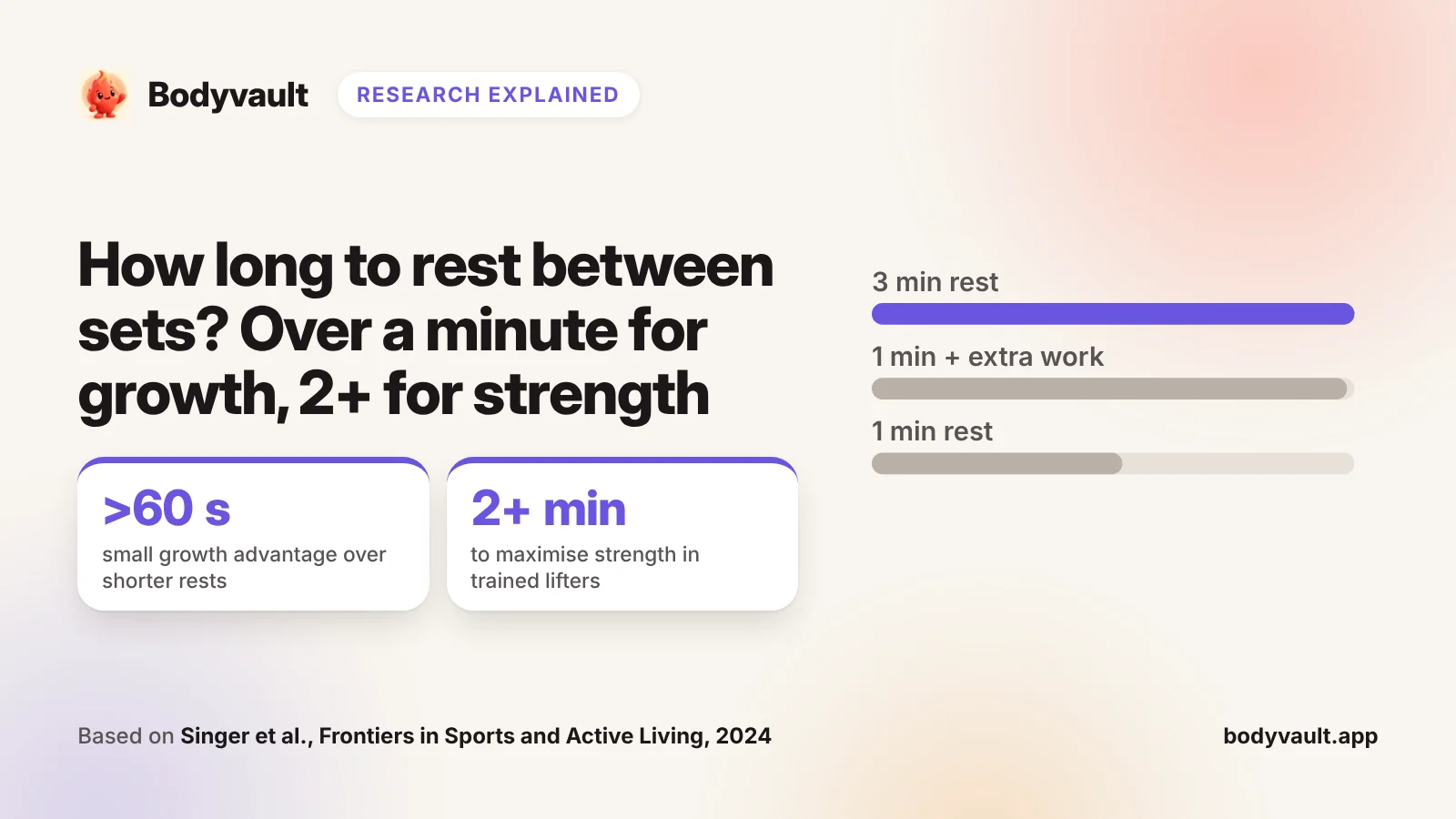
For muscle growth, rest longer than a minute: a 2024 meta-analysis found a small advantage for rests over 60 seconds, but no clear extra gain beyond about 90 seconds. For strength, trained lifters appear to do best with rests of more than 2 minutes.
The short answer
>60s
rest gave a small growth advantage over shorter rests
≈90s
beyond this, no clear extra growth was detected
2+min
appear to maximise strength gains in trained lifters
3–5min
the ACSM’s 2009 advice for heavy loads of 1–6 reps
Strength of evidenceModerate
Only nine trials on growth, 5–10 weeks long and mostly in untrained young men, with no data on the chest, back or shoulders. The 2026 ACSM position stand judged the evidence on rest and growth insufficient to draw a conclusion.
Key findingRest long enough to keep your reps and weights up. Short rests still build muscle, but you get less work done in each set. If you rest briefly to save time, add a set or pair exercises for opposing muscles.
What the 2024 meta-analysis found
Longer (over 60 s) vs short (60 s or less) rest: difference in growth
- Thigh muscles0.17 (−0.13 to 0.43)
- Arm muscles0.13 (−0.27 to 0.51)
- Whole body (lean mass)−0.08 (−0.45 to 0.29)
Every rest length built muscle
Within each group, muscle grew whatever the rest. Intermediate rests of 61–119 seconds had the largest estimate, but the intervals overlap heavily, and the authors caution that the pattern across the longer categories was too uneven to support resting longer and longer.
Growth from before to after training, by rest length
- Short (60 s or less)0.47 (0.19 to 0.80)
- Intermediate (61–119 s)0.65 (0.18 to 1.1)
- Long (120–179 s)0.55 (0.15 to 0.90)
- Very long (180 s or more)0.50 (0.14 to 0.89)
Why rest matters: the work you can do
Short rests leave you less recovered, so you do fewer reps or lift less in the next set. One clever trial in 28 people trained each leg differently for 10 weeks. When the short-rest leg did extra work to match the long-rest leg, it grew just as much.
In the same trial, as cited by the 2024 review, lifters averaged 9.8 reps across three sets with 60-second rests, against 16.1 with 180-second rests. That lost work is the most likely reason short rests build slightly less.
Rest for strength
For strength, longer rests make more sense. A systematic review of 23 studies and 491 people found that rests longer than 2 minutes appear to maximise strength gains in trained lifters, while 60–120 seconds seems enough for beginners; even rests under a minute produced solid gains. In a trial of 21 trained men, 3-minute rests raised squat and bench press one-rep max more than 1-minute rests, and grew the front thigh more.
| Source | For muscle growth | For strength |
|---|---|---|
| ACSM position stand (2009) | 1–2 minutes | 3–5 minutes for heavy loads (1–6 reps) |
| Grgic et al. (2017), 6 studies | Short and long rests both work; long may help trained people | – |
| Grgic et al. (2018), 23 studies | – | Over 2 minutes in trained lifters; 60–120 s in beginners |
| Schoenfeld et al. (2016), trial in 21 trained men | 3 minutes beat 1 minute for the thigh | 3 minutes beat 1 minute for squat and bench |
| Singer et al. (2024), 9 trials | Over 60 s slightly better; little extra past about 90 s | – |
| ACSM position stand (2026) | Not enough evidence to conclude | Rest judged not to affect strength |
The 2026 position stand’s view, that rest didn’t affect strength, rests on two reviews. Most guidance still favours longer rests for heavy, low-rep work, where fatigue limits how much you can lift.
Saving time without losing gains
If you’re short on time, supersets help: doing two exercises back to back, then resting. A 2025 meta-analysis of 19 studies found supersets gave similar long-term gains in strength and muscle size as traditional sets, in less time. Pairing opposing muscles, such as a press with a row, let people complete more reps, while pairing two exercises for the same muscle reduced the work done.
Claims and evidence
ClaimShort rests of 30–90 seconds are best for muscle growth.
EvidenceResting more than 60 seconds showed a small advantage for arm and thigh growth, and in trained men 3-minute rests beat 1-minute rests.
ClaimThe longer you rest, the more you grow.
EvidenceNo appreciable extra growth was detected beyond about 90 seconds; the results for very long rests were uncertain and inconsistent.
ClaimRest time itself drives growth, through the pump or hormones.
EvidenceWhen the short-rest leg did extra work to match, it grew as much as the long-rest leg. Preserved work, not rest itself, is the likely mechanism.
ClaimStrength training doesn’t need long rests.
EvidenceRests over 2 minutes appear to maximise strength in trained lifters, and the ACSM recommends 3–5 minutes for heavy loads.
ClaimShort rests don’t work at all.
EvidenceShort-rest groups still grew muscle (effect size about 0.47) and gained strength; they may just need an extra set to match the work.
What this means for you
What this means for you
- For muscle growth, rest about 1.5–2 minutes on most sets, and longer on hard compound lifts.
- For heavy strength work of 1–6 reps, rest 2–5 minutes.
- Rest until you can repeat roughly the reps and weight you planned at the same effort.
- Short on time? Rest less and add a set, or superset opposing muscles.
What these studies can’t tell you
- The upper body. No trials in the 2024 review measured the chest, back or shoulders.
- Trained lifters and high volumes. There were too few studies to analyse trained people separately, and training volumes were moderate.
- Long-term effects. Small differences might add up over longer than the 5–10 weeks studied.
How Bodyvault uses this research
Bodyvault’s rest timer starts from your plan. In strength and muscle-building plans that’s 2–3 minutes for compound lifts and 75–90 seconds for isolation exercises, and you can change any of them. With a watch or chest strap, it can also show when your heart rate has come most of the way back to its level before the set, never sooner than 30 seconds, or you can time rests by the clock alone. No trial has tested heart-rate-guided rest against fixed rest for long-term gains, so treat that cue as a sign you’re ready to go, not a way to grow faster; for heavy sets the research favours 2 minutes or more. Your sets and rests are logged in the workout tracker.
Share or cite this explainer
Bodyvault (2026). How long to rest between sets: what the research says. https://bodyvault.app/blog/how-long-to-rest-between-sets
The charts on this page may be reused with a link back to it. The underlying data belong to the studies cited below.
Questions
How long should I rest between sets to build muscle?
More than 60 seconds: a 2024 meta-analysis found a small advantage for longer rests, with no clear extra gain beyond about 90 seconds. About 1.5–2 minutes suits most sets.
How long should I rest between sets for strength?
Trained lifters appear to gain the most strength with rests of more than 2 minutes, and the ACSM recommends 3–5 minutes for heavy loads of 1–6 reps.
Is 30 seconds of rest enough?
It still builds muscle, but you’ll do fewer reps in later sets. If you keep rests short, add a set to make up the work.
Is resting 5 minutes too long?
Not for heavy strength sets. For muscle growth it isn’t harmful, but no extra benefit was seen beyond about 90 seconds, so it mostly costs time.
Do supersets work for muscle growth?
Yes. In a 2025 meta-analysis, supersets gave similar long-term gains as traditional sets in less time, especially when pairing opposing muscles.
Sources
- Singer A et al. (2024). Give it a rest: a systematic review with Bayesian meta-analysis on the effect of inter-set rest interval duration on muscle hypertrophy. Front Sports Act Living 6:1429789.
- Schoenfeld BJ et al. (2016). Longer interset rest periods enhance muscle strength and hypertrophy in resistance-trained men. J Strength Cond Res 30(7):1805–1812.
- Longo AR et al. (2022). Volume load rather than resting interval influences muscle hypertrophy during high-intensity resistance training. J Strength Cond Res 36(6):1554–1559.
- Grgic J et al. (2017). The effects of short versus long inter-set rest intervals in resistance training on measures of muscle hypertrophy: a systematic review. Eur J Sport Sci 17(8):983–993.
- Grgic J et al. (2018). Effects of rest interval duration in resistance training on measures of muscular strength: a systematic review. Sports Med 48(1):137–151.
- American College of Sports Medicine (2009). Position stand: progression models in resistance training for healthy adults. Med Sci Sports Exerc 41(3):687–708.
- Currier BS et al. (2026). American College of Sports Medicine position stand: resistance training prescription for muscle function, hypertrophy, and physical performance in healthy adults. Med Sci Sports Exerc.
- Zhang X et al. (2025). Superset versus traditional resistance training prescriptions: a systematic review and meta-analysis exploring acute and chronic effects on mechanical, metabolic, and perceptual variables. Sports Med 55(4):953–975.
General information about fitness and nutrition, not medical advice. If you have a health condition, are pregnant or take medication, talk to your doctor before changing your diet or training.