
Research explained
How many sets per muscle per week? What 67 studies show
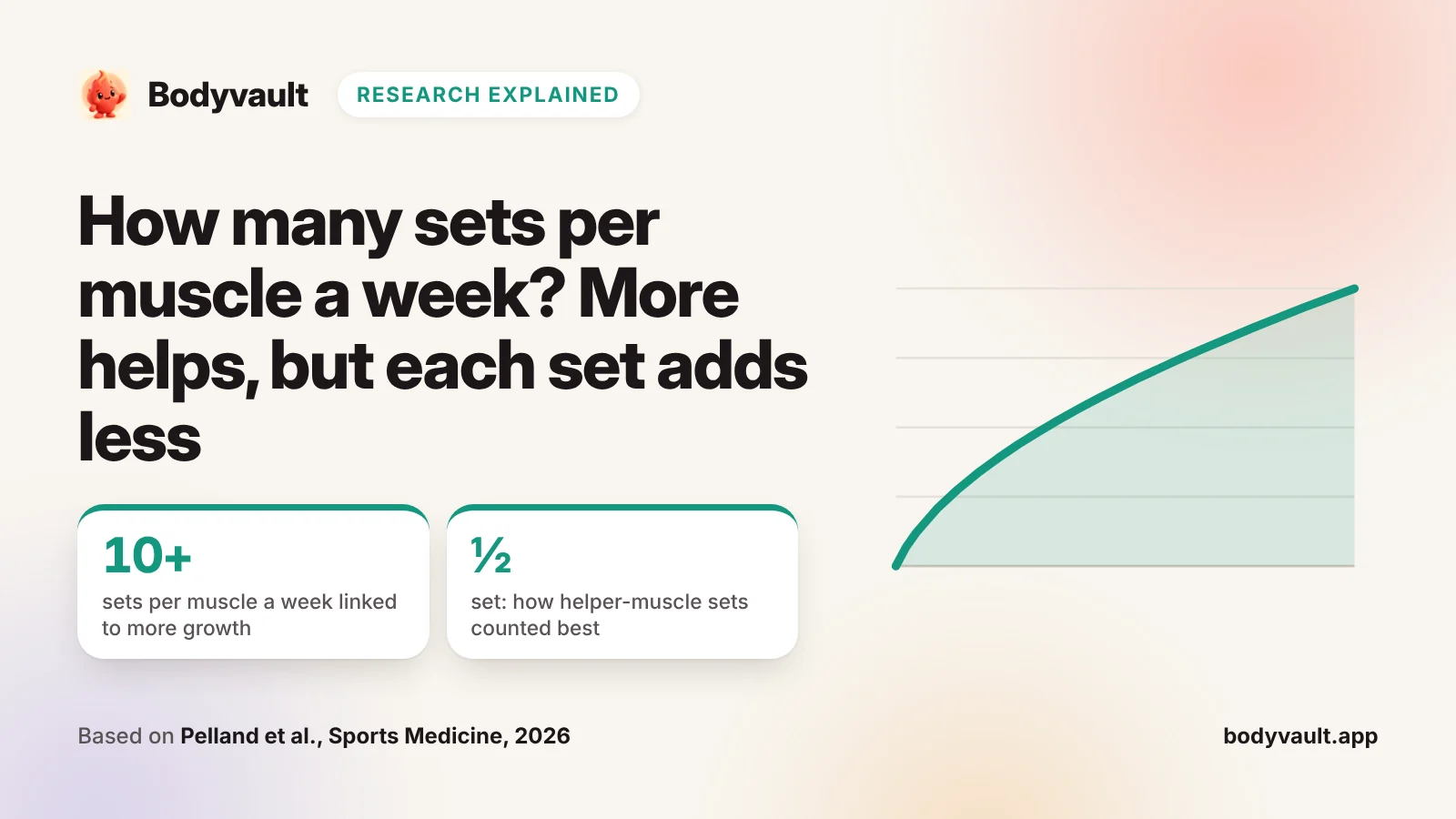
More sets per muscle per week generally means more growth, but each extra set adds a little less. The 2026 ACSM position stand links 10 or more sets per muscle a week to more growth; a 2026 meta-analysis of 67 studies found gains kept rising beyond that, while strength flattened after only a few sets.
The short answer
10+sets
per muscle a week: the volume the 2026 ACSM position stand links to more growth
≈4sets
a week: the smallest dose with detectable growth (preprint analysis)
+0.24%
extra growth for each added weekly set, at average volumes (preprint analysis)
½set
how sets for helper muscles counted best, in the 67-study analysis
Strength of evidenceGood
Two large meta-analyses and the 2026 ACSM position stand agree on the direction. Most studies lasted about 10 weeks in young men, and few tested more than about 25 sets a week.
Key findingMore sets help, with diminishing returns. Roughly 10–20 hard sets per muscle per week, counting sets for helper muscles as half, is a sensible range for most people who want to build muscle. For strength, a few hard sets of the lift itself go a long way.
What counts as a set
In these studies a set means a hard working set: about 78% of the growth results came from programmes that took sets to failure, by one definition or another, and warm-ups didn’t count (see training to failure). The 2026 meta-analysis also tested how to count exercises that work a muscle indirectly. Counting a set as one for the muscle it mainly trains and as half for muscles that help, called fractional sets, predicted results better than counting every set fully or ignoring helper sets.
| A week of training | Direct biceps sets | Helper sets (×½) | Fractional sets for biceps |
|---|---|---|---|
| 5 sets of curls + 5 sets of rows | 5 | 5 rows → 2.5 | 7.5 |
| 5 sets of curls + 5 sets of pulldowns + 5 sets of rows | 5 | 10 → 5 | 10 |
| 10 sets of rows only | 0 | 10 → 5 | 5 |
The half-set weighting is the counting rule that fitted the data best, not a measured fact about every exercise. Rows and pulldowns were treated as helper work for the biceps; bench and overhead presses for the triceps; and squats and leg presses for the rectus femoris, one of the four quadriceps muscles, with the leg extension counted as direct work.
The dose-response curve
Predicted gains by weekly sets per muscle
- Muscle size
- Strength
Two patterns stand out. Muscle growth kept rising across the whole range studied, with no clear plateau, though it rose more slowly the more sets were added. Strength rose steeply over the first few sets and then barely moved: the authors describe diminishing returns as “considerably more pronounced” for strength.
What each extra set adds
The authors also grouped volumes into tiers by how many extra sets it takes to add one detectable increment of growth. These tiers appear in their preprint, not the published abstract.
| Goal | Tier | Fractional sets a week | What it means |
|---|---|---|---|
| Muscle | Minimum effective dose | 4 | Enough for detectable growth |
| Muscle | Higher efficiency | 5–10 | About 6 more sets per extra increment |
| Muscle | Intermediate efficiency | 11–18 | About 8.5 more sets per increment |
| Muscle | Lower efficiency | 19–29 | About 10.75 more sets per increment |
| Muscle | Lowest efficiency | 30–42 | About 12.5 more sets per increment |
| Strength | Minimum effective dose | 1 | Enough for a detectable strength gain |
| Strength | Higher efficiency | 2 | About 0.75 more sets per increment |
| Strength | Intermediate efficiency | 3–4 | About 2.25 more sets per increment |
| Strength | Lower efficiency | 5 or more | More sets didn’t reliably add detectable strength |
Is there a ceiling at 20 sets?
Not a hard one. The 67-study analysis found no plateau for growth, though very few studies went above about 25 sets a week, so the right-hand side of the curve is the least certain. A smaller review of trained lifters comparing 12–20 with more than 20 sets a week found no clear difference for the quadriceps or biceps, and an advantage for more than 20 sets only for the triceps. An older meta-analysis estimated that each extra weekly set added about 0.37% growth.
12–20 vs more than 20 sets a week, trained lifters
- Quadriceps−0.2 (−0.49 to 0.10)
- Biceps−0.1 (−0.46 to 0.26)
More sets also mean more time and more fatigue to recover from, which these short studies didn’t measure. A planned lighter week helps manage that; see deload weeks.
How often should you train each muscle?
For muscle growth
- With weekly sets held equal, training a muscle more often made little or no difference
- Pelland: +0.32% per extra weekly session, an interval that includes zero
- So split your sets across the week however suits you
For strength
- Practising a lift more often helped
- Pelland: +3.27% strength per extra weekly session
- One hard set one to three times a week still added 12 kg to trained men’s one-rep max
The 2026 ACSM position stand agrees that growth was not affected by frequency once volume was equal, while strength benefited from heavier loads and at least two sessions a week.
Claims and evidence
ClaimDouble the sets, double the growth.
EvidenceGains continue but shrink with each set: about +4.2 points from 0–10 fractional sets, +2.4 from 10–20 and +1.9 from 20–30 (calculated from the preprint tables).
ClaimAnything above 20 sets a week is wasted.
EvidenceNo clear plateau was found, though data above about 25 sets are sparse; comparisons of 12–20 with more than 20 sets were mixed.
ClaimOnly isolation sets count for a muscle.
EvidenceCounting sets for helper muscles as half a set predicted growth and strength better than counting them fully or not at all.
ClaimTo get stronger you need lots of volume.
EvidenceStrength flattened after a few weekly sets of a lift, and one hard set one to three times a week produced meaningful one-rep max gains in trained men.
ClaimLow-volume training doesn’t build muscle.
EvidenceAbout 4 fractional sets a week was the smallest dose with detectable growth in the preprint analysis, and the ACSM notes that minimal doses produce substantial gains.
What this means for you
What this means for you
- Count your hard sets per muscle each week, giving helper exercises half a set.
- If you’re new or short on time, about 4–10 sets per muscle builds muscle; 10–20 is a good range for most people focused on growth.
- Add sets gradually, a set or two at a time, and only if you’re recovering well and progressing.
- For strength, practise the lift often with heavy loads; you don’t need high volume.
- Split your weekly sets across as many sessions as suits your schedule.
What these studies can’t tell you
- Long-term and high-volume effects. Studies averaged about 10 weeks, mostly in young men, and few tested more than about 25 sets a week. Burnout and injury weren’t assessed.
- Your best number. Prediction intervals were wide (at 10 sets, from about −6% to +16%), reflecting large differences between people.
- Published details. The predicted values and tiers on this page come from the authors’ preprint and data tables; the paywalled journal version may differ slightly.
How Bodyvault uses this research
Bodyvault counts weekly sets the way this research found worked best: a set counts as one for the muscle it mainly trains and as half for muscles that help. Plans it builds start each muscle in a weekly range based on your experience: 6–10 sets for new lifters, 8–12 for beginners, 12–18 for intermediate and 14–22 for advanced lifters. They begin near the low end, add about a set a week through a block and finish with a lighter week. A few muscles that get lots of help from other lifts, such as the front of the shoulders, get smaller ranges. You can see your weekly sets for each muscle in the workout tracker.
Share or cite this explainer
Bodyvault (2026). How many sets per muscle per week? What 67 studies show. https://bodyvault.app/blog/how-many-sets-per-muscle-per-week
The charts on this page may be reused with a link back to it. The underlying data belong to the studies cited below.
Questions
How many sets per muscle per week to build muscle?
About 10 or more hard sets per muscle a week is linked to more growth, and about 4 is enough for some. Gains continue above 10–20 sets but get smaller with each extra set.
Is 20 sets per muscle per week too much?
Not necessarily. No clear plateau was found, but few studies went above about 25 sets, gains per set get small, and recovery matters. Add volume only if you recover and progress.
Do warm-up sets count?
No. The studies counted hard working sets, mostly taken to or close to failure. Warm-ups prepare you but aren’t counted.
How many sets a week for strength?
Fewer than for growth. Strength gains flattened after a few weekly sets of a lift, and even one hard set one to three times a week produced meaningful gains in trained men.
Is it better to train a muscle twice a week?
For growth, frequency made little difference once weekly sets were equal, so it’s a matter of preference. For strength, practising a lift more often helped.
Sources
- Pelland JC et al. (2026). The resistance training dose response: meta-regressions exploring the effects of weekly volume and frequency on muscle hypertrophy and strength gains. Sports Med.
- Pelland JC et al. (2024). Preprint of the above (SportRxiv 460, version 2) with the authors’ data tables on OSF, the source of the predicted values on this page.
- Schoenfeld BJ, Ogborn D, Krieger JW (2017). Dose-response relationship between weekly resistance training volume and increases in muscle mass: a systematic review and meta-analysis. J Sports Sci 35(11):1073–1082.
- Baz-Valle E et al. (2022). A systematic review of the effects of different resistance training volumes on muscle hypertrophy. J Hum Kinet 81:199–210.
- Currier BS et al. (2023). Resistance training prescription for muscle strength and hypertrophy in healthy adults: a systematic review and Bayesian network meta-analysis. Br J Sports Med 57(18):1211–1220.
- Androulakis-Korakakis P, Fisher JP, Steele J (2020). The minimum effective training dose required to increase 1RM strength in resistance-trained men: a systematic review and meta-analysis. Sports Med 50(4):751–765.
- Schoenfeld BJ, Grgic J, Krieger J (2019). How many times per week should a muscle be trained to maximize muscle hypertrophy? A systematic review and meta-analysis. J Sports Sci 37(11):1286–1295.
- Currier BS et al. (2026). American College of Sports Medicine position stand: resistance training prescription for muscle function, hypertrophy, and physical performance in healthy adults. Med Sci Sports Exerc.
General information about fitness and nutrition, not medical advice. If you have a health condition, are pregnant or take medication, talk to your doctor before changing your diet or training.