
Research explained
Training to failure: do you need it to build muscle?
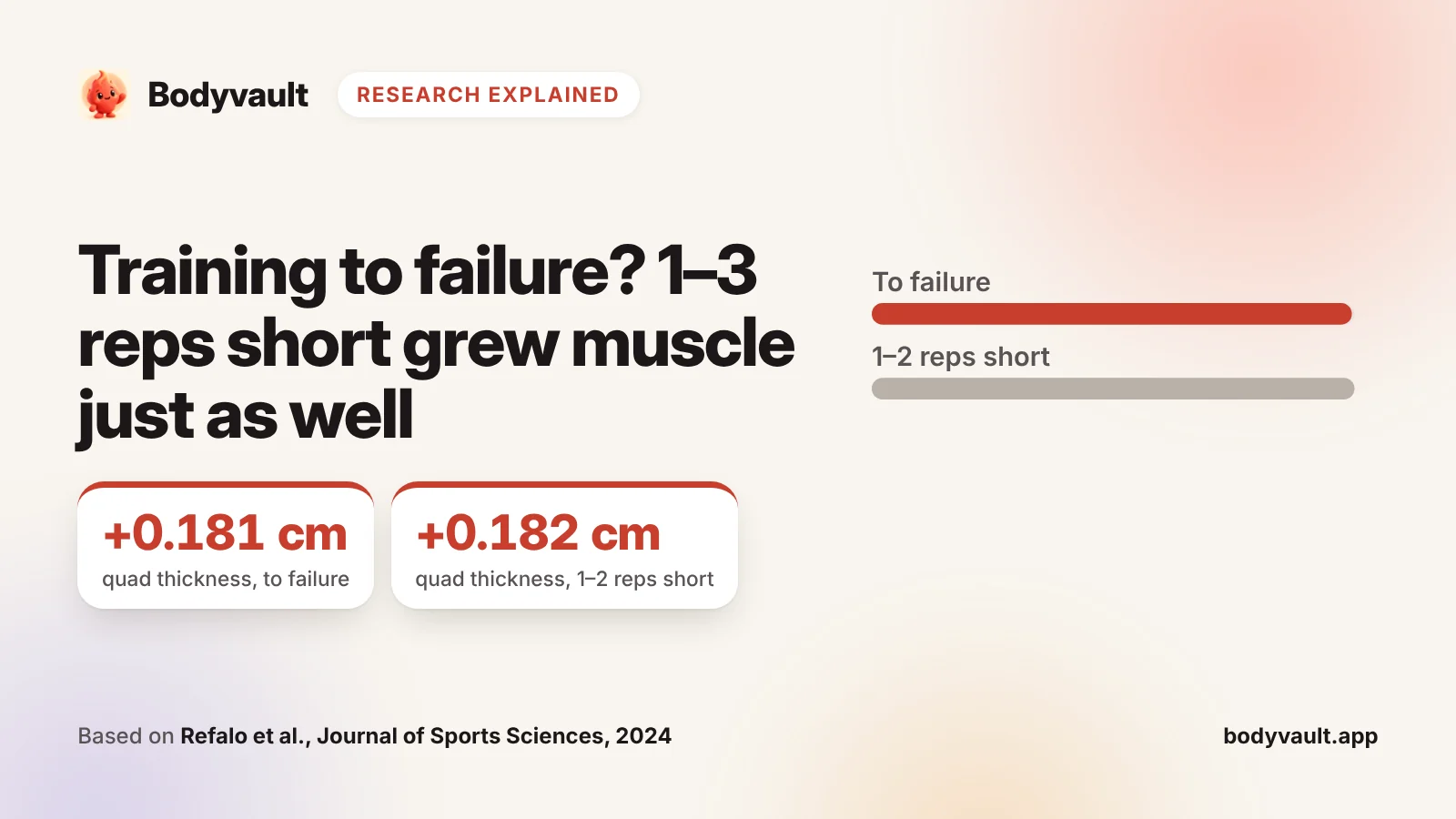
You don’t need to train to failure to build muscle. Sets that end closer to failure tend to build a little more, but in head-to-head trials, stopping 1–3 reps short grew muscle as well as going all the way. Strength gains barely depended on it.
The short answer
1–3reps
short of failure grew muscle as well as failure in head-to-head trials
≈0.5
percentage points less predicted muscle growth for each extra rep left in reserve, in volume-matched studies (preprint analysis)
≈15%
average strength gain whether sets ended at 0 or 10 reps in reserve (preprint analysis)
≈1rep
more than lifters predicted they had left, on average
Strength of evidenceGood
Several meta-analyses and recent head-to-head trials point the same way. The trials are small and short (about 8 weeks), and in the largest analysis reps in reserve were estimated from study descriptions rather than measured.
Key findingEffort matters: very easy sets build less. But the last rep or two before failure adds little or no extra growth and costs more fatigue, so ending most sets 1–3 reps short of failure is a well-supported default.
What failure and reps in reserve mean
Momentary muscular failure is the point in a set where you can’t complete another full rep with good form. Reps in reserve (RIR) counts how many more reps you could have done when you stopped: 0 RIR is failure, 2 RIR means you stopped two reps short. Many lifters rate sets on the related RPE scale, where RPE 10 means no reps left and each point lower means one more rep in reserve.
| RPE | Reps in reserve | What it feels like |
|---|---|---|
| 10 | 0 | Failure: no more reps possible |
| 9 | 1 | One more rep was possible |
| 8 | 2 | Two more reps were possible |
| 7 | 3 | Three more reps were possible |
| 6 | 4 | Four more reps were possible |
To turn an RPE or RIR into a weight for your next set, use the RPE calculator.
Closer to failure, more growth, on average
A 2024 series of meta-regressions pooled volume-matched studies to ask how growth and strength change as sets end further from failure. Because most papers don’t report RIR, the authors estimated it from each study’s description, and they call the analysis exploratory. Predicted muscle growth fell steadily as sets ended further from failure; strength barely changed.
Predicted gains by reps left in reserve
- Muscle size
- Strength
Two cautions. First, these are averages: at 0 RIR the range of results expected in a new study ran from about −1.6% to +20.3%. Second, every study in the analysis matched the number of sets. Stopping further from failure is less tiring, so in real training it may let you do more sets, which the analysis couldn’t account for.
Head to head: failure against stopping short
When studies compared failure with non-failure training directly, the differences in growth were small and uncertain, and failure didn’t help strength.
Failure vs non-failure training, effect sizes
- Growth: any set to failure0.19 (0.00 to 0.37)
- Growth: momentary failure0.12 (−0.13 to 0.37)
- Growth: all studies (second review)0.22 (−0.11 to 0.55)
- Growth: trained people only0.15 (0.03 to 0.26)
- Strength: all studies−0.09 (−0.22 to 0.05)
The 2026 position stand from the American College of Sports Medicine, which reviewed 137 systematic reviews, reached the same conclusion: growth was not affected by training to failure, and “training to failure is not obligatory”.
But very easy sets do build less
Effort still matters. The same 2023 meta-analysis reported how much muscle grew under each condition. Growth was similar for sets taken to failure and for sets stopped a little short, but much smaller when sets ended far from failure, measured as only a small slow-down in bar speed (“low velocity loss”).
A separate meta-analysis of velocity-loss studies agrees: sets with more slow-down, closer to failure, were linked to more growth, with no effect on strength or muscular endurance.
For strength, failure matters even less
In the 2022 meta-analysis, failure training gave no extra strength (effect size −0.09). When the amount of training wasn’t matched, non-failure training came out ahead for strength (−0.32, 95% CI −0.57 to −0.07). A review of autoregulation found that stopping sets once bar speed had dropped by 25% or less produced 2.3 kg more on the one-rep max than letting it drop further. For strength, heavy loads and practice of the lift matter more than grinding every set out.
Can you judge how many reps you have left?
Roughly. Across 12 studies and 414 people, lifters predicted they had about one rep fewer left than they really did (0.95 reps on average), and individuals varied a lot. Estimates were much better close to failure and on sets of 12 reps or fewer.
Ratings are more accurate
- Close to failure (1–3 reps left)
- On sets of 12 reps or fewer
- In trained lifters: calling 1 and 3 reps in reserve on the bench press, the average error was 0.65 reps
Ratings are less accurate
- Far from failure
- On high-rep sets (more than 12 reps)
- In less experienced lifters: effort ratings tracked bar speed less closely in novices than in experienced squatters
Claims and evidence
ClaimYou have to train to failure to build muscle.
EvidenceMomentary failure was not clearly better than stopping short (effect size 0.12, −0.13 to 0.37), and trials stopping 1–3 reps short matched failure for growth.
ClaimEffort doesn’t matter, as long as you do your sets.
EvidenceIn volume-matched studies, predicted growth fell as sets ended further from failure (about 8.8% at 0 reps in reserve against 3.7% at 10), and very easy sets grew muscle about half as much.
ClaimGetting stronger means grinding every set to failure.
EvidenceStrength gains were essentially flat across reps in reserve, and non-failure training favoured strength when the amount of work wasn’t matched.
ClaimNobody can judge reps in reserve, so logging it is pointless.
EvidenceThe average error was about one rep, and trained lifters calling 1 and 3 reps in reserve were within about 0.65 reps.
ClaimTraining to failure is harmful.
EvidenceOn average it didn’t hurt strength or growth, but it causes more fatigue within a session, so it is best used selectively.
What this means for you
What this means for you
- End most working sets 1–3 reps short of failure. You get nearly all of the growth with less fatigue.
- Don’t stop much earlier than that: sets that end far from failure build noticeably less.
- If you go to failure, do it on the last set of an exercise, and on machines or isolation moves where a missed rep is safe.
- For strength, focus on heavy loads and practice of the lift rather than failure.
- Calibrate now and then: take a safe exercise to failure and compare it with what you predicted.
What these studies can’t tell you
- Exact targets. The 2026 position stand says there isn’t enough evidence to set precise reps-in-reserve targets; 1–3 is a practical convention that fits the trials.
- Long-term effects. Most trials lasted about 8 weeks, mostly in young adults and often on machines.
- Your response. Individual results ranged widely around every average on this page.
How Bodyvault uses this research
Bodyvault logs reps in reserve on every working set, or RPE if you prefer (it converts with RIR = 10 − RPE). Plans it builds keep compound lifts about 2 reps short of failure and isolation exercises about 1 rep short, and at least 2 for newer lifters. The first week of a block is a rep easier and the last hard week a rep closer, the only time isolation sets may reach failure. If you’re an intermediate or advanced lifter and your last session’s sets averaged 2 or more reps easier than planned, it suggests adding weight; see progressive overload for how increases work. To find a weight for a target RPE, use the RPE calculator.
Share or cite this explainer
Bodyvault (2026). Training to failure: do you need it to build muscle?. https://bodyvault.app/blog/training-to-failure
The charts on this page may be reused with a link back to it. The underlying data belong to the studies cited below.
Questions
Is training to failure necessary for muscle growth?
No. In head-to-head trials, stopping 1–3 reps short of failure grew muscle as well as training to failure. Sets do need to be reasonably hard, though: very easy sets built less.
How many reps in reserve should I leave?
About 1–3 reps on most working sets is a good default. It matches the trials, and the 2026 ACSM position stand notes there isn’t enough evidence to set more exact targets.
Is training to failure bad?
Not on average: it didn’t reduce strength or growth in meta-analyses. It does cause more fatigue, so use it selectively, on safe exercises and late in a session.
Should I train to failure for strength?
It isn’t needed. Strength gains were similar across reps in reserve, and heavy loads matter more. When training wasn’t matched, non-failure training came out slightly ahead.
What does RPE 8 mean?
On the reps-in-reserve RPE scale, RPE 8 means you could have done two more reps. RPE 10 is failure. The RPE calculator turns it into a load.
Sources
- Robinson ZP et al. (2024). Exploring the dose-response relationship between estimated resistance training proximity to failure, strength gain, and muscle hypertrophy: a series of meta-regressions. Sports Med 54(9):2209–2231.
- Robinson ZP et al. (2023). Preprint of the above (SportRxiv 295, version 2) with the authors’ data tables on OSF, the source of the predicted values on this page.
- Refalo MC et al. (2023). Influence of resistance training proximity-to-failure on skeletal muscle hypertrophy: a systematic review with meta-analysis. Sports Med 53(3):649–665.
- Grgic J et al. (2022). Effects of resistance training performed to repetition failure or non-failure on muscular strength and hypertrophy: a systematic review and meta-analysis. J Sport Health Sci 11(2):202–211.
- Refalo MC et al. (2024). Similar muscle hypertrophy following eight weeks of resistance training to momentary muscular failure or with repetitions-in-reserve in resistance-trained individuals. J Sports Sci 42(1):85–101.
- Vasconcelos T et al. (2026). Comparative adaptations to different leg extension set-termination strategies in trained men and women: a unilateral within-participant study. J Strength Cond Res.
- Jukic I et al. (2023). The acute and chronic effects of implementing velocity loss thresholds during resistance training: a systematic review, meta-analysis, and critical evaluation of the literature. Sports Med 53(1):177–214.
- Halperin I et al. (2022). Accuracy in predicting repetitions to task failure in resistance exercise: a scoping review and exploratory meta-analysis. Sports Med 52(2):377–390.
- Refalo MC et al. (2024). Accuracy of intraset repetitions-in-reserve predictions during the bench press exercise in resistance-trained male and female subjects. J Strength Cond Res 38(3):e78–e85.
- Zourdos MC et al. (2016). Novel resistance training-specific rating of perceived exertion scale measuring repetitions in reserve. J Strength Cond Res 30(1):267–275.
- Hickmott LM et al. (2022). The effect of load and volume autoregulation on muscular strength and hypertrophy: a systematic review and meta-analysis. Sports Med Open 8(1):9.
- Currier BS et al. (2026). American College of Sports Medicine position stand: resistance training prescription for muscle function, hypertrophy, and physical performance in healthy adults. Med Sci Sports Exerc.
General information about fitness and nutrition, not medical advice. If you have a health condition, are pregnant or take medication, talk to your doctor before changing your diet or training.