
Research explained
Working out on your period: what research says about cycle syncing
You can train on your period. Across 78 studies, performance in the early part of the cycle was at most trivially lower than at other times, and a 2023 umbrella review concluded that planning strength training around cycle phases is “not an evidence-based approach”. What makes more difference is how you feel on the day.
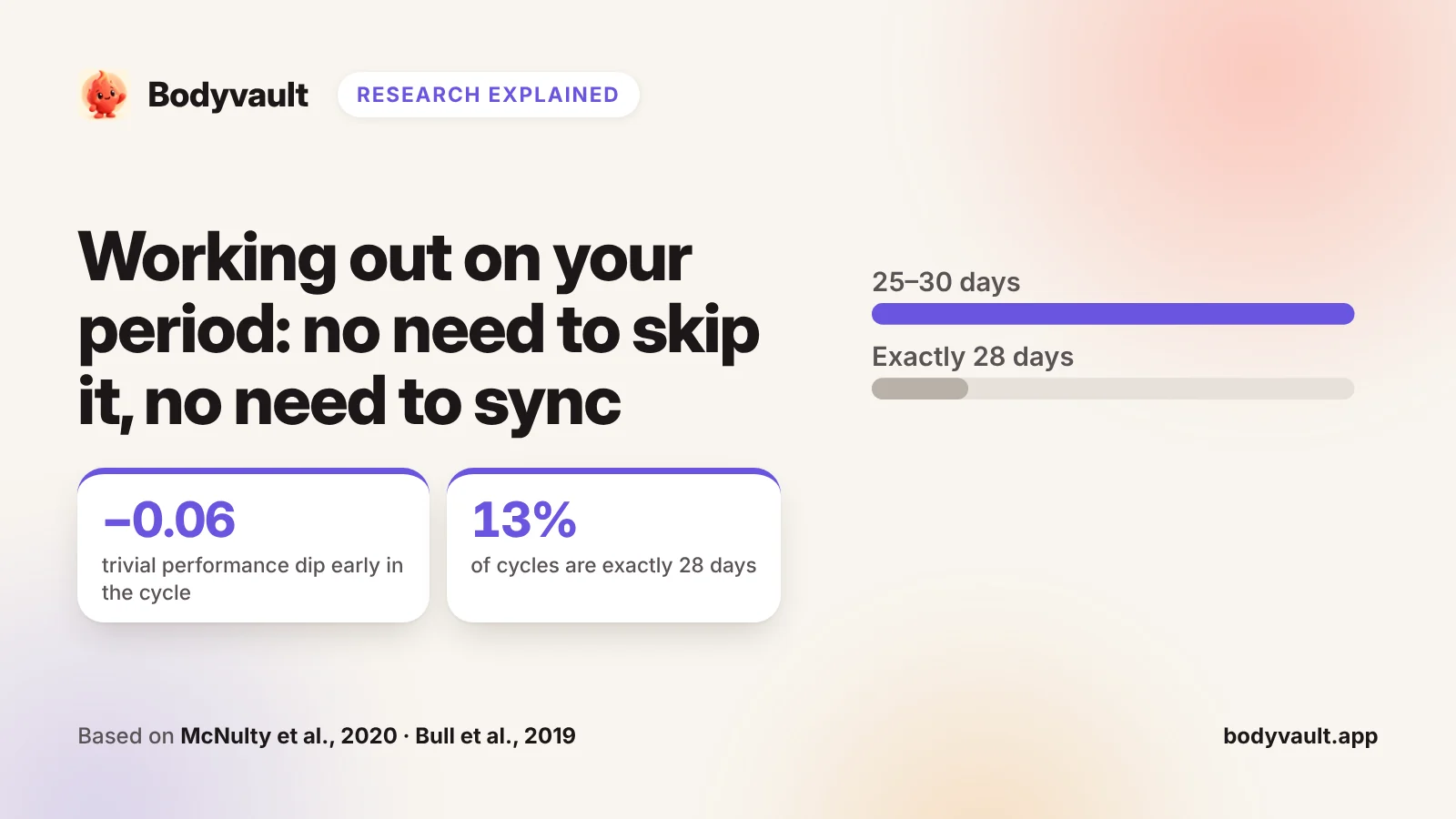
The short answer
−0.06
average performance difference around your period compared with other phases: trivial, and not clearly different from zero
13%
of 612,613 tracked cycles lasted exactly 28 days
≈25mm
less period pain on a 100 mm scale with regular exercise (low-certainty evidence)
86%
of 6,812 exercising women reported tiredness or fatigue with their cycle
Strength of evidenceLimited
There are many studies, but most are small (14 women on average), often didn’t confirm cycle phase with hormone tests, and were rated low or very low quality.
Key findingThere’s no need to skip training on your period, or to follow a phase-based plan. Train by how you feel: lighten a session when symptoms are bad, and keep exercising regularly across the month.
Your cycle isn’t a calendar
A cycle runs from the first day of one period to the first day of the next. The follicular phase starts with your period and lasts until ovulation; the luteal phase runs from ovulation to the next period. Textbooks draw a 28-day cycle with ovulation on day 14, but in data from 612,613 cycles tracked in an app, only 13% lasted exactly 28 days. Most (65%) were 25–30 days, and the average was 29.3.
Length of each phase across 612,613 cycles
- Follicular phase (period to ovulation)16.9 days (10–30)
- Luteal phase (ovulation to period)12.4 days (7–17)
That variation is one reason studies of the cycle are hard to do well, and why a phase calendar based on an average cycle can be days out for any one person.
Does performance change across the cycle?
Performance in the early follicular phase compared with each other phase
- All other phases, pooled−0.06 (−0.16 to 0.04)
- Late follicular−0.14 (−0.26 to −0.03)
- Ovulation−0.07 (−0.15 to 0.07)
- Early luteal−0.07 (−0.19 to 0.16)
- Mid-luteal−0.04 (−0.11 to 0.08)
- Late luteal−0.01 (−0.18 to 0.17)
Reviews of strength alone point the same way, with caveats. One of 21 studies found only trivial-to-small differences in strength between phases, with no variation between studies. A 2024 review of 22 studies found small to medium advantages for the late follicular phase or ovulation over the days of your period for some kinds of strength, but the studies were few and mostly low quality, and dynamic strength like a one-rep max differed least (effect size 0.14, 3 studies).
Does cycle syncing build more muscle?
“Cycle syncing” usually means training harder in the follicular phase and easing off in the luteal phase. A 2022 opinion piece argued that follicular-phase training “possibly is superior”, but it pooled no data, and the trials behind it point both ways.
| Study | Who and how | Follicular-focused | Luteal-focused | Verdict |
|---|---|---|---|---|
| Sung et al., 2014 | 20 women; each leg trained mainly in one phase for 3 cycles | Strength +267 N; muscle +0.57 cm | Strength +188 N; muscle +0.39 cm | Favoured follicular |
| Sakamaki-Sunaga et al., 2016 | 14 women; each arm trained more often in one phase for 12 weeks | Muscle +6.2%; 1RM +36.4% | Muscle +7.8%; 1RM +31.8% | No major difference |
| Colenso-Semple et al., 2025 | 12 women; crossover, phases confirmed by hormone tests | Muscle protein synthesis 1.52% a day | 1.46% a day | No difference |
A 2023 umbrella review of the systematic reviews concluded that it is “premature” to say short-term hormone changes across the cycle appreciably affect strength or training results, and that prescribing resistance training around cycle phases is “not an evidence-based approach”. Its authors recommend individual programming and recording symptoms instead.
Symptoms matter more than the phase
Cycle symptoms are common and do affect training. In a survey of 6,812 exercising women who weren’t using combined hormonal contraception, 81.1% reported at least one symptom often.
That’s the practical case for adjusting training to how you feel on the day, rather than to a predicted phase: two women in the same phase can feel completely different, and the same woman can feel different from one cycle to the next.
Exercise and period pain
In a Cochrane review of 9 trials and 632 women, regular exercise programmes were linked to about 25 mm less period pain on a 100 mm scale (effect size −1.86), though the certainty of the evidence was low. Programmes typically lasted 45–60 minutes, three or more times a week, and ranged from stretching and yoga to aerobic dance. Most were done between periods, and no trial tested strength training, so this is evidence for regular exercise across the month rather than for exercising during your period specifically. If your period pain is severe or stops you doing normal things, see a doctor.
The pill, energy and missed periods
Hormonal contraception. Across 42 studies, women taking the pill performed about the same as naturally menstruating women; any difference was likely trivial (effect sizes 0.13–0.18, with intervals including zero), and the authors advise an individual approach. Perimenopause, PCOS and irregular cycles are much less studied.
Energy. Resting metabolism was slightly higher in the luteal phase across 26 studies (effect size 0.33), but the difference was smaller and not significant in studies since 2000, and no reliable calorie figure was reported. It’s not a reason to eat much more before your period.
Missed periods. Long gaps between periods in someone training hard and eating little can be a warning sign of low energy availability, part of what the International Olympic Committee calls relative energy deficiency in sport (REDs). A short questionnaire, the LEAF-Q, flags women who may need a check-up, with a score of 8 or more counted as positive. In 50 female endurance athletes who also had a full clinical assessment, it caught 79% of cases but also flagged many women who didn’t have REDs (specificity 50%), so it’s a prompt for a conversation, not a diagnosis. If your periods stop or become irregular and you aren’t pregnant, see a doctor.
Claims and evidence
ClaimYou shouldn’t exercise on your period.
EvidencePerformance was at most trivially lower in the early follicular phase (−0.06, an interval crossing zero), and regular exercise was linked to less period pain.
ClaimExercise makes period pain worse.
EvidenceRegular exercise programmes were linked to about 25 mm less pain on a 100 mm scale, in low-certainty evidence, mostly with exercise done between periods.
ClaimCycle syncing your workouts builds more muscle.
EvidenceTrials conflict, muscle protein synthesis was the same in follicular and luteal phases, and an umbrella review called phase-based prescriptions “not an evidence-based approach”.
ClaimYou’re much weaker in the luteal phase.
EvidenceLuteal effect sizes were close to zero (−0.07 to −0.01), and strength differences between phases were trivial to small.
ClaimEveryone has a 28-day cycle, so a calendar can tell you your phase.
EvidenceOnly 13% of 612,613 cycles were 28 days long, and the follicular phase ranged from about 10 to 30 days.
ClaimYou burn far more calories before your period.
EvidenceResting metabolism is slightly higher in the luteal phase (effect size 0.33), and the effect wasn’t significant in studies since 2000.
What this means for you
What this means for you
- Train on your period if you feel up to it; there’s no need to skip.
- On bad symptom days, lighten the session (a set fewer and further from failure) or swap it for mobility or an easy walk.
- Keep exercising regularly across the month: it’s linked to less period pain.
- Log symptoms for a few cycles to spot your own patterns, rather than following a generic phase calendar.
- See a doctor if your periods stop or become irregular, if pain is severe, or if bleeding is very heavy.
What these studies can’t tell you
- Your own pattern. Averages hide big individual differences, and many studies didn’t confirm phases with hormone tests.
- Everyone with a cycle. Most research is in young, naturally menstruating women. Hormonal contraception, perimenopause, PCOS and irregular cycles are under-studied.
- Long-term training results. The phase-based training trials were small and short, and they disagree.
- Exercising during a period. The pain evidence mostly comes from exercise done between periods.
How Bodyvault uses this research
Bodyvault doesn’t change your training by cycle phase. Instead it adds up the symptoms you log that tend to limit training (cramps, fatigue, headache, back pain, nausea and poor sleep), counting heavy flow and low energy too. A total of two or more prompts a lighter session: one set fewer per exercise and a rep further from failure (see reps in reserve), without counting against your progression. At three or more, it also offers mobility or easy zone 2 work instead. Your Readiness score compares luteal nights with luteal nights once you’ve logged two full cycles and enough nights, and the phase can only make a reading look more ready, never less; see what a readiness score is. A +100 kcal luteal allowance exists but stays off unless you turn it on. Modes cover hormonal contraception, irregular cycles or PCOS, perimenopause, menopause, pregnancy and postpartum; phase estimates appear only for a natural cycle, and in pregnancy and postpartum training advice pauses and the app points you to your clinician. If you’re losing weight, training five or more days a week and your last cycle ran longer than 35 days, it suggests the LEAF-Q questionnaire. For planned easier weeks, see deload weeks.
Share or cite this explainer
Bodyvault (2026). Working out on your period: what research says about cycle syncing. https://bodyvault.app/blog/working-out-on-your-period
The charts on this page may be reused with a link back to it. The underlying data belong to the studies cited below.
Questions
Is it okay to work out on your period?
Yes, if you feel up to it. Performance was at most trivially lower around the start of the cycle, and regular exercise was linked to less period pain. On bad days, a lighter session is fine.
Should I sync my workouts to my cycle?
The evidence doesn’t support it: a 2023 umbrella review called phase-based training “not an evidence-based approach”, and the trials conflict. Adjusting to your symptoms on the day makes more sense.
Am I weaker on my period?
On average, barely. Strength differences between phases were trivial to small, and the dip in performance around your period was not clearly different from zero.
Does exercise help period cramps?
Regular exercise programmes were linked to less period pain, about 25 mm on a 100 mm scale, in low-certainty evidence. Most of the exercise was done between periods.
When should I see a doctor about my periods?
If your periods stop or become very irregular and you aren’t pregnant, if pain is severe or stops you doing normal things, or if bleeding is very heavy. A doctor can look for causes, including low energy availability.
Sources
- McNulty KL et al. (2020). The effects of menstrual cycle phase on exercise performance in eumenorrheic women: a systematic review and meta-analysis. Sports Med 50(10):1813–1827.
- Colenso-Semple LM et al. (2023). Current evidence shows no influence of women’s menstrual cycle phase on acute strength performance or adaptations to resistance exercise training. Front Sports Act Living 5:1054542.
- Blagrove RC, Bruinvels G, Pedlar CR (2020). Variations in strength-related measures during the menstrual cycle in eumenorrheic women: a systematic review and meta-analysis. J Sci Med Sport 23(12):1220–1227.
- Niering M et al. (2024). The influence of menstrual cycle phases on maximal strength performance in healthy female adults: a systematic review with meta-analysis. Sports (Basel) 12(1):31.
- Kissow J et al. (2022). Effects of follicular and luteal phase-based menstrual cycle resistance training on muscle strength and mass. Sports Med 52(12):2813–2819.
- Sung E et al. (2014). Effects of follicular versus luteal phase-based strength training in young women. SpringerPlus 3:668.
- Sakamaki-Sunaga M et al. (2016). Effects of menstrual phase-dependent resistance training frequency on muscular hypertrophy and strength. J Strength Cond Res 30(6):1727–1734.
- Colenso-Semple LM et al. (2025). Menstrual cycle phase does not influence muscle protein synthesis or whole-body myofibrillar proteolysis in response to resistance exercise. J Physiol 603(5):1109–1121.
- Armour M et al. (2019). Exercise for dysmenorrhoea. Cochrane Database Syst Rev 9:CD004142.
- Bruinvels G et al. (2021). Prevalence and frequency of menstrual cycle symptoms are associated with availability to train and compete: a study of 6812 exercising women recruited using the Strava exercise app. Br J Sports Med 55(8):438–443.
- Bull JR et al. (2019). Real-world menstrual cycle characteristics of more than 600,000 menstrual cycles. npj Digit Med 2:83.
- Elliott-Sale KJ et al. (2020). The effects of oral contraceptives on exercise performance in women: a systematic review and meta-analysis. Sports Med 50(10):1785–1812.
- Benton MJ, Hutchins AM, Dawes JJ (2020). Effect of menstrual cycle on resting metabolism: a systematic review and meta-analysis. PLoS One 15(7):e0236025.
- Mountjoy M et al. (2023). 2023 International Olympic Committee’s (IOC) consensus statement on Relative Energy Deficiency in Sport (REDs). Br J Sports Med 57(17):1073–1097.
- Melin A et al. (2014). The LEAF questionnaire: a screening tool for the identification of female athletes at risk for the female athlete triad. Br J Sports Med 48(7):540–545.
- Wasserfurth P et al. (2025). Screening for Relative Energy Deficiency in Sport: detection of clinical indicators in female endurance athletes. Med Sci Sports Exerc 57(6):1257–1265.
General information about fitness and nutrition, not medical advice. If you have a health condition, are pregnant or take medication, talk to your doctor before changing your diet or training.