
Research explained
Zone 2 training: what the research actually says
Zone 2 is easy, conversational aerobic exercise. It builds fitness, but a 2025 review found no evidence that it is the optimal intensity for the general population, and harder efforts appear to matter most when training time is short.
The short answer
0
evidence that zone 2 is the optimal intensity for the general population (2025 review)
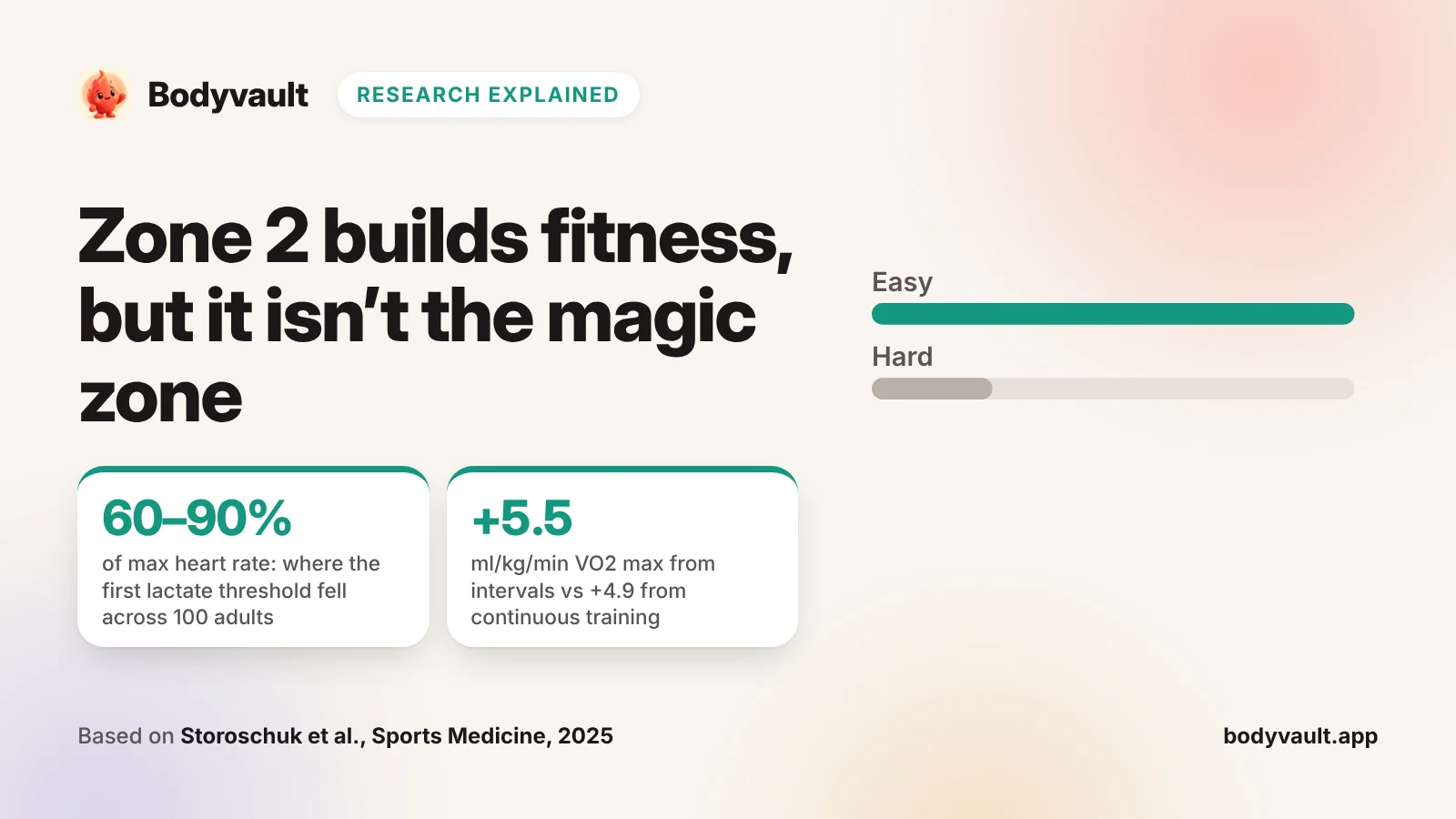
60–90%
of max heart rate: where the first lactate threshold fell across 100 adults
+4.9ml
VO2 max gain (ml/kg/min) from continuous training vs no exercise
+5.5ml
VO2 max gain (ml/kg/min) from interval training vs no exercise
Strength of evidenceModerate
Easy aerobic training clearly improves fitness. Whether zone 2 is better than other intensities rests on small trials, mostly in trained athletes.
Key findingEasy training is worth doing and is the base of most endurance plans. But “zone 2 is the best way to build your mitochondria” goes beyond the evidence. When you have little time, adding some harder work appears to matter.
What zone 2 means
Zone 2 is low-intensity exercise below the first lactate threshold: you can breathe through your nose and hold a conversation. Labs measure it with blood lactate (around 2 mmol/L). Watches and apps estimate it from heart rate, usually as 60–70% of your maximum or of your heart-rate reserve.
Those percentages are a rough guide. In a study of 100 women and men who were tested in the lab, the lactate threshold fell anywhere from 60% to 90% of maximum heart rate. For some people, a watch’s “zone 2” is too easy; for others it is above their threshold.
Where the first lactate threshold fell, by person
- First lactate threshold60–90% of max HR
- Maximal lactate steady state75–97% of max HR
- A typical watch “zone 2”60–70% of max HR
To find your heart-rate numbers, use the heart rate zone calculator, then check them against how the effort feels: zone 2 should feel easy enough to chat.
What the 2025 review concluded
Easy and hard both raise fitness
A meta-analysis of 28 studies in healthy adults aged 18 to 45 compared continuous endurance training with interval training. Both raised VO2 max well above doing nothing; intervals added a little more.
An umbrella review of 24 meta-analyses, covering healthy, overweight and older adults, found high-intensity interval training improved aerobic fitness compared with both no exercise and moderate continuous training. For losing fat, though, intervals and steady exercise gave similar results in overweight adults; intervals simply took about 40% less time.
The 80/20 idea, and its limits
Elite endurance athletes typically spend about 80% of their sessions at low intensity and 20% at high intensity. That pattern comes from people training 10 to 13 times a week. A small trial in well-trained athletes compared four ways of distributing nine weeks of training:
| Plan | Low | Threshold | High | VO2 peak change |
|---|---|---|---|---|
| Polarised | 68% | 6% | 26% | +11.7% |
| High-intensity intervals | 43% | 0% | 57% | +4.8% |
| Threshold | 46% | 54% | 0% | No significant change |
| High volume, mostly easy | 83% | 16% | 1% | No significant change |
Note that the mostly-easy plan didn’t improve VO2 peak in these trained athletes, while the plan mixing easy work with hard intervals did. Larger reviews are more mixed: across 13 studies and 348 athletes, polarised and pyramidal plans (mostly easy, some moderate, a little hard) gave similar VO2 max gains overall, and recreational athletes may do slightly better with the pyramidal mix.
Claims and evidence
ClaimZone 2 is the optimal intensity for metabolic health and mitochondria.
EvidenceA 2025 review found current evidence doesn’t support zone 2 as optimal in the general population, and higher intensities appear critical when training volume is low.
ClaimEveryone should train 80% easy and 20% hard, like the pros.
EvidenceThat pattern describes athletes training 10–13 times a week. Across 348 athletes there was no single best mix, and recreational athletes may suit a pyramidal plan.
ClaimSteady “fat-burning zone” cardio is best for losing fat.
EvidenceIntervals and steady exercise reduced fat mass and waist size similarly in overweight adults; intervals took about 40% less time.
ClaimA fixed percentage of max heart rate puts everyone in zone 2.
EvidenceThe first lactate threshold fell anywhere from 60% to 90% of maximum heart rate across 100 adults.
What this means for you
What this means for you
- If you have little time, don’t do only easy cardio: one or two sessions a week with harder intervals are an efficient way to raise fitness.
- If you train often, keep most sessions easy so you recover for the hard ones; that’s where the 80/20 idea makes sense.
- Judge “easy” by feel as well as heart rate: you should be able to talk in full sentences.
- Any regular aerobic training beats none. The guidelines ask adults for 150–300 minutes of moderate or 75–150 minutes of vigorous activity a week.
What the research can’t tell you yet
The trials are small, short and mostly in trained athletes, and they define intensity in different ways (lactate, ventilation, or percentages of heart rate). We don’t yet have large, long trials in everyday exercisers comparing a zone 2 plan with other plans for health outcomes.
How Bodyvault uses this research
Bodyvault shows your live heart-rate zone on Apple Watch and iPhone during cardio, using your own resting and maximum heart rate or the zones set in Apple’s Workout app, and totals your time in each zone afterwards. It doesn’t call any zone “optimal”: the point is to see your mix of easy and hard training over a week. Your heart rate recovery after workouts is tracked as a trend too; see heart rate recovery explained.
Share or cite this explainer
Bodyvault (2026). Zone 2 training: what the research actually says. https://bodyvault.app/blog/zone-2-training
The charts on this page may be reused with a link back to it. The underlying data belong to the studies cited below.
Questions
What is zone 2 training?
Easy aerobic exercise below the first lactate threshold, roughly 60–70% of maximum heart rate for many people, at a pace where you can still hold a conversation.
Is zone 2 better than HIIT?
Not shown. Both improve aerobic fitness; intervals raise VO2 max slightly more in healthy adults and take less time. Most good plans combine easy and harder sessions.
How much zone 2 should I do a week?
There is no research-based prescription for zone 2 specifically. Guidelines recommend 150–300 minutes of moderate activity a week, and athletes who train often do most of it at low intensity.
Is zone 2 the fat-burning zone?
You burn a higher share of fat at low intensity, but for fat loss, intervals and steady cardio gave similar results in overweight adults.
How do I find my zone 2 heart rate?
Use a lab test if you can; otherwise the heart rate zone calculator gives an estimate. Check it against the talk test.
Sources
- Storoschuk KL et al. (2025). Much ado about zone 2: a narrative review assessing the efficacy of zone 2 training for improving mitochondrial capacity and cardiorespiratory fitness. Sports Med 55(7):1611–1624.
- Iannetta D et al. (2020). A critical evaluation of current methods for exercise prescription in women and men. Med Sci Sports Exerc 52(2):466–473.
- Milanović Z, Sporiš G, Weston M (2015). Effectiveness of high-intensity interval training and continuous endurance training for VO2max improvements: a systematic review and meta-analysis. Sports Med 45(10):1469–1481.
- Poon ET et al. (2024). High-intensity interval training and cardiorespiratory fitness in adults: an umbrella review of systematic reviews and meta-analyses. Scand J Med Sci Sports 34(5):e14652.
- Wewege M et al. (2017). The effects of high-intensity interval training vs. moderate-intensity continuous training on body composition in overweight and obese adults. Obes Rev 18(6):635–646.
- Seiler S (2010). What is best practice for training intensity and duration distribution in endurance athletes? Int J Sports Physiol Perform 5(3):276–291.
- Stöggl T, Sperlich B (2014). Polarized training has greater impact on key endurance variables than threshold, high intensity, or high volume training. Front Physiol 5:33.
- Rosenblat MA et al. (2019). Polarized vs. threshold training intensity distribution on endurance sport performance: a systematic review and meta-analysis of randomized controlled trials. J Strength Cond Res.
- Rosenblat MA et al. (2025). Which training intensity distribution intervention will produce the greatest improvements in maximal oxygen uptake and time-trial performance in endurance athletes? Sports Med 55(3):655–673.
General information about fitness and nutrition, not medical advice. If you have a health condition, are pregnant or take medication, talk to your doctor before changing your diet or training.