
Research explained
Heart rate recovery: what one minute after exercise says about fitness
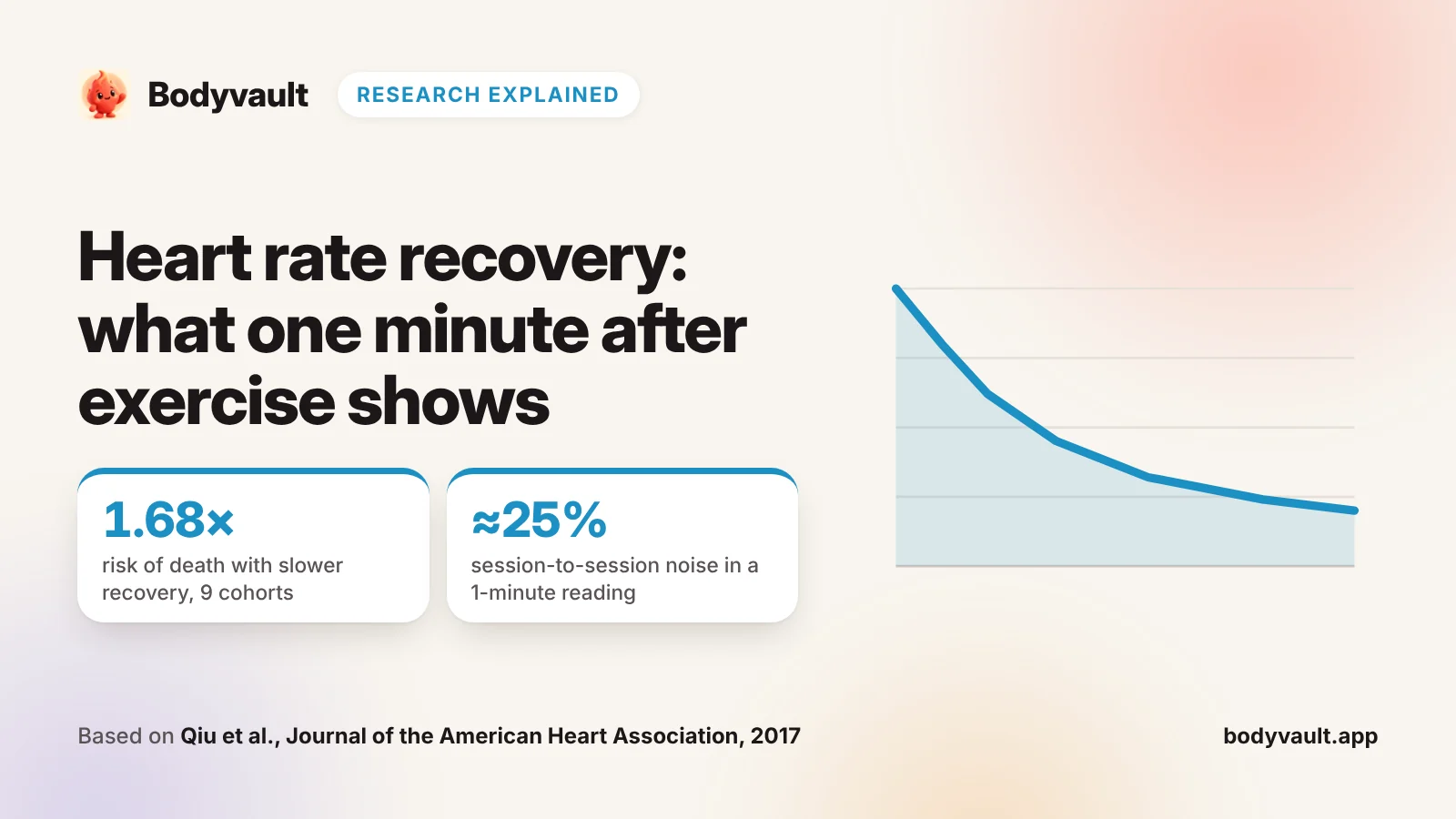
Heart rate recovery is how much your heart rate drops in the first minute or two after you stop exercising. In large studies, slower recovery was linked to higher long-term risk; across nine cohorts, people with an attenuated recovery had a 68% higher risk of death during follow-up.
The short answer
1.68×
risk of death with attenuated recovery, pooled from 9 cohorts (41,600 people)
12bpm
the original 1-minute cut-off, after a treadmill test with a cool-down walk
18bpm
the cut-off used when people lay down straight away, with no cool-down
≈25%
typical day-to-day error of a 1-minute recovery reading
Strength of evidenceStrong as a link, weak as a daily score
Consistent cohort studies tie slow recovery to higher risk. But the cut-offs come from clinical treadmill tests, and one reading after a workout is noisy.
Key findingHeart rate recovery is a useful fitness trend when you compare similar workouts. It is not a diagnosis, and a single slow reading after a hard session means very little on its own.
What heart rate recovery measures
When you stop exercising, your heart rate falls quickly at first and then more slowly. The fast early drop is mostly your parasympathetic (vagal) nervous system switching back on; the slower part reflects the sympathetic “accelerator” easing off. Fitter people usually recover faster.
Peak
Heart rate is highest at the end of the effort.
First minute
A fast drop as vagal activity returns: this is HRR1, the most studied measure.
Minutes 2–5
A slower fall as the body clears the effort and cools down.
Resting again
Back near your resting heart rate; how long that takes depends on how hard you went.
The study that started it
Later studies confirmed the link in other groups. In 5,234 adults without heart disease, a slow two-minute recovery after a submaximal test was linked to higher risk over 12 years. A meta-analysis of nine cohorts from the general population pooled the results:
Attenuated vs fast heart rate recovery, pooled hazard ratios
- Death from any cause1.68 (1.51–1.88)
- Cardiovascular events1.69 (1.05–2.71)
- Death, per 10 bpm slower1.09 (1.01–1.19)
- Events, per 10 bpm slower1.13 (1.05–1.21)
| Study | Who | Test and timing | “Abnormal” recovery | Adjusted risk | Follow-up |
|---|---|---|---|---|---|
| Cole et al., 1999 | 2,428 adults referred for testing | Maximal treadmill test, cool-down walk; 1 minute | 12 bpm or less | Death: RR 2.0 (1.5–2.7) | 6 years |
| Watanabe et al., 2001 | 5,438 adults referred for testing | Treadmill test, lying down at once; 1 minute | 18 bpm or less | Death: HR 2.09 (1.49–2.82) | 3 years |
| Cole et al., 2000 | 5,234 adults without heart disease | Submaximal treadmill test; 2 minutes | 42 bpm or less | Death: RR 1.55 (1.22–1.98) | 12 years |
| Qiu et al., 2017 (9 cohorts) | 41,600 people from the general population | Various; 1–2 minutes | Defined by each study | Death: HR 1.68 (1.51–1.88) | – |
RR and HR are relative risk and hazard ratio, after adjusting for age and other factors; 2.0 means twice the risk over the follow-up. The meta-analysis found the one-minute and two-minute measures gave similar results for death from any cause.
Why 12 bpm isn’t a universal cut-off
You will often read that a drop of less than 12 beats in the first minute is “abnormal”. That number came from one protocol: a maximal clinical treadmill test followed by a slow walk. Change the protocol and the cut-off changes.
Your recovery also depends on what you just did. After a harder effort, heart rate falls more slowly, so readings after an easy jog and after hard intervals aren’t comparable. Medicines that lower heart rate, such as β-blockers, change it too.
How noisy is a single reading?
Quite noisy. A review of heart-rate monitoring in athletes put the typical session-to-session error of a one-minute recovery at about 25%; the smallest change worth paying attention to was about 7%. In practice that means one reading tells you little, and averages across several similar workouts tell you much more.
The same fitness, different days: a 30 bpm recovery ± 25%
- Range you might see22–38 bpm
Wrist sensors add their own delay. In a study comparing a wrist optical monitor with an ECG, the wrist registered the post-exercise drop later in 97% of cases, which makes the one-minute value look slower than it is. Apple Watch heart rate during exercise agrees with chest straps and ECG within about −7 to +6 bpm in pooled studies. Of the ways to measure recovery, the simple one-minute drop was among the most reproducible; curve-fitted measures fared worse.
Claims and evidence
ClaimIf your heart rate drops less than 12 bpm after any workout, something is wrong.
EvidenceThe 12 bpm cut-off came from clinical treadmill tests with a cool-down. Other protocols used 18 bpm at one minute or 42 bpm at two minutes.
ClaimOne workout’s recovery tells you how recovered you are today.
EvidenceA one-minute reading has a typical error of about 25%, and it depends on how hard the session was.
ClaimA faster recovery always means you are fresher.
EvidenceUsually it reflects better fitness, but a recovery that keeps getting faster during a heavy block, and doesn’t reverse with rest, can accompany overreaching.
ClaimA wrist watch captures recovery as well as an ECG.
EvidenceA wrist sensor registered the drop later than ECG in 97% of cases.
What this means for you
What this means for you
- Track recovery after similar workouts, such as the same run or the same interval session, and look at the trend over weeks.
- End sessions the same way each time: stopping still and walking give different numbers.
- Expect your recovery to improve as your aerobic fitness improves; that is the most useful thing it shows.
- If you have chest pain, dizziness, fainting or unusual breathlessness during or after exercise, see a doctor; a recovery number can’t rule anything out.
How Bodyvault uses this research
Bodyvault measures the heart-rate drop in the first minute after each workout (HRR1) when your watch or strap records enough data, and shows it as a trend across workouts rather than judging any single one against a clinical cut-off. The trend is one small input to the Readiness score, beside HRV, resting heart rate and sleep. For the numbers behind your zones, see the heart rate zone calculator.
Share or cite this explainer
Bodyvault (2026). Heart rate recovery: what one minute after exercise says about fitness. https://bodyvault.app/blog/heart-rate-recovery
The charts on this page may be reused with a link back to it. The underlying data belong to the studies cited below.
Questions
What is a good heart rate recovery?
In clinical treadmill studies with a cool-down walk, a drop of more than 12 bpm in the first minute was considered normal. For everyday workouts, compare yourself with your own past readings after similar sessions.
How do I measure heart rate recovery?
Note your heart rate at the end of a hard effort and again one minute later, ending the same way each time. A chest strap is more precise than a wrist sensor.
Can I improve my heart rate recovery?
Recovery is strongly linked to aerobic fitness, so regular aerobic training usually improves it over weeks to months.
Is a slow heart rate recovery dangerous?
In large groups it was linked to higher long-term risk, but one slow reading after a workout is not a diagnosis. If you have symptoms or concerns, see a doctor.
Sources
- Cole CR et al. (1999). Heart-rate recovery immediately after exercise as a predictor of mortality. N Engl J Med 341(18):1351–1357.
- Cole CR et al. (2000). Heart rate recovery after submaximal exercise testing as a predictor of mortality in a cardiovascularly healthy cohort. Ann Intern Med 132(7):552–555.
- Watanabe J et al. (2001). Heart rate recovery immediately after treadmill exercise and left ventricular systolic dysfunction as predictors of mortality. Circulation 104(16):1911–1916.
- Qiu S et al. (2017). Heart rate recovery and risk of cardiovascular events and all-cause mortality: a meta-analysis of prospective cohort studies. J Am Heart Assoc 6(5):e005505.
- Peçanha T, Silva-Júnior ND, Forjaz CL (2014). Heart rate recovery: autonomic determinants, methods of assessment and association with mortality and cardiovascular diseases. Clin Physiol Funct Imaging 34(5):327–339.
- Buchheit M (2014). Monitoring training status with HR measures: do all roads lead to Rome? Front Physiol 5:73.
- Fecchio RY et al. (2019). Reproducibility of post-exercise heart rate recovery indices: a systematic review. Auton Neurosci 221:102582.
- Bretonneau Q et al. (2024). Accuracy of heart-rate-recovery parameters assessed from a wrist-worn photoplethysmography monitor (Polar Unite). Int J Sports Physiol Perform.
- Lambe R et al. (2026). The accuracy of Apple Watch measurements: a living systematic review and meta-analysis. npj Digit Med 9(1):63.
General information about fitness and nutrition, not medical advice. If you have a health condition, are pregnant or take medication, talk to your doctor before changing your diet or training.