
Research explained
HRV-guided training: does training by your HRV work?
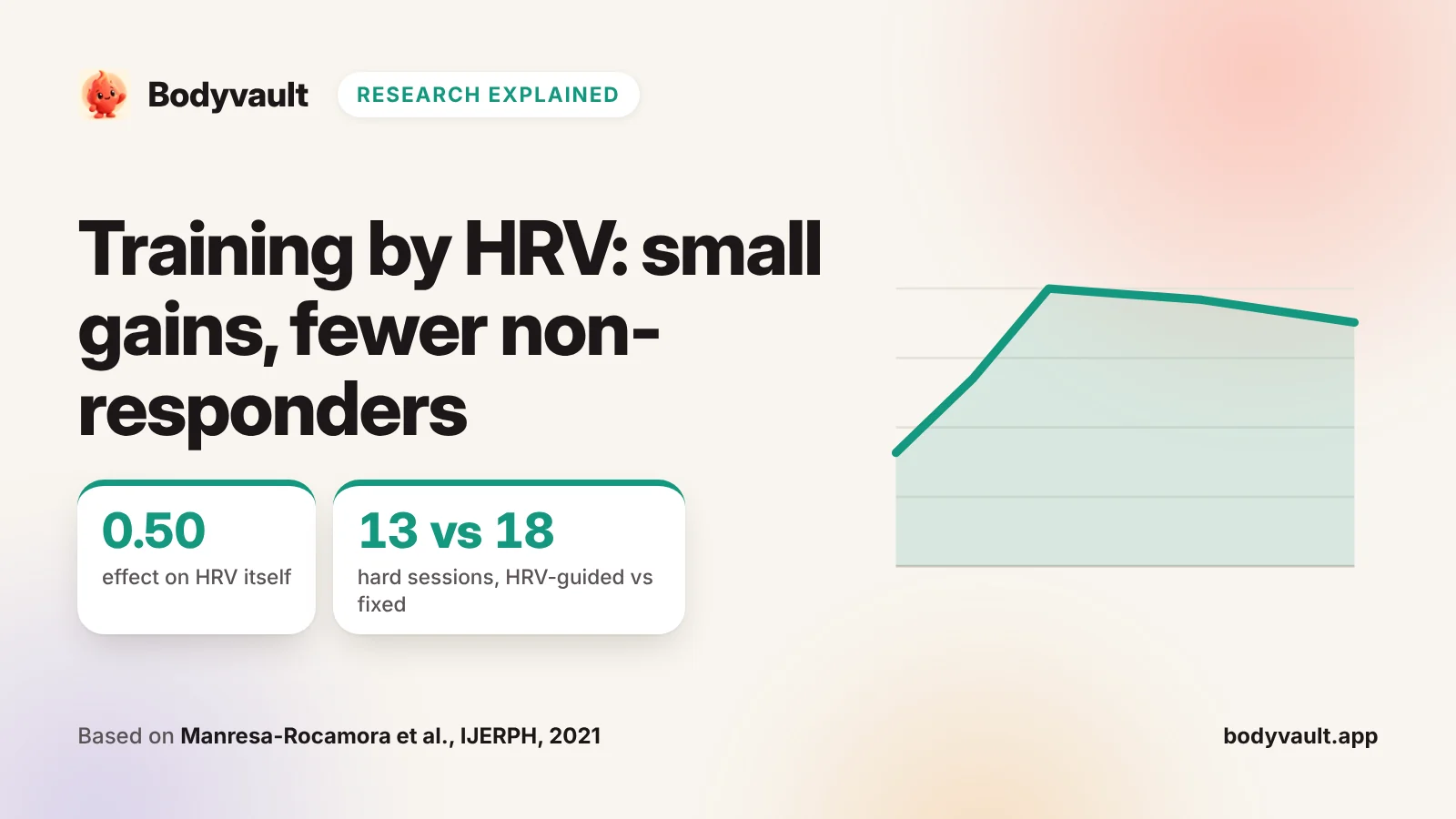
HRV-guided training means choosing hard or easy days from your heart rate variability. In trials it brought small, uncertain extra gains in fitness over a fixed plan, but fewer people failed to improve, often with fewer hard sessions.
The short answer
0.50
effect size for HRV itself: the clearest benefit of HRV-guided training
0.13
effect size for VO2 max: small and not statistically clear
13 vs 18
hard sessions in 8 weeks for HRV-guided runners against a fixed plan (13.2 and 17.7)
3–4days
of valid readings a week captured most of the HRV signal
Strength of evidenceModerate
Two meta-analyses of about eight small endurance-training studies each. Randomisation was poorly reported and there was almost no blinding. There is no trial evidence yet for strength or muscle-building programmes.
Key findingHRV guidance helps you place hard days when your body seems ready, rather than adding big extra gains. Its clearest benefits were fewer people failing to improve and, in one trial, the same progress from fewer hard sessions.
What HRV-guided training is
Heart rate variability (HRV) is the small variation in time between heartbeats. Compared with your own usual level, higher values tend to reflect more rest-and-recover (parasympathetic) activity, and a clear drop can follow hard training, poor sleep, alcohol or illness. HRV-guided training uses that signal to decide each day whether to train hard or easy, instead of following a fixed calendar. Most trials used RMSSD, a common HRV measure, recorded for a few minutes each morning.
Measure
Record HRV each morning, as most trials did, or overnight with a wearable.
Compare
Set today’s value against your own recent average, such as a rolling 7-day or 10-day mean.
Decide
Within your normal range or above: train hard as planned. Clearly below: train easy or rest.
Repeat
Over weeks, hard sessions land on the days you seem most ready for them.
The rules varied. In one early trial, people trained hard when morning HRV was unchanged or higher, and went easy when it fell below their 10-day average minus one standard deviation, or fell two days in a row. Another allowed moderate or hard sessions only when HRV was within each runner’s individually set normal range. Of the eight studies in one meta-analysis, five used RMSSD; four compared a 3- or 7-day rolling average with a 3–4-week baseline, and four compared single days with a moving average, mostly over 10 days.
What the meta-analyses found
HRV-guided vs fixed training plans, effect sizes
- Vagal HRV (RMSSD)0.50 (0.09 to 0.91)
- Resting heart rate0.04 (−0.34 to 0.43)
- VO2 max0.13 (−0.12 to 0.39)
- Maximal aerobic capacity0.20 (−0.07 to 0.47)
- Capacity at the second threshold0.26 (−0.05 to 0.57)
- Endurance performance0.20 (−0.09 to 0.48)
A second meta-analysis of 8 studies and 198 people found a clear benefit only for submaximal physiological measures (effect size 0.30); gains in performance (0.08) and VO2 peak (0.17) were small and not statistically clear. It also found fewer non-responders with HRV guidance, and noted that most HRV-guided groups did fewer moderate and hard sessions.
Inside the trials
| Trial | Who | HRV-guided group | Fixed plan | Between groups |
|---|---|---|---|---|
| Kiviniemi et al., 2007 | Moderately fit men, 4 weeks of running | VO2 peak 56 → 60 ml/kg/min; top speed 15.5 → 16.4 km/h | VO2 peak 54 → 55 (not significant); top speed 15.1 → 15.7 km/h | Larger top-speed gain with HRV (0.9 vs 0.5 km/h) |
| Vesterinen et al., 2016 | 40 recreational runners, 8 weeks | 3,000 m run 2.1% faster; 13.2 hard sessions | 3,000 m run 1.1% faster (not significant); 17.7 hard sessions | Fewer hard sessions with HRV; a small difference in the run |
| Javaloyes et al., 2019 | 17 well-trained cyclists, 8 weeks | Peak power +5.1%; 40-minute time trial +7.3% | No significant improvement | No significant difference |
One morning tells you little
HRV is noisy. In athletes, the typical day-to-day variation in morning RMSSD (log-transformed) is about 12%, and swings of 10–20% are common when training changes from day to day. The smallest change worth paying attention to is only about 3%. A hard session lowers HRV for 24–48 hours, so a dip the morning after hard intervals is expected, not a warning.
That’s why averages work better. In trained triathletes, a weekly HRV average needed only three or four valid days to capture nearly all of the change seen with seven.
How much change a weekly HRV average detected, by days measured
Other things move HRV
Training isn’t the only influence. In 4,098 Finnish employees, alcohol was linked to lower RMSSD in the first three hours of sleep, more so the more they drank. Illness and short sleep shift it too. A low reading after a night out reflects a real change in your body, but not that your training is going badly.
Devices differ as well. In a lab comparison of six wearables against an ECG, the average error in RMSSD ranged from −4.5 to −22.4 ms, and agreement varied widely between devices. Compare your HRV only with your own baseline on the same device; for typical values, see HRV by age and Apple Watch HRV. Most trials used short morning recordings, while wearables usually measure overnight; the two are related but not identical, and one review calls whole-night HRV without sleep-stage information “particularly challenging” to interpret.
Claims and evidence
ClaimA low HRV morning means you are overtrained.
EvidenceHRV swings 10–20% from day to day, and alcohol, illness and stress lower it too. No single marker can diagnose overtraining.
ClaimA higher HRV than other people means you’re fitter or healthier.
EvidenceHRV varies hugely between people and measurement methods. Compare it only with your own baseline.
ClaimHRV-guided training makes you dramatically fitter.
EvidenceThe average extra effect on VO2 max and performance was small and statistically uncertain, though fewer people failed to improve.
ClaimYou need a perfect HRV reading every day.
EvidenceThree or four valid readings a week captured most of the signal, and rolling averages are recommended.
ClaimEasy days on low-HRV mornings mean losing fitness.
EvidenceHRV-guided runners did fewer hard sessions (13.2 against 17.7) and improved their 3,000 m time as much or more.
What this means for you
What this means for you
- Compare HRV with your own baseline on the same device, and look at a 7-day average rather than one morning.
- Treat a clearly low trend as a cue to swap a hard session for an easy one, especially if you also feel run down.
- Expect dips after hard training, alcohol or a short night; they don’t mean your plan has failed.
- Don’t expect HRV guidance to make you dramatically fitter. Its value is putting hard work on the right days.
- If HRV stays low alongside symptoms such as fever or unusual tiredness, rest, and see a doctor if it doesn’t improve.
What these studies can’t tell you
- Big, long trials. About eight small endurance-training studies per meta-analysis, with poorly reported randomisation and almost no blinding.
- Strength training. There’s no trial evidence yet for using HRV to guide strength or muscle-building programmes.
- Overnight readings. The trials used short morning recordings; overnight wearable HRV is related but not the same.
How Bodyvault uses this research
Bodyvault’s Readiness score follows the same idea as these trials: it compares last night with your own baseline, not with other people. HRV carries the most weight (35%), with resting heart rate and sleep at 20% each, and smaller inputs from temperature and breathing rate, training load, your check-in and heart rate recovery. It uses RMSSD once it has 7 nights of it, otherwise SDNN, and never mixes the two. It needs 7 nights before giving a score, builds your baseline from up to 60 nights and reaches full confidence after 28. On a “Pace yourself” day it suggests holding back, with about 15% fewer sets and one more rep in reserve; on a “Recover” day, a lighter session. Nothing changes unless you choose it. For how the score works, see what is a readiness score.
Share or cite this explainer
Bodyvault (2026). HRV-guided training: does training by your HRV work?. https://bodyvault.app/blog/hrv-guided-training
The charts on this page may be reused with a link back to it. The underlying data belong to the studies cited below.
Questions
What is HRV-guided training?
Choosing each day’s training from your heart rate variability: hard sessions when HRV is within or above your normal range, easier sessions or rest when it is clearly below.
Does HRV-guided training work?
Partly. In meta-analyses, HRV itself improved more and fewer people failed to improve, but extra gains in VO2 max and performance were small and not statistically clear.
Should I skip a workout if my HRV is low?
One low reading means little. If your 7-day trend is clearly down and you feel run down, swapping a hard session for an easy one is what the trials did.
How many days of HRV do I need?
At least 3 valid readings a week captured most of the signal in trained athletes. The trials compared those readings with baselines of about 3–4 weeks.
What is a good HRV?
There isn’t one number: HRV varies widely between people, ages and devices. Compare with your own baseline; HRV by age shows typical ranges.
Sources
- Manresa-Rocamora A et al. (2021). Heart rate variability-guided training for enhancing cardiac-vagal modulation, aerobic fitness, and endurance performance: a methodological systematic review with meta-analysis. Int J Environ Res Public Health 18(19):10299.
- Düking P et al. (2021). Monitoring and adapting endurance training on the basis of heart rate variability monitored by wearable technologies: a systematic review with meta-analysis. J Sci Med Sport 24(11):1180–1192.
- Kiviniemi AM et al. (2007). Endurance training guided individually by daily heart rate variability measurements. Eur J Appl Physiol 101(6):743–751.
- Vesterinen V et al. (2016). Individual endurance training prescription with heart rate variability. Med Sci Sports Exerc 48(7):1347–1354.
- Javaloyes A et al. (2019). Training prescription guided by heart-rate variability in cycling. Int J Sports Physiol Perform 14(1):23–32.
- Plews DJ et al. (2014). Monitoring training with heart-rate variability: how much compliance is needed for valid assessment? Int J Sports Physiol Perform 9(5):783–790.
- Plews DJ et al. (2013). Training adaptation and heart rate variability in elite endurance athletes: opening the door to effective monitoring. Sports Med 43(9):773–781.
- Buchheit M (2014). Monitoring training status with HR measures: do all roads lead to Rome? Front Physiol 5:73.
- Pietilä J et al. (2018). Acute effect of alcohol intake on cardiovascular autonomic regulation during the first hours of sleep in a large real-world sample of Finnish employees: observational study. JMIR Ment Health 5(1):e23.
- Miller DJ, Sargent C, Roach GD (2022). A validation of six wearable devices for estimating sleep, heart rate and heart rate variability in healthy adults. Sensors 22(16):6317.
- Meeusen R et al. (2013). Prevention, diagnosis, and treatment of the overtraining syndrome: joint consensus statement of the European College of Sport Science and the American College of Sports Medicine. Med Sci Sports Exerc 45(1):186–205.
- Shaffer F, Ginsberg JP (2017). An overview of heart rate variability metrics and norms. Front Public Health 5:258.
General information about fitness and nutrition, not medical advice. If you have a health condition, are pregnant or take medication, talk to your doctor before changing your diet or training.