
Research explained
How many steps a day do you need? What the research says
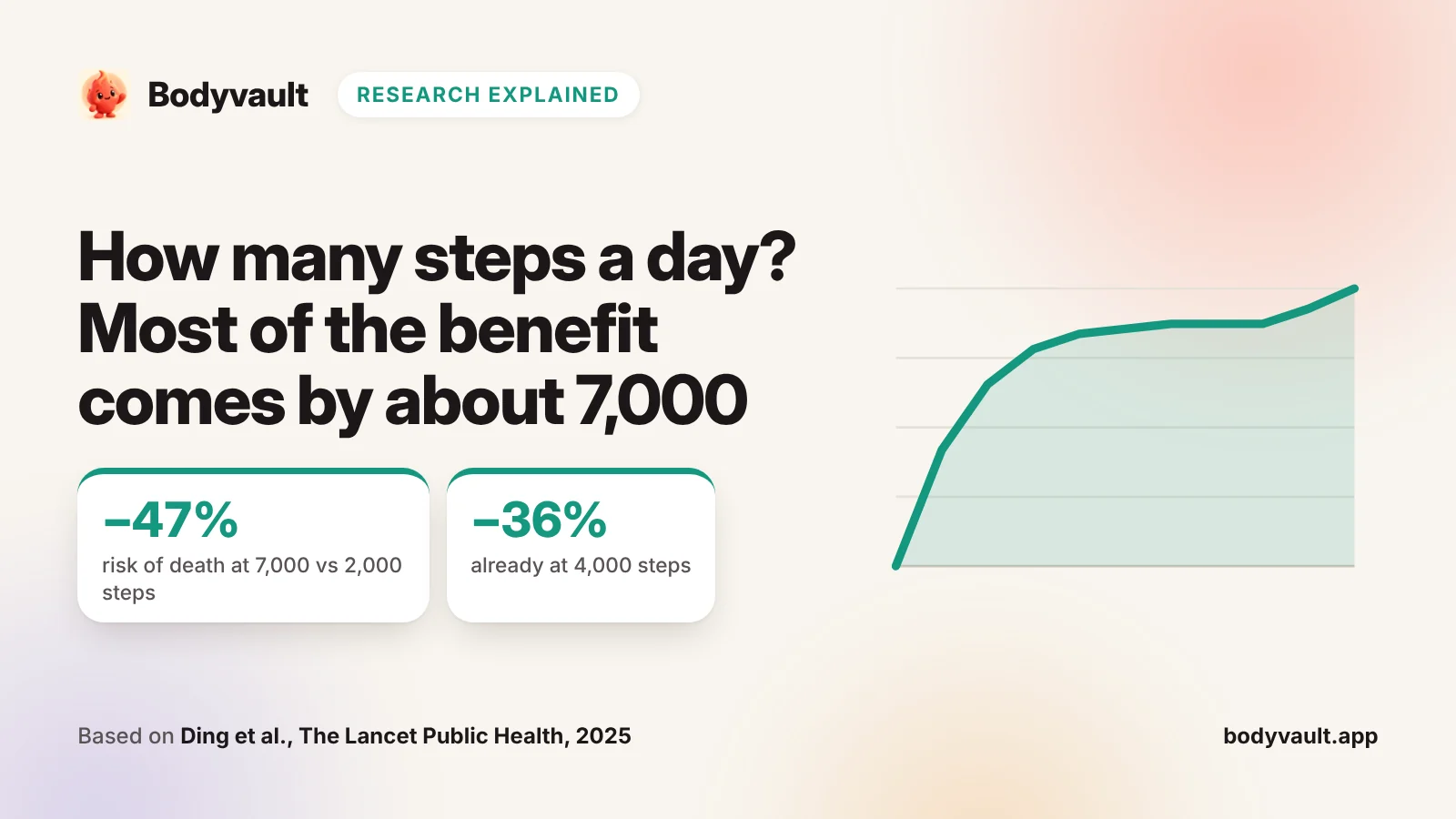
About 7,000 steps a day captures most of the benefit seen in large studies. In a 2025 meta-analysis, people who walked that much had a 47% lower risk of dying during follow-up than people taking 2,000 steps. More steps still helped, but each extra thousand added less.
The short answer
−47%
risk of death at 7,000 steps a day, compared with 2,000
−36%
already at 4,000 steps a day
6–8k
steps where the benefit levelled off for adults aged 60 and over
−15%
risk of death for each extra 1,000 steps a day, in a second meta-analysis
Strength of evidenceStrong for the pattern
Large, consistent cohort studies in more than 160,000 people. All are observational: they show links between steps and health, not proof that steps cause every difference.
Key findingYou don’t need 10,000 steps for most of the benefit. Going from very few steps to a few thousand made the biggest difference, and the gains flattened somewhere between about 5,000 and 7,000 steps.
What the biggest study found
The researchers pooled the studies into a single curve. Risk fell steeply over the first few thousand steps and then flattened. In their words, the decrease in risk “attenuated before 7,000 steps per day”. Their statistical bend in the curve for death from any cause sat at about 5,400 steps.
Risk of death from any cause, by daily steps
| Steps a day | Hazard ratio | Lower risk than at 2,000 steps |
|---|---|---|
| 3,000 | 0.77 | 23% |
| 4,000 | 0.64 | 36% |
| 5,000 | 0.57 | 43% |
| 6,000 | 0.54 | 46% |
| 7,000 | 0.53 | 47% |
| 8,000 | 0.52 | 48% |
| 9,000 | 0.52 | 48% |
| 10,000 | 0.52 | 48% |
| 11,000 | 0.49 | 51% |
| 12,000 | 0.45 | 55% |
The last column is calculated as (1 − hazard ratio) × 100. The hazard ratios at 8,000, 9,000 and 10,000 steps were the same, 0.52, which is why the curve looks flat there.
It isn’t only about living longer
The same meta-analysis looked at other outcomes. At 7,000 steps a day, compared with 2,000, every one moved in a healthier direction except cancer incidence, which wasn’t clearly different. The researchers call the outcomes other than death and heart disease exploratory, because each rests on only two to four studies.
Health outcomes at 7,000 steps a day, compared with 2,000
- Death from any cause0.53 (0.46–0.60)
- Heart disease (new cases)0.75 (0.67–0.85)
- Death from heart disease0.53 (0.37–0.77)
- Death from cancer0.63 (0.55–0.72)
- Type 2 diabetes0.86 (0.74–0.99)
- Dementia0.62 (0.53–0.73)
- Depressive symptoms0.78 (0.73–0.83)
- Falls0.72 (0.65–0.81)
- Cancer (new cases)0.94 (0.87–1.01)
Does age change the target?
A meta-analysis of 15 cohorts found the benefit levelled off earlier in older adults:
Adults aged 60 and over
- Risk fell until about 6,000–8,000 steps a day
- Median in the studies: 5,649 steps
- Older women in another study: levelling off near 7,500
Adults under 60
- Risk fell until about 8,000–10,000 steps a day
- Median in the studies: 7,803 steps
- No extra risk was seen at high step counts
The 2025 meta-analysis complicated this picture: in older adults it found no plateau at all for death from any cause, while younger adults levelled off near 5,400 steps. Its authors conclude that whether younger and older adults need different targets “remains uncertain”. Either way, both analyses agree on the direction: more steps than you take now is better, up to well beyond 7,000.
Do you have to hit it every day?
No. A study of 3,101 US adults compared how many days a week people reached 8,000 steps. Reaching it on just one or two days was linked to almost as large a difference as reaching it on three or more.
Does walking pace matter?
Less than the total, as far as these studies can tell. After accounting for total steps, faster cadence wasn’t clearly linked to lower risk in US adults or in older women. In the 15-cohort analysis the findings were mixed: the fastest 30 minutes of the day was associated with lower risk, but time spent walking at 100 or more steps a minute was not. A pace of about 100 steps a minute is the usual floor for moderate-intensity walking, and 30 minutes at that pace adds about 3,000 steps.
A step on your watch isn’t always a step in the study
Most of these studies measured steps with devices worn on the hip. Wrist-worn devices, like most watches, tend to count more steps, and research and consumer devices can differ by 20% or more. A review of Apple Watch studies rated its step counting as moderately accurate, based on a few studies of early models. So treat 7,000 on your watch as a rough match for 7,000 in the studies, and compare your watch with itself over time.
Claims and evidence
ClaimYou need 10,000 steps a day to get any benefit.
EvidenceCompared with 2,000 steps, 7,000 was linked to 47% lower risk of death, and most of the reduction came before 7,000.
ClaimIf you can’t reach the goal, a few thousand extra steps don’t matter.
EvidenceGoing from 2,000 to 4,000 steps was linked to 36% lower risk, and each extra 1,000 steps to about 15% lower risk.
ClaimAbove 10,000 steps there is no benefit, or it becomes harmful.
EvidenceRisk of death kept falling to 12,000 steps, the highest level studied, and no harm was seen at high step counts. For some outcomes, though, extra steps above 7,000 made no clear difference.
ClaimYou have to hit your step goal every single day.
EvidenceReaching 8,000 steps on one or two days a week was linked to almost the same difference as reaching it on three or more.
What this means for you
What this means for you
- If you walk little now, add steps gradually, about 1,000 at a time. The first few thousand are linked to the biggest difference.
- Around 7,000 steps a day is a good target for most adults; more is fine and may help further.
- Look at your week, not only today. A short day is not a failed day.
- Steps don’t count cycling, swimming or strength training, which matter too. Adults are advised to do muscle-strengthening work on two or more days a week as well.
What these studies can’t tell you
- Cause and effect. People who are unwell walk less, which can make steps look more protective than they are. When the 15-cohort analysis left out deaths in the first two years, the link weakened but did not disappear.
- Your own number. These are averages across large groups. They can’t give an individual risk, and Bodyvault never shows one.
- Who was studied. Most data come from high-income countries, and many cohorts were mostly white volunteers.
How Bodyvault uses this research
Bodyvault reads your steps from Apple Health or Health Connect. Your daily goal starts at 8,000, inside the range where these studies saw most of the benefit, and you can set it anywhere from 3,000 to 20,000. If you’re well short of it by early evening, or you’ve barely moved for an hour, it can nudge you to walk, and after you log a meal it can suggest a short walk; see walking after eating for what those studies found. To turn steps into calories and distance, use the steps to calories calculator.
Share or cite this explainer
Bodyvault (2026). How many steps a day do you need? What the research says. https://bodyvault.app/blog/how-many-steps-a-day
The charts on this page may be reused with a link back to it. The underlying data belong to the studies cited below.
Questions
How many steps a day should I take?
Around 7,000 steps a day captures most of the benefit seen in large studies. If you take far fewer now, any increase helps: going from 2,000 to 4,000 steps was linked to 36% lower risk of death.
Is 10,000 steps a day necessary?
No. It is a round number, not a research threshold. Benefits were seen well below it, though more steps were still linked to a little lower risk up to 12,000.
How many steps a day is sedentary?
There is no single cut-off, but healthy adults typically take 4,000 to 18,000 steps a day. In the 2025 meta-analysis, the most inactive group (around 2,000 steps) had the highest risk.
How many steps a day to lose weight?
Steps help by adding to the energy you use; how much depends on your weight and distance. The steps to calories calculator works it out. Weight loss also depends on what you eat.
Does walking speed matter more than steps?
After accounting for total steps, faster walking wasn’t consistently linked to lower risk. Total steps mattered more in these studies.
Sources
- Ding D et al. (2025). Daily steps and health outcomes in adults: a systematic review and dose-response meta-analysis. The Lancet Public Health 10(8):e668–e681.
- Paluch AE et al. (2022). Daily steps and all-cause mortality: a meta-analysis of 15 international cohorts. The Lancet Public Health 7(3):e219–e228.
- Banach M et al. (2023). The association between daily step count and all-cause and cardiovascular mortality: a meta-analysis. Eur J Prev Cardiol 30(18):1975–1985.
- Saint-Maurice PF et al. (2020). Association of daily step count and step intensity with mortality among US adults. JAMA 323(12):1151–1160.
- Inoue K et al. (2023). Association of daily step patterns with mortality in US adults. JAMA Netw Open 6(3):e235174.
- Lee IM et al. (2019). Association of step volume and intensity with all-cause mortality in older women. JAMA Intern Med 179(8):1105–1112.
- Tudor-Locke C et al. (2011). How many steps/day are enough? For adults. Int J Behav Nutr Phys Act 8:79.
- Lambe R et al. (2026). The accuracy of Apple Watch measurements: a living systematic review and meta-analysis. npj Digit Med 9(1):63.
General information about fitness and nutrition, not medical advice. If you have a health condition, are pregnant or take medication, talk to your doctor before changing your diet or training.