
Research explained
Walking after eating: what the research says, and how long to walk
A short, easy walk after a meal is one of the best-studied habits in metabolic research. In lab trials, light walking breaks gave a clearly smaller rise in blood glucose after eating than sitting still, and walking after a meal did better than walking before it. But most of these studies lasted a single day, and who took part matters.
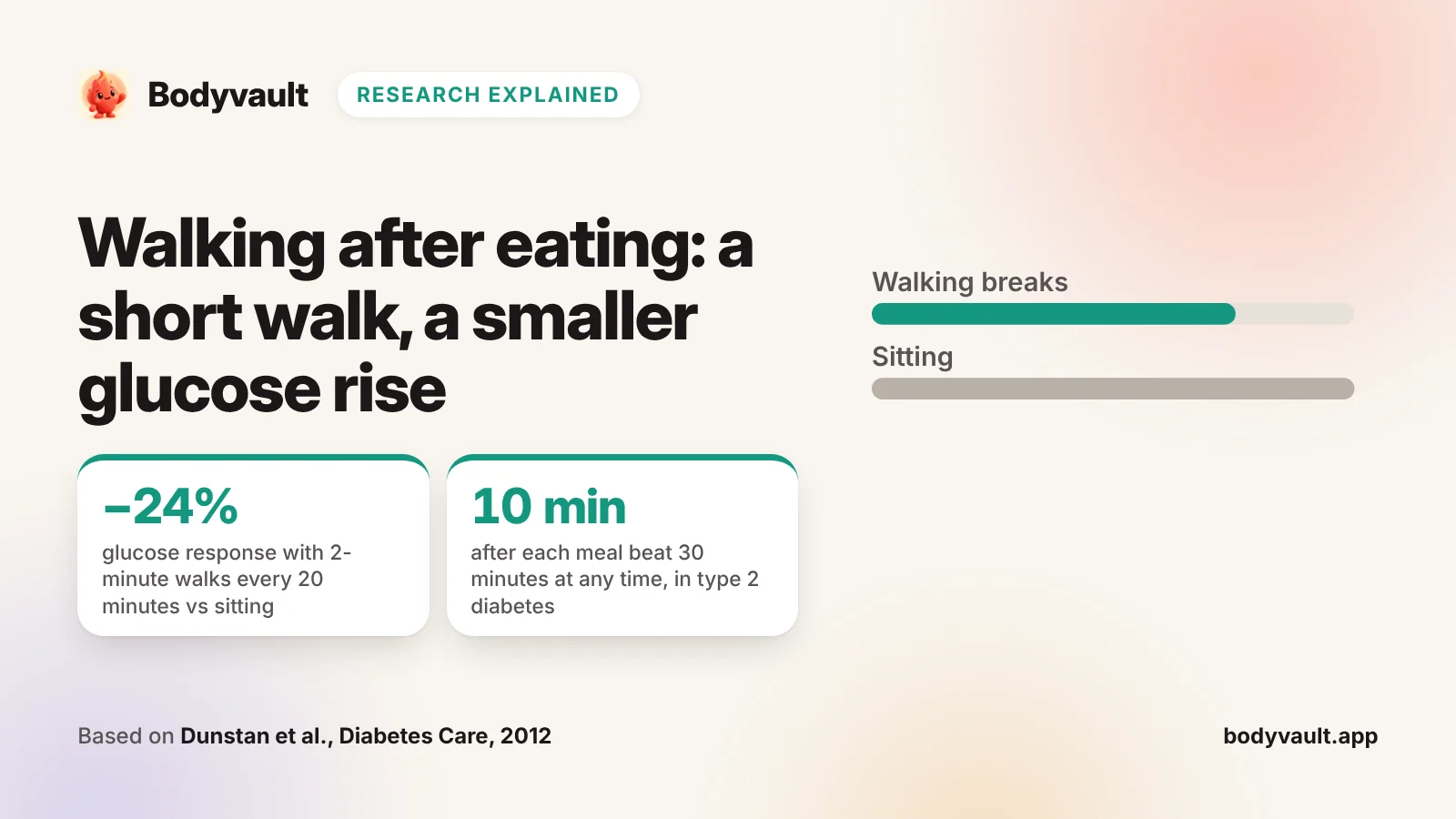
The short answer
−24%
glucose response with 2-minute walks every 20 minutes, compared with sitting (adults with overweight, no diabetes)
−0.72
effect size for glucose, light walking breaks vs sitting, across 7 trials: a medium to large effect
−12%
glucose response after meals in adults with type 2 diabetes who walked 10 minutes after each meal instead of 30 minutes at any time (our calculation)
0.45
correlation between glucose responses to the same meal eaten twice by people without diabetes (1 would be a perfect match)
Strength of evidenceGood for the short term
Many randomised crossover trials agree that walking after eating gives a smaller glucose rise than sitting. Nearly all lasted a single day in a lab, and the best time to start is still debated.
Key findingA few minutes of easy walking after a meal, or short walking breaks while you sit, gave a smaller rise in blood glucose than sitting still, and walking after the meal beat walking before it. What these one-day studies can’t show is a long-term change in health for people without diabetes.
Why a walk changes what happens after a meal
After a meal with carbohydrate, glucose from the food enters the blood and rises for an hour or two before settling. Working muscles draw glucose from the blood for fuel, which is the usual explanation for why moving while a meal is being absorbed changes the curve. An expert consensus on exercise in type 2 diabetes, from the American College of Sports Medicine, notes that using more energy after a meal reduces glucose levels “regardless of exercise intensity or type”. You don’t need a hard workout; an easy stroll counts.
What the trials found
Walking and standing breaks compared with sitting, and with each other
- Glucose: walking vs sitting−0.72 (−1.03 to −0.41)
- Glucose: standing vs sitting−0.31 (−0.60 to −0.03)
- Glucose: walking vs standing−0.30 (−0.52 to −0.08)
- Insulin: walking vs sitting−0.83 (−1.18 to −0.48)
- Insulin: standing vs sitting−0.30 (−0.60 to 0.01)
- Insulin: walking vs standing−0.54 (−0.75 to −0.33)
One of the trials in that review shows how little walking it takes. Nineteen adults aged 45–65 with overweight or obesity sat for five hours after a sugary, fatty test drink, three times: once without a break, and twice getting up every 20 minutes for 2 minutes of walking.
Walking after meals in type 2 diabetes
A trial in 41 adults with type 2 diabetes kept total walking the same, 30 minutes a day, and changed only its timing. For two weeks they walked 10 minutes after each main meal, and for two weeks 30 minutes at any time of day, while a continuous glucose monitor recorded the three hours after each meal.
If you have diabetes or take medicine that lowers glucose, talk to your care team before changing your routine around meals.
Before or after the meal, and how soon?
A meta-analysis of eight trials that tested exercise both before and after the same meal found that after was clearly better. Exercise before the meal made no clear difference compared with none.
Exercise after the meal compared with before it, or with none
- After vs before the meal0.47 (0.23 to 0.70)
- After vs before: no diabetes0.57 (0.30 to 0.83)
- After vs before: type 2 diabetes0.24 (−0.14 to 0.62)
- After the meal vs no exercise0.55 (0.34 to 0.75)
How soon to start is less settled. In that analysis, starting sooner after the meal was linked to a larger effect, and the authors suggest starting “as soon as possible”. A larger meta-analysis of 31 studies, mostly of men and mostly of people with type 2 diabetes, found that starting within the first hour or later made no difference to the glucose response to the meal, while sessions longer than 30 minutes had about twice the effect of shorter ones (our calculation from effect sizes of −0.450 and −0.209). And in ten inactive adults aged 60 and over with raised fasting glucose, three 15-minute walks starting 30 minutes after each meal gave an average 24-hour glucose of 116 mg/dL, against 129 on a day without them: a bigger difference than one 45-minute morning walk made (118 against 127).
In healthy people, a walk mostly flattens the peak
Effects are smaller in lean, healthy people. In young, active adults, a brisk 30-minute walk starting 15 minutes after a meal cut the glucose peak at 30 minutes, but in the first study the total rise over two hours didn’t change significantly; after the bigger meal, glucose simply rose later.
| Test meal | Sitting (mmol/L) | Walking (mmol/L) | Difference (our calculation) |
|---|---|---|---|
| Mixed meal, 0.75 g carbohydrate per kg | 6.96 | 5.16 | about −26% |
| Mixed meal, 1.5 g carbohydrate per kg | 6.70 | 5.17 | about −23% |
| Mixed meal, 75 g carbohydrate | 7.81 | 5.99 | about −23% |
| Carbohydrate drink, 75 g | 8.17 | 6.56 | about −20% |
Who these studies included
The size of the effect depends on who is walking, so it’s worth knowing who took part in each study.
| Study | Who took part | What they did |
|---|---|---|
| Buffey et al., 2022 (7 trials) | Mostly adults with overweight or obesity; none described with type 2 diabetes | Short walking or standing breaks while sitting, one day per condition |
| Dunstan et al., 2012 | 19 adults aged 45–65 with overweight or obesity, no diagnosed diabetes | 2-minute walks every 20 minutes for 5 hours |
| Reynolds et al., 2016 | 41 adults with type 2 diabetes | 10 minutes after each main meal vs 30 minutes at any time, 2 weeks each |
| DiPietro et al., 2013 | 10 inactive adults aged 60 and over with raised fasting glucose | Three 15-minute walks starting 30 minutes after meals |
| Bellini et al., 2022 | 21 healthy, active young adults | A 30-minute brisk walk starting 15 minutes after a meal |
Why one meal’s reading can mislead
If you wear a continuous glucose monitor, it’s tempting to judge a meal, or a walk, from a single curve. Research says to be careful. When 30 adults without diabetes ate identical meals about a week apart, the two glucose responses correlated only weakly to moderately (r = 0.45–0.46), with low reliability (0.17–0.28 on a 0–1 scale). When people wore two monitors at once, the two agreed only moderately on how the same person’s meals ranked, and a diet chosen from one monitor’s rankings gave half the glucose reduction when judged by the other. Averages over several similar meals tell you far more than one reading.
Watches and rings can’t measure glucose on their own: the US Food and Drug Administration warns against any smartwatch or ring that claims to, and glucose numbers should come from an authorised device such as a CGM.
Claims and evidence
ClaimA walk only counts if it lasts 30 minutes or more.
Evidence2-minute easy walks every 20 minutes gave a 24% smaller glucose response than sitting. Longer sessions may help more: in one meta-analysis, sessions over 30 minutes had about twice the effect of shorter ones.
ClaimStanding up is as good as walking.
EvidenceStanding breaks had less than half the effect on glucose (−0.31 against −0.72) and no clear effect on insulin.
ClaimExercising before a meal works as well as after.
EvidenceExercise after the meal beat exercise before it (effect size 0.47), and exercise before the meal made no clear difference compared with none.
ClaimYou must walk the moment you finish eating, or it’s wasted.
EvidenceOne analysis found sooner starts worked a little better; another found starting within the first hour or later gave similar results. Walks starting 30 minutes after meals still helped older adults.
ClaimWalking straight after meals makes you lose more weight.
EvidenceThe only study behind this claim is a self-experiment in two people, with no control group or statistics.
ClaimA walk after a meal cancels the meal out.
EvidenceIn healthy young adults a 30-minute walk cut the glucose peak by about a fifth to a quarter (our calculation), but the total rise over two hours often didn’t change.
What this means for you
What this means for you
- After your main meals, take an easy walk of 10–15 minutes, starting within the first hour; sooner may help a little more.
- If you sit for long stretches, get up for 2–5 minutes of easy walking every 20–30 minutes. Walking beats standing, and standing beats sitting.
- Longer walks seem to do more, but any walk counts.
- Use walks alongside what you eat, not as a reason to change it.
- If you have diabetes or take glucose-lowering medicine, follow your care team’s advice.
What these studies can’t tell you
- Long-term effects. Nearly all trials lasted a single day in a lab. None here shows long-term changes in weight, HbA1c or disease risk in people without diabetes.
- Daily life. The ACSM consensus notes that breaks from sitting “have not been shown to lower hyperglycemia in free-living environments”.
- Everyone. Results come from different groups: people with type 2 diabetes, older adults at risk, adults with overweight, and healthy young adults, in whom effects were smaller and mostly on the peak.
- The best start time. Two meta-analyses disagree on whether starting straight away matters.
How Bodyvault uses this research
After you log a main meal, or a snack of 250 kcal or more, Bodyvault can suggest a 10-minute walk about 20 minutes later. It can also nudge you to move after an hour with barely any steps while you’re awake, though not in the 90 minutes after a workout. If you use a continuous glucose monitor whose readings reach Apple Health, or import a LibreView or similar export, Meal Impact plots your glucose around each logged meal and sorts the rise into a low, medium or high band. For meals you plan, it predicts only a band, never a glucose number, labelled as a general estimate until it has learned enough from your own meals. Bodyvault is a wellness app and isn’t for managing diabetes. For your daily walking, see how many steps a day; to log meals, use the Indian calorie counter; and to see what a walk uses, try the steps to calories calculator.
Share or cite this explainer
Bodyvault (2026). Walking after eating: what the research says, and how long to walk. https://bodyvault.app/blog/walking-after-eating
The charts on this page may be reused with a link back to it. The underlying data belong to the studies cited below.
Questions
Is walking after eating good for you?
In short-term studies, light walking after meals gave a smaller rise in blood glucose than sitting, in people with and without type 2 diabetes. Long-term effects in people without diabetes haven’t been tested.
How long should you walk after eating?
Even 2-minute easy walks every 20 minutes helped in lab studies, and 10–15 minutes after each meal was used in others. Sessions over 30 minutes had larger effects in one meta-analysis.
Is it better to walk before or after eating?
After. In a meta-analysis of trials that tested both, exercise after the meal gave a smaller glucose rise than exercise before it, which made no clear difference.
How soon after eating should I walk?
The evidence is mixed: one analysis favoured starting as soon as possible, another found starting within the first hour or later worked similarly. Any time in the first hour is reasonable.
Does walking after eating help with weight loss?
Walking uses energy whenever you do it. The claim that walking straight after a meal burns more comes from a two-person self-experiment, so there’s no good evidence that timing matters for weight. The steps to calories calculator estimates what a walk uses.
Sources
- Buffey AJ et al. (2022). The acute effects of interrupting prolonged sitting time in adults with standing and light-intensity walking on biomarkers of cardiometabolic health in adults: a systematic review and meta-analysis. Sports Med 52(8):1765–1787.
- Dunstan DW et al. (2012). Breaking up prolonged sitting reduces postprandial glucose and insulin responses. Diabetes Care 35(5):976–983.
- Reynolds AN et al. (2016). Advice to walk after meals is more effective for lowering postprandial glycaemia in type 2 diabetes mellitus than advice that does not specify timing: a randomised crossover study. Diabetologia 59(12):2572–2578.
- DiPietro L et al. (2013). Three 15-min bouts of moderate postmeal walking significantly improves 24-h glycemic control in older people at risk for impaired glucose tolerance. Diabetes Care 36(10):3262–3268.
- Engeroff T, Groneberg DA, Wilke J (2023). After dinner rest a while, after supper walk a mile? A systematic review with meta-analysis on the acute postprandial glycemic response to exercise before and after meal ingestion. Sports Med 53(4):849–869.
- Kang J et al. (2023). Efficacy of postprandial exercise in mitigating glycemic responses in overweight individuals and individuals with obesity and type 2 diabetes: a systematic review and meta-analysis. Nutrients 15(20):4489.
- Bellini A et al. (2022). The effects of postprandial walking on the glucose response after meals with different characteristics. Nutrients 14(5):1080.
- Hengist A et al. (2025). Imprecision nutrition? Intraindividual variability of glucose responses to duplicate presented meals in adults without diabetes. Am J Clin Nutr 121(1):74–82.
- Howard R, Guo J, Hall KD (2020). Imprecision nutrition? Different simultaneous continuous glucose monitors provide discordant meal rankings for incremental postprandial glucose in subjects without diabetes. Am J Clin Nutr 112(4):1114–1119.
- Kanaley JA et al. (2022). Exercise/physical activity in individuals with type 2 diabetes: a consensus statement from the American College of Sports Medicine. Med Sci Sports Exerc 54(2):353–368.
- Hijikata Y, Yamada S (2011). Walking just after a meal seems to be more effective for weight loss than waiting for one hour to walk after a meal. Int J Gen Med 4:447–450.
- U.S. Food and Drug Administration (2024). Do not use smartwatches or smart rings to measure blood glucose levels: FDA safety communication.
General information about fitness and nutrition, not medical advice. If you have a health condition, are pregnant or take medication, talk to your doctor before changing your diet or training.