
Research explained
How much protein per meal? What the research actually says
There’s no 25–30 g limit on how much protein your body can use from a meal. In a 2023 trial, a 100 g dose kept feeding muscle for at least 12 hours. A practical target is about 0.4 g per kg of body weight per meal over at least four meals, but your daily total matters most.
The short answer
53g
of a 100 g protein dose reached the blood within 12 hours, against 16 g of a 25 g dose
13g
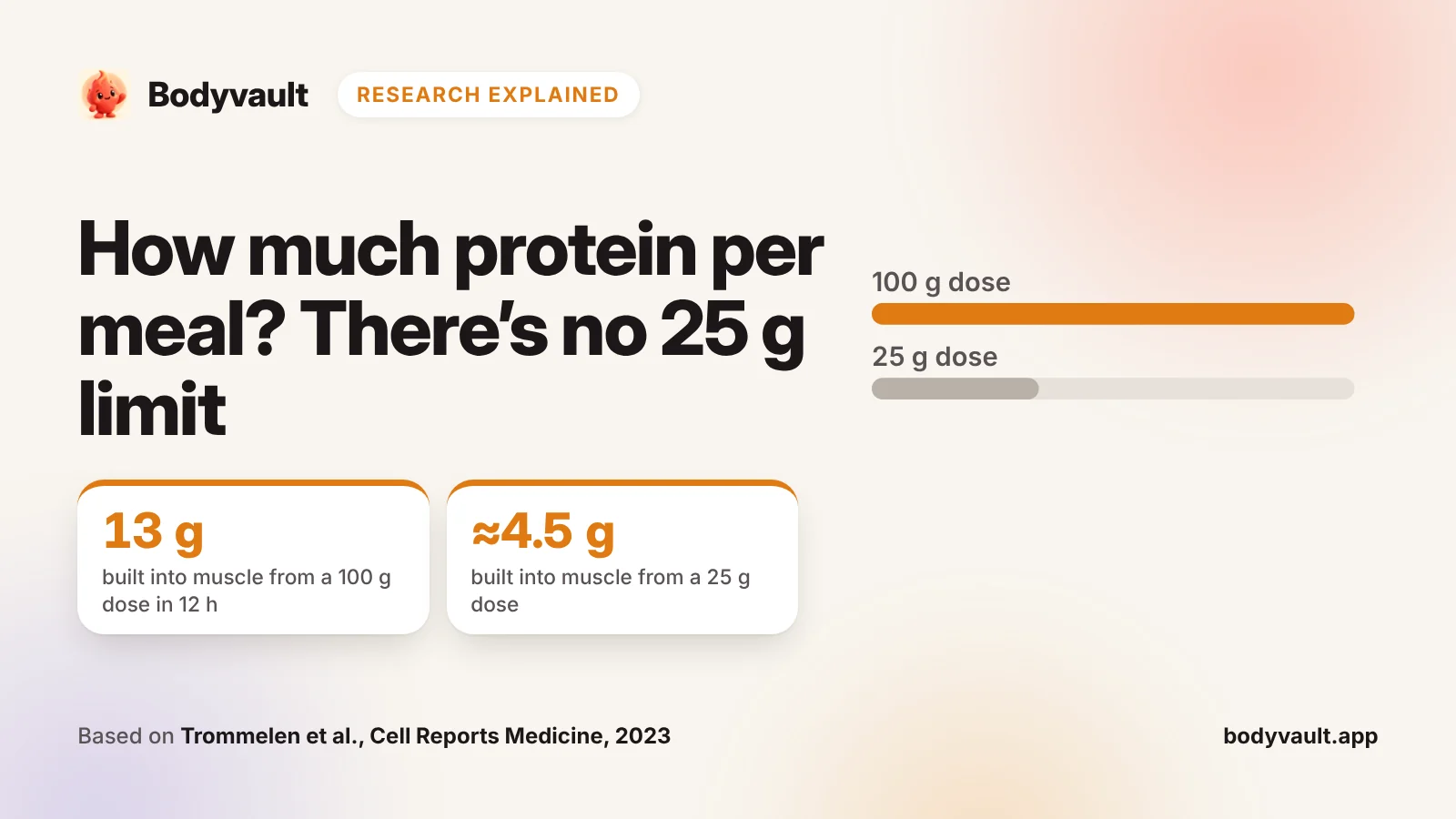
of the 100 g dose was built into muscle in 12 hours, against about 4.5 g of the 25 g dose
0.4g/kg
per meal, over at least four meals: a practical target for building muscle
1.6g/kg
a day: where average gains in lean mass levelled off, in a meta-analysis of 49 trials
Strength of evidenceModerate
The finding that a large dose keeps working comes from one carefully controlled 12-hour trial in 36 young men. Per-meal targets come from short laboratory studies; the importance of the daily total rests on dozens of longer training trials.
Key findingGet your daily total right first. Then spread it across three to five meals with a decent serving at each, about 0.4 g per kg of body weight. A bigger protein meal isn’t wasted: it is digested more slowly and keeps working for longer.
Where the 20–30 g idea came from
Early studies measured muscle protein synthesis, the rate at which muscle builds new protein, for a few hours after a single dose of fast-digesting protein, usually after exercising only the legs. In young men, synthesis rose up to about 20 g and barely more after that, while more of the extra protein was burned for energy. That became the popular idea that you can only “absorb” 20–30 g at a time. Studies that trained the whole body, measured for longer or used bigger doses told a different story.
- 2009
20 g looks like enough
After leg exercise, synthesis from egg protein was highest at 20 g, and the amount burned for energy rose at higher doses (Moore et al.).
- 2014
40 g adds little after one-leg exercise
Whey raised synthesis by 49% at 20 g and 56% at 40 g, compared with none (Witard et al.).
- 2016
Whole-body training changes the answer
After training the whole body, 40 g of whey gave higher synthesis than 20 g in 30 trained young men (Macnaughton et al.).
- 2018
A per-meal target
A review proposed about 0.4 g per kg of body weight per meal, over at least four meals (Schoenfeld and Aragon).
- 2023
No upper limit found
100 g kept building muscle for at least 12 hours, more than 25 g did (Trommelen et al.).
The 2023 trial that tested 100 g
The bigger dose was digested more slowly. After 25 g, most of the protein that would reach the blood had arrived within 4 hours and the curve flattened. After 100 g, protein was still arriving at 12 hours, when measurements stopped.
Protein from the drink reaching the blood
- 100 g dose
- 25 g dose
More of it also ended up in muscle. Protein from the 25 g drink was built into muscle mainly in the first 4 hours; after 100 g, the amount kept climbing in a straight line for the whole 12 hours.
Protein from the drink built into muscle
- 100 g dose
- 25 g dose
Absorbed isn’t the same as built into muscle
“Absorbed” and “used for muscle” are often mixed up. Of the protein that reached the blood, only part was built into muscle within 12 hours; some went into blood proteins, and the rest went to other tissues and uses that the study didn’t separate. The amount burned for energy rose only slightly with 100 g, and was small compared with the extra protein the body built.
| By 12 hours | 25 g dose | 100 g dose |
|---|---|---|
| Reached the blood | 66% | 53% |
| … built into muscle protein | 18% | 13% |
| … built into blood proteins | 6% | 4% |
| Not yet released into the blood | 34% | 47% |
The last row is our calculation (100% minus the share that reached the blood). It isn’t wasted protein: the larger dose was simply still being digested when the measurements stopped.
So how much per meal?
Body size and age matter. A pooled analysis of earlier studies found that muscle building levelled off at a smaller dose, per kg of body weight, in younger men than in older men.
Schoenfeld and Aragon took the young-adult figure of about 0.25 g/kg, added a margin of two standard deviations, and suggested 0.4 g/kg per meal over at least four meals, which adds up to at least 1.6 g/kg a day. At an upper daily intake of 2.2 g/kg, the same four meals come to about 0.55 g/kg each. In older men, 45 g of milk protein after exercise raised muscle building clearly more than none, while 30 g fell just short of a clear difference.
| Body weight | 0.24 g/kg | 0.4 g/kg | 0.55 g/kg | Daily total at 1.6 g/kg |
|---|---|---|---|---|
| 50 kg | 12 g | 20 g | 28 g | 80 g |
| 60 kg | 14 g | 24 g | 33 g | 96 g |
| 70 kg | 17 g | 28 g | 38 g | 112 g |
| 80 kg | 19 g | 32 g | 44 g | 128 g |
| 90 kg | 22 g | 36 g | 50 g | 144 g |
| 100 kg | 24 g | 40 g | 55 g | 160 g |
0.24 g/kg is where younger men’s response levelled off, 0.4 g/kg the practical target and 0.55 g/kg the upper end. For how much protein common Indian foods give, see protein in paneer or the Indian calorie counter.
Does spreading it out matter?
In a 12-hour lab study, the same 80 g of whey was given in three patterns after a weights session. Four doses of 20 g every 3 hours gave the most muscle building.
A week-long study found something similar with real meals: about 30 g of protein at each of three meals gave higher 24-hour muscle protein synthesis (0.075% per hour) than the same daily amount weighted towards dinner (0.056% per hour). These are short-term lab markers, though, and the 100 g trial shows a large meal keeps working for longer than these studies could see. An even spread is a sensible default, not a strict rule.
The daily total matters most
Over weeks and months, how much protein you eat in total matters more than how you split it. A meta-analysis of 49 trials with 1,863 people found that protein supplements added 0.30 kg of fat-free mass and 2.49 kg to one-rep max strength during resistance training. The extra benefit levelled off at a total intake of about 1.62 g per kg a day, but the uncertainty was wide (95% CI 1.03 to 2.20), so the authors suggested up to about 2.2 g/kg for people who want to maximise gains.
India’s 2024 dietary guidelines cite the same plateau of about 1.6 g/kg. The national recommended dietary allowance of 0.83 g/kg a day is what healthy adults need in general, not a muscle-building target.
Is there an anabolic window?
Not a narrow one. In a meta-analysis of protein timing, protein taken around workouts seemed to help muscle growth slightly (effect size 0.24), but once total daily protein was accounted for, the difference was no longer significant (0.14, P = 0.20). Total protein intake was the strongest predictor of growth. A review of nutrient timing suggests the meals before and after a typical 45–90-minute session needn’t be more than about 3–4 hours apart, or 5–6 hours if they are large mixed meals.
Claims and evidence
ClaimYour body can only absorb 20–30 g of protein at a time; the rest is wasted.
EvidenceAbsorption isn’t capped. After 100 g, protein kept entering the blood for the whole 12 hours (53 g against 16 g after 25 g), and more was built into muscle (13 g against about 4.5 g).
ClaimProtein above about 25 g is just burned for energy.
EvidenceBurning rises somewhat with bigger doses, but in the 100 g trial it was small compared with the extra protein built, and 40 g beat 20 g after whole-body training.
ClaimYou must eat protein within 30–60 minutes of a workout.
EvidenceOnce total daily protein was accounted for, timing made no significant difference to muscle growth.
ClaimEveryone needs the same grams of protein per meal.
EvidencePer-meal needs scale with body size and age: the plateau was about 0.24 g/kg in younger men and 0.40 g/kg in older men.
ClaimMore protein always builds more muscle.
EvidenceOn average, gains in lean mass from training levelled off around 1.6 g/kg a day (95% CI 1.03 to 2.20).
What this means for you
What this means for you
- Set your daily target first: about 1.6 g per kg of body weight if you’re trying to build muscle, and some people go up to 2.2.
- Split it over three to five meals, with at least 0.25–0.4 g/kg at each main meal: about 17–28 g if you weigh 70 kg.
- If you’re older, aim for the higher end per meal: older men needed about 0.4 g/kg for the same response.
- A big protein meal isn’t wasted. It is simply digested more slowly.
- Have a protein-rich meal within a few hours either side of training; there’s no need to rush.
- If you have kidney disease, are pregnant or have a medical condition, check your protein target with a doctor or dietitian.
What these studies can’t tell you
- Muscle over months. Most of these studies measured muscle protein synthesis over hours, a short-term marker, not muscle growth over months.
- Everyone. The 100 g trial included 36 healthy young men after one whole-body session; results may differ for women, older adults or less active people.
- Real meals. Most used milk, whey or egg protein in drinks; mixed meals and plant proteins digest differently.
How Bodyvault uses this research
Bodyvault sets your daily protein target in grams per kg of body weight: 2.0 if you’re losing fat, 1.8 if you’re building muscle or strength and 1.6 for general health or endurance, and you can set it anywhere from 0.8 to 3.0. In meal plans it points out main meals with less than about 0.25 g of protein per kg, and notes when protein is spread across three or more meals. If you log food regularly and are still well short of your target at 4 p.m., it can suggest a protein-rich snack. To work out your own numbers, use the protein calculator.
Share or cite this explainer
Bodyvault (2026). How much protein per meal? What the research actually says. https://bodyvault.app/blog/how-much-protein-per-meal
The charts on this page may be reused with a link back to it. The underlying data belong to the studies cited below.
Questions
How much protein can your body absorb at once?
There’s no fixed limit. In a 2023 trial, 100 g of protein kept being digested and built into muscle for at least 12 hours, more than 25 g did. Bigger meals are simply absorbed more slowly.
How much protein per meal to build muscle?
About 0.4 g per kg of body weight per meal, over at least four meals, is a practical target: about 28 g if you weigh 70 kg. Younger adults may get close to the full response with about 0.24 g/kg.
Is 50 g of protein in one meal too much?
No. Large protein meals aren’t wasted; they are digested more slowly and keep working for longer. Spreading protein over the day is still a sensible default.
Do I need protein right after a workout?
Not within a narrow window. Once total daily protein was accounted for, timing made no significant difference to muscle growth. A protein-rich meal within a few hours of training is enough.
How much protein do I need a day?
India’s RDA for healthy adults is 0.83 g per kg a day. For building muscle with training, gains levelled off around 1.6 g/kg on average. The protein calculator works out your number.
Sources
- Trommelen J et al. (2023). The anabolic response to protein ingestion during recovery from exercise has no upper limit in magnitude and duration in vivo in humans. Cell Rep Med 4(12):101324.
- Moore DR et al. (2015). Protein ingestion to stimulate myofibrillar protein synthesis requires greater relative protein intakes in healthy older versus younger men. J Gerontol A Biol Sci Med Sci 70(1):57–62.
- Schoenfeld BJ, Aragon AA (2018). How much protein can the body use in a single meal for muscle-building? Implications for daily protein distribution. J Int Soc Sports Nutr 15:10.
- Morton RW et al. (2018). A systematic review, meta-analysis and meta-regression of the effect of protein supplementation on resistance training-induced gains in muscle mass and strength in healthy adults. Br J Sports Med 52(6):376–384.
- Areta JL et al. (2013). Timing and distribution of protein ingestion during prolonged recovery from resistance exercise alters myofibrillar protein synthesis. J Physiol 591(9):2319–2331.
- Mamerow MM et al. (2014). Dietary protein distribution positively influences 24-h muscle protein synthesis in healthy adults. J Nutr 144(6):876–880.
- Moore DR et al. (2009). Ingested protein dose response of muscle and albumin protein synthesis after resistance exercise in young men. Am J Clin Nutr 89(1):161–168.
- Witard OC et al. (2014). Myofibrillar muscle protein synthesis rates subsequent to a meal in response to increasing doses of whey protein at rest and after resistance exercise. Am J Clin Nutr 99(1):86–95.
- Macnaughton LS et al. (2016). The response of muscle protein synthesis following whole-body resistance exercise is greater following 40 g than 20 g of ingested whey protein. Physiol Rep 4(15):e12893.
- Holwerda AM et al. (2019). Dose-dependent increases in whole-body net protein balance and dietary protein-derived amino acid incorporation into myofibrillar protein during recovery from resistance exercise in older men. J Nutr 149(2):221–230.
- Schoenfeld BJ, Aragon AA, Krieger JW (2013). The effect of protein timing on muscle strength and hypertrophy: a meta-analysis. J Int Soc Sports Nutr 10(1):53.
- Aragon AA, Schoenfeld BJ (2013). Nutrient timing revisited: is there a post-exercise anabolic window? J Int Soc Sports Nutr 10(1):5.
- ICMR-NIN (2020). A brief note on Nutrient Requirements for Indians: Recommended Dietary Allowances and Estimated Average Requirements.
- ICMR-NIN (2024). Dietary Guidelines for Indians, revised edition.
General information about fitness and nutrition, not medical advice. If you have a health condition, are pregnant or take medication, talk to your doctor before changing your diet or training.