
Research explained
Does creatine cause hair loss? What the research shows
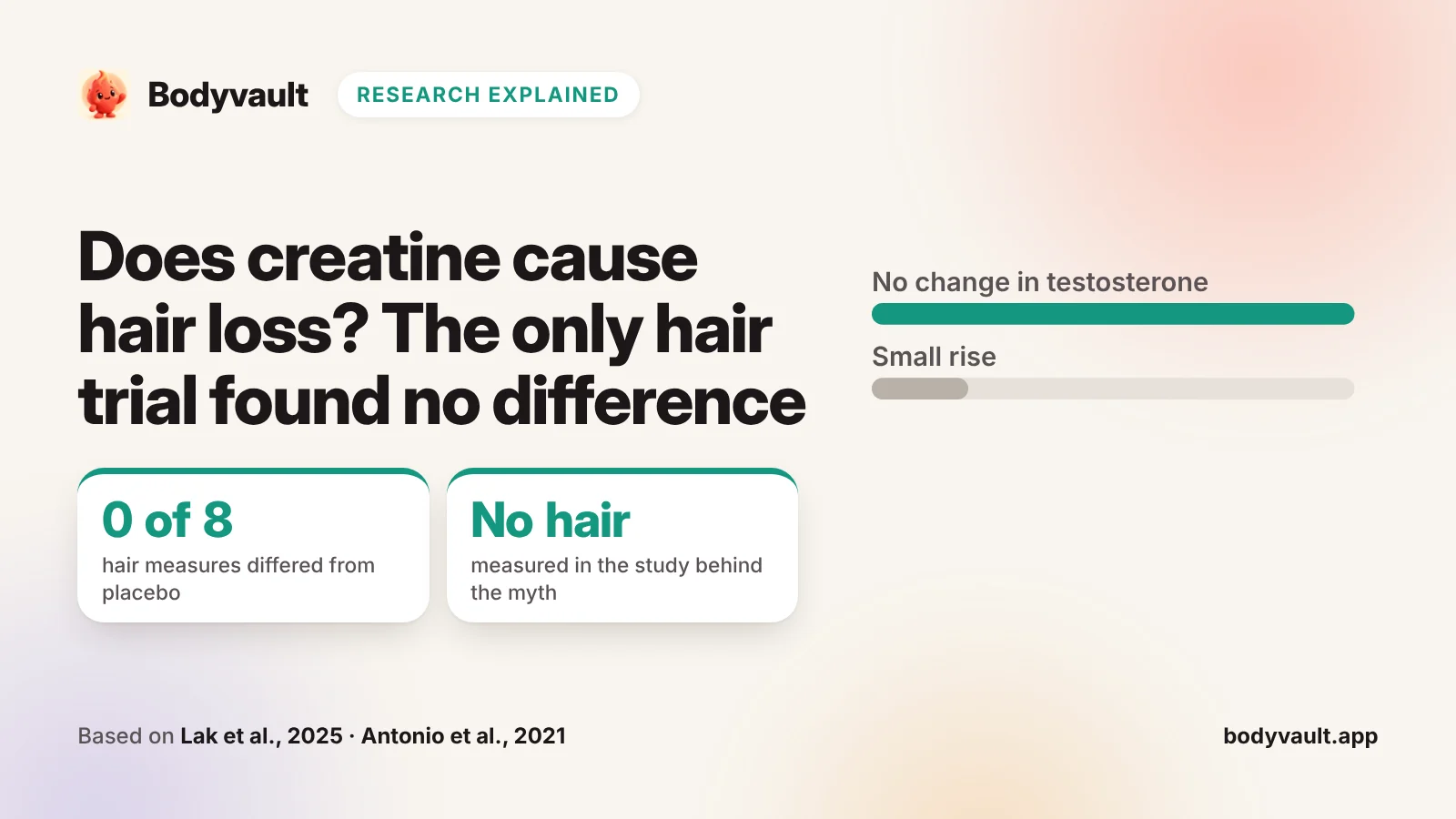
There’s no direct evidence that creatine causes hair loss. The worry traces to a 2009 study in 20 rugby players that measured a hormone, DHT, and never looked at hair. The only trial that measured hair found no difference from placebo after 12 weeks.
The short answer
0 of 8
hair measures that differed from placebo in the only trial that measured hair (5 g a day for 12 weeks)
+56%
rise in DHT after a week of high-dose loading in the 2009 study behind the myth, which didn’t measure hair
10 of 12
other studies found no change in testosterone; the other 2 found small rises
+0.13mg/dL
average rise in blood creatinine, a lab marker, with no significant change in kidney filtration
Strength of evidenceLimited but reassuring
One small 12-week randomised trial measured hair and found no effect. The study that started the worry measured a hormone, not hair, and hasn’t been repeated. Both were in men.
Key findingNo study has shown that creatine causes hair loss. A small 2009 study saw a rise in DHT, a hormone involved in male-pattern hair loss, but didn’t measure hair. The only trial that did found no difference from placebo in hair or hormones.
Where the worry comes from
DHT (dihydrotestosterone) is a potent hormone made from testosterone, and it’s involved in male-pattern hair loss in people who are genetically prone to it. So in 2009, when a small study reported that creatine raised DHT, the step to “creatine makes your hair fall out” was quick. The study itself never looked at hair.
DHT in the 2009 study, creatine vs placebo
- Creatine
- Placebo
A rise in a blood hormone over three weeks is not the same as losing hair, and this study had other limits: it was small and short, it used a high loading dose taken with glucose, DHT started lower in the creatine condition, and every value stayed within the normal range. The result has not been repeated.
The trial that measured hair
| Measure | Creatine vs placebo over 12 weeks (p-value) | Difference from placebo? |
|---|---|---|
| DHT | 0.70 | No |
| DHT-to-testosterone ratio | 0.44 | No |
| Total testosterone | 0.12 | No |
| Free testosterone | 0.87 | No |
| Hair count | 0.51 | No |
| Hair density | 0.51 | No |
| Growing and resting hairs (anagen and telogen) | 0.82 | No |
| Follicular units | 0.23 | No |
| Terminal and vellus hairs | 0.84 | No |
| Hair thickness | 0.94 | No |
| Creatinine | 0.91 | No |
| eGFR | 0.84 | No |
Hair counts drifted a little in both groups over the 12 weeks, but no change and no difference between the groups was statistically significant, so neither direction is a finding. The DHT-to-testosterone ratio fell in both groups because testosterone rose in both, which the authors suspect was seasonal.
Why the two studies disagree
| Study detail | van der Merwe et al. (2009) | Lak et al. (2025) |
|---|---|---|
| Design | Double-blind crossover with placebo | Double-blind randomised trial with placebo |
| People | 20 college rugby players in season (16 completed) | 39 resistance-trained men aged 18–40 (38 for blood, 37 for hair) |
| Dose | 25 g a day with glucose for 7 days, then 5 g a day with glucose for 14 days | 5 g a day for 12 weeks, no loading |
| Length | 3 weeks | 12 weeks |
| Hair measured | No | Yes, at the crown |
| Hormone result | DHT +56% then +40%, within the normal range; testosterone unchanged | No difference from placebo in DHT or testosterone |
| Kidney markers | Not reported | Creatinine and eGFR unchanged |
The 2025 trial didn’t use a loading phase, so it doesn’t directly re-test the 2009 scenario of 25 g a day with glucose. For transparency, its authors include the chief executive of the International Society of Sports Nutrition and advisers to creatine brands; an independent repeat would add confidence.
What the wider evidence says
A 2021 review by the International Society of Sports Nutrition looked at the other studies of creatine and testosterone, at doses of 3–25 g a day for 6 days to 12 weeks. Ten of 12 found no change; two found small increases the authors judged physiologically insignificant, and the five that measured free testosterone found no rise. Its conclusion: most evidence doesn’t support a link between creatine and hair loss. We found no systematic review on creatine and hair published from 2023 to 2025.
What creatine does do
Creatine is one of the best-studied supplements. It is in Group A of the Australian Institute of Sport’s framework, meaning strong evidence for specific uses in sport. Across 60 placebo-controlled trials it improved lower-body strength by a small amount, and the effect didn’t depend on who was studied, the training, the dose or how long people took it. In older adults who did resistance training, creatine added about 1.4 kg more lean mass than placebo (1.37 kg, 95% CI 0.97 to 1.76), part of which may be water.
Creatine vs placebo: lower-body strength, effect sizes
- Squat0.34 (0.05 to 0.63)
- Leg press0.30 (0.10 to 0.50)
- Quadriceps overall0.27 (0.15 to 0.38)
- All lower-body tests0.24 (0.13 to 0.35)
The gains depend on training: creatine helps you do a little more work, and the training builds the muscle. See how hard to train each set, how much protein to eat per meal, and track progress with the one-rep max calculator.
Creatine and kidney blood tests
Creatine breaks down into creatinine, the waste product most blood tests use to estimate kidney function (eGFR). So taking creatine can nudge creatinine up and the calculated eGFR down, even when the kidneys are working as before.
| Marker | What creatine did | Source |
|---|---|---|
| Creatinine | +0.13 mg/dL on average (95% CI 0.07 to 0.18), 19 studies | Tsiaras et al., 2026 |
| eGFR (calculated) | −5.2 mL/min/1.73 m² (95% CI −15.0 to 4.6), 8 studies: not significant | Tsiaras et al., 2026 |
| Urea | −0.60 mg/dL (95% CI −2.15 to 0.96), 12 studies: not significant | Tsiaras et al., 2026 |
| Cystatin C | Fell in both groups with training: 0.82 to 0.71 mg/L on creatine, 0.88 to 0.75 on placebo | Gualano et al., 2008 |
A second meta-analysis found the creatinine rise was clearest in the first week of taking creatine. Cystatin C is a kidney marker that isn’t made from creatine, and international kidney guidelines (KDIGO 2024) list creatine supplements as a non-kidney influence on creatinine. When a creatinine-only eGFR is less accurate and the result matters, they recommend an eGFR that uses both creatinine and cystatin C.
That doesn’t mean creatine is harmless for everyone’s kidneys. The trials were mostly short and in healthy people, and long-term trials of more than a year are lacking. Rare case reports exist: a 17-year-old developed acute kidney injury after a 6-day high-dose load, with cystatin C rising alongside creatinine, which is why doctors look at both markers. Kidney guidelines also note case reports of kidney inflammation linked to creatine used for body building. If you have kidney disease or are pregnant, talk to your doctor before taking creatine.
Claims and evidence
ClaimCreatine makes your hair fall out.
EvidenceThe only trial that measured hair found no difference from placebo after 12 weeks of 5 g a day, in hair count, density, growth phase, follicles or thickness. The claim traces to a 2009 hormone study that never measured hair.
ClaimCreatine raises DHT.
EvidenceOne 3-week study with a high-dose loading phase saw DHT rise 56% and stay 40% above the start, within the normal range. The 12-week trial found no change in DHT, and 10 of 12 other studies found no change in testosterone.
ClaimCreatine damages healthy kidneys.
EvidencePooled trials found no significant change in eGFR or urea, and cystatin C didn’t worsen in a 3-month trial of about 10 g a day. Long-term data are scarce, and rare case reports of kidney injury exist.
ClaimA higher creatinine on your blood test means your kidneys are failing.
EvidenceCreatine raises creatinine by about 0.13 mg/dL on average without a significant change in measured eGFR in pooled trials. Kidney guidelines list creatine as a non-kidney influence on creatinine; ask your doctor rather than guessing either way.
ClaimYou have to load creatine for it to work.
Evidence3 g a day for 28 days raised muscle creatine about as much as 20 g a day for 6 days; loading only gets there faster. In 2009, the DHT rise followed a loading phase.
ClaimCreatine is a steroid.
EvidenceIt is made from amino acids in the liver and kidneys and found in meat, and expert reviews conclude it isn’t an anabolic steroid. Contamination is a separate risk: in one international survey, 94 of 634 supplements contained steroids not on the label.
What this means for you
What this means for you
- On current evidence, hair loss isn’t a known effect of creatine: the only trial that measured hair found no difference over 12 weeks.
- Most research uses 3–5 g a day. A loading phase is optional, and the 2009 DHT rise followed one.
- Before a blood test, tell your doctor you take creatine; it can raise creatinine and lower the calculated eGFR. A cystatin C test can help if the result is borderline.
- If you have kidney disease or are pregnant, talk to your doctor before taking it.
- Choose a product that’s third-party tested, because some supplements have been found to contain undeclared steroids.
- If you notice hair loss, see a doctor: family history plays a large part (men whose fathers lost their hair were about twice as likely to), and other causes are worth checking.
What these studies can’t tell you
- Long-term or high-dose effects on hair. The hair trial lasted 12 weeks, which is short compared with the hair growth cycle, and it didn’t test a loading phase.
- Women. Both studies were in men; there are no hair data in women.
- Small effects. No significant difference in 37 men isn’t proof of zero effect, and the paper reports p-values rather than ranges for the hair results.
- Kidneys over years, or with kidney disease. Most trials were short and in healthy people.
How Bodyvault uses this research
Bodyvault’s creatine card rates it as Australian Institute of Sport Group A with strong support from the International Society of Sports Nutrition, at 3–5 g a day with loading optional. Its cautions cover what the evidence supports: creatine can raise blood creatinine and lower the calculated eGFR without kidney harm, with a suggestion to ask about a cystatin C test; expect 1–2 kg of water weight in the first weeks; and talk to your doctor first if you have kidney disease. If you log creatine and add a blood test with creatinine, eGFR or cystatin C, those results carry a note explaining the effect and suggesting you tell your doctor. Hair loss isn’t listed as a caution, which matches the evidence above.
Share or cite this explainer
Bodyvault (2026). Does creatine cause hair loss? What the research shows. https://bodyvault.app/blog/does-creatine-cause-hair-loss
The charts on this page may be reused with a link back to it. The underlying data belong to the studies cited below.
Questions
Does creatine cause hair loss?
There’s no direct evidence that it does. The only randomised trial that measured hair found no difference from placebo after 12 weeks of 5 g a day. The worry comes from a 2009 study that measured DHT, not hair.
Does creatine increase DHT?
One small 2009 study found DHT rose 56% after a week of high-dose loading and stayed 40% above the start, within the normal range. A 2025 trial of 5 g a day for 12 weeks found no change.
Does creatine affect your kidneys?
In healthy people, pooled trials found no significant change in kidney filtration (eGFR) or urea. Creatine does raise blood creatinine slightly, which can make a calculated eGFR look lower. If you have kidney disease, talk to your doctor first.
Should I stop creatine before a blood test?
Ask your doctor, and at least tell them you take it: it raises creatinine by about 0.13 mg/dL on average. Cystatin C isn’t made from creatine, so a cystatin C test can help if your eGFR looks low.
How much creatine should I take?
Most research uses 3–5 g a day, and a loading phase is optional. The 12-week hair trial used 5 g a day without loading.
Sources
- van der Merwe J, Brooks NE, Myburgh KH (2009). Three weeks of creatine monohydrate supplementation affects dihydrotestosterone to testosterone ratio in college-aged rugby players. Clin J Sport Med 19(5):399–404.
- Lak M et al. (2025). Does creatine cause hair loss? A 12-week randomized controlled trial. J Int Soc Sports Nutr 22(sup1):2495229.
- Antonio J et al. (2021). Common questions and misconceptions about creatine supplementation: what does the scientific evidence really show? J Int Soc Sports Nutr 18(1):13.
- Kreider RB et al. (2017). International Society of Sports Nutrition position stand: safety and efficacy of creatine supplementation in exercise, sport, and medicine. J Int Soc Sports Nutr 14:18.
- Tsiaras A et al. (2026). The effect of creatine supplementation on kidney function: a systematic review and meta-analysis of randomized controlled trials. J Ren Nutr.
- Naeini EK et al. (2025). Effect of creatine supplementation on kidney function: a systematic review and meta-analysis. BMC Nephrol 26(1):622.
- Gualano B et al. (2008). Effects of creatine supplementation on renal function: a randomized, double-blind, placebo-controlled clinical trial. Eur J Appl Physiol 103(1):33–40.
- KDIGO CKD Work Group (2024). KDIGO 2024 clinical practice guideline for the evaluation and management of chronic kidney disease. Kidney Int 105(4S):S117–S314.
- Inker LA et al. (2021). New creatinine- and cystatin C-based equations to estimate GFR without race. N Engl J Med 385(19):1737–1749.
- Filler G et al. (2025). Acute kidney injury with cast nephropathy following creatine loading in a 17-year-old. Pediatr Nephrol 40(10):3089–3092.
- Lanhers C et al. (2015). Creatine supplementation and lower limb strength performance: a systematic review and meta-analyses. Sports Med 45(9):1285–1294.
- Chilibeck PD et al. (2017). Effect of creatine supplementation during resistance training on lean tissue mass and muscular strength in older adults: a meta-analysis. Open Access J Sports Med 8:213–226.
- Geyer H et al. (2004). Analysis of non-hormonal nutritional supplements for anabolic-androgenic steroids: results of an international study. Int J Sports Med 25(2):124–129.
- Australian Institute of Sport. AIS Sports Supplement Framework: Group A supplements.
General information about fitness and nutrition, not medical advice. If you have a health condition, are pregnant or take medication, talk to your doctor before changing your diet or training.