
Research explained
Are fitness tracker calories accurate? What validation studies show
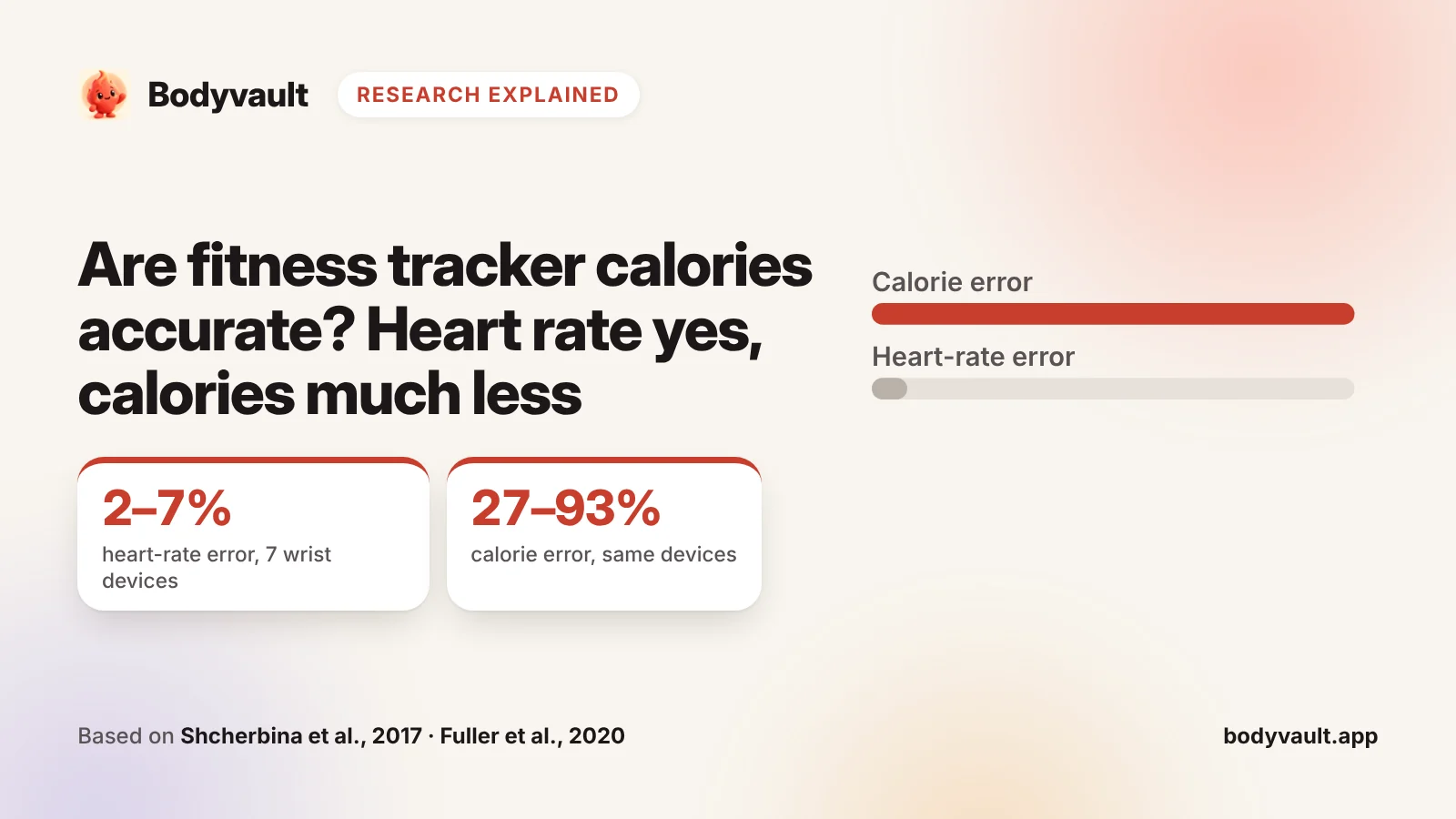
Fitness trackers are good at heart rate and much less good at calories. In a lab study of seven wrist devices, heart-rate error was 2–7%, but calorie error ranged from 27% to 93%. Across 158 studies, only 9% of lab calorie comparisons landed within 3% of the measured value.
The short answer
2–7%
heart-rate error across 7 wrist devices in a lab study
27–93%
calorie error for the same 7 devices
9.2%
of lab calorie comparisons within 3% of the measured value, across 158 studies
−123kcal
average gap for one watch over about an hour of rest, walking and cycling
Strength of evidenceConsistent
Dozens of lab studies and several systematic reviews agree that calorie estimates are much less accurate than heart rate. Most tested devices from 2015–2019, so newer models may do better, but they are less studied.
Key findingYour watch measures heart rate well, but its calorie number is an estimate that can be off by a quarter or more. Use it to compare your own days, not as a precise budget for what to eat.
Why calories are harder than heart rate
A watch measures your pulse directly, with light sensors on the skin, and counts movement with an accelerometer. Calories aren’t measured at all: a model estimates them from your heart rate and movement together with your age, sex, height and weight. In the lab, researchers measure the real figure from the oxygen you use and the carbon dioxide you breathe out, a method called indirect calorimetry. That’s the yardstick every study below compares watches with.
The same devices, two very different scores
Across 158 studies
A systematic review of 158 publications, covering 45 devices from 9 brands, counted how often each kind of measurement came within 3% of the lab value. Heart rate did so more than half the time, calories less than one time in ten.
The errors don’t all point the same way. In the lab, 54.1% of calorie comparisons underestimated and 36.7% overestimated, and the usual direction depended on the brand. No brand was within ±3% more than 13% of the time.
| Brand | Most common direction of calorie error in lab tests |
|---|---|
| Apple | Overestimated in 58% of comparisons (18 of 31) |
| Polar | Overestimated in 69% (9 of 13) |
| Garmin | Underestimated in 69% (37 of 51) |
| Withings | Underestimated in 74% (34 of 46) |
| Fitbit | Underestimated in 48.4% and overestimated in 39.5% (of 157) |
A second review, of 57 accuracy studies, found calorie errors above 30% for every brand; reported Apple Watch errors ranged from 15% to 211% across studies. A meta-analysis of 60 studies added that combining heart rate with movement reduced the error for most activities, but differences between studies were large.
What that means in a single workout
In the same study, heart-rate error was only 1–9%, while calorie error was 9–43%.
Heart rate is the strong suit
A living review of Apple Watch studies, updated as new research appears, pooled 22 heart-rate studies with 1,247 people. On average the watch was within a fraction of a beat of reference devices, though single readings could differ by about 7 bpm either way.
Apple Watch heart rate compared with reference devices
- All readings−0.27 (−7.2 to 6.6)
- During exercise−0.63 (−6.9 to 5.6)
- At rest0.21 (−8.1 to 8.6)
Skin tone has been a concern for optical sensors. In a study of 53 people across all six Fitzpatrick skin types, heart-rate accuracy didn’t differ significantly by skin tone, but error was about 30% higher during activity than at rest. The Apple Watch 4 averaged 4.4 bpm error at rest and 4.6 bpm during activity; consumer devices overall averaged 7.2 and 10.2 bpm. An earlier study reported higher error with darker skin, so the evidence is mixed.
When there’s no watch data: estimating from heart rate
Apps that estimate calories from heart rate often use the Keytel equation. It was developed in 115 adults aged 18–45 during steady treadmill and cycling exercise at about 57–90% of maximum heart rate. Using sex, heart rate, weight and age, it explained 73.4% of the variation in energy use (83.3% when a fitness test was added). That’s good for groups doing steady exercise, but it wasn’t designed for rest, strength training or intervals.
Claims and evidence
ClaimIf my watch gets heart rate right, its calories are right too.
EvidenceIn the same devices, heart-rate error was 2.0–6.8% but calorie error was 27.4–92.6%.
ClaimWatch calories are precise enough to eat back.
EvidenceCalorie errors of 9–43% were seen over an hour of exercise, and only 9.2% of lab comparisons were within 3%.
ClaimWearables always overestimate calories.
EvidenceIn lab studies 54.1% of comparisons underestimated and 36.7% overestimated; the direction depended on the brand.
ClaimA premium watch solves the calorie problem.
EvidenceNo device was judged accurate for calories, and reported Apple Watch errors ranged from 15% to 211% across studies.
ClaimOptical heart rate doesn’t work on darker skin.
EvidenceOne study across all six skin types found no significant difference, while movement raised error by about 30%; an earlier study found higher error with darker skin, so the evidence is mixed.
What this means for you
What this means for you
- Trust your watch’s heart rate more than its calories: heart-rate zones and recovery trends rest on firmer ground.
- Use calories to compare your own days and weeks on the same device, not as an exact number.
- Don’t eat back exercise calories one for one. If you track food, judge your intake by how your weight changes over several weeks.
- Expect bigger errors for strength training, intervals and everyday activity, which are the least studied.
- Switching brands can shift your numbers, because their errors run in different directions.
What these studies can’t tell you
- Today’s watches. Most validation studies tested 2015–2019 devices; current calorie algorithms are largely untested.
- Every activity. Protocols were mostly walking, running and cycling. Strength training, intervals and daily life are less studied.
- A simple correction. Errors differ by brand and activity, so there’s no reliable factor to adjust your watch’s number by.
How Bodyvault uses this research
Bodyvault shows where every workout’s calorie number comes from. It uses the active energy saved to Apple Health first. If there is none, it estimates from your average heart rate with the Keytel equation, when that average is at least 90 bpm, and otherwise from the exercise’s MET value, your weight and the time you actually spent on sets, never the whole time the workout was open. A note under the number names the method. Your daily calorie target doesn’t add workout calories back: it comes from a standard formula for your body and activity level, and with Pro it adapts to your logged food and weight trend over the weeks. To work out a starting target, use the calorie deficit calculator. For the heart-rate side, see Apple Watch HRV, and for how Bodyvault compares with a strap, the WHOOP alternative page.
Share or cite this explainer
Bodyvault (2026). Are fitness tracker calories accurate? What validation studies show. https://bodyvault.app/blog/are-fitness-tracker-calories-accurate
The charts on this page may be reused with a link back to it. The underlying data belong to the studies cited below.
Questions
Are Apple Watch calories accurate?
Its heart rate is accurate, typically within a few beats per minute, but its calorie estimates are much less precise. Studies reported Apple Watch calorie errors from 15% to over 200%, depending on the activity and the study.
Which fitness tracker is most accurate for calories?
None was judged accurate. In a lab test of seven devices the best had a median calorie error of 27%, and across 158 studies no brand was within 3% more than 13% of the time.
Do fitness trackers overestimate calories?
Not always. In lab studies they underestimated more often (54% of comparisons) than they overestimated (37%), and the direction varied by brand.
Should I eat back the calories my watch says I burned?
Not one for one: the estimate can easily be off by a quarter or more. Set your intake from your weight trend over a few weeks instead, starting with the calorie deficit calculator.
Is my watch’s heart rate accurate?
Mostly, yes. In pooled studies, Apple Watch heart rate was on average within a fraction of a beat of reference devices, though single readings varied by about 7 bpm either way, more during irregular movement.
Sources
- Shcherbina A et al. (2017). Accuracy in wrist-worn, sensor-based measurements of heart rate and energy expenditure in a diverse cohort. J Pers Med 7(2):3.
- Fuller D et al. (2020). Reliability and validity of commercially available wearable devices for measuring steps, energy expenditure, and heart rate: systematic review. JMIR Mhealth Uhealth 8(9):e18694.
- Germini F et al. (2022). Accuracy and acceptability of wrist-wearable activity-tracking devices: systematic review of the literature. J Med Internet Res 24(1):e30791.
- Wallen MP et al. (2016). Accuracy of heart rate watches: implications for weight management. PLoS One 11(5):e0154420.
- Lambe R et al. (2026). The accuracy of Apple Watch measurements: a living systematic review and meta-analysis. npj Digit Med 9(1):63.
- Bent B et al. (2020). Investigating sources of inaccuracy in wearable optical heart rate sensors. npj Digit Med 3:18.
- Keytel LR et al. (2005). Prediction of energy expenditure from heart rate monitoring during submaximal exercise. J Sports Sci 23(3):289–297.
- O’Driscoll R et al. (2020). How well do activity monitors estimate energy expenditure? A systematic review and meta-analysis of the validity of current technologies. Br J Sports Med 54(6):332–340.
General information about fitness and nutrition, not medical advice. If you have a health condition, are pregnant or take medication, talk to your doctor before changing your diet or training.