
Compare
Bodyvault as a WHOOP alternative for Apple Watch
WHOOP is a strap you wear all day with a membership that scores your recovery. If you already wear an Apple Watch, Bodyvault gives you a Readiness score from the same kinds of signals, without a second device, and adds food and training to it.

Checked on 2 October 2026 from WHOOP’s own pages. Features and prices change, so check whoop.com before you decide.
The short answer
- Choose WHOOP if you want a screenless sensor you wear around the clock, with a battery that lasts days.
- Choose Bodyvault if you already wear an Apple Watch to sleep and want a recovery score plus food logging, meal plans and workout logging in one app, with your data kept on your phone.
Side by side
| WHOOP | Bodyvault | |
|---|---|---|
| What you wear | The WHOOP sensor and band, with the charger included in your particular membership | The Apple Watch you already have (or another watch, ring or band that shares data through Apple Health or Health Connect) |
| How you pay | A membership (plans and prices vary by country) | Free to download; Pro is a monthly subscription or a one-time lifetime purchase |
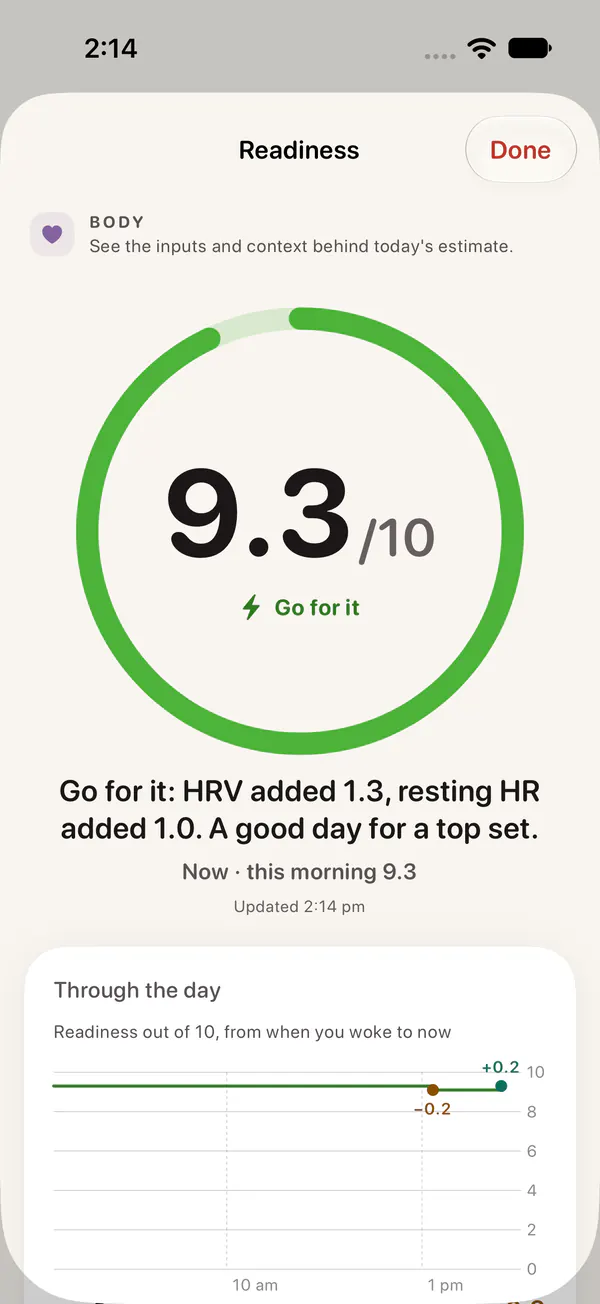
| Morning score | Recovery, 0 to 100%, in green, yellow and red | Readiness, 0 to 10, in four states from Recover to Go for it |
| Based on | HRV, resting heart rate, breathing rate and sleep | HRV, resting heart rate, sleep, wrist temperature, breathing rate, training load, check-ins and heart-rate recovery |
| Through the day | Strain builds as you go | Load builds as you go, and Readiness itself moves with training, naps, food, stress and how you feel |
| Why the number | The contributors to your score | A ledger: each part with how much it added or took, adding up to the score |
| Food | Macros auto-logged into the WHOOP Journal from nutrition apps such as Cronometer, through Apple Health | Calorie and macro tracking using national food tables, regional recipes, photo logging, barcode search and meal plans |
| Phones | iPhone and Android | iPhone and Android, with an Apple Watch app |
| Your data | A WHOOP account, with data in WHOOP’s service | No account; data in an encrypted database on your phone |
Where WHOOP is the better choice
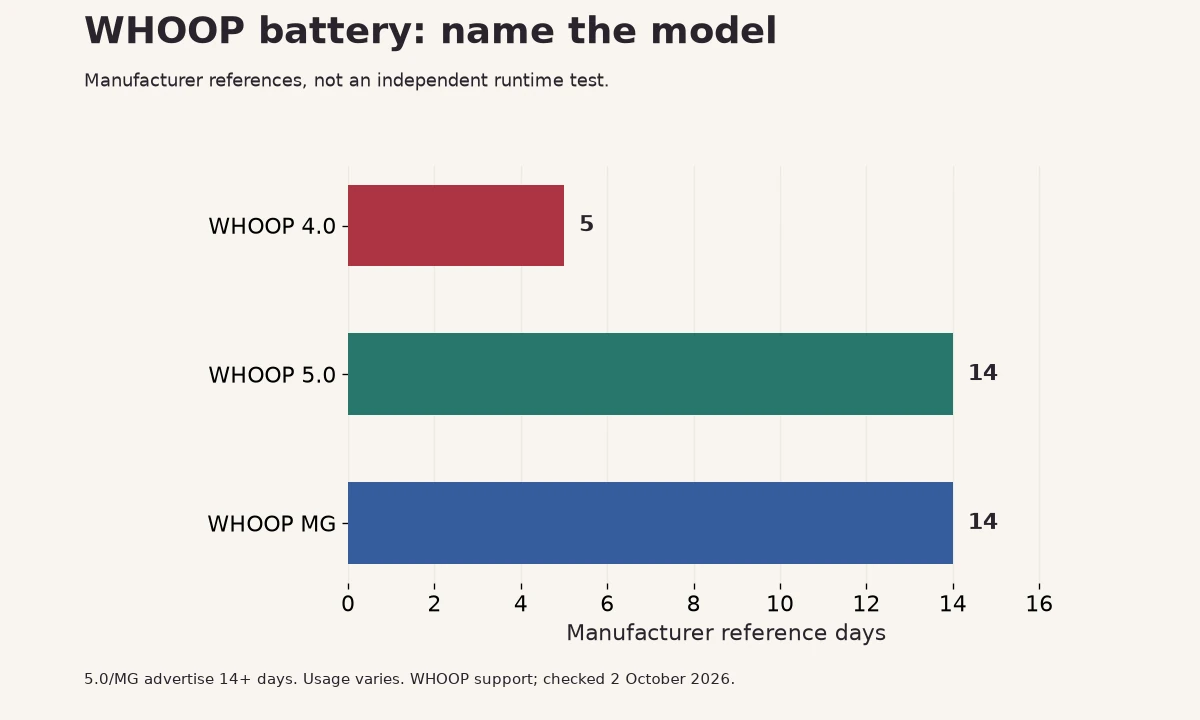
- Wear it all the time. WHOOP 5.0 and MG advertise 14+ days of battery life; the older 4.0 is rated around five days. Charger type depends on your plan. With Apple Watch, build a charging routine that preserves the sleep recordings you need; runtime varies by model and settings.
- A longer track record. WHOOP has years of members and research behind its scores. Bodyvault is newer, and its scores are still being refined.
Where Bodyvault is the better choice
- No second device. If you already wear an Apple Watch to sleep, the data for a recovery score is already in Apple Health.
- Recovery, food and training together. Your Readiness changes your training advice, your training changes your food targets, and your food feeds back into your day’s Readiness.
- Food alongside training. Food entries from national tables and regional recipes, weighed portions and meal planning. Check the database entries that match what you actually eat.
- Private by default. No account, and your data stays on your phone. On supported iPhones, Ask Coach runs on Apple Intelligence.
| Device | Manufacturer battery reference | What to check |
|---|---|---|
| WHOOP 4.0 | Around 5 days | Older model and compatible battery pack |
| WHOOP 5.0 | 14+ days | Exact device and charger in your offer |
| WHOOP MG | 14+ days | Plan, regional health-feature eligibility and charger |
Other Apple Watch recovery apps
Bodyvault isn’t the only app that turns Apple Watch data into a recovery score. Athlytic and Bevel do too, and both are worth a look. Bodyvault’s difference is that the score sits inside a full coach for food and training, and that every score shows its working.
Switching from WHOOP
Bodyvault learns your own baselines, so it needs about a week of nights before your first Readiness score and about four weeks for full confidence. Wear your Apple Watch to sleep, charge it in the morning or evening, and keep Apple Health permissions on for heart rate, HRV and sleep.
Review the same signals, not just the total
Compare recording time, metric and your own baseline before comparing apps. Read the Apple Watch HRV guide and the Bevel vs Athlytic comparison. A wearable cannot rule out illness or clear an injury.
Questions
Is Bodyvault a WHOOP alternative without a subscription?
Bodyvault is free to download, with no device to buy. Readiness is part of Bodyvault Pro, which you can take as a monthly subscription or as a one-time lifetime purchase, so a subscription is optional. You need an iPhone or an Android phone, and an Apple Watch or another device that shares HRV and sleep through Apple Health or Health Connect.
Is an Apple Watch as accurate as WHOOP?
Both use optical heart-rate sensors on the wrist and are less precise than a chest strap or ECG, especially during movement. For a morning recovery score, what matters most is measuring the same way every night and comparing you with your own baseline, which is what Bodyvault does.
Can I see my WHOOP data in Bodyvault?
If WHOOP writes your data to Apple Health on iPhone or Health Connect on Android, Bodyvault can read it from there. Check which data types WHOOP shares in the Health app or in Health Connect.