
Research explained
Sleep and muscle growth: what poor sleep costs athletes
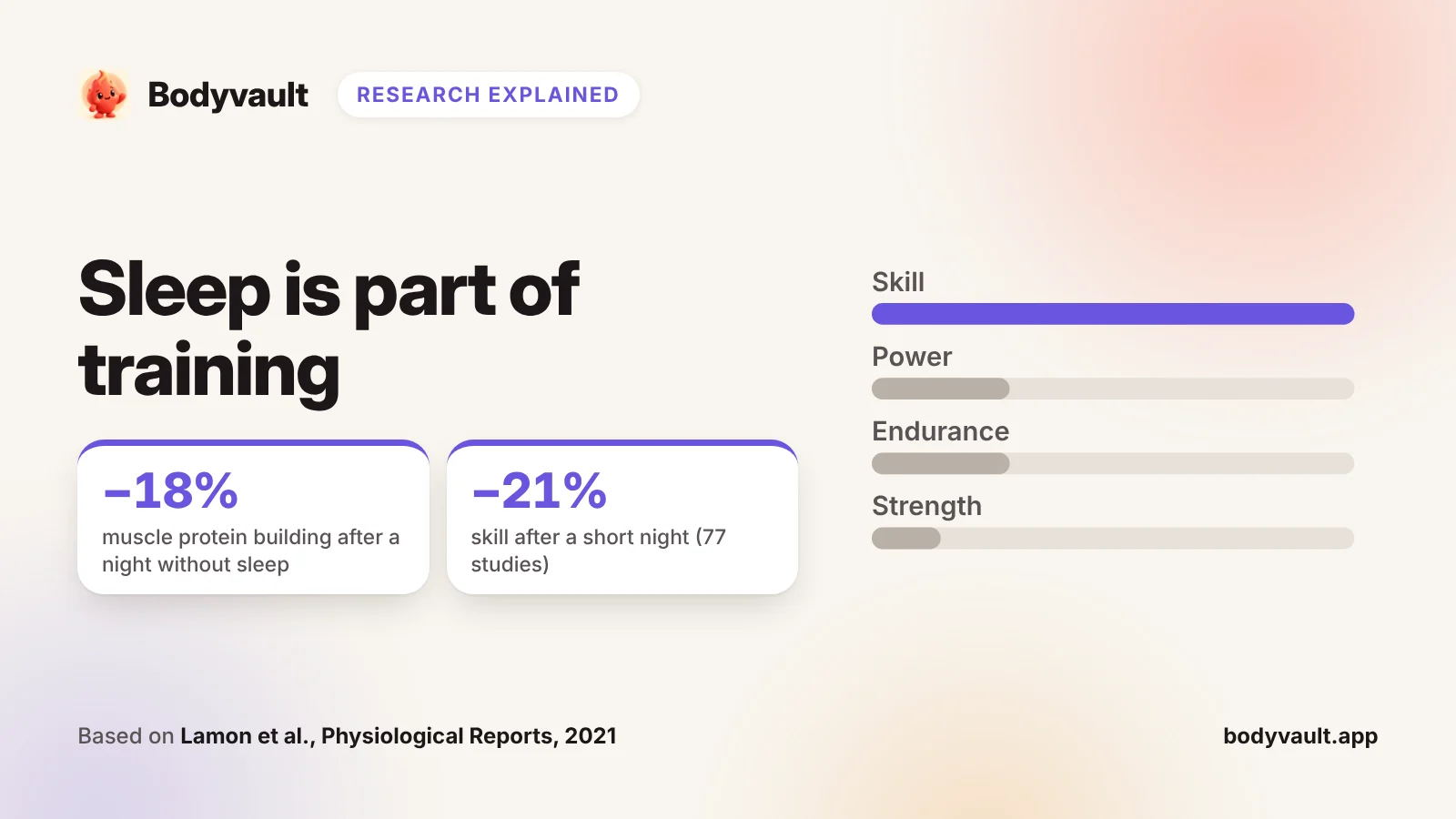
Sleep and muscle growth are linked: in a lab, one night without sleep cut how fast young adults built muscle protein by 18%. Short nights also lower next-day performance, and they go with more injuries and colds.
The short answer
−18%
Less new muscle protein built after one night without sleep, in 13 young adults
−7.6%
Average drop in performance after a night of 6 hours or less (77 studies)
1.7×
Teen athletes who slept under 8 hours were 1.7 times as likely to have had an injury
+111min
Extra sleep a night when college basketball players aimed for 10 hours in bed
Strength of evidenceModerate
Short sleep clearly lowers next-day performance. The link with muscle growth comes from small lab studies that lasted one night or two weeks, not from long training trials.
Key findingTreat sleep as part of your training. One bad night won’t undo your progress. But short sleep lowers how well you perform the next day, and regular short nights go with more injuries and colds.
How sleep and muscle growth are connected
Lifting weights doesn’t build muscle on the spot. It sends a signal. Over the next hours and days, your body builds new muscle protein to repair and grow the muscle. Eating protein helps too.
Muscle grows when building beats breakdown over time. Hormones play a part. Testosterone helps build muscle. Cortisol, a stress hormone, helps break it down. Sleep affects both.
Sleep also shapes how well you train. In 2021, a panel of sports-sleep experts reviewed the research. They found that top athletes often sleep less than 7 hours a night, and often sleep poorly. Training times, travel, games, stress and worry all get in the way.
Does sleep affect muscle growth?
One of the clearest tests comes from a lab in Australia. Thirteen healthy young adults each tried two kinds of night. On one, they slept as usual at home. On the other, they stayed awake all night in the lab. The order was picked by chance.
The next day, everyone ate the same meals, and no one lifted weights. The researchers took tiny muscle samples to see how fast the thigh built new protein. After the night without sleep, it was 18% slower. Cortisol was higher and testosterone was lower.
This was one extreme night, so it can’t tell you what months of short sleep do to your gains. But it fits with a second kind of study.
Short sleep while dieting
In a US trial, 10 overweight adults followed the same low-calorie diet in a lab for two weeks, twice. Once they had 8.5 hours in bed each night. Once they had 5.5 hours. The order was picked by chance.
They lost about 3 kg both times. But with short sleep, less of that weight was fat and more was fat-free mass. Fat-free mass is everything that isn’t fat, such as muscle, water and organs.
No one in this study lifted weights, and it lasted only two weeks. Still, if you want to lose fat and keep muscle, sleep looks like part of the plan, along with protein and strength training. See how much protein per meal.
Sleep and athletic performance
A 2022 review pooled 77 studies with 959 healthy adults, most of them men. People did the same exercise tests after a normal night and after 6 hours of sleep or less. After the short night, they did about 7.6% worse on average.
Skill tasks suffered most, and maximum strength least. An older review found much the same. Some all-out efforts held up after sleep loss. But sport skills, reaction time and decisions often got worse. That review also warned that poor sleep may unbalance the nervous system in ways that look like overtraining, and may weaken the immune system.
The 2022 review found two more useful things:
- Time of day. Afternoon and evening sessions suffered more than morning ones. After a short night, performance fell about 0.4% for every hour you had been awake.
- How you lose sleep. No sleep at all, or waking up much earlier than usual, hurt most. Going to bed later than usual mostly didn’t, except for skill and endurance tasks.
Can more sleep make you a better athlete?
At Stanford University, 11 men on the basketball team first kept their usual sleep for 2–4 weeks. Then, for 5–7 weeks, they aimed for at least 10 hours in bed each night. A wrist sensor showed they slept about 111 minutes more a night, close to 2 extra hours. Before, they had slept under 7 hours a night on average.
By the end, they shot better and ran faster. Their sprint of about 86 metres dropped from 16.2 to 15.5 seconds. They also felt less sleepy and reacted faster.
This was a small study with no comparison group, so other things may have helped, such as more practice. But a 2023 review of 25 studies in athletes came to a similar view. Sleeping longer at night and taking naps were the most helpful sleep changes.
In those studies, athletes who usually slept about 7 hours added 46–113 minutes a night. To do that, they needed 9–10 hours in bed. Naps of 20–90 minutes also helped. After a short night, a 20-minute nap worked as well as a 90-minute one. More on naps in how long a nap should be.
Sleep, injuries and colds
Two studies looked at what short sleep goes with outside the gym. Both show links. They can’t prove that short sleep was the cause.
At one US school, 112 athletes aged 12 to 18 filled in a survey about their training and sleep. Researchers matched their answers with the school’s injury records. Those who slept under 8 hours a night were 1.7 times as likely to have had an injury.
In the second study, 164 healthy adults wore a wrist sensor for a week to measure their sleep. Then they got nose drops with a cold virus and were watched for 5 days. Those who slept under 6 hours a night were more likely to catch the cold. Their odds were about 4 times those of people who slept over 7 hours. Odds are one way to compare chances.
Odds of catching a cold, by sleep in the week before
- Under 5 hours4.5×
- 5–6 hours4.2×
- 6–7 hours1.7×, no clear difference
- Over 7 hours1 (comparison)
The 2021 expert panel agreed. People who often sleep under 7 hours are more likely to catch colds and chest infections. The experts also advised against one sleep target, such as 7–9 hours, for every athlete. Instead, each athlete should learn their own need. Our guide on how much sleep you need has more.
Claims and evidence
ClaimYour muscles grow in the gym.
EvidenceTraining starts the process, but the building happens over the hours and days after. In a lab, one night without sleep cut how fast young adults built muscle protein by 18%.
ClaimEveryone needs exactly 8 hours of sleep.
EvidenceSports-sleep experts advise against one number for everyone. They suggest each athlete learns their own need. In studies, athletes who added 46–113 minutes a night did better.
ClaimOne bad night ruins your workout.
EvidenceNot always. On average, people did about 8% worse after a short night. Skill dropped about 21%, but maximum strength only about 3%, and morning sessions suffered less.
ClaimShort sleep just makes you tired.
EvidenceIt also goes with more injuries in teen athletes and more colds in adults. These studies show links, not proof that short sleep was the cause.
What this means for you
What this means for you
- Protect your sleep in hard training weeks. If you often feel sleepy, try more time in bed for a few weeks. In studies, athletes who added 46–113 minutes a night did better.
- After a bad night, train earlier in the day if you can. Pick simpler, steady work over skill-heavy or all-out sessions.
- If you face an early start, such as travel to a game, going to bed late seems to hurt less than getting up very early.
- After a short night, a nap of 20–90 minutes can help. Give yourself at least 30 minutes to wake up fully before you train. The sleep calculator can help you plan a bedtime.
- If you snore loudly, stop breathing in your sleep, or feel very sleepy even after enough time in bed, talk to a doctor.
What the research can’t tell you yet
- No long trials on muscle growth. The muscle studies lasted one night or two weeks, with 13 and 10 people. No one in them lifted weights.
- Mostly young men. About 9 in 10 people in the performance review were men. Women may respond differently.
- Links, not proof. The injury and cold studies measured sleep and then waited. Other things, such as stress or training load, may explain part of the link.
- Weak study designs. The basketball study had no comparison group, and none of the 25 studies in the 2023 review was free of design problems.
How Bodyvault uses this research
Bodyvault works out a personal sleep need. It starts at 8 hours and, after 14 nights, learns from the nights after which you woke up rested. It adds a little after hard training days, plus a third of the sleep you missed over the past week. In Bodyvault Pro, last night’s sleep is about a fifth of your Readiness score. A night under 6 hours counts against you, even if it is normal for you.
Share or cite this explainer
Bodyvault (2026). Sleep and muscle growth: what poor sleep costs athletes. https://bodyvault.app/blog/sleep-and-muscle-growth
The charts on this page may be reused with a link back to it. The underlying data belong to the studies cited below.
Questions
Does sleep affect muscle growth?
It seems to. In a lab, one night without sleep cut how fast young adults built muscle protein by 18%. In a two-week diet study, short sleep meant more fat-free mass lost. Long training studies are still missing.
How much sleep do athletes need?
There is no single number. Experts advise each athlete to learn their own need. In studies that helped, athletes who usually slept about 7 hours added 46–113 minutes a night, which took 9–10 hours in bed.
Does sleep help muscle recovery?
Sleep supports the repair and building of muscle protein. After a short night, people also perform worse the next day, especially on skill tasks and later in the day.
Can a nap make up for a bad night?
Partly. In athletes, naps of 20–90 minutes improved performance. After a short night, a 20-minute nap helped as much as a 90-minute one. Allow 30 minutes to wake up fully before hard training.
Should I train after a bad night’s sleep?
Usually you can, but expect to be a little worse. Train earlier in the day if you can, and choose steady work over skill-heavy or all-out sessions.
Sources
- Lamon S et al. (2021). The effect of acute sleep deprivation on skeletal muscle protein synthesis and the hormonal environment. Physiol Rep 9(1):e14660.
- Nedeltcheva AV et al. (2010). Insufficient sleep undermines dietary efforts to reduce adiposity. Ann Intern Med 153(7):435–441.
- Craven J et al. (2022). Effects of acute sleep loss on physical performance: a systematic and meta-analytical review. Sports Med 52(11):2669–2690.
- Fullagar HHK et al. (2015). Sleep and athletic performance: the effects of sleep loss on exercise performance, and physiological and cognitive responses to exercise. Sports Med 45(2):161–186.
- Walsh NP et al. (2021). Sleep and the athlete: narrative review and 2021 expert consensus recommendations. Br J Sports Med 55(7):356–368.
- Mah CD et al. (2011). The effects of sleep extension on the athletic performance of collegiate basketball players. Sleep 34(7):943–950.
- Cunha LA et al. (2023). The impact of sleep interventions on athletic performance: a systematic review. Sports Med Open 9(1):58.
- Milewski MD et al. (2014). Chronic lack of sleep is associated with increased sports injuries in adolescent athletes. J Pediatr Orthop 34(2):129–133.
- Prather AA et al. (2015). Behaviorally assessed sleep and susceptibility to the common cold. Sleep 38(9):1353–1359.
General information about fitness and nutrition, not medical advice. If you have a health condition, are pregnant or take medication, talk to your doctor before changing your diet or training.