
Research explained
How much sleep should an adult get?
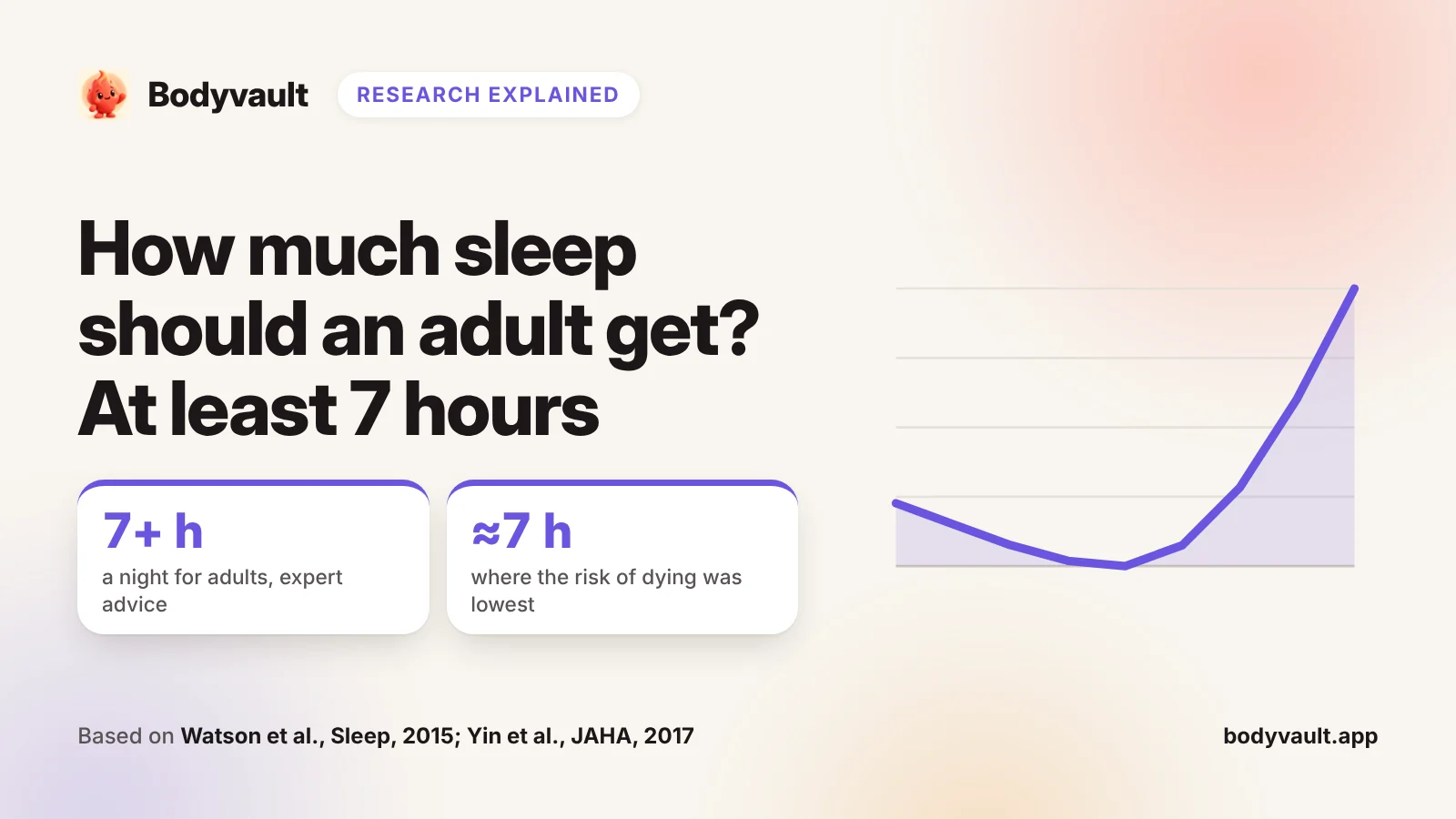
How much sleep should an adult get? Sleep experts say at least 7 hours a night, and 7 to 9 hours suits most adults.
The short answer
7+h
Sleep a night that US sleep experts advise for adults aged 18 to 60
7–9h
The National Sleep Foundation’s range for adults aged 18 to 64. From 65 it is 7–8 hours
≈7h
Where the risk of dying was lowest in studies of 3.6 million people
90min
Average length of a sleep cycle. But one cycle can easily run 25 minutes shorter or longer
Strength of evidenceGood
Two expert panels agree, and a 2026 check of 133 reviews backed the NSF ranges. Most of the health evidence comes from studies that watched people, so it shows links, not proof.
Key findingAim for at least 7 hours of sleep on most nights. Between 7 and 9 hours suits most adults. If you often need much more than 9, talk to a doctor.
What “enough sleep” means
In 2015, 15 sleep experts in the US looked at 5,314 studies on sleep and health. Then they voted, round by round, until they agreed. Their advice is short: adults should sleep 7 hours or more a night, on most nights.
This is advice written by a panel of experts after reviewing the research. It gives a minimum, not a perfect number for you. The experts say sleep need differs between people. Genes, health, habits and your surroundings all play a part.
The advice is about sleep, not time in bed. Most people need a while to fall asleep, so plan a little extra time. The sleep calculator adds 15 minutes for this unless you change it. Watch sleep scores judge a night in their own way: see how the Apple Watch sleep score works.
How much sleep do you need at your age?
The US National Sleep Foundation (NSF) set ranges for every age in 2015. A panel of 18 experts from 12 groups agreed on them. Adults aged 18 to 64 should get 7 to 9 hours. Teenagers need more, and people over 65 a little less.
Recommended hours of sleep a day, by age
- Children aged 6–139–11 h
- Teenagers aged 14–178–10 h
- Adults aged 18–647–9 h
- Adults aged 65 and over7–8 h
The panel said needs vary from person to person. On its website, the NSF adds that an hour or two either side of a range can be fine for some people. But sleeping far outside the range is rare. It can be a sign of a health problem.
Ten years later, the NSF checked its ranges again. Its team looked at 133 meta-analyses from 2015 to 2025. A meta-analysis is a study that pools the results of many earlier studies. Three in four fitted the ranges, and none went against them.
Do women need more sleep than men?
Not as far as the research can tell. The same 2026 check found that most meta-analyses showed no clear difference between men and women. So the 7 to 9 hour range applies to both.
Two big reviews agree. In one, of 3.6 million people, the lowest risk came at about 7 hours for both sexes. In another, of 1.4 million people, the link between short sleep and dying earlier was alike in men and women. If you are pregnant or have a health condition, ask your doctor what is right for you.
How much sleep is too much?
For most adults, regularly sleeping much more than 9 hours goes with higher health risks. A 2010 review pooled 16 studies of 1.4 million adults in 8 countries. People were followed for 4 to 25 years. Both short and long sleepers were more likely to die during the studies than people who slept about 7 to 8 hours.
- Short sleepers (usually under 7 hours, often 5 or less) had a 12% higher risk.
- Long sleepers (usually more than 8 or 9 hours) had a 30% higher risk.
These were cohort studies: studies that follow a large group of people over time. They show a link. They can’t prove that one thing causes the other. The authors think long sleep may often be a sign of illness, such as depression or a health problem no one had found yet.
A 2017 review went further. It pooled 67 articles covering 3.6 million people and drew one curve for every hour of sleep. Risk was lowest at about 7 hours. It rose slowly with less sleep and faster with a lot more.
Risk of dying during the studies, by hours of sleep a day
Short and long sleepers compared with the middle group
- Short sleep (2010 review)1.12 (1.06–1.18)
- Long sleep (2010 review)1.30 (1.22–1.38)
- Shortest sleep (2017 review)1.13 (1.10–1.17)
- Longest sleep (2017 review)1.35 (1.29–1.41)
Long sleep isn’t always a warning sign. The 2015 experts said more than 9 hours can be fine for some people. That includes young adults, people catching up on lost sleep and people who are ill. If you often sleep much longer than 9 hours and still feel tired, see a doctor.
Are sleep cycles really 90 minutes?
During the night, you pass through cycles of light sleep, deep sleep and REM (rapid eye movement) sleep. A 2025 study measured these cycles in 205 healthy adults aged 18 to 75. Each person had a full overnight sleep test, which records brain waves, breathing and more.
Cycles lasted 90 minutes on average. But the typical spread was 25 minutes either way. Adults had about 4 to 5 cycles a night (4.7 on average). In about 1 in 4 adults, the first cycle had no REM sleep at all. Cycles were also shorter in children and teenagers.
How long sleep cycles lasted
- Adults, classic cycles90 min (65–115)
- Children and teens aged 8–1780 min (57–103)
- Adults, new brain-wave method89 min (55–123)
This matters if you plan sleep around 90-minute blocks. The sleep calculator shows bedtimes for 7 to 9 hours of sleep. It calls the cycle count “about” and notes that real cycles vary. This study shows why. A cycle can easily end 25 minutes earlier or later than the maths says. So no calculator can promise to wake you at the end of a cycle. Getting enough total sleep matters more.
Claims and evidence
ClaimEveryone needs exactly 8 hours.
EvidenceExperts give a range, not one number: 7 to 9 hours for most adults and 7 to 8 from age 65. Needs differ between people.
ClaimThe more sleep, the better.
EvidenceIn 3.6 million people, the risk of dying was lowest at about 7 hours. At 10 hours it was 32% higher than at 7, though long sleep may be a sign of illness rather than a cause.
ClaimYou should always sleep in 90-minute blocks.
EvidenceCycles averaged 90 minutes in 205 adults, but they often ran 25 minutes shorter or longer. Total sleep matters more than cycle maths.
ClaimWomen need an extra hour or more of sleep.
EvidenceA 2026 check of 133 meta-analyses found that most showed no clear difference between men and women.
What this means for you
What this means for you
- Aim for at least 7 hours of sleep on most nights. Between 7 and 9 hours suits most adults.
- Count sleep, not time in bed. Leave extra time to fall asleep.
- Use 90-minute cycles as a rough guide only. A steady wake-up time helps more: see why regular sleep matters.
- Teenagers need more sleep, about 8 to 10 hours. From age 65, 7 to 8 hours is the usual range.
- If you often need much more than 9 hours, feel sleepy despite enough sleep, snore loudly or stop breathing at night, see a doctor.
What the research can’t tell you yet
- Cause and effect. The health risks come from studies that watched people. People who are ill may sleep longer, which makes long sleep look worse than it is.
- Self-reported sleep. Most big studies simply asked people how long they slept, once. They often couldn’t tell time asleep from time in bed.
- Who was studied. Most studies were in Europe, the US and Asia. The 2015 expert advice covers adults aged 18 to 60.
- Your own number. These are averages across large groups. They can’t give your exact sleep need.
How Bodyvault uses this research
Bodyvault works out a sleep need for you. It starts at 8 hours, inside the range experts advise, and learns your own need from nights after which you woke up rested. Your Sleep score compares how long you slept with that need, and Coach points it out when your 7-day average drops below 7 hours. The sleep planner works back from your wake-up time and your need, not from 90-minute cycles.
Share or cite this explainer
Bodyvault (2026). How much sleep should an adult get? https://bodyvault.app/blog/how-much-sleep-do-you-need
The charts on this page may be reused with a link back to it. The underlying data belong to the studies cited below.
Questions
How much sleep should adults get?
At least 7 hours a night on most nights, say US sleep experts. For most adults, 7 to 9 hours is the range to aim for. From age 65, 7 to 8 hours is usual.
How much sleep do I need?
Most adults need 7 to 9 hours. Teenagers need 8 to 10, and people over 65 need 7 to 8. Your own need may be a little above or below these ranges.
How much sleep is too much sleep?
For most adults, regularly sleeping much more than 9 hours goes with higher health risks in big studies. That may be because illness makes people sleep longer. If you often need more than 9 hours and still feel tired, see a doctor.
How much sleep do women need?
The same as men: 7 to 9 hours for most adults. A 2026 check of 133 meta-analyses found that most showed no clear difference between the sexes. If you are pregnant or have a health condition, ask your doctor.
How long is a sleep cycle?
About 90 minutes on average, but it varies. In 205 adults tested overnight, cycles often ran 25 minutes shorter or longer. Treat cycle counts in the sleep calculator as a rough guide.
Sources
- Watson NF et al. (2015). Recommended amount of sleep for a healthy adult: a joint consensus statement of the American Academy of Sleep Medicine and Sleep Research Society. Sleep 38(6):843–844.
- Hirshkowitz M et al. (2015). National Sleep Foundation’s sleep time duration recommendations: methodology and results summary. Sleep Health 1(1):40–43.
- National Sleep Foundation (2026). How much sleep do you really need? (age ranges of the 2015 recommendations).
- Dzierzewski JM et al. (2026). How much sleep do you need: a 10-year systematic review of National Sleep Foundation’s sleep duration recommendations and examination of sex differences. Sleep Health 12(4):599–611.
- Cappuccio FP et al. (2010). Sleep duration and all-cause mortality: a systematic review and meta-analysis of prospective studies. Sleep 33(5):585–592.
- Yin J et al. (2017). Relationship of sleep duration with all-cause mortality and cardiovascular events: a systematic review and dose-response meta-analysis of prospective cohort studies. J Am Heart Assoc 6(9):e005947.
- Rosenblum Y et al. (2025). Fractal cycles of sleep, a new aperiodic activity-based definition of sleep cycles. eLife 13:RP96784.
General information about fitness and nutrition, not medical advice. If you have a health condition, are pregnant or take medication, talk to your doctor before changing your diet or training.