
Research explained
Sleep debt: can you catch up on lost sleep?
Sleep debt is the sleep you owe after a run of short nights. You can pay some of it back, but lab trials show that one long night or a weekend lie-in doesn’t clear it all.
The short answer
14nights
Of 6 hours or less in bed caused losses in thinking and attention as big as up to 2 nights with no sleep
10h
In bed for one night still didn’t fully restore attention after five 4-hour nights
4nights
Of 12 hours in bed still left attention a little slow after five 4-hour nights
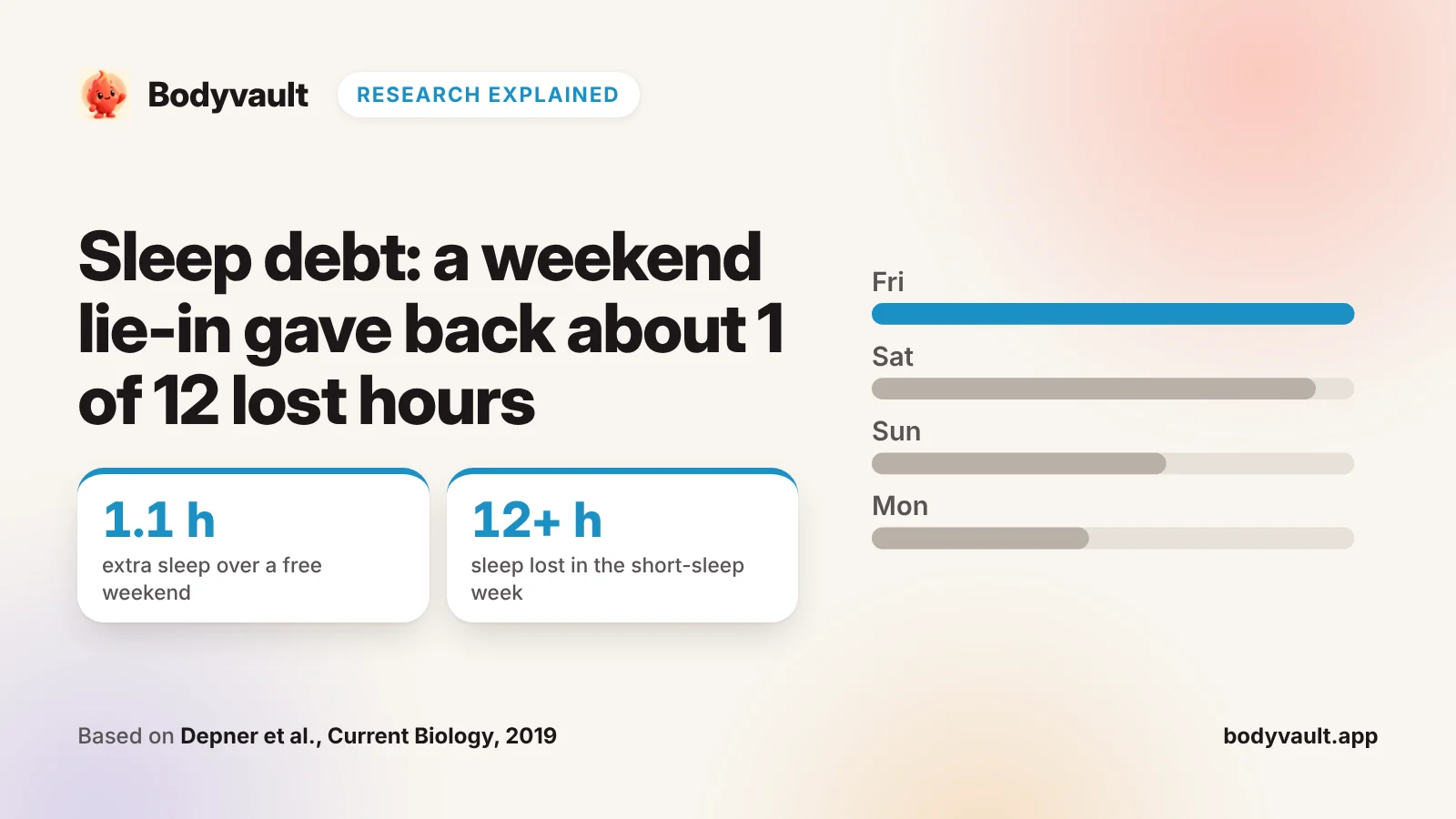
1.1h
Extra sleep people got back over a free weekend, after losing more than 12 hours in the week
Strength of evidenceModerate
Careful lab trials agree that short nights add up and take more than one night to repay. But the trials were small and short, and mostly in young, healthy adults.
Key findingYou can pay back part of a sleep debt, and you will feel better quickly. But attention can take longer to recover, and a lie-in doesn’t protect you if short nights keep coming back. The surest fix is enough sleep on most nights.
What is sleep debt?
Sleep debt is the gap between the sleep you need and the sleep you get, added up over several nights. Say you need 8 hours but sleep 6 for five nights in a row. You now owe 10 hours (our example).
A famous lab study showed how this adds up. Researchers studied 48 healthy adults aged 21 to 38. Some were put into groups by chance with 4, 6 or 8 hours in bed a night for 14 nights. Others stayed awake for 3 nights in a row. On 6 hours or less, people did a little worse on thinking and attention tests every day. By the end, they did as badly as people kept awake for up to 2 nights in a row.
The surprise was how they felt. Their sleepiness rose at first, then barely changed. The 4-hour group didn’t feel clearly sleepier than the 6-hour group, though it did worse on the tests. So people didn’t notice how much worse they were getting.
Why sleep debt matters for your body
Sleep debt affects more than your attention. In a 1999 lab study, 11 young men spent 6 nights with only 4 hours in bed. Then they had 6 nights with 12 hours in bed. The researchers compared their tests at the end of each week.
After the short nights, the men’s bodies cleared sugar from the blood less well. Their evening levels of cortisol, a stress hormone, were higher. Their “fight or flight” nervous system was more active. The authors said the changes looked like normal ageing. After the long nights, these measures were better.
Can you catch up on sleep in one night?
Not fully, if the debt is large. A 2010 trial is the clearest test. In a lab, 142 healthy adults aged 22 to 45 spent 5 nights with 4 hours in bed. Then each got one recovery night, chosen by chance: anywhere from 0 to 10 hours in bed.
The researchers measured attention lapses: times when people took half a second or more to react on a simple reaction test. More recovery sleep helped more. But no group got all the way back to where they started.
Ten hours in bed gave about 9 hours of sleep. Even then, people had more lapses and felt sleepier and more tired than at the start. The researchers estimated it would take about 10.7 hours in bed to match people who had slept well all week. They said full recovery may need a longer night or several nights.
Can you catch up over several nights?
Mostly, but not completely. In a 2021 trial, 41 healthy adults aged 21 to 50 spent 5 nights with 4 hours in bed. Then they had four recovery nights with 12 hours in bed.
After the first long night, they felt fine. Their sleepiness and tiredness were back to normal. But their attention was still a little slow after all four nights, even though they slept just over 8 hours on the last one. Feeling rested and being fully recovered aren’t always the same thing.
Can you catch up on sleep on the weekends?
A weekend lie-in helps a little, but it doesn’t undo a short week. A 2019 trial tested this directly, in a lab with food freely available.
Short sleep also changed how people ate. After-dinner snacking rose from about 290 to more than 771 calories. The weekend cut it for a while, but it came back with the short nights. Weight rose too, and the weekend lie-in didn’t stop it.
The body’s response to insulin also got weaker. Insulin is the hormone that moves sugar from the blood into your cells. With short nights all week, this response fell by about 13%. In the weekend group, it fell by about 27% once the short nights came back. The weekend also shifted people’s body clocks later, so a Monday alarm was more likely to ring during their biological night.
One more detail: over the weekend, the men slept about 2 hours more than usual. The women slept almost no extra.
What happens over years?
Lab trials last days or weeks. For the long view, a Swedish study followed 38,015 adults for 13 years. People said how long they usually slept on workdays and on days off. This kind of study shows a link. It can’t prove that one thing causes the other.
Risk of dying in Swedish adults under 65, by weekday and weekend sleep
- 5 hours or less, every day1.65 (1.22–2.23)
- 8 hours or more, every day1.25 (1.05–1.50)
- 5 hours or less at weekends1.52 (1.15–2.02)
In people under 65, those who slept 5 hours or less every day had a 65% higher risk of dying during the study. But people who slept short on weekdays and longer at weekends did no worse than steady 6 to 7 hour sleepers. The authors think the extra weekend sleep may have helped make up for short weeknights. They say this idea still needs testing. In people aged 65 and over, there was no link either way.
How to catch up on sleep debt
Spread it out
One long night isn’t enough after a short week. Add extra sleep over several nights instead.
Go to bed earlier
Sleeping in for hours pushed people’s body clocks later in the lab trial. An earlier bedtime adds sleep without moving your morning.
Keep your wake-up time steady
A steady morning keeps your body clock on track. See how to fix your sleep schedule.
Nap if you need to
In 22 small trials with active young men, an afternoon nap helped thinking and physical performance, even after a short night.
Then protect your sleep
Paying back debt works best when you stop adding to it. Most adults need at least 7 hours: see how much sleep you need.
Claims and evidence
ClaimYou can get used to less sleep.
EvidenceOver 14 nights of 6 hours or less, people kept getting worse at attention tests. Their sleepiness rose at first and then barely changed, so they didn’t notice.
ClaimOne long lie-in wipes the slate clean.
EvidenceAfter five 4-hour nights, even 10 hours in bed left attention lapses higher than before the short nights.
ClaimWeekend sleep cancels out short weeknights.
EvidenceIn a lab trial, a free weekend gave back only about 1.1 of more than 12 lost hours. Weight gain and a weaker insulin response came back with the short nights.
ClaimIf you feel fine again, you’ve fully recovered.
EvidenceAfter four nights of 12 hours in bed, people felt rested, but their attention was still a little slow.
What this means for you
What this means for you
- After a short week, add extra sleep over several nights. Going to bed earlier is gentler on your body clock than sleeping in for hours.
- Keep your wake-up time about the same, even at weekends, if you can.
- A short early-afternoon nap can help you get through a day after a short night. It won’t clear a week of debt.
- Don’t judge your recovery only by how you feel. Attention can lag behind.
- If you are very sleepy in the day despite enough sleep, snore loudly or stop breathing at night, see a doctor. Never drive when you are fighting sleep.
What the research can’t tell you yet
- Small, short studies. The lab trials had 11 to 159 people and lasted from a few days to about three weeks.
- Who was studied. Mostly young, healthy adults. The 1999 study had only men, and none of the trials tested older adults.
- Harsh schedules. Most trials used 4 or 5 hours in bed, which is shorter than many people’s short nights.
- Real life. The Swedish study shows links, not proof. People chose their own sleep, and sleep was asked about only once.
How Bodyvault uses this research
Bodyvault keeps a running sleep debt from your last 7 nights, with recent nights counting most. It adds a third of that debt, up to an hour, to tonight’s sleep need, so you repay it over several nights. When the debt passes 1.5 hours, the sleep planner suggests a full recovery night, and any nap lowers that night’s need by its length. In Bodyvault Pro, a short night also pulls down your Readiness score, and a nap later that day can win some of it back.
Share or cite this explainer
Bodyvault (2026). Sleep debt: can you catch up on lost sleep? https://bodyvault.app/blog/sleep-debt
The charts on this page may be reused with a link back to it. The underlying data belong to the studies cited below.
Questions
Can you catch up on sleep?
Partly. Extra sleep helps you feel better quickly, and some body measures improve. But in lab trials, one long night and even four 12-hour nights did not fully restore attention after five 4-hour nights.
How do you catch up on sleep?
Add extra sleep over several nights, ideally by going to bed earlier rather than sleeping in for hours. Keep your wake-up time fairly steady. Then aim for enough sleep on most nights so the debt doesn’t build again.
Can you catch up on sleep on the weekends?
Only partly. In a lab trial, a free weekend gave back about 1.1 of more than 12 lost hours, and the body clock shifted later. In a big Swedish study, people under 65 who slept longer at weekends after short weeknights did no worse than steady sleepers. That study shows a link, not proof.
Do naps help you catch up on sleep?
Naps can help you feel and perform better after a short night. In 22 small trials with active young men, naps helped even after a short night. In Bodyvault, a nap also lowers that night’s sleep need. See how long a nap should be.
How long does it take to recover from sleep debt?
Longer than one night. After five 4-hour nights, people felt rested after one long night. But their attention was still a little slow after four nights of 12 hours in bed.
Sources
- Van Dongen HPA et al. (2003). The cumulative cost of additional wakefulness: dose-response effects on neurobehavioral functions and sleep physiology from chronic sleep restriction and total sleep deprivation. Sleep 26(2):117–126.
- Spiegel K, Leproult R, Van Cauter E (1999). Impact of sleep debt on metabolic and endocrine function. Lancet 354(9188):1435–1439.
- Banks S et al. (2010). Neurobehavioral dynamics following chronic sleep restriction: dose-response effects of one night for recovery. Sleep 33(8):1013–1026.
- Yamazaki EM et al. (2021). Residual, differential neurobehavioral deficits linger after multiple recovery nights following chronic sleep restriction or acute total sleep deprivation. Sleep 44(4):zsaa224.
- Depner CM et al. (2019). Ad libitum weekend recovery sleep fails to prevent metabolic dysregulation during a repeating pattern of insufficient sleep and weekend recovery sleep. Curr Biol 29(6):957–967.e4.
- Åkerstedt T et al. (2019). Sleep duration and mortality – does weekend sleep matter? J Sleep Res 28(1):e12712.
- Mesas AE et al. (2023). Is daytime napping an effective strategy to improve sport-related cognitive and physical performance and reduce fatigue? A systematic review and meta-analysis of randomised controlled trials. Br J Sports Med 57(7):417–426.
General information about fitness and nutrition, not medical advice. If you have a health condition, are pregnant or take medication, talk to your doctor before changing your diet or training.