
Research explained
How long should a nap be? What studies show
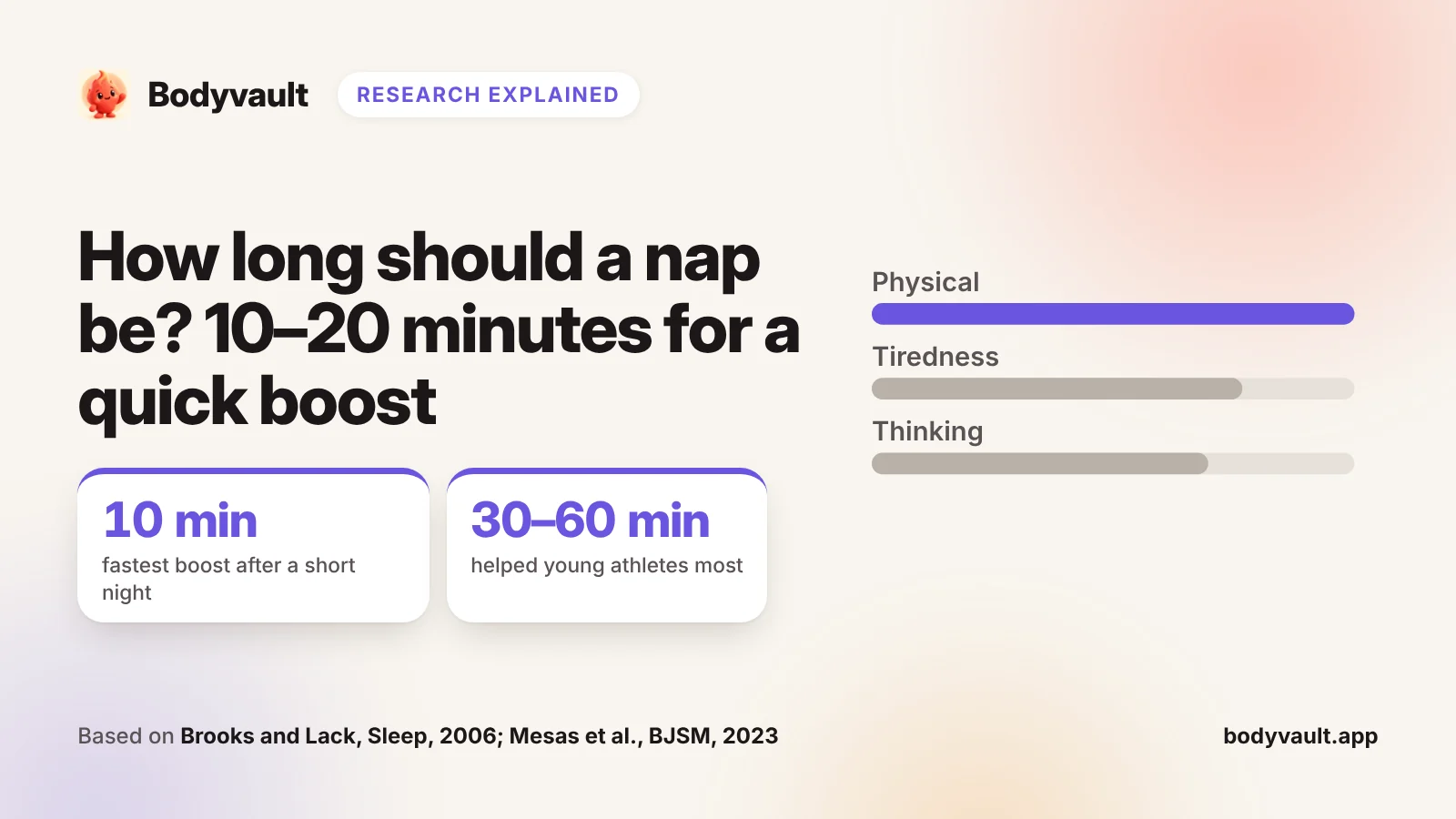
How long a nap should be depends on what you need. For a quick lift, about 10 to 20 minutes works with little grogginess. If you have an hour to wake up properly, 30 to 60 minutes helped young athletes most.
The short answer
10min
Nap that gave the fastest boost after a short night, lasting up to 155 minutes
30–60min
Nap length that helped young athletes most, with an hour to wake up before testing
2h
About how long the lift in alertness lasted after an afternoon nap
+37%
Higher risk of heart and blood vessel disease linked with regular naps of an hour or more
Strength of evidenceModerate
Many small trials agree that naps can boost alertness and performance for a few hours. But the trials were small and mostly in young people, and the evidence on the best length is limited.
Key findingFor a quick boost, nap for about 10 to 20 minutes, early in the afternoon. A nap of 30 to 60 minutes can help more, but you may feel groggy at first, so leave time to wake up. Keep regular naps under an hour.
What happens when you nap
When you fall asleep, you drift from light sleep into deeper sleep. If you wake up from deep sleep, you often feel groggy and slow for a while. This is called sleep inertia. Longer naps usually hold more deep sleep, so they tend to cause more grogginess.
Many people feel a dip in alertness in the early afternoon. The authors of a 2021 review explain that it comes mainly from your body clock, not from lunch. Most nap studies test naps in the early afternoon.
People often call a short daytime nap a “power nap”. The studies below describe naps by their length instead.
How long a nap should be, by goal
The classic test of nap length is a small 2006 trial with 24 healthy young adults. Each person tried five options on different days: no nap, or a 3 pm nap of exactly 5, 10, 20 or 30 minutes of sleep. Each time, their night sleep had been cut to about 5 hours. Then they did tests for 3 hours.
| Nap | What happened | Grogginess at first? |
|---|---|---|
| 5 minutes | Few benefits compared with no nap | Not reported |
| 10 minutes | Less sleepy and tired, and sharper straight away. Some benefits lasted up to 155 minutes | No |
| 20 minutes | Benefits started about 35 minutes after waking and lasted up to 125 minutes | Benefits came later |
| 30 minutes | Alertness and performance were worse at first, then better for up to 155 minutes | Yes |
The authors judged the 10-minute nap the best overall. But that was after a short night, with naps at 3 pm only. Longer naps can still pay off if you have time to wake up properly.
This 2023 study was a meta-analysis: a study that pools the results of many earlier trials. In these trials, people were put into groups by chance, so the groups could be fairly compared. The authors called the effects moderate to large. But the results varied a lot from trial to trial, and all the people were young men.
So the best nap length depends on your goal:
- Need to be sharp soon after? About 10 to 20 minutes.
- Training or competing later in the day? About 30 to 60 minutes, with at least an hour to wake up fully.
- After a very short night? A nap can help you get through the day. To pay back a big sleep debt, you need extra sleep over several nights: see sleep debt.
Power nap benefits for your brain
A 2021 review pooled 11 lab studies of 381 working-age adults. Their naps lasted 55 minutes on average, from 15 to 90 minutes, and started around 1:30 pm. Compared with resting awake, a nap gave a small but clear boost to thinking. The boost was clearest for alertness.
Naps that started before 1 pm helped a little more than later naps. Age and sex didn’t change the benefit. In this review, nap length didn’t clearly change the boost either.
Do naps help in sport?
A 2024 review looked at 18 studies of athletes and active people who had slept normally the night before. Their naps lasted 25 to 90 minutes. Seven of the studies used a shuttle-run test with repeated short sprints.
Napping also helped people tire less during the test. But it did not clearly change their strength. There were too few studies to judge sprints, jumps or endurance. The authors warn that grogginess can last up to 2 hours in people who aren’t athletes, so leave time before you train.
Are naps good for you?
Short naps seem fine. Long naps are another story. A 2024 review pooled 21 studies that followed about 371,000 adults for 4 to 18 years. Many were in China and the US. People said how long they usually napped.
Usual nap length and long-term risk, compared with not napping
- Under 1 hour: dying early1.00 (0.90–1.11)
- Under 1 hour: heart disease1.03 (0.87–1.12)
- 1 hour or more: dying early1.22 (1.12–1.33)
- 1 hour or more: heart disease1.37 (1.09–1.71)
Naps under an hour were not linked with dying early or with heart disease. Regular naps of an hour or more were linked with a 22% higher risk of dying and a 37% higher risk of heart disease. These were cohort studies, so they show a link, not a cause. They can’t tell whether long naps harm health, or whether poor health leads to long naps.
Naps can also affect your night. The 2024 sport review notes that a nap may make it take longer to fall asleep that night, though the evidence is limited. If that happens to you, keep naps short and early.
Claims and evidence
ClaimThe longer the nap, the better.
EvidenceAfter a short night, a 10-minute nap gave the fastest boost. A 30-minute nap helped too, but only after a groggy spell.
ClaimA nap makes you stronger in the gym.
EvidenceIn a review of 18 studies, naps helped repeated sprints but did not clearly change muscle strength.
ClaimAny nap is bad for your health.
EvidenceIn 21 studies of about 371,000 adults, naps under an hour were not linked with dying early or heart disease. Regular naps of an hour or more were.
ClaimThe afternoon slump comes from lunch.
EvidenceIt comes mainly from your body clock, the authors of a 2021 review explain.
What this means for you
What this means for you
- Need to be sharp soon after? Nap for about 10 to 20 minutes.
- Training later in the day? A 30 to 60-minute nap can help, if you leave at least an hour to wake up fully.
- Nap early in the afternoon. Late naps may make it harder to fall asleep at night.
- Keep regular naps under an hour.
- If you need long naps most days, or feel very sleepy despite enough night sleep, see a doctor.
What the research can’t tell you yet
- Small, short studies. Most trials had a few dozen people and measured performance for a few hours.
- Who was studied. Mostly young adults, and the sport studies were almost all men. We know little about women and older adults.
- Long-term risk. The health studies watched people. They can’t show that long naps cause harm.
- Measuring naps. Only 2 of the 18 sport studies measured nap sleep with a full lab sleep test.
How Bodyvault uses this research
Bodyvault counts naps from Apple Health or Health Connect, or you can log one by hand with quick choices from 20 to 90 minutes. Apple Watch records naps only when Sleep Focus is on. Each nap lowers that night’s sleep need by its length, so the app won’t push you to sleep longer than you need. In Bodyvault Pro, a nap of 10 minutes or more also lifts your Readiness score, more for longer naps up to an hour.
Share or cite this explainer
Bodyvault (2026). How long should a nap be? What studies show. https://bodyvault.app/blog/how-long-should-a-nap-be
The charts on this page may be reused with a link back to it. The underlying data belong to the studies cited below.
Questions
How long for a nap?
For a quick boost, about 10 to 20 minutes. After a short night, a 10-minute nap helped straight away in a small trial. If you have time to wake up properly, 30 to 60 minutes helped young athletes most.
What is the best nap length?
It depends on your goal. Short naps of 10 to 20 minutes help fast with little grogginess. Naps of 30 to 60 minutes can help more later on, for example before sport. Keep regular naps under an hour.
Are naps good for you?
Short naps can boost alertness and performance for a few hours. In large studies, naps under an hour were not linked with health risks. Regular naps of an hour or more were, but these studies can’t show that the naps caused the harm.
What are the benefits of a power nap?
A short nap can make you more alert and less tired for up to about 2 hours. It may also help you perform better in sport later that day. The boost is modest, and longer naps can leave you groggy at first.
When is the best time to nap?
Early afternoon. In a review of 11 lab studies, naps that started before 1 pm helped a little more. In 22 sport trials, naps were taken between 12:30 and 4:50 pm, most often at 2 pm.
Sources
- Brooks A, Lack L (2006). A brief afternoon nap following nocturnal sleep restriction: which nap duration is most recuperative? Sleep 29(6):831–840.
- Mesas AE et al. (2023). Is daytime napping an effective strategy to improve sport-related cognitive and physical performance and reduce fatigue? A systematic review and meta-analysis of randomised controlled trials. Br J Sports Med 57(7):417–426.
- Dutheil F et al. (2021). Effects of a short daytime nap on the cognitive performance: a systematic review and meta-analysis. Int J Environ Res Public Health 18(19):10212.
- Boukhris O et al. (2024). The impact of daytime napping following normal night-time sleep on physical performance: a systematic review, meta-analysis and meta-regression. Sports Med 54(2):323–345.
- Wang M et al. (2024). Association between self-reported napping and risk of cardiovascular disease and all-cause mortality: a meta-analysis of cohort studies. PLoS One 19(10):e0311266.
General information about fitness and nutrition, not medical advice. If you have a health condition, are pregnant or take medication, talk to your doctor before changing your diet or training.