
Research explained
How to fix your sleep schedule: why regular sleep matters
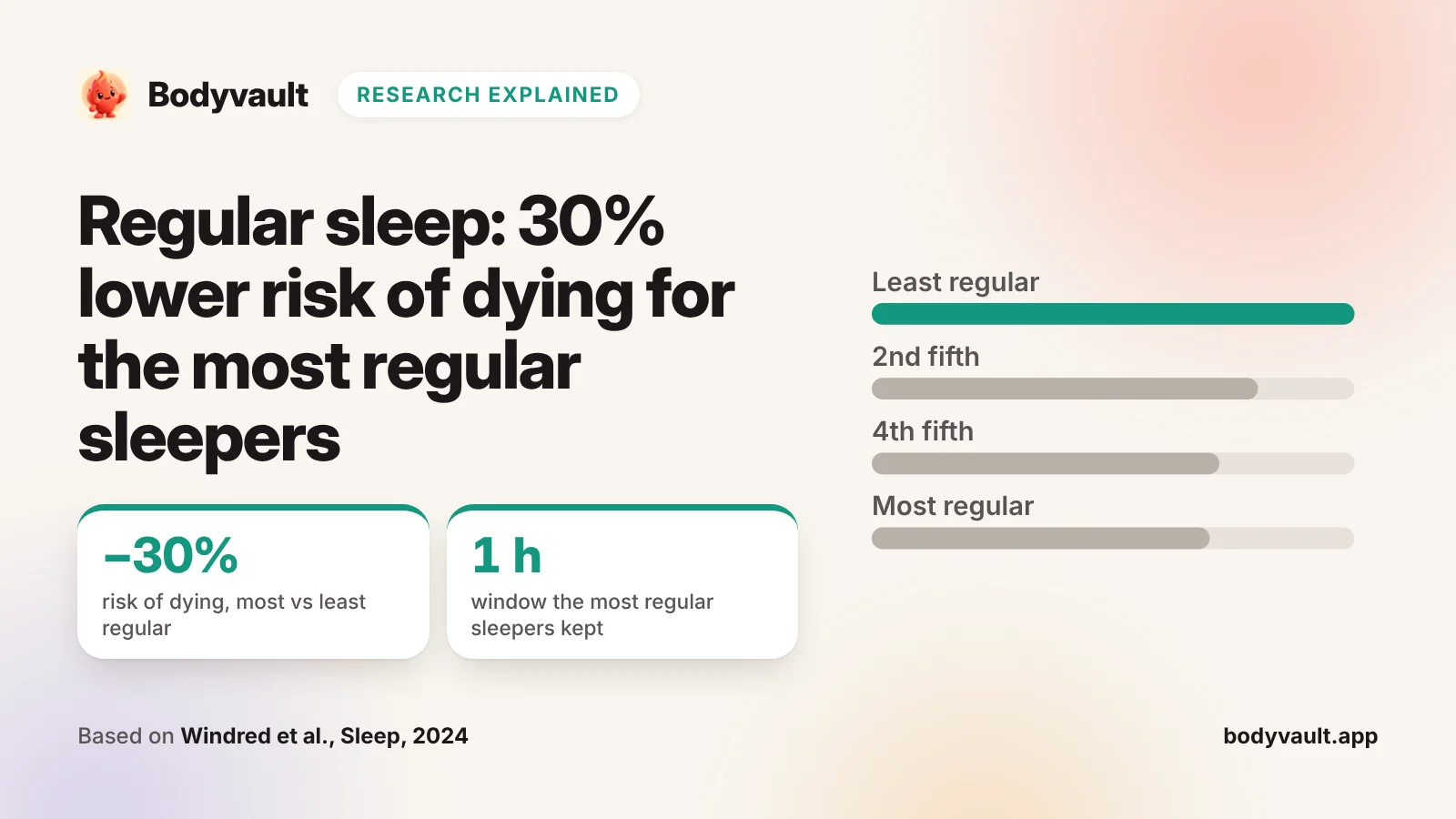
Here is how to fix a sleep schedule: wake up at the same time every day, get daylight and keep your evenings dim. In 61,000 UK adults, the most regular sleepers had a 30% lower risk of dying during the study than the least regular.
The short answer
−30%
Risk of dying during the study for the most regular sleepers, compared with the least regular, in 61,000 UK adults
1h
Window in which the most regular sleepers fell asleep and woke up on most days. The least regular: about 3 hours
2.5h
How much later the body clock ran in students with irregular sleep (our calculation)
3h
Before bed: when experts advise keeping lights dim
Strength of evidenceModerate
Expert panels agree that regular sleep matters, and large studies link it with better health. But those studies watched people. We still lack trials showing that fixing a schedule improves health.
Key findingKeep your wake-up time steady, ideally within about an hour every day, weekends included. Bright light by day and dim light at night help your body clock settle.
What your sleep schedule does to your body clock
Your body clock (your circadian rhythm) runs on a cycle of about 24 hours. It helps decide when you feel sleepy and when you feel awake. Light, most of all daylight, helps keep it on time.
In the evening, your body starts to make melatonin, a hormone that tells it night is coming. The time this starts is a good sign of where your body clock is.
A 2017 study followed 61 university students for a month. They wrote down when they slept every day. The 12 least regular sleepers slept as long as the 12 most regular, about 7.2 hours a night. But their melatonin started much later.
That is about 2.5 hours later (our calculation). The irregular sleepers also got less light during the day, and the gap between their bright days and dark nights was smaller. A computer model of the body clock used only their light patterns. It predicted most of the delay. So light seems to be a big part of why a messy schedule drifts later.
The regular sleepers also got slightly better grades. That is a link. It doesn’t prove that regular sleep caused better grades.
Why regular sleep matters
A large 2024 study used motion sensors worn on the wrist. It measured sleep regularity with the Sleep Regularity Index. The index checks how often you are asleep or awake at the same clock time on back-to-back days. It runs from 0 (random) to 100 (exactly the same every day).
This was a cohort study: a study that follows a large group of people over time. It shows a link. It can’t prove that one thing causes the other. The people studied were mostly middle-aged or older, and white, so the results may differ in other groups.
Risk of dying, by how regular people’s sleep was
- Least regular fifthcomparison group
- Next fifth0.80 (0.69–0.93)
- Middle fifth0.75 (0.64–0.88)
- Fourth fifth0.72 (0.61–0.84)
- Most regular fifth0.70 (0.59–0.83)
- Longest sleepers, compared with the shortest0.76 (0.65–0.89)
Other research points the same way. A 2025 review looked at 59 studies of sleep timing. Irregular sleep went with more signs of depression and anxiety, higher weight, high blood pressure and more heart problems. It also went with insulin resistance. That is when the body stops responding well to insulin, the hormone that moves sugar from the blood into your cells. In five careful studies, the least regular sleepers had a 20% to 88% higher risk of dying.
In 2023, a panel of sleep and body-clock experts from the National Sleep Foundation reviewed the evidence. They agreed that steady times to fall asleep and wake up matter for health, safety and performance.
How to fix a sleep schedule, step by step
Pick one wake-up time
Choose a time you can keep every day, weekends included. Aim to wake within about an hour of it, as the most regular sleepers in the UK study did.
Get bright light early in the day
Experts advise plenty of bright light during the day, ideally daylight. Bright light earlier in the day can also soften the effect of light in the evening.
Dim the lights 3 hours before bed
Keep light low from at least 3 hours before bed. Warm, dim lamps at normal home levels can be enough.
Keep your bedroom dark
Make your room as dark as you can. Blackout blinds help, with a dim night light only if you need to see.
Go easy on lie-ins
If you need extra sleep, go to bed earlier rather than sleeping in for hours.
Get enough sleep, too
Regular timing works best with enough hours. Most adults need at least 7: see how much sleep you need.
Screens add light in the evening too. For what screens and blue-light filters do, see blue light and sleep.
What about weekend lie-ins?
A long lie-in can push your body clock later. In a 2019 lab trial, young adults with short weeknights could sleep as long as they liked at the weekend. They woke about 3.9 hours later than usual on Saturday and 3.5 hours later on Sunday.
By Monday, the end of their biological night came about 1.4 hours later than at the start. So a Monday alarm was more likely to ring while their body still thought it was night. Some extra weekend sleep may still help when your weeknights are short, the 2023 expert panel said. Just get it by going to bed earlier, not by sleeping in for hours. For more on paying back lost sleep, see sleep debt.
Claims and evidence
ClaimAs long as you get your hours, timing doesn’t matter.
EvidenceIn 61,000 UK adults, regular timing predicted the risk of dying better than sleep length did.
ClaimSleeping in at the weekend is harmless.
EvidenceIt depends. Some catch-up sleep may help after short weeknights. But in one trial, waking 3.5 to 4 hours later shifted body clocks about 1.4 hours later by Monday.
ClaimA late body clock is just how you are.
EvidenceStudents with irregular sleep had body clocks about 2.5 hours later. A model based only on their light exposure predicted most of that gap.
ClaimA regular schedule is only about bedtime.
EvidenceWake-up time matters as much. Experts stress steady times to fall asleep and to wake up, and the most regular sleepers kept both within about an hour.
What this means for you
What this means for you
- Choose a wake-up time you can keep 7 days a week, and stay within about an hour of it.
- Get outside, or sit by a bright window, during the day, especially earlier in the day.
- From 3 hours before bed, switch to dim, warm lamps. Keep your bedroom dark.
- If you need more sleep, go to bed earlier rather than sleeping in.
- If you work shifts, or your sleep stays out of step despite these steps, talk to a doctor.
What the research can’t tell you yet
- Links, not proof. The big studies watched people. We still lack trials that test whether a more regular schedule lowers health risks.
- Who was studied. The UK study was mostly older, white adults, with one week of data each. The student study had 61 people at one university.
- Light targets. The light advice is based mostly on lab studies of healthy adults aged 18 to 55. You can’t measure this kind of light with a phone.
- Shift work. People who work nights, and people with sleep disorders, need different advice.
How Bodyvault uses this research
Your Bodyvault Sleep score has a Consistency part, worth 15%, that checks how much the middle of your sleep moves from night to night. In Bodyvault Pro, the same check makes up a quarter of the sleep part of your Readiness score. The sleep planner keeps one wake time for weekdays and one for weekends, and never suggests a bedtime more than 90 minutes earlier than usual. If your check-ins show that time outdoors in daylight clearly helps your sleep or Readiness, Today suggests 30 minutes outside.
Share or cite this explainer
Bodyvault (2026). How to fix your sleep schedule: why regular sleep matters. https://bodyvault.app/blog/fix-your-sleep-schedule
The charts on this page may be reused with a link back to it. The underlying data belong to the studies cited below.
Questions
How do I fix my sleep schedule?
Pick one wake-up time and keep it every day, weekends included. Get daylight during the day, keep lights dim for 3 hours before bed and sleep in a dark room. If you need more sleep, go to bed earlier rather than sleeping in.
What is a consistent sleep schedule?
Going to sleep and waking up at about the same times every day. In a UK study, the most regular sleepers fell asleep and woke within about a 1-hour window on most days. The least regular varied by about 3 hours.
What is sleep regularity?
How alike your sleep and wake times are from one day to the next. Researchers often measure it with the Sleep Regularity Index, from 0 (random) to 100 (the same every day). In 61,000 UK adults, the middle score was 81.
Is sleeping in on weekends bad?
A little extra sleep may help if your weeknights are short, experts say. But big lie-ins can push your body clock later. In one lab trial, waking 3.5 to 4 hours later shifted it about 1.4 hours by Monday.
Sources
- Windred DP et al. (2024). Sleep regularity is a stronger predictor of mortality risk than sleep duration: a prospective cohort study. Sleep 47(1):zsad253.
- Phillips AJK et al. (2017). Irregular sleep/wake patterns are associated with poorer academic performance and delayed circadian and sleep/wake timing. Sci Rep 7(1):3216.
- Brown TM et al. (2022). Recommendations for daytime, evening, and nighttime indoor light exposure to best support physiology, sleep, and wakefulness in healthy adults. PLoS Biol 20(3):e3001571.
- Depner CM et al. (2019). Ad libitum weekend recovery sleep fails to prevent metabolic dysregulation during a repeating pattern of insufficient sleep and weekend recovery sleep. Curr Biol 29(6):957–967.e4.
- Sletten TL et al. (2023). The importance of sleep regularity: a consensus statement of the National Sleep Foundation sleep timing and variability panel. Sleep Health 9(6):801–820.
- Kalkanis A et al. (2025). Sleep regularity as an important component of sleep hygiene: a systematic review. Sleep Med Rev 84:102203.
General information about fitness and nutrition, not medical advice. If you have a health condition, are pregnant or take medication, talk to your doctor before changing your diet or training.