
Research explained
Blue light filters and sleep: do screens and glasses matter?
Bright screens late in the evening can delay your body clock. But do blue light filters help your sleep? In a trial of 167 young adults, the iPhone’s Night Shift filter made no clear difference, and trials of blue-blocking glasses disagree. Dimmer light in the evening has better support.
The short answer
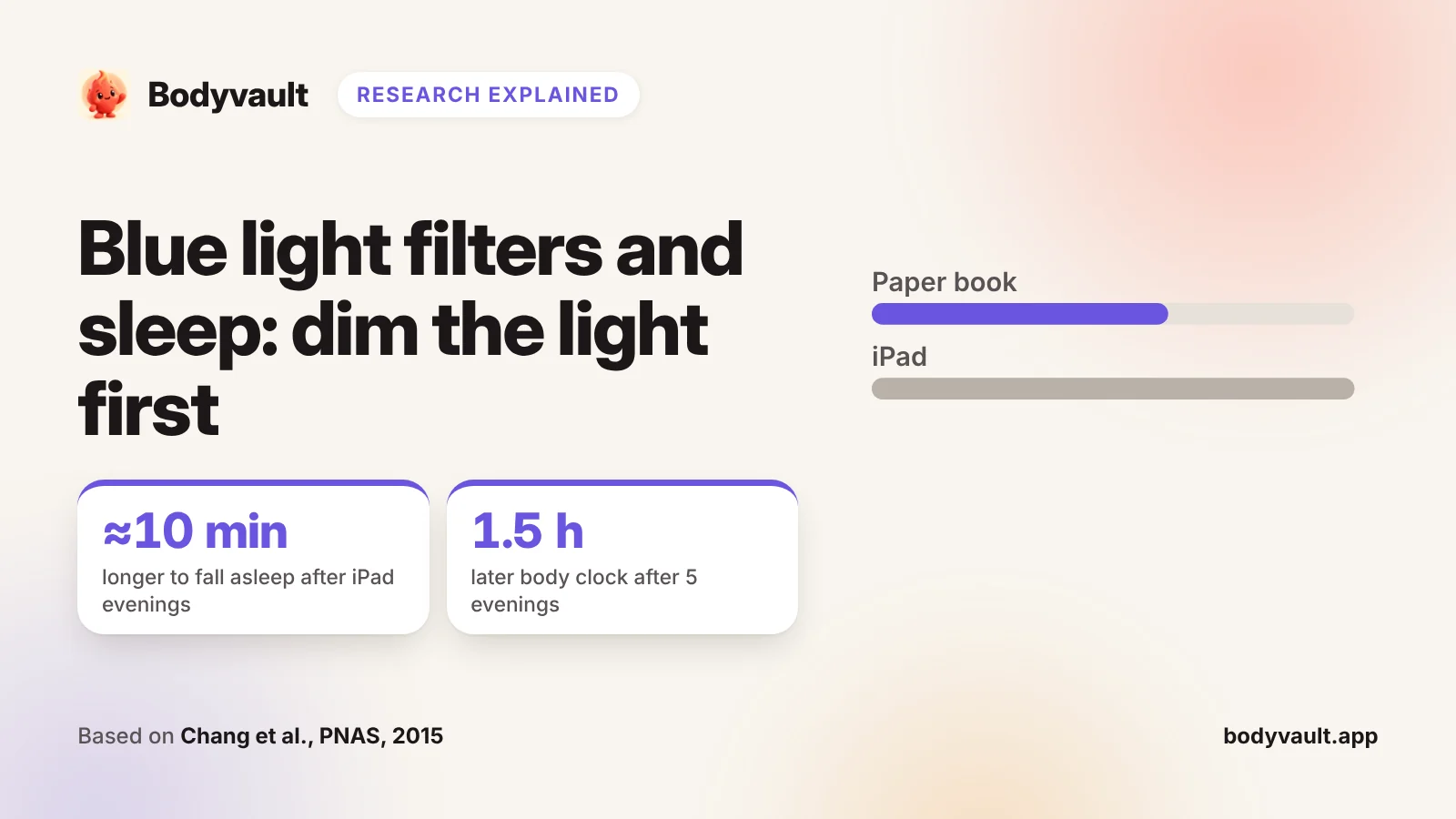
≈10min
Longer to fall asleep after evenings of reading on a bright iPad instead of a paper book (12 adults)
1.5h
How much later their body clock ran after five evenings of iPad reading
10lux
The most body-clock light experts advise in the 3 hours before bed
3of 6
Small trials of blue-blocking glasses that reported better sleep. The other 3 found no clear difference.
Strength of evidenceModerate
Lab studies show clearly that bright evening light shifts your body clock. Whether filters or glasses improve sleep in real life is not clear: the trials are few, small and mixed.
Key findingYour body clock reacts to how much light reaches your eyes in the evening, not just its colour. Experts advise dim light for the 3 hours before bed, and darkness while you sleep. A filter may help a little, but it is not enough on its own.
What is blue light, and why does it matter at night?
Light comes in many colours. Blue light is the part of the light we can see that has short waves. Daylight is full of it, and so is the light from many screens. The light from the iPad in one study peaked in the blue range.
Your eyes have special cells that tell your body clock whether it is day or night. These cells react most to blue-green light. In the evening, light on them holds back melatonin, a hormone that helps you feel sleepy. It also pushes your body clock later, so you feel sleepy later.
So colour matters, but so does brightness. Experts now measure evening light in “melanopic lux”. This counts light by how strongly it acts on those cells, so blue-ish light counts for more.
What reading on a tablet before bed did
In a well-known 2015 study, 12 healthy young adults lived in a sleep lab for two weeks. On five evenings they read on an iPad at full brightness, and on five they read a printed book. They read for about 4 hours before a 10 p.m. bedtime, in a very dim room.
After iPad evenings, they took nearly 10 minutes longer to fall asleep. Their evening melatonin was cut by 55%, while the book didn’t cut it at all. Their body clock ran 1.5 hours later. They had about 12 minutes less REM (dream) sleep (our calculation). They felt less sleepy at bedtime, but sleepier the next morning.
There are caveats. Four hours at full brightness, in an otherwise very dim room, is a strong dose of screen light. The study had no dim or warm-coloured screen to compare, so the authors say brightness, not blue light, may explain the effect. Total sleep didn’t change, but everyone stayed in bed for exactly 8 hours.
Blue light filters and sleep: do phone filters work?
Many phones have a setting that cuts blue light in the evening, such as Night Shift on the iPhone. A 2021 trial put 167 students aged 18–24 into three groups by chance. For a week, in the hour before bed, one group used an iPhone with Night Shift on. One used it with Night Shift off, and one used no phone. Wrist sensors tracked their sleep.
There were no clear differences between the three groups. In an extra check of students who usually slept more than 6.8 hours, those with no phone slept best. For them, putting the phone away beat using it with Night Shift on.
A 2023 lab study tested the idea behind filters more strictly. Researchers built a special screen that could cut the body-clock part of its light about three times over. It still looked just as bright and the same colour. 72 healthy young men sat at it for 3.5 hours before bed.
With less body-clock light, the men felt sleepier and made more melatonin. But they fell asleep faster only at the brightest screen setting. Across all the settings, the total dose of body-clock light mattered most.
Experts say the colour settings on ordinary screens cut body-clock light only by about half. They advise using a filter together with a dimmer screen and dim room lights.
Do blue light glasses work for sleep?
Blue light glasses have lenses that filter out part of the blue light. In 2023, a Cochrane review, a careful review of all the trials on one question, looked at 17 trials with 619 people. Six of the trials, with 148 people in total, checked sleep.
Three small trials reported better sleep and three found no clear difference. The three that gave numbers the review could use were the ones with no clear difference. The trials studied very different people, from athletes to people with insomnia, depression or bipolar disorder. None of them measured melatonin in the blood.
Side effects were uncommon but included headaches, discomfort and lower mood. On eye strain from computers, the same review found the glasses may make no difference.
How much light is too much in the evening?
In 2022, a panel of 18 light and sleep experts published simple targets for healthy adults. They measured light at the eye in melanopic lux.
This is easier than it sounds. Evening light in a typical home is about 30 lux, and with warm white bulbs that can already meet the target. In one study of homes, nearly half of the evening readings already did. A screen on its own, with no other light, can give more than 60 melanopic lux.
Daylight matters too. Bright light during the day may soften the effect of light in the evening. People also differ a lot. Some react to evening light more than 10 times as strongly as others, and children react more than adults. Experts add that a regular daily pattern of light and dark helps your body clock; see how to fix your sleep schedule.
Claims and evidence
ClaimNight Shift or a blue light filter protects your sleep.
EvidenceIn 167 students, Night Shift made no clear difference to sleep over a week. In the lab, cutting body-clock light from a screen helped only a little.
ClaimBlue light glasses are proven to improve sleep.
EvidenceSix small trials disagree, and a 2023 Cochrane review rated the evidence very low certainty.
ClaimOnly the colour of the light matters.
EvidenceHow much light reaches your eyes matters too. In the iPad study, the authors say brightness may explain the effect.
ClaimLight only matters at night.
EvidenceExperts advise bright light by day, at least 250 melanopic lux. Brighter days may soften the effect of evening light.
What this means for you
What this means for you
- For the last 3 hours before bed, keep the lights low. Warm white bulbs and fewer lamps make this easier.
- Turn your screen brightness down and hold the screen further from your eyes. Use a filter if you like it, but don’t rely on it alone.
- Put the phone away a while before you sleep. In one trial, students who slept enough slept better with no phone than with Night Shift on.
- Get daylight early in the day, and keep your bedroom as dark as you can. Blackout blinds help.
- If you can’t sleep well for weeks at a time, talk to a doctor. If blue-blocking glasses give you headaches or low mood, stop using them.
What the research can’t tell you yet
- Small lab studies. The key experiments tested 12 adults and 72 young men, over a few evenings.
- Real-life filters. We found only one trial of a phone filter where people were put into groups by chance. It lasted one week, in students.
- Glasses. The six sleep trials were small and short, in very different groups.
- Teenagers and older adults. Most people studied were young adults. Experts expect children to react more strongly to evening light.
How Bodyvault uses this research
If you turn on nudges, Bodyvault reminds you to wind down 45 minutes before bed: dim the lights and put the phone away. You can set this from 15 to 90 minutes, though experts suggest keeping light low for 3 hours. Five minutes before bed, a second reminder says screens off. The check-in can ask about screens or books in bed and time outdoors, and “Your data shows” compares these with your sleep.
Share or cite this explainer
Bodyvault (2026). Blue light filters and sleep: do screens and glasses matter? https://bodyvault.app/blog/blue-light-and-sleep
The charts on this page may be reused with a link back to it. The underlying data belong to the studies cited below.
Questions
What is blue light?
It is the part of visible light with short waves. Daylight has a lot of it, and so do many screens. In the evening, it acts strongly on the eye cells that set your body clock.
Do blue light glasses work?
For sleep, it isn’t clear. In a 2023 Cochrane review, three small trials reported better sleep and three found no clear difference. The review rated the evidence very low certainty, and found the glasses may not ease eye strain either.
What do blue light glasses do?
Their lenses filter out part of the blue light, and often ultraviolet light, before it reaches your eyes. How much they block differs from lens to lens.
Does the iPhone’s blue light filter help you sleep?
A 2021 trial followed 167 students for a week. In the hour before bed, they used an iPhone with Night Shift on, with it off, or no phone at all. Their sleep was no different between the groups. Among students who usually slept enough, no phone gave the best sleep.
How long before bed should I stop using screens?
No study has fixed an exact time. Experts advise dim light for at least 3 hours before bed, so turn the screen and room lights down early. Put the phone away before you settle down to sleep.
Sources
- Chang AM et al. (2015). Evening use of light-emitting eReaders negatively affects sleep, circadian timing, and next-morning alertness. Proc Natl Acad Sci USA 112(4):1232–1237.
- Brown TM et al. (2022). Recommendations for daytime, evening, and nighttime indoor light exposure to best support physiology, sleep, and wakefulness in healthy adults. PLoS Biol 20(3):e3001571.
- Singh S et al. (2023). Blue-light filtering spectacle lenses for visual performance, sleep, and macular health in adults. Cochrane Database Syst Rev 8(8):CD013244.
- Duraccio KM et al. (2021). Does iPhone night shift mitigate negative effects of smartphone use on sleep outcomes in emerging adults? Sleep Health 7(4):478–484.
- Schöllhorn I et al. (2023). Melanopic irradiance defines the impact of evening display light on sleep latency, melatonin and alertness. Commun Biol 6(1):228.
General information about fitness and nutrition, not medical advice. If you have a health condition, are pregnant or take medication, talk to your doctor before changing your diet or training.