
Research explained
Alcohol’s sleep effects: what one drink does to your night
Alcohol’s sleep effects start sooner than many people think. In a 2025 review of 27 studies, about two drinks delayed and shortened REM (dream) sleep. Falling asleep faster only showed up after about five drinks.
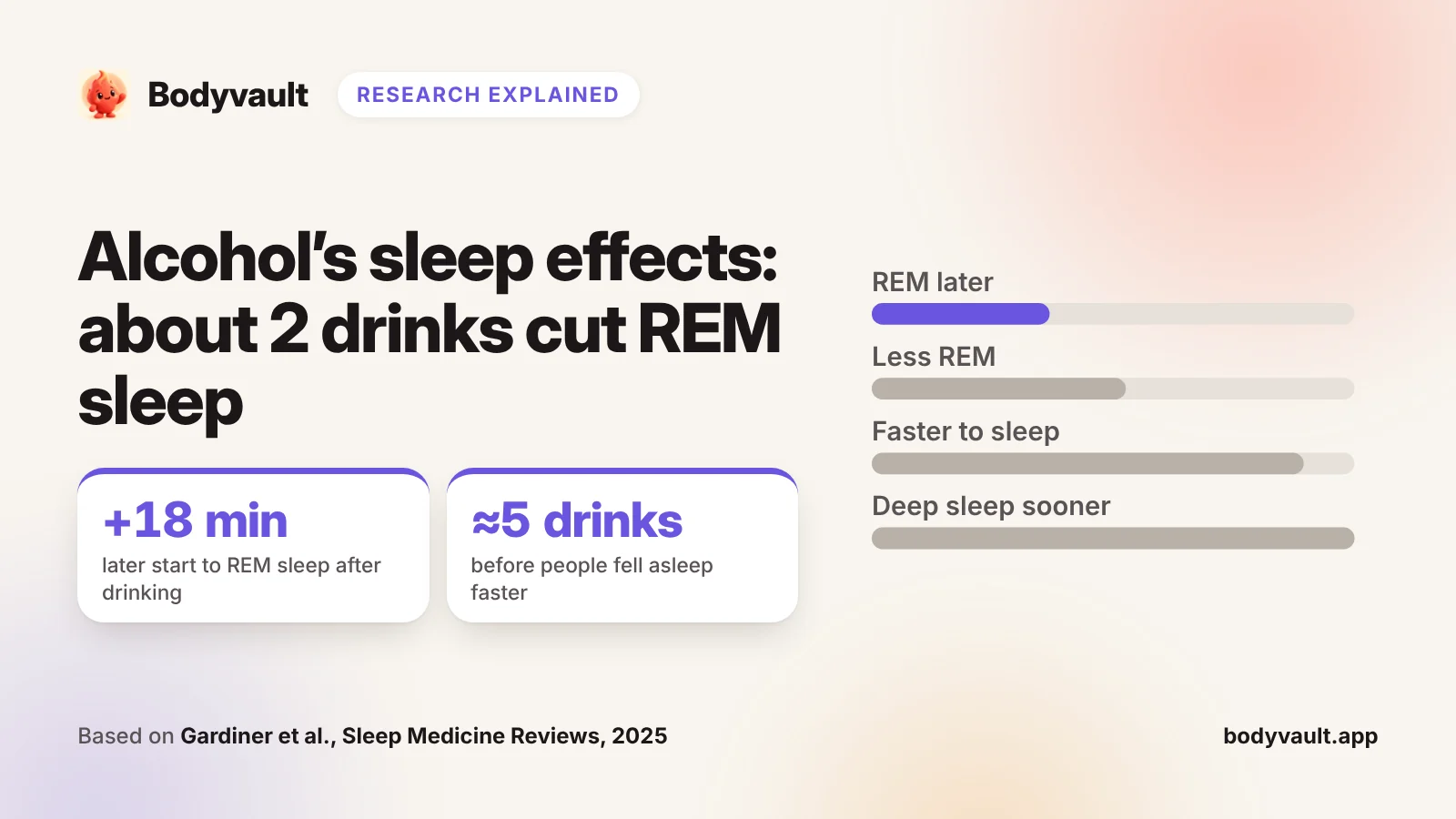
The short answer
+18min
Later start to REM (dream) sleep after drinking, across 27 lab studies
−11min
Less REM sleep in the night
≈2drinks
Where REM sleep began to change, counting 10 g of alcohol a drink for a 62 kg adult
≈5drinks
Needed before people fell asleep faster
Strength of evidenceGood
Two reviews agree that alcohol pushes REM sleep later and cuts it. Most studies were small, short lab trials in young adults, and the effect on total sleep is still unclear.
Key findingA drink may make you drowsy, but it changes the rest of the night. From about two drinks, REM sleep starts later and there is less of it. The more you drink, the bigger the change.
Alcohol’s sleep effects across the night
Sleep comes in stages. Light and deep sleep come first. Then comes REM sleep, short for rapid eye movement, when your eyes move fast under your lids and most dreaming happens. You go through these stages several times a night, and more of your REM sleep comes in the second half.
A 2013 review of the older lab studies described alcohol’s effect in two halves. In the first half of the night, sleep was more solid, with more deep sleep. In the second half, it was more broken. At every dose, the first REM sleep came later than usual.
Why the second half? Alcohol calms the brain at first. As your body breaks it down, that calm wears off. The substances your body makes from alcohol can also make you more alert and warmer, and that can disturb sleep.
What the 2025 review of 27 studies found
The newest review pooled 27 studies of healthy adults aged 18 to 70. In almost all of them, the same people slept after alcohol and after none, so the nights could be fairly compared. A full overnight sleep test in a lab, which records brain waves, breathing and more, measured each night. Most people drank within about 3 hours of bed.
How alcohol changed a night’s sleep, in minutes
- Time until the first REM sleep+18.0 (8.8 to 27.1)
- REM (dream) sleep−11.3 (−20.8 to −1.8)
- Total sleep−10.1 (−24.6 to 4.4)
- Deep sleep−5.7 (−13.8 to 2.5)
- Time awake in the night+4.0 (−2.3 to 10.3)
- Time to fall asleep−2.0 (−4.3 to 0.2)
The clearest change was in REM sleep. It started about 18 minutes later and was about 11 minutes shorter. Its share of the night fell by about 3 points, and light sleep took up a little more. REM normally makes up about 21–30% of a healthy adult’s sleep. So the authors note that a change this size may be small on its own.
The effect on total sleep was unclear. On average, people slept 10 minutes less, but the likely range ran from 25 minutes less to 4 minutes more. Five studies asked people how well they slept. Two found worse sleep, one found better sleep and two found no difference.
How many drinks before sleep changes?
To compare people of different sizes, the review measured alcohol in grams per kilogram of body weight. It turned this into drinks for a 62 kg adult, with 10 g of alcohol in each drink. The more alcohol, the bigger the change.
| Change in sleep | Alcohol per kg | 62 kg adult | 80 kg adult |
|---|---|---|---|
| REM sleep starts later | 0.35 g | 22 g | 28 g |
| Less REM sleep | 0.50 g | 31 g | 40 g |
| Fall asleep faster | 0.85 g | 53 g | 68 g |
| Deep sleep starts sooner | 0.95 g | 59 g | 76 g |
So REM sleep changed at what the review called a low dose. Falling asleep faster, the effect many people drink for, only showed up at high doses. Drinks differ in size and strength, so treat these as rough guides.
That matters because alcohol is a common sleep aid. Surveys cited in the review suggest that about 10–28% of people use it to help them sleep. The authors say this is not a good idea: the dose that sped up sleep also brought more REM loss.
What a wearable study saw in 4,098 people
Lab studies are small, so a Finnish study looked at real life instead. Researchers compared 4,098 working adults’ sleep after days with and without alcohol. Each person wore a chest strap that recorded every heartbeat, and the study looked at the first 3 hours of sleep. This kind of study shows a link. It can’t prove that one thing causes the other.
The more people drank, the faster their heart beat in early sleep. Their HRV, the tiny changes in time between one heartbeat and the next, fell too (see HRV by age for typical values). In this study, a low heart rate and a high HRV marked the body’s “recovery” state. After five drinks, an 80 kg person had about 45 minutes less of it in the first 3 hours of sleep.
Even about one drink went with a small change. Being fit didn’t protect people: active and inactive people showed the same pattern, and so did women and men. Two of the authors worked for the company that made the chest strap.
Alcohol and breathing at night
Sleep apnoea is a condition where your breathing keeps stopping for short spells while you sleep. A 2018 review combined 21 studies. People who drank, or drank more, were about 25% more likely to have sleep apnoea than people who drank less or not at all.
Drinking and the chance of having sleep apnoea
- All 21 studies1.25 (1.13–1.38)
- Studies that allowed for body weight1.41 (1.13–1.75)
- Rich countries1.07 (0.98–1.17)
- Low- and middle-income countries1.47 (1.17–1.85)
Most of these studies looked at a large group of people once. They show a link, not proof, and in rich countries the link was not clear. The likely reason for it is that alcohol relaxes the muscles that keep your throat open. If you snore loudly, stop breathing in your sleep or feel very sleepy in the day, see a doctor.
Claims and evidence
ClaimA nightcap helps you sleep.
EvidenceFalling asleep faster only showed up at about 5 drinks. From about 2 drinks, REM sleep started later and was shorter. Total sleep didn’t clearly change.
ClaimOne or two drinks don’t affect your sleep.
EvidenceIn 4,098 Finnish workers, nights after about one drink came with a slightly faster sleeping heart rate. REM changes were clear from about two drinks.
ClaimBeing fit protects you from alcohol’s effect on sleep.
EvidenceActive and inactive people showed the same rise in sleeping heart rate after drinking.
ClaimYour body makes up the lost REM sleep later in the night.
EvidenceDespite talk of a “rebound”, the 2025 review still found less REM sleep over the whole night.
What this means for you
What this means for you
- For your best sleep, an alcohol-free evening is the simplest choice.
- Don’t use alcohol as a sleep aid. The doses that sped up sleep also cut more REM sleep.
- If you drink, fewer drinks means smaller changes. Drinking earlier may not be enough. In one small study of 10 older men, a small drink 6 hours before bed still added 28 minutes awake.
- Look at your own nights with and without alcohol. Your sleep score and night-time heart rate can show what it does for you.
- This page is about sleep, not a reason to drink. The World Health Organization says no amount of alcohol is safe for health. If you are pregnant, take medicines or have a health condition, ask a doctor about alcohol.
What the research can’t tell you yet
- Small studies. 22 of the 27 lab studies had fewer than 20 people (our count), and 21 had weak spots in how they were run or reported.
- Timing. Most people drank within 3 hours of bed, so we don’t know how early is early enough.
- Women. 12 studies tested only men and 4 only women. One study hinted that women’s sleep may be more affected.
- Regular drinking. Most studies tested single nights, not weeks of drinking.
- Real life. The heart rate and sleep apnoea studies show links, not causes, and relied on people reporting their own drinks.
How Bodyvault uses this research
Bodyvault counts the drinks you log as food, or asks “Any alcohol yesterday?” in the daily check-in. After at least 5 days with alcohol and 5 without, “Your data shows” compares your sleep after drinking with your other nights. It calls a pattern Clear only when the gap is big and steady, and it reminds you that these are patterns, not proof. If it finds a Clear pattern, the Today screen may suggest an alcohol-free evening.
Share or cite this explainer
Bodyvault (2026). Alcohol’s sleep effects: what one drink does to your night. https://bodyvault.app/blog/alcohol-and-sleep
The charts on this page may be reused with a link back to it. The underlying data belong to the studies cited below.
Questions
Does alcohol affect sleep?
Yes. In a 2025 review of 27 lab studies, alcohol delayed REM (dream) sleep by about 18 minutes and cut it by about 11 minutes. The changes began at about two drinks and grew with more. Its effect on total sleep time was unclear.
Does alcohol help you sleep?
Not really. People fell asleep faster only after about five drinks, and those doses cut more REM sleep. The review’s authors say alcohol is not a good sleep aid.
How does alcohol affect REM sleep?
It pushes the first REM sleep later and leaves less of it. In the 2025 review, REM started about 18 minutes later and was about 11 minutes shorter. The more alcohol, the bigger the change.
Why do I wake up in the night after drinking?
As your body clears alcohol, its calming effect wears off, so the second half of the night tends to be more broken. Alcohol is also linked with sleep apnoea, where breathing stops for short spells.
How long before bed should I stop drinking?
Research can’t say yet, because most studies gave alcohol within 3 hours of bed. In one small study, a small drink 6 hours before bed still added about 28 minutes awake. Fewer drinks is a surer way to protect your sleep.
Sources
- Gardiner C et al. (2025). The effect of alcohol on subsequent sleep in healthy adults: a systematic review and meta-analysis. Sleep Med Rev 80:102030.
- Ebrahim IO et al. (2013). Alcohol and sleep I: effects on normal sleep. Alcohol Clin Exp Res 37(4):539–549.
- Pietilä J et al. (2018). Acute effect of alcohol intake on cardiovascular autonomic regulation during the first hours of sleep in a large real-world sample of Finnish employees: observational study. JMIR Ment Health 5(1):e23.
- Simou E, Britton J, Leonardi-Bee J (2018). Alcohol and the risk of sleep apnoea: a systematic review and meta-analysis. Sleep Med 42:38–46.
- World Health Organization Regional Office for Europe (2023). No level of alcohol consumption is safe for our health. News release, 4 January 2023.
General information about fitness and nutrition, not medical advice. If you have a health condition, are pregnant or take medication, talk to your doctor before changing your diet or training.