
Research explained
Overtraining symptoms: is it real, and how do you spot it?
Common overtraining symptoms are tiredness that doesn’t lift, performance that keeps falling and a low mood. After a hard block, this is usually overreaching, which clears in about 2 weeks of easier training. True overtraining syndrome lasts longer and is hard to prove.
The short answer
≈2 weeks
Usual recovery from overreaching, the short-term tiredness after hard training
3–4+ weeks
How long performance stays down before doctors consider overtraining syndrome
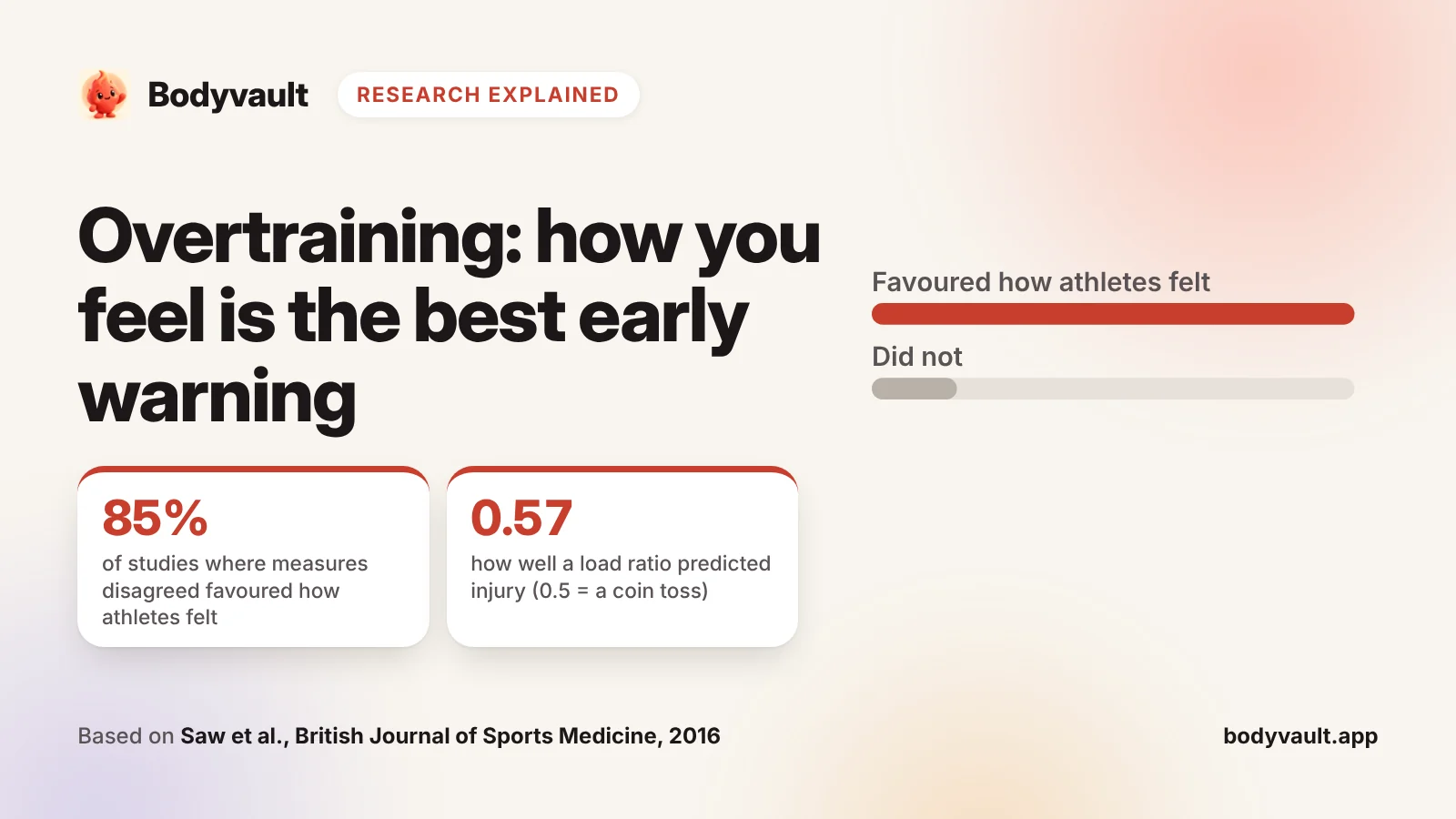
85%
Studies that favoured how athletes felt, where self-ratings and lab or device measures disagreed
0.57
How well a popular training-load ratio predicted injury, where 0.5 is a coin toss
Strength of evidenceLimited
Overtraining is hard to study, and most studies are small. A 2022 review rated the evidence on diagnosis as low. The research on self-ratings is more consistent.
Key findingFeeling worn out for a week or two after hard training is normal, and it usually passes with easier training. If your performance stays down for weeks, see a doctor to rule out other causes. No single test or app score can diagnose overtraining.
Overreaching vs overtraining: what’s the difference?
Training works by stressing your body, then letting it recover and adapt. When the stress outweighs recovery for a while, scientists describe three stages. They differ mainly in how long it takes to bounce back.
| Stage | What happens | Typical recovery |
|---|---|---|
| Functional overreaching | A short dip in performance after hard training, then a rebound to a higher level | Up to about 2 weeks |
| Non-functional overreaching | A longer dip with no rebound, when training and recovery stay out of balance | Up to about 3–4 weeks |
| Overtraining syndrome | Performance stays down for more than 3–4 weeks, often with lasting tiredness and low mood | Thought to take months, sometimes years |
The first stage is part of normal hard training. For elite athletes, it is often seen as a normal result of a tough block. The trouble starts when the tiredness doesn’t lift with rest.
Telling the later two stages apart is very difficult, because the signs are often the same. Experts from the European and American colleges of sports medicine say it depends on how things turn out, and on ruling out other causes.
Is overtraining real?
Yes, but it is harder to pin down than the word suggests. A 2004 review found that most studies labelled “overtraining” had really studied overreached athletes. It concluded that the evidence supports the syndrome, but more research is needed to be certain.
A 2022 review mapped every study that tried to diagnose it. It found 39 reports on 328 athletes with the syndrome. Eight of the reports described a single person, and most athletes did endurance sports. The reviewers rated the evidence as low.
There is still no gold-standard test. Doctors diagnose overtraining syndrome by ruling other things out. In one research project, none of 117 possible markers could tell affected athletes from healthy ones on its own.
Overtraining symptoms: the signs to watch
The main signs and symptoms of overtraining are tiredness that won’t go away, performance that keeps falling, and changes in mood. In questionnaires, athletes with the syndrome reported more fatigue, tension, anger, low mood and confusion. They also reported less vigour, which means energy and drive.
A 2016 review found that these everyday ratings change with training load, so they are worth checking:
- Energy and motivation to train
- Aches, pains and other physical symptoms
- Stress from life outside training
- How recovered and “in shape” you feel
- Your general health and well-being
Earlier advice also suggests watching for irritability, and whether you still want to train and enjoy it. Any of these on its own is common after a hard week. What matters is a pattern that lasts despite easier training. The same signs can also have other causes. Experts list illness or infection, eating too little, too little carbohydrate or protein, low iron or magnesium, and allergies.
That is why a lasting drop needs a doctor’s check. Blood tests can find some of these causes, like low iron, even though they can’t diagnose overtraining itself. If your iron is low, tea and coffee with meals matter too: see coffee and iron absorption.
How do you know if you’re overtraining?
Start with how you feel. A 2016 review asked a simple question. Which tracks an athlete’s response to training better: how they feel, or lab and device tests? It found 56 studies that measured both at the same time.
Self-ratings got worse when training suddenly rose, and during long periods of hard training. They got better when training was cut back. Most blood and heart measures didn’t respond so clearly.
Lab tests still have a job. They can find medical problems, like an infection or low iron. But for day-to-day tracking, a quick check of how you feel is simple and sensitive. The review suggests comparing each day with your normal: worse, normal or better.
Some watches track HRV (heart rate variability): the tiny changes in time between one heartbeat and the next. In athletes with the syndrome, studies found HRV changed in different directions. Read HRV-guided training for what it can and can’t do, and what a readiness score is.
Can a training-load ratio predict injury?
A popular idea in sport compares your training this week with your recent average. It is called the acute:chronic workload ratio. “Acute” means the last week. “Chronic” means your average week over the last three to six weeks.
A 2016 review helped make the idea popular. It argued that sudden spikes in training, not hard training itself, cause many injuries. It called a ratio of 0.8 to 1.3 the “sweet spot” and 1.5 or more the “danger zone”. In elite cricket fast bowlers, the chance of injury in the next week was about 4% at a ratio under 1. At 1.5 or more, it was 2 to 4 times higher.
Later papers found several problems with the ratio:
- A 2020 review found no study that had tested whether changing the ratio changes injury rates. It said the ratio’s maths can create false patterns.
- Another 2020 review noted that the International Olympic Committee had recommended the ratio. But the ratio behaves oddly when you first start tracking, or when you plan an easier week.
- A 2021 study re-ran a published analysis with made-up numbers in place of the real “chronic” load. The link with injury looked almost the same.
An odds ratio of 2 means about twice the odds of injury. The same study then checked how well the ratio predicted who got injured. On a scale where 0.5 is a coin toss and 1 is perfect, it scored 0.57.
So the ratio can describe how much your training changed. It can’t reliably tell you whether you will get injured. Building up step by step is still sensible, because hard training needs matching recovery.
Claims and evidence
ClaimA blood test can diagnose overtraining.
EvidenceNo single marker meets the criteria to diagnose it. In one research project, none of 117 possible markers told affected athletes from healthy ones on its own.
ClaimFeeling wrecked after a hard week means you are overtrained.
EvidenceShort-term overreaching usually clears in about 2 weeks. Overtraining syndrome means performance stays down for more than 3–4 weeks.
ClaimKeep your acute:chronic ratio between 0.8 and 1.3 and you won’t get injured.
EvidenceRatios built with made-up numbers gave almost the same link with injury. The ratio predicted injuries only a little better than a coin toss (0.57, where 0.5 is chance).
ClaimYour watch knows how recovered you are better than you do.
EvidenceAcross 56 studies, athletes’ own ratings tracked training load more sensitively and consistently than most blood and heart measures.
What this means for you
What this means for you
- Check in with yourself each morning. Rate your energy, mood, soreness and stress against your normal.
- After a hard block, plan an easier week. Most short-term tiredness clears within about 2 weeks. Read how a deload week works.
- If your performance and mood stay down for 3–4 weeks despite easier training, see a doctor. They can check for illness, low iron and eating too little.
- Build up your training step by step. Treat load ratios as a rough guide to how much things changed, not an injury forecast.
- Stop and get medical help for chest pain, fainting or unusual breathlessness during exercise.
What the research can’t tell you yet
- No gold-standard test. Overtraining syndrome is still diagnosed by ruling other causes out.
- Small studies. Many reports describe a handful of athletes, and some only one person.
- Who was studied. Mostly men in endurance sports. Few studies included women.
- Summaries only. Several key papers are behind paywalls, so we relied on their published abstracts.
- Team sports. Most load-ratio research comes from team sports, not from gym-goers or recreational runners.
How Bodyvault uses this research
Bodyvault does use a load ratio: your last 7 days against your usual week over the past 28. Your daily Load target keeps it at or below 1.3, or 1.4 on a “Go for it” day. In Readiness, part of Bodyvault Pro, weekly sets above 1.3 times your usual can take points off. Coach also flags weeks when your sets jump by over 30%. As these studies show, the ratio describes change but can’t reliably predict injury, so weigh it against how you feel.
Share or cite this explainer
Bodyvault (2026). Overtraining symptoms: is it real, and how do you spot it? https://bodyvault.app/blog/overtraining
The charts on this page may be reused with a link back to it. The underlying data belong to the studies cited below.
Questions
What is overtraining?
Overtraining syndrome is a lasting drop in performance, with tiredness and mood changes. It follows a long spell of too much training and other stress, and too little recovery. Performance stays down for more than 3–4 weeks, and other causes have been ruled out.
How do you know if you’re overtraining?
Look for a pattern that lasts: falling performance, tiredness that rest doesn’t fix, low mood or motivation, and lingering soreness. If it lasts 3–4 weeks despite easier training, see a doctor to rule out other causes.
Is overtraining real?
Yes, but it is hard to diagnose. Most research labelled “overtraining” really studied short-term overreaching. There is still no single test for the syndrome.
How long does it take to recover from overtraining?
Short-term overreaching usually clears in about 2 weeks, and longer overreaching within about 3–4 weeks. Overtraining syndrome is thought to take months, sometimes years.
What is the difference between overreaching and overtraining?
Overreaching is a dip in performance that recovers within weeks, often with a rebound. Overtraining syndrome lasts longer than 3–4 weeks, with no rebound.
Sources
- Halson SL, Jeukendrup AE (2004). Does overtraining exist? An analysis of overreaching and overtraining research. Sports Med 34(14):967–981.
- Meeusen R et al. (2013). Prevention, diagnosis, and treatment of the overtraining syndrome: joint consensus statement of the European College of Sport Science and the American College of Sports Medicine. Med Sci Sports Exerc 45(1):186–205.
- Carrard J et al. (2022). Diagnosing overtraining syndrome: a scoping review. Sports Health 14(5):665–673.
- Saw AE, Main LC, Gastin PB (2016). Monitoring the athlete training response: subjective self-reported measures trump commonly used objective measures: a systematic review. Br J Sports Med 50(5):281–291.
- Gabbett TJ (2016). The training-injury prevention paradox: should athletes be training smarter and harder? Br J Sports Med 50(5):273–280.
- Impellizzeri FM et al. (2020). Acute:chronic workload ratio: conceptual issues and fundamental pitfalls. Int J Sports Physiol Perform 15(6):907–913.
- Impellizzeri FM et al. (2021). What role do chronic workloads play in the acute to chronic workload ratio? Time to dismiss ACWR and its underlying theory. Sports Med 51(3):581–592.
- Wang C et al. (2020). Analyzing activity and injury: lessons learned from the acute:chronic workload ratio. Sports Med 50(7):1243–1254.
General information about fitness and nutrition, not medical advice. If you have a health condition, are pregnant or take medication, talk to your doctor before changing your diet or training.