
Research explained
What does creatine do? Benefits beyond muscle
What does creatine do? It helps your muscles remake energy quickly during short, hard efforts. With training, that adds a little extra strength and muscle, most clearly in young adults. Benefits for the brain are not proven.
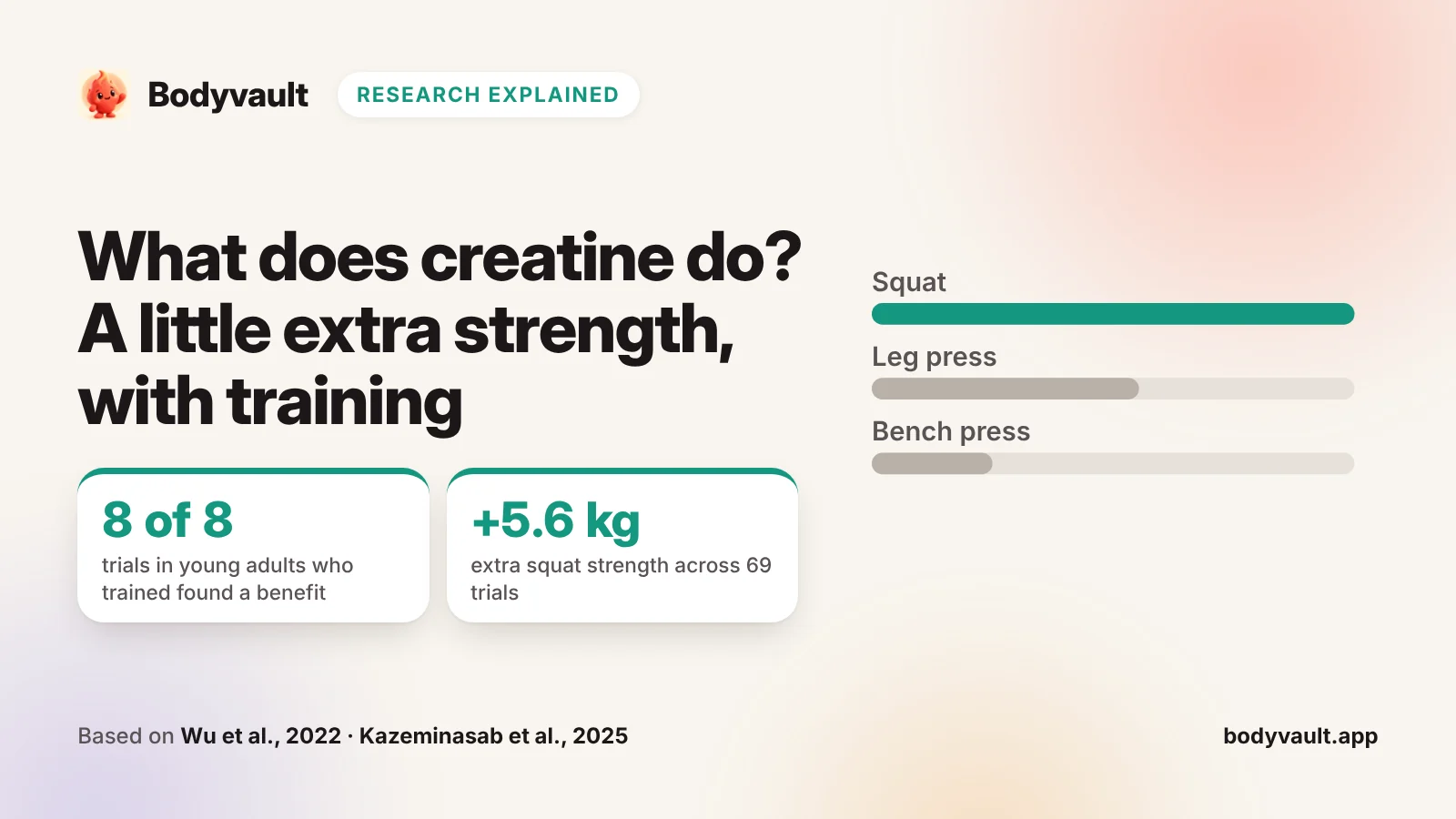
The short answer
8 of 8
Trials in healthy young people who trained that found more strength or muscle with creatine
+5.6kg
Extra squat strength with creatine and training, compared with a dummy powder, across 69 trials
1–3g
Creatine your body uses each day. About half comes from food such as meat and fish.
Not shown
That creatine improves thinking in healthy adults, said Europe’s food safety agency in 2024
Strength of evidenceStrong for strength
Many trials and reviews agree that creatine adds to the strength you gain from training. The evidence for women, older adults and the brain is thinner.
Key findingCreatine adds a little to the strength and muscle you build by training. It worked in every recent trial of healthy young people who trained, but less clearly in older adults or without training. Women benefit too, though there are fewer trials. Brain benefits are possible but not proven.
What does creatine do in your body?
Creatine is a natural substance your body makes from amino acids, the building blocks of protein. About 95% of it is in your muscles. You use about 1–3 g a day. Around half comes from food, mainly meat and fish, and your liver and kidneys make the rest. A pound (about 450 g) of raw beef or salmon has 1–2 g.
Your muscles store creatine as phosphocreatine. During a sprint or a heavy lift, it quickly remakes ATP, the molecule your muscles use for energy. On a normal diet, your muscle stores are about 60–80% full. Supplements fill them up, raising muscle creatine by 20–40%. That lets you do a little more work in short, hard efforts, and over weeks of training, that adds up.
Vegetarians start with lower stores, so they may gain more from a supplement. If you don’t eat meat or fish, see whey vs plant protein too.
| Method | Dose | Time to fill your muscle stores |
|---|---|---|
| Loading | 5 g four times a day (about 20 g), then 3–5 g a day | 5–7 days |
| No loading | 3 g a day | About 28 days |
Creatine for muscle and strength
A 2022 review looked at 16 trials from 2012 to 2021, with 456 people. In healthy young people, creatine helped in all 8 trials, whether or not they had trained before. In other groups, it rarely helped.
An earlier review of 53 trials with 1,138 people found the same for the upper body. Creatine gave a small extra gain in bench and chest press. The benefit didn’t depend on age, sex, dose or how long people took it.
Creatine for women
Most creatine research has been done in men. In the 16-trial review above, 393 people were men and 63 were women. A 2021 review by creatine researchers looked at the trials in women. Two of its authors advise a creatine maker, which also paid its publishing fee.
In one 10-week trial, untrained women who took creatine while training gained 20–25% more leg strength than women on a dummy powder. They also gained more lean mass, which is everything in the body except fat: 2.6 kg vs 1.6 kg. In 14 female soccer players, squat strength rose 24% with creatine and 12% without it. But not every trial found an extra benefit.
Women can use the same doses as men. A loading phase raised muscle creatine by 19% in women, much as in men. After menopause, most trials that combined creatine with weight training found more muscle and strength. Results for bone were mixed. There are no human trials in pregnancy.
The pooled numbers are less clear. In the 69-trial review, women’s gains were small or uncertain, partly because there were few trials. For example, extra squat strength was 6.4 kg in men, from 20 study groups, but 1.6 kg in women, from just 5.
Strength training itself matters most. Read more in strength training for women.
Creatine and your brain
A small share of your creatine is in your brain, which is why people hope it helps thinking. A 2024 review pooled 16 trials with 492 adults. Creatine seemed to help memory a little, and the reviewers rated this as moderate certainty. Effects on attention and speed were less certain. Overall thinking didn’t clearly change.
Later in 2024, Europe’s food safety agency (EFSA) looked at the evidence for a creatine maker. The company wanted to claim that creatine improves thinking. EFSA found that 10 trials in healthy people didn’t show a consistent effect. Memory gains seen at 20 g a day for about a week didn’t appear at 2.2–14 g a day. EFSA also said the 2024 review had counted some people more than once. Its verdict: a cause-and-effect link has not been shown.
One small trial tested creatine during a night without sleep. Fifteen healthy young adults stayed awake for about 21 hours in a lab. On different nights, they took one very large dose of creatine, 0.35 g per kg, or a dummy powder. That’s about 28 g for an 80 kg adult (our calculation), or 6–9 times a usual 3–5 g dose.
With creatine, they felt 8% less tired and did better on memory and speed tests. The effect peaked about 4 hours after the dose. But it was one small study with many tests, the dose was very high, and the creatine was supplied by its maker.
Creatine before bed, and creatine and sleep
Creatine works by slowly filling your muscle stores: in about a week with loading, or about 4 weeks at 3 g a day. That’s why research focuses on taking it every day, not on the time of day. The studies in this explainer didn’t test taking creatine at bedtime, and none measured normal sleep.
So pick a time you’ll remember, such as with a meal. The sleep-loss study above doesn’t mean creatine can make up for lost sleep. For that, see sleep debt.
Creatine for older adults
As we age, we lose muscle and strength. A 2025 review by creatine researchers looked at healthy older adults who did weight training. It says creatine, at 3 g a day or more, added about 1.2 kg more lean mass than training alone. But in the 16-trial review, only 1 of 4 trials in older adults found a benefit. Most of the 2025 review’s authors have ties to creatine makers. Read more in keeping your muscle as you age.
Claims and evidence
ClaimCreatine builds muscle on its own.
EvidenceGains showed up in trials where people trained. In 2 trials with an arm or leg in a cast, creatine didn’t protect muscle or strength.
ClaimCreatine is only for men.
EvidenceTrials in women found strength gains too, but there are far fewer of them. Pooled results in women were smaller or unclear, mainly because so few trials exist.
ClaimCreatine makes you smarter.
EvidenceA 2024 review found a small memory benefit. But Europe’s food safety agency found no consistent effect in 10 trials in healthy people.
ClaimYou have to take creatine right after training, or at night.
EvidenceThe studies here didn’t test timing. Creatine works by filling your muscle stores over days to weeks, which is why daily use is the focus.
What this means for you
What this means for you
- Most research uses 3–5 g a day. A loading phase of about 20 g a day for 5–7 days is optional: it only fills your stores faster.
- Take it at a time you’ll remember. Daily use is what fills your stores.
- Keep training. Creatine adds a little to what training builds; it doesn’t replace it. Track your lifts with the one-rep max calculator.
- Expect your weight to go up a little at first. Weight gain, mostly water, is the only side effect seen consistently.
- If you have kidney disease, are pregnant or breastfeeding, or take medicines, talk to a doctor or pharmacist first. Creatine can raise a kidney blood test, so tell your doctor you take it (see creatine, hair and kidneys). Choose products tested by an independent lab.
What the research can’t tell you yet
- Mostly young men. Women made up 63 of 456 people in one review, and older adults had mixed results.
- Brain studies are small. Many used high doses, and some were linked to creatine makers.
- Timing and sleep. The studies here didn’t test bedtime use or measure normal sleep.
- Industry ties. Many creatine reviews are written by researchers who advise creatine makers or get money from them.
How Bodyvault uses this research
Bodyvault’s creatine card grades it A, for strength and lean mass alongside training. It suggests 3–5 g a day with loading optional, and says taking it daily matters more than timing. Its cautions cover early water weight, kidney blood tests and kidney disease. It makes no claims about the brain.
Share or cite this explainer
Bodyvault (2026). What does creatine do? Benefits beyond muscle. https://bodyvault.app/blog/creatine-benefits
The charts on this page may be reused with a link back to it. The underlying data belong to the studies cited below.
Questions
What does creatine do?
It helps your muscles quickly remake energy during short, hard efforts like sprints and heavy lifts. Over weeks of training, that adds a little extra strength and muscle. Your body makes some creatine and gets more from meat and fish.
Can I take creatine before bed?
The studies here didn’t test bedtime use. Creatine works by filling your muscle stores over days to weeks, so taking it every day matters most. Choose a time you’ll remember.
Is creatine good for women?
Trials in women found gains in strength and lean mass with training, and the same doses work. But there are far fewer trials in women, and pooled gains were smaller or unclear. If you are pregnant or breastfeeding, talk to your doctor first: there are no human trials in pregnancy.
Does creatine help your brain?
Possibly, but it isn’t proven. A 2024 review found a small memory benefit, but Europe’s food safety agency found no consistent effect in trials in healthy people.
Does creatine affect sleep?
The studies here didn’t measure normal sleep. In one small lab study, a very large single dose helped young adults think faster during a night without sleep. That doesn’t mean everyday doses improve sleep or replace it.
Sources
- Wu SH et al. (2022). Creatine supplementation for muscle growth: a scoping review of randomized clinical trials from 2012 to 2021. Nutrients 14(6):1255.
- Kazeminasab F et al. (2025). The effects of creatine supplementation on upper- and lower-body strength and power: a systematic review and meta-analysis. Nutrients 17(17):2748.
- Lanhers C et al. (2017). Creatine supplementation and upper limb strength performance: a systematic review and meta-analysis. Sports Med 47(1):163–173.
- Smith-Ryan AE et al. (2021). Creatine supplementation in women’s health: a lifespan perspective. Nutrients 13(3):877.
- Gordji-Nejad A et al. (2024). Single dose creatine improves cognitive performance and induces changes in cerebral high energy phosphates during sleep deprivation. Sci Rep 14(1):4937.
- Xu C et al. (2024). The effects of creatine supplementation on cognitive function in adults: a systematic review and meta-analysis. Front Nutr 11:1424972.
- EFSA Panel on Nutrition, Novel Foods and Food Allergens (2024). Creatine and improvement in cognitive function: evaluation of a health claim pursuant to Article 13(5) of Regulation (EC) No 1924/2006. EFSA J 22(11):e9100.
- Candow DG et al. (2025). Creatine monohydrate supplementation for older adults and clinical populations. J Int Soc Sports Nutr 22(sup1):2534130.
- Kreider RB et al. (2017). International Society of Sports Nutrition position stand: safety and efficacy of creatine supplementation in exercise, sport, and medicine. J Int Soc Sports Nutr 14:18.
General information about fitness and nutrition, not medical advice. If you have a health condition, are pregnant or take medication, talk to your doctor before changing your diet or training.