
Research explained
Sarcopenia: how to keep your muscle as you age
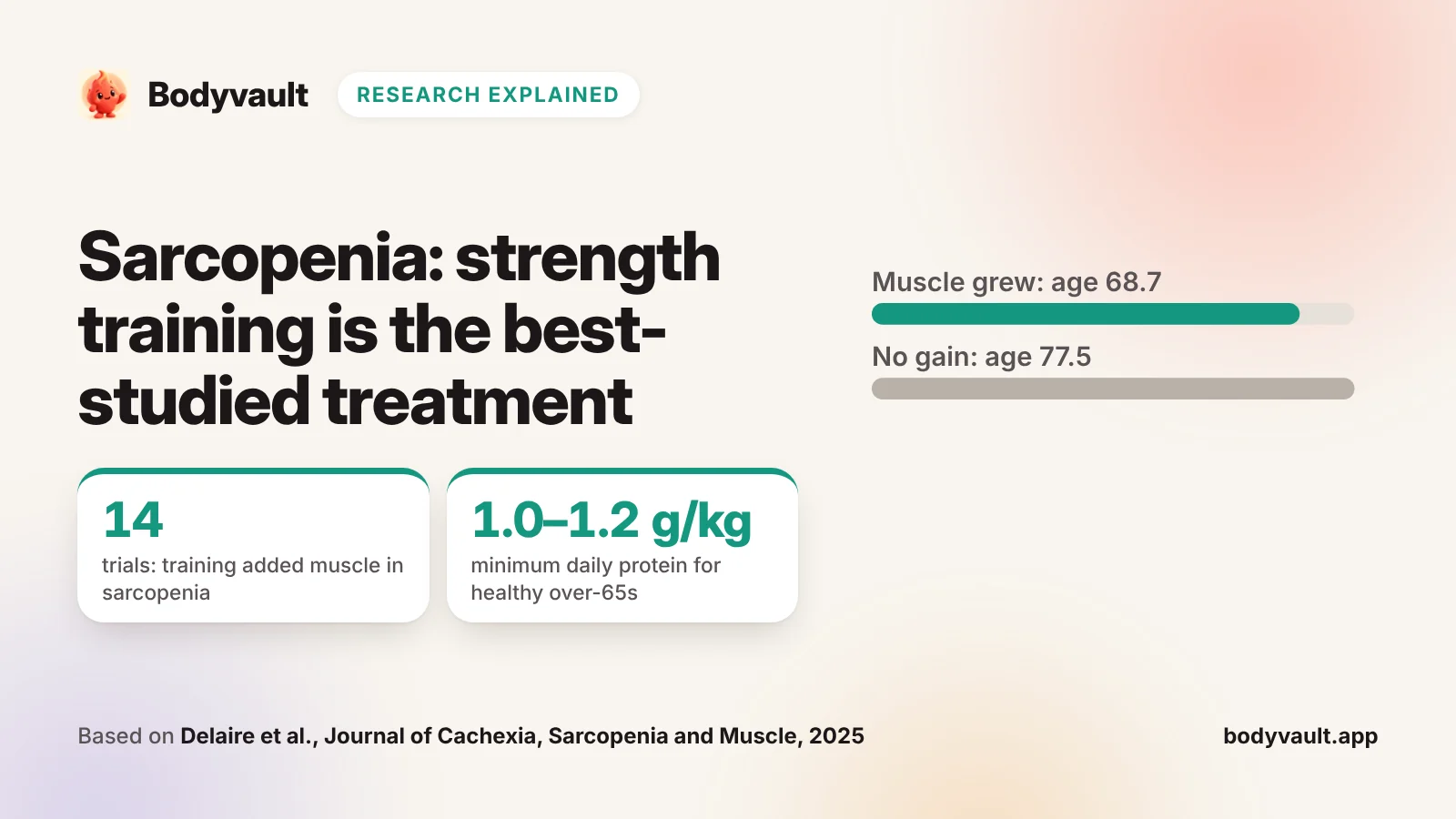
Sarcopenia is the loss of muscle and strength that comes with age. Strength training is the best-studied treatment: in a 2025 review of 14 trials, it added muscle in people already diagnosed. Eating enough protein helps too.
The short answer
1–2%
Leg muscle lost each year after age 50, in studies reviewed by European experts. Strength falls 1.5–5% a year
14
Trials in a 2025 review where strength training added muscle in older adults with sarcopenia
1.0–1.2g/kg
Minimum daily protein that experts advise for healthy adults over 65, per kg of body weight
17–21%
Fewer falls in older adults who exercised, in two large reviews
Strength of evidenceGood
Expert groups and many trials agree that strength training helps older muscles. Protein advice comes from expert panels. Supplements such as creatine and whey have smaller and less certain effects.
Key findingStrength training two or three times a week, with enough protein, is the best-supported way to keep muscle as you age. Supplements are extras, not replacements.
What is sarcopenia?
Sarcopenia means loss of muscle and strength with age. European experts updated its definition in 2019. They call it a muscle disease that makes falls, broken bones, disability and early death more likely. It now has its own medical diagnosis code.
Doctors check three things, in this order:
- Strength. Low strength means sarcopenia is likely. Doctors often test grip strength, or how fast you can stand up from a chair five times.
- Muscle amount. A scan showing low muscle confirms it.
- Physical performance. If you also walk slowly or do poorly on other tests, it is severe.
| Test | Men | Women | What it shows |
|---|---|---|---|
| Grip strength | under 27 kg | under 16 kg | Low strength |
| Standing up from a chair 5 times | more than 15 seconds | more than 15 seconds | Low leg strength |
| Muscle in arms and legs (scan) | under 20 kg | under 15 kg | Low muscle |
| Walking speed | 0.8 m/s or slower | 0.8 m/s or slower | Severe sarcopenia |
Only a doctor can diagnose sarcopenia. A 5-question form called SARC-F can help spot people who should be tested.
How common is it? The National Strength and Conditioning Association (NSCA) estimates it affects about 1 in 10 adults over 60, and more than half of adults over 80. Muscle loss usually starts after age 30 and speeds up after 60.
What causes sarcopenia?
Ageing is the main cause. When no other cause is found, experts call it primary sarcopenia. It can also come from illness, from not moving enough, or from eating too little food or protein. That is called secondary sarcopenia.
Ageing muscles also respond less to the protein you eat. Experts call this anabolic resistance. Moving less for a short time, such as two weeks of fewer steps, can make it worse.
After age 50, people lose about 1–2% of their leg muscle and 1.5–5% of their strength each year, in studies reviewed by the European experts. The NSCA says strength falls 2 to 5 times faster than muscle size.
Can sarcopenia be reversed with strength training?
Experts call strength training the most powerful treatment for sarcopenia that doesn’t involve a drug. A 2025 review pooled 14 trials with 528 people already diagnosed with sarcopenia. They were 73 on average, and 73% were women. Strength training alone, without diet changes, added muscle compared with no training.
Age mattered most. In trials where muscle grew, people were about 69 on average. In trials where it didn’t, they were about 78. None of the trials in people aged 80 and over, all in care homes, increased muscle size.
That doesn’t mean it’s too late at 80. The NSCA says strength still improves in people over 85. In a classic study, nursing home residents over 90 gained muscle, strength and walking speed after 8 weeks of heavy training. Still, younger people gained more muscle, which is a good reason not to wait.
Strength training for sarcopenia: how to start
The NSCA’s 2019 position statement is advice written by a panel of experts after reviewing the research. Multi-joint exercises, such as squats and presses, move several joints at once. Here is what the NSCA advises for older adults:
| What | NSCA advice |
|---|---|
| How often | 2–3 times a week |
| Exercises | 1–2 multi-joint exercises for each major muscle group |
| Sets | 2–3 sets of each |
| How heavy | Work up to 70–85% of the most you can lift once |
| How to start | Begin around 55% and build up; frail adults can start at 20–30% |
| Power | Add some fast lifts with lighter weights (40–60%) |
| Effort | No need to go to failure |
Add balance work too. The World Health Organization (WHO) advises adults over 65 to do varied activity with balance and strength training. It suggests 3 or more days a week, to help prevent falls. Falls are common: in the US, about 30% of older adults fall at least once a year.
Is it safe? The NSCA says well-planned strength training is safe for healthy older adults. In 20 studies of 2,544 frail people aged 70 and over, there was just one case of shoulder pain. But some conditions need a doctor’s OK first, such as very high blood pressure or unstable heart disease.
Diet for sarcopenia: how much protein?
Older muscles need more protein to respond. Two expert groups advise healthy adults over 65 to eat at least 1.0–1.2 g of protein per kg of body weight a day. The usual adult allowance is 0.8 g/kg. For a 70 kg person, 1.0–1.2 g/kg is 70–84 g a day (our calculation).
Many older adults fall short. In Europe, up to 10% of older adults living at home and 35% of those in care eat less than 0.7 g/kg a day. Older adults who ate about 1.1 g/kg lost less muscle than those eating 0.7–0.9 g/kg.
Kidney disease is the big exception. People with severe kidney disease who aren’t on dialysis, a treatment where a machine cleans the blood, may need to limit protein. If you have kidney disease, ask your doctor what is right for you.
To spread protein over the day, see how much protein per meal. To work out your own number, use the protein calculator.
Do whey protein, creatine or fish oil help?
Whey protein. A 2024 review pooled 10 trials with 1,154 people with sarcopenia, aged 72 to 84 on average. Whey shakes, often with vitamin D, added a little muscle and improved walking speed. Grip strength only rose when people also did strength training, and whey added little on top of training. For protein sources, see whey vs plant protein.
Creatine. A 2017 review pooled 22 trials with 721 older adults. Creatine taken during strength training added about 1.4 kg more lean mass than a dummy pill. Lean mass is everything except fat, so it includes water as well as muscle. A 2025 review by creatine researchers, some with industry ties, found no extra benefit in frail older adults. Creatine can raise a kidney blood test called creatinine. In older adults, this seems to come from the creatine itself, not from kidney damage, so tell your doctor you take it. Read more in what creatine does.
Fish oil. A 2021 review found small gains in muscle mass with omega-3 supplements. But most trials were in people with illnesses such as cancer, and two of the authors work for a company that makes omega-3. See fish oil benefits.
Talk to a doctor or pharmacist before taking a supplement if you take medicines or have a health condition. Supplement quality varies.
Claims and evidence
ClaimLosing muscle with age can’t be stopped.
EvidenceEuropean experts say exercise and nutrition seem to slow or even reverse sarcopenia. In 14 trials, strength training added muscle in people already diagnosed.
ClaimOlder people should only lift very light weights.
EvidenceThe NSCA advises working up to 70–85% of the most you can lift once, after starting lighter. Frail adults can start at 20–30% and build up.
ClaimA protein shake can replace exercise.
EvidenceWhey added a little muscle in people with sarcopenia, but strength only rose with training. Protein works best alongside strength training.
ClaimStrength training is dangerous for older people.
EvidenceThe NSCA calls well-planned training safe for healthy older adults. In 20 studies of 2,544 frail older people, there was one case of shoulder pain.
What this means for you
What this means for you
- Do strength training 2–3 times a week, working all your main muscles. Start light and build up over weeks.
- Add balance work. From age 65, aim for 3 or more days a week of balance and strength activity.
- Eat at least 1.0–1.2 g of protein per kg of body weight a day, spread over your meals, unless your doctor advises otherwise.
- Treat supplements as extras. Training and food come first.
- See a doctor before you start if you have heart, joint or balance problems, very high blood pressure or kidney disease.
What the research can’t tell you yet
- Small trials. The sarcopenia review had only 14 trials, and their results varied a lot.
- Short studies. Most programmes lasted about 12 weeks. We know less about years of training.
- Who was studied. Most sarcopenia trials came from Asia, and most people were women. The very old and people in care homes are under-studied.
- Expert advice. Protein targets come from expert panels, not from long trials that compare different amounts.
- Measuring muscle. Studies measured muscle in different ways, which makes them hard to compare.
How Bodyvault uses this research
Bodyvault doesn’t diagnose sarcopenia, and it doesn’t change its plans or targets by age. Your protein target starts at 1.6–2.0 g per kg of body weight, depending on your goal. That is above the 1.0–1.2 g/kg minimum these experts advise, and you can set it from 0.8 to 3.0 g/kg. If you have kidney disease, ask your doctor before raising it. Bodyvault Pro’s generated plans start new and beginner lifters at least 2 reps short of failure. They can also leave out exercises that strain a sore knee, hip, shoulder or lower back.
Share or cite this explainer
Bodyvault (2026). Sarcopenia: how to keep your muscle as you age. https://bodyvault.app/blog/sarcopenia
The charts on this page may be reused with a link back to it. The underlying data belong to the studies cited below.
Questions
What is sarcopenia?
Sarcopenia is the loss of muscle and strength that comes with age. European experts define it as low muscle strength, confirmed by low muscle mass. It makes falls, broken bones and disability more likely.
Can sarcopenia be reversed?
It can often be improved. In a 2025 review of 14 trials, strength training added muscle in people with sarcopenia, though gains were smaller in older people. Strength can still improve in people in their 90s.
What causes sarcopenia?
Mostly ageing, together with not moving enough. Illness and eating too little food or protein can also cause it or make it worse.
How can you prevent sarcopenia?
Do strength training two or three times a week and add balance work. Eat at least 1.0–1.2 g of protein per kg of body weight a day. European experts advise building muscle when young, keeping it in midlife and limiting losses later.
What is the best exercise for sarcopenia?
Strength training has the best evidence, ideally with balance work. The NSCA advises 2–3 sets of multi-joint exercises, 2–3 times a week, working up to fairly heavy weights. Start light, and see a doctor first if you have heart, joint or balance problems.
Sources
- Cruz-Jentoft AJ et al. (2019). Sarcopenia: revised European consensus on definition and diagnosis. Age Ageing 48(1):16–31.
- Delaire L et al. (2025). Influence of resistance training variables to improve muscle mass outcomes in sarcopenia: a systematic review with meta-regressions. J Cachexia Sarcopenia Muscle 16(6):e70162.
- Fragala MS et al. (2019). Resistance training for older adults: position statement from the National Strength and Conditioning Association. J Strength Cond Res 33(8):2019–2052.
- Bauer J et al. (2013). Evidence-based recommendations for optimal dietary protein intake in older people: a position paper from the PROT-AGE Study Group. J Am Med Dir Assoc 14(8):542–559.
- Deutz NE et al. (2014). Protein intake and exercise for optimal muscle function with aging: recommendations from the ESPEN Expert Group. Clin Nutr 33(6):929–936.
- Li ML et al. (2024). Improving sarcopenia in older adults: a systematic review and meta-analysis of randomized controlled trials of whey protein supplementation with or without resistance training. J Nutr Health Aging 28(4):100184.
- Chilibeck PD et al. (2017). Effect of creatine supplementation during resistance training on lean tissue mass and muscular strength in older adults: a meta-analysis. Open Access J Sports Med 8:213–226.
- Candow DG et al. (2025). Creatine monohydrate supplementation for older adults and clinical populations. J Int Soc Sports Nutr 22(sup1):2534130.
- Bird JK et al. (2021). The effect of long chain omega-3 polyunsaturated fatty acids on muscle mass and function in sarcopenia: a scoping systematic review and meta-analysis. Clin Nutr ESPEN 46:73–86.
- Bull FC et al. (2020). World Health Organization 2020 guidelines on physical activity and sedentary behaviour. Br J Sports Med 54(24):1451–1462.
General information about fitness and nutrition, not medical advice. If you have a health condition, are pregnant or take medication, talk to your doctor before changing your diet or training.