
Research explained
Fish oil benefits: does it protect your heart?
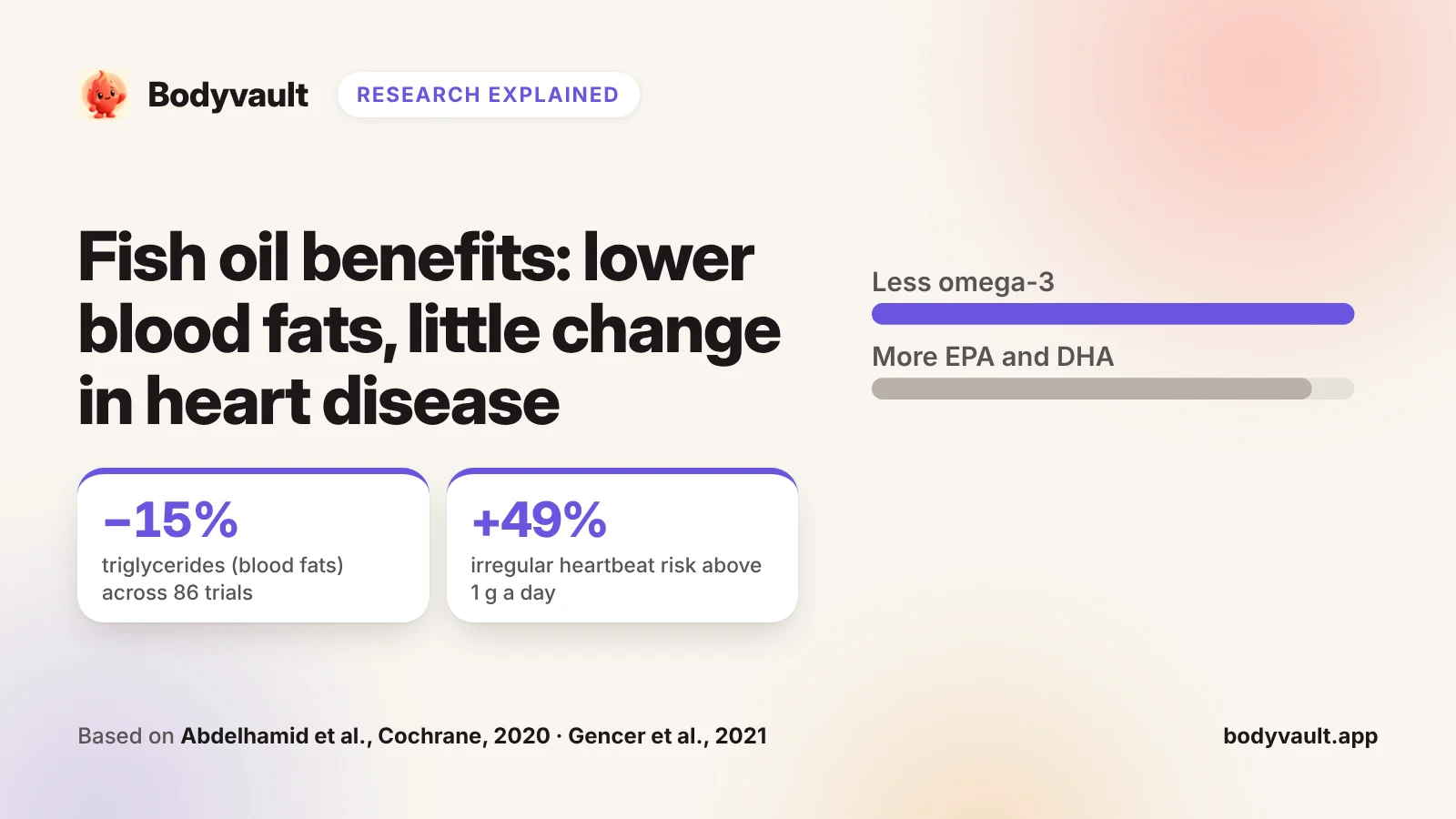
The clearest fish oil benefit is lower triglycerides, a type of fat in the blood: about 15% lower across 86 trials. It made little or no difference to deaths or strokes, and heart disease events may drop only slightly.
The short answer
−15%
Triglycerides, a type of fat in the blood, with fish oil’s omega-3 fats in 86 trials
78
Deaths per 1,000 people with more omega-3, compared with 80 per 1,000 with less: little or no difference
62
Heart disease events per 1,000 people with more omega-3, compared with 68. This small drop is low-certainty evidence.
+49%
Higher risk of an irregular heartbeat in trials using more than 1 g a day
Strength of evidenceGood
Large reviews give high-certainty evidence of little or no effect on deaths, and a clear drop in triglycerides. The small drop in heart disease events, and any benefit for muscle, are less certain.
Key findingFish oil is not a heart shield for most people. It lowers triglycerides and may slightly cut heart disease events. But it did not prevent strokes or deaths overall, and doses above 1 g a day went with more irregular heartbeats.
What is in fish oil?
Fish oil contains omega-3 fats. The two main ones in fish are called EPA and DHA. Plant foods such as flaxseed, walnuts and rapeseed (canola) oil give a different omega-3, called ALA.
Your body can’t make ALA, so it has to come from food. It can turn some ALA into EPA and DHA, but only part of it, and experts still debate how much. So plant omega-3 is not the same as fish oil.
India’s National Institute of Nutrition (ICMR-NIN) says adults need about 2.2 g of omega-3 (ALA) a day. Nuts, oilseeds and a varied diet can supply it, even if you don’t eat fish.
Capsules differ a lot. The one tested in the biggest trial, VITAL, held 1 g of oil. That oil had 840 mg of omega-3: 460 mg of EPA and 380 mg of DHA. So check the EPA and DHA on the label, not just the amount of oil.
Does fish oil protect your heart?
The best summary of the evidence is this Cochrane review. Cochrane reviews are careful reviews of all the trials on one question. This one pooled 86 trials.
More EPA and DHA made little or no difference to deaths, strokes, or heart and blood vessel problems as a whole. The reviewers were very sure about this for deaths and for heart and blood vessel problems.
Heart disease events, such as heart attacks, may have dropped slightly. About 167 people would need to take more omega-3 for a few years for one of them to avoid an event. The reviewers rated this finding low certainty, which means the true effect could be quite different.
The trials also tested plant ALA. Eating more ALA made little or no difference to deaths. It may slightly reduce heart and blood vessel problems, and it probably slightly reduces irregular heartbeats. There was little trial evidence on eating fish itself.
What the VITAL trial found
VITAL also tested fish oil in the same 25,871 US adults as its vitamin D test. (The vitamin D results are in how much vitamin D should you take.) About half took 1 g of fish oil a day, and half took a dummy pill made with olive oil, for about 5 years.
Major heart problems were not clearly different: 386 people with fish oil and 419 with the dummy pill. Cancer and deaths from any cause were also about the same. Heart attacks were fewer (145 vs 200). But that was a second question, so it needs confirming in other trials.
VITAL: risk with 1 g of fish oil a day, compared with a dummy pill
- Major heart problems0.92 (0.80–1.06)
- Heart attacks0.72 (0.59–0.90)
- Strokes1.04 (0.83–1.31)
- Death from heart disease0.96 (0.76–1.21)
- Cancer1.03 (0.93–1.13)
- Death from any cause1.02 (0.90–1.15)
People who ate little fish seemed to gain more. This came from a smaller part of the trial, so it is a hint to test, not a result. Fish oil raised omega-3 in the blood by about half, and about 8 in 10 people took most of their capsules. There was no more bleeding or stomach trouble than with the dummy pill.
Fish oil benefits for cholesterol
Fish oil’s clearest effect is on triglycerides, a type of fat in your blood. In the Cochrane review, more EPA and DHA lowered triglycerides by about 15%. The reviewers were very sure of this.
It did not change LDL (“bad”) cholesterol, HDL (“good”) cholesterol or total cholesterol in a meaningful way. It did not change body weight either. Plant ALA made little or no difference to any of these blood fats.
The safety point: an irregular heartbeat
Atrial fibrillation, or AF, is an irregular heartbeat. A 2021 review pooled 7 large trials of omega-3 capsules with 81,210 people. Their average age was 65, and they were followed for about 5 years.
People who took omega-3 were 25% more likely to get AF than people on a dummy pill. The extra risk was 12% in trials using 1 g a day or less, and 49% in trials using more. Each extra gram a day went with about 11% more risk.
Risk of an irregular heartbeat with omega-3 capsules
- All 7 trials1.25 (1.07–1.46)
- Trials using 1 g a day or less1.12 (1.03–1.22)
- Trials using more than 1 g a day1.49 (1.04–2.15)
- VITAL alone (1 g a day)1.09 (0.96–1.24)
In VITAL alone, at 1 g a day, there was no clear difference (469 vs 431 cases). In a trial using 4 g a day, 2.2% of people got AF, compared with 1.3% on the dummy pill. Most trials in the review were in people with heart disease, diabetes or a high risk of heart disease.
If you have an irregular heartbeat or heart disease, or you take blood thinners, talk to your doctor before taking fish oil. This matters most for doses above 1 g a day.
Fish oil benefits for women and men
The best evidence for women is in pregnancy. A 2018 Cochrane review pooled 70 trials with 19,927 pregnant women. Those who took omega-3 had fewer babies born early, and fewer babies with a low birth weight.
Births before 34 weeks fell from 4.6% to 2.7%, about 2 fewer per 100 pregnancies (our calculation). The reviewers rated this high-quality evidence. Pregnancies lasting past 42 weeks became a little more common (2.6% vs 1.6%). There were few differences in children’s IQ or development later on.
If you are pregnant or planning a pregnancy, ask your doctor or midwife before taking any supplement.
No benefit just for men has been shown. VITAL was about half men and half women, and it found no overall drop in heart problems or cancer. Prostate cancer was not clearly different either: 219 cases with fish oil and 192 with the dummy pill.
Does fish oil help build muscle?
Maybe a little, but it is not a proven muscle builder. A 2021 review found 123 trials of omega-3 and muscle and pooled 66 of them. Most were in people with illnesses such as cancer or lung disease, or in healthy people after tiring exercise.
Omega-3 went with gains in lean mass (muscle and other non-fat tissue), in muscle mass and in thigh strength. The review looked at six measures, and only these three showed a clear effect. Even for these, the likely ranges came close to no effect.
Omega-3 and muscle: pooled results from 66 trials
- Lean body mass0.27 (0.04–0.51)
- Muscle mass0.31 (0.01–0.60)
- Thigh strength0.47 (0.02–0.93)
The trials were small and mixed, so the authors said bigger trials are needed in people at risk of losing muscle. All four authors had ties to DSM Nutritional Products: two worked for it, and two advised it. Sarcopenia is the loss of muscle and strength with age. To keep your muscle as you get older, see our sarcopenia explainer and the protein calculator.
Claims and evidence
ClaimFish oil prevents heart attacks and strokes.
EvidenceIn 86 trials, strokes were about the same (21 vs 20 per 1,000 people). Heart disease events may drop slightly (62 vs 68 per 1,000), but that evidence is low certainty.
ClaimFish oil lowers cholesterol.
EvidenceIt lowers triglycerides by about 15%. It does not change LDL (“bad”) or HDL (“good”) cholesterol in a meaningful way.
ClaimMore fish oil is better.
EvidenceIn 7 large trials, the risk of an irregular heartbeat was 12% higher at 1 g a day or less. Above 1 g a day, it was 49% higher.
ClaimPlant omega-3 does the same job as fish oil.
EvidenceALA from plants is a different fat. Your body turns only part of it into EPA and DHA, and its trials show small effects at best.
What this means for you
What this means for you
- If you are healthy, don’t count on fish oil to prevent heart disease. Its main proven effect is lower triglycerides.
- If you take it, check the label for EPA and DHA. Stay at 1 g a day or less unless your doctor advises more, because the rhythm risk was smaller at that dose.
- If you don’t eat fish, nuts and oilseeds such as flaxseed and walnuts give plant omega-3 (ALA). India’s nutrition institute advises about 2.2 g a day.
- If you are pregnant, ask your doctor or midwife about omega-3. Trials found fewer early births.
- Talk to your doctor first if you have heart disease or an irregular heartbeat, take blood thinners or other medicines, or have a health condition. Supplement quality varies, so choose a trusted brand.
What the research can’t tell you yet
- Different doses and products. Trials used from 0.5 g to more than 5 g a day, as capsules, foods or a purified drug.
- Who was studied. Most heart trials were in high-income countries, and none took place in low- or lower-middle-income countries.
- Hints, not proof. VITAL’s drop in heart attacks, and the extra benefit in people who ate little fish, need confirming.
- Muscle. Most muscle trials were small and in people who were ill. We don’t know if fish oil helps healthy people build muscle.
- Rhythm risk by dose. No trial has compared doses directly for the risk of an irregular heartbeat.
How Bodyvault uses this research
Bodyvault’s omega-3 evidence card rates fish oil as weak for strength and recovery, and says it is mainly useful if you rarely eat oily fish. In Bodyvault Pro, the nutrient view shows how much plant omega-3 (ALA) is in the food you log. Fish oil capsules you log as a supplement are not added to those food totals.
Share or cite this explainer
Bodyvault (2026). Fish oil benefits: does it protect your heart? https://bodyvault.app/blog/fish-oil-benefits
The charts on this page may be reused with a link back to it. The underlying data belong to the studies cited below.
Questions
What are fish oil benefits?
Fish oil lowers triglycerides, a type of blood fat, by about 15%. It may slightly reduce heart disease events, and in pregnancy it went with fewer early births. It made little or no difference to deaths or strokes.
What are fish oil benefits for women?
The clearest benefit is in pregnancy. In 70 trials, births before 34 weeks fell from 4.6% to 2.7%. Outside pregnancy, VITAL was about half women and found no overall drop in heart problems or cancer.
What are fish oil benefits for men?
No benefit just for men has been shown. VITAL was about half men. Prostate cancer was not clearly different: 219 cases with fish oil and 192 with a dummy pill.
Is fish oil good for cholesterol?
It lowers triglycerides by about 15%. It does not change LDL (“bad”) or HDL (“good”) cholesterol in a meaningful way. If you are being treated for cholesterol, keep following your doctor’s plan.
Does fish oil help build muscle?
Pooled trials found gains in muscle mass and thigh strength, mostly in people with illnesses. The likely ranges came close to no effect. It hasn’t been shown to help healthy people build muscle.
Sources
- Abdelhamid AS et al. (2020). Omega-3 fatty acids for the primary and secondary prevention of cardiovascular disease. Cochrane Database Syst Rev 3(3):CD003177.
- Manson JE et al. (2019). Marine n-3 fatty acids and prevention of cardiovascular disease and cancer. N Engl J Med 380(1):23–32.
- Gencer B et al. (2021). Effect of long-term marine ω-3 fatty acids supplementation on the risk of atrial fibrillation in randomized controlled trials of cardiovascular outcomes: a systematic review and meta-analysis. Circulation 144(25):1981–1990.
- Middleton P et al. (2018). Omega-3 fatty acid addition during pregnancy. Cochrane Database Syst Rev 11(11):CD003402.
- Bird JK et al. (2021). The effect of long chain omega-3 polyunsaturated fatty acids on muscle mass and function in sarcopenia: a scoping systematic review and meta-analysis. Clin Nutr ESPEN 46:73–86.
- ICMR-National Institute of Nutrition (2020). Nutrient requirements for Indians: recommended dietary allowances and estimated average requirements (brief note). Hyderabad: ICMR-NIN.
General information about fitness and nutrition, not medical advice. If you have a health condition, are pregnant or take medication, talk to your doctor before changing your diet or training.