
Research explained
How much vitamin D should you take? Benefits and limits
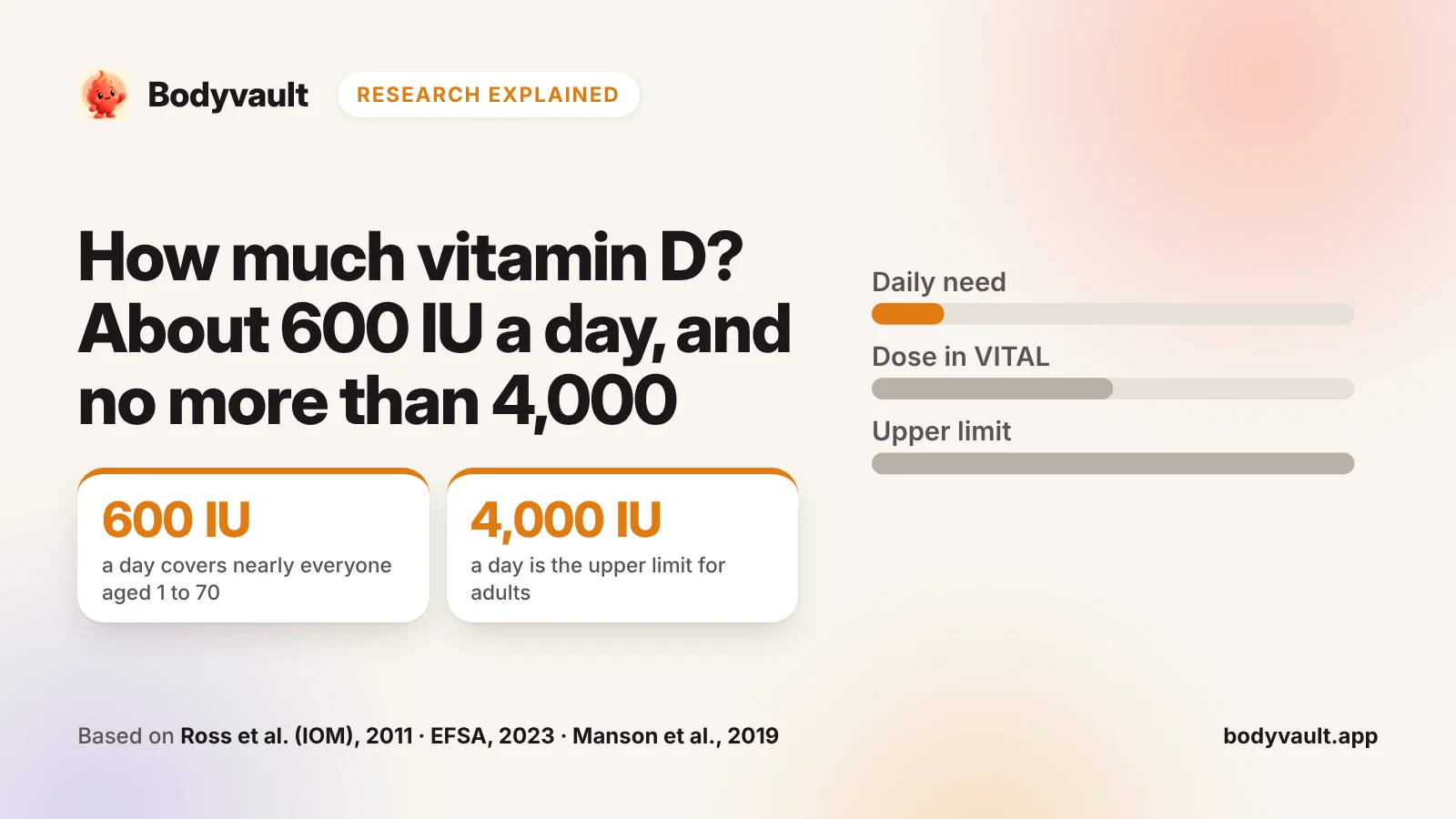
How much vitamin D should you be taking? Most adults need about 600 IU a day (800 IU from age 71), and 4,000 IU a day is the upper limit.
The short answer
600IU
Vitamin D a day covers the needs of nearly everyone aged 1 to 70. From age 71 it is 800 IU.
4,000IU
A day is the upper limit for adults and teens, from food and supplements added together.
25,871
Adults in the VITAL trial. Taking 2,000 IU a day for about 5 years did not lower cancer, heart disease or broken bones.
14ng/mL
Average vitamin D level in the blood across 40 studies in India. A level of 20 is enough for nearly everyone.
Strength of evidenceGood
Expert panels in the US, Canada and Europe agree on the 4,000 IU upper limit. India uses the same 600 IU daily amount as the US. Large trials agree that extra vitamin D does not prevent disease in people who already have enough. Less is known about people who start very low.
Key findingGet enough vitamin D, but more is not better. About 600 IU a day covers nearly everyone. In people who already had enough, extra vitamin D did not prevent cancer, heart disease or broken bones. Stay under 4,000 IU a day unless a doctor advises more.
What vitamin D does, and how it is measured
Vitamin D helps your body use calcium to build and keep strong bones. Your skin makes it in sunlight. Very few foods are naturally rich in it. That is why many people also get it from fortified foods, which have vitamin D added, or from pills.
Doses come in international units (IU) or micrograms (µg). One microgram is 40 IU. So 600 IU is 15 µg, and 4,000 IU is 100 µg.
Doctors check your vitamin D with a blood test called 25(OH)D. It shows how much you get from sun, food and pills together. Results come in ng/mL or nmol/L. To turn ng/mL into nmol/L, multiply by 2.5.
So how much is enough? An expert panel for the US and Canada, the Institute of Medicine (IOM), looked at this in its 2011 report. It said a level of 20 ng/mL (50 nmol/L) is enough for at least 97.5% of people. Levels above 30 ng/mL were not clearly linked with more benefit. For some health problems, risks showed up above 50 ng/mL.
How much vitamin D should you be taking each day?
The IOM’s 14 experts looked at many health problems. Only bone health had strong enough evidence to set the amounts. For cancer, heart disease and diabetes, the results did not agree.
Most people aged 1 to 70 need 600 IU a day. People aged 71 and over need 800 IU. These amounts cover at least 97.5% of people.
The panel assumed you get little or no sun. That is because the amount your skin makes varies a lot. It depends on the season, your skin colour, sunscreen, where you live and how long you spend outdoors. Sun on your skin also carries a risk of skin cancer.
India’s National Institute of Nutrition (ICMR-NIN) also advises 600 IU a day for adults. It raised its figure from 400 IU in 2020.
| Age | Recommended a day (IOM) | Upper limit a day (IOM) | Upper limit a day (EFSA) |
|---|---|---|---|
| 0–6 months | 400 IU* | 1,000 IU | 1,000 IU |
| 6–12 months | 400 IU* | 1,500 IU | 1,400 IU (7–11 months) |
| 1–3 years | 600 IU | 2,500 IU | 2,000 IU |
| 4–8 years | 600 IU | 3,000 IU | 2,000 IU |
| 9–10 years | 600 IU | 4,000 IU | 2,000 IU |
| 11–17 years | 600 IU | 4,000 IU | 4,000 IU |
| 18–70 years | 600 IU | 4,000 IU | 4,000 IU |
| 71 and over | 800 IU | 4,000 IU | 4,000 IU |
| Pregnant or breastfeeding | 600 IU | 4,000 IU | 4,000 IU |
These amounts are for healthy people. They are not meant for treating an illness. A doctor may prescribe a different dose for a medical reason, such as a confirmed deficiency.
How much vitamin D is too much?
The upper limit is the most you can take every day with no likely risk of harm. For adults and teens, the IOM set it at 4,000 IU a day. It is lower for young children, as the table shows. The IOM stressed that the upper limit is not a target.
In 2023, Europe’s food safety agency (EFSA) checked the newer trials. It kept the same 4,000 IU limit for adults, including during pregnancy and breastfeeding.
Too much vitamin D can push extra calcium into your urine. This can show up before calcium in the blood rises too high. EFSA saw it as an early warning sign that goes away once the extra vitamin D or calcium stops.
Two trials found this problem at 10,000 IU a day. In one, older adults took that dose with calcium for 3 years, and their risk of it tripled. EFSA divided 10,000 IU by 2.5 to leave a safety margin, which gives 4,000 IU. Trials using 4,000 to 5,000 IU a day for a year or more found no lasting calcium problems caused by vitamin D.
The limit counts every source together: fortified foods, multivitamins and vitamin D pills. Weekly doses count too. For example, 60,000 IU once a week works out at about 8,600 IU a day (our calculation). That is more than twice the daily upper limit. Only take a dose like that if a doctor has prescribed it for a set time.
For adults over 50 who do need vitamin D, a 2024 guideline prefers small daily doses to big doses taken less often.
Vitamin D benefits: what the biggest trial found
VITAL was a trial where people were put into groups by chance, so the groups could be fairly compared. In each group, about 6 in 100 people got cancer during the trial (our calculation). Deaths from any cause were also about the same: 485 with vitamin D and 493 with the dummy pill.
Fewer people died of cancer with vitamin D (154 vs 187). But this difference was not clear enough to rule out chance. A later report from the same trial looked at broken bones. Again there was no difference: 769 people broke a bone with vitamin D and 782 with the dummy pill. Broken hips were 57 and 56.
VITAL: risk with 2,000 IU of vitamin D a day, compared with a dummy pill
- Cancer0.96 (0.88–1.06)
- Major heart problems0.97 (0.85–1.12)
- Death from cancer0.83 (0.67–1.02)
- Death from any cause0.99 (0.87–1.12)
- Any broken bone0.98 (0.89–1.08)
- Broken hip1.01 (0.70–1.47)
The pills did raise vitamin D in the blood. In people tested again after a year, the average rose from about 30 to about 42 ng/mL. The extra vitamin D just didn’t prevent these diseases.
There is a catch. Most people in VITAL already had enough vitamin D. Their average level was 30.8 ng/mL, and only about 1 in 8 started below 20. In that smaller group the results were no different either, but the trial was not designed to test people who are very low. The same trial also tested fish oil, which we cover in our fish oil explainer.
Who might need more? The 2024 guideline
In 2024, the Endocrine Society, a large group of hormone doctors, published advice on using vitamin D to prevent disease. Other groups backed it, including the Endocrine Society of India.
For healthy adults under 75, it suggests sticking to the normal daily amounts and not taking more. That means 600 IU a day, or 800 IU over 70. It suggests extra vitamin D for four groups.
- Children and teens aged 1 to 18. The aim is to prevent rickets, a bone disease, and perhaps some airway infections.
- Adults aged 75 and over, because it may lower the risk of dying.
- Pregnant people, because it may lower the risk of some problems, such as early birth.
- Adults with high-risk prediabetes, together with lifestyle changes. Prediabetes means blood sugar that is higher than normal but not yet diabetes.
Daily vitamin D doses in the trials behind the 2024 advice
- Children and teens, 1–18300–2,000 IU (about 1,200)
- Adults 75 and over400–3,333 IU (about 900)
- Pregnancy600–5,000 IU (about 2,500)
- High-risk prediabetes842–7,543 IU (about 3,500)
The panel said the best dose for these groups is still unclear. All of its advice is worded “we suggest”, which means the evidence was not strong.
It also suggests against routine vitamin D blood tests for healthy people, including people with darker skin or obesity. Trials have not shown which level to aim for. This does not apply if a doctor has a medical reason to test you, such as low calcium in your blood.
Is low vitamin D common in India?
Yes, in many studies. A 2017 review pooled 40 studies of 19,761 healthy people across India. Their average vitamin D level was about 14 ng/mL (35 nmol/L). That is below the 20 ng/mL that is enough for nearly everyone.
Levels were higher in South India (17.5 ng/mL) than in other regions (12.3 to 14). Women had lower levels than men, and people in cities had lower levels than people in villages. Summer studies found about twice the level of winter studies. The authors noted that low vitamin D was common despite plenty of sunshine.
Keep the limits in mind. The studies used different lab tests, and none came from India’s north-east or centre. Still, they suggest many Indians start lower than the people in VITAL did.
Do multivitamins help memory?
A multivitamin is one pill with many vitamins and minerals. The COSMOS-Mind trial tested one in 2,262 US adults aged 65 and over, with an average age of 73. People were put into groups by chance to take a daily multivitamin or a dummy pill for 3 years. They also took cocoa extract or a dummy pill. Memory and thinking tests were done by phone once a year.
The multivitamin group scored slightly better on tests of overall thinking, memory, and planning and attention. Cocoa extract made no clear difference. The authors’ rough estimate was that the multivitamin slowed age-related decline in thinking by about 1.8 years over the 3 years. They said this estimate is not precise.
Treat this as an early finding. The multivitamin was the trial’s second question, not its main one. Most people were White, and the tests were done by phone. An earlier trial in 5,947 male doctors found no effect of a multivitamin on thinking. If you take a multivitamin, its vitamin D counts toward your daily total.
Claims and evidence
ClaimMore vitamin D is always better.
EvidenceBlood levels above 30 ng/mL were not clearly linked with more benefit, and risks for some problems showed up above 50 ng/mL. For adults, 4,000 IU a day is the upper limit.
ClaimVitamin D pills prevent cancer and heart disease.
EvidenceIn a trial of 25,871 US adults, 2,000 IU a day for about 5 years did not lower either one. 793 people got cancer with vitamin D, and 824 with a dummy pill.
ClaimEveryone should get a vitamin D blood test.
EvidenceA 2024 guideline suggests against routine tests for healthy adults, because trials have not shown which level to aim for. A doctor may still test you for a medical reason.
ClaimYou can’t be low in vitamin D in a sunny country.
EvidenceAcross 40 studies of healthy people in India, the average level was about 14 ng/mL. That is below the 20 ng/mL that is enough for nearly everyone.
What this means for you
What this means for you
- Aim for about 600 IU of vitamin D a day in total, or 800 IU if you are over 70. Count fortified foods, multivitamins and pills together.
- Don’t go above 4,000 IU a day unless a doctor tells you to. Weekly doses count too: 60,000 IU a week is about 8,600 IU a day.
- If you already get enough, don’t expect extra vitamin D to prevent cancer, heart disease or broken bones.
- If you are 75 or over, pregnant, or have prediabetes, ask your doctor whether extra vitamin D makes sense for you.
- Talk to a doctor or pharmacist first if you have kidney disease or have had high calcium. Do the same if you take medicines, or are pregnant or breastfeeding. Supplement quality varies, so choose a trusted brand.
What the research can’t tell you yet
- Who was studied. VITAL tested older US adults, and most already had enough vitamin D. There are fewer large trials in people who start very low, or in South Asia.
- One dose. VITAL tested only 2,000 IU a day, for about 5 years.
- The best blood level. No trial has shown which level to aim for. The IOM panel asked experts to agree on what counts as low, to avoid both too little and too much treatment.
- Indian data. The Indian studies used different and mostly older lab tests, in different seasons and regions. They give averages, not the share of people who are low.
- Multivitamins and memory. This rests on one trial in mostly White older adults, with tests by phone. It needs repeating.
How Bodyvault uses this research
Bodyvault sets your daily nutrient targets from your country’s standard. In India, the US and Europe, most adults get a vitamin D target of 600 IU (15 µg) and an upper limit of 4,000 IU. In Bodyvault Pro, vitamin D from supplements you mark as taken counts toward your daily total. Pro also shows a caution card if your planned supplements and food add up to more than 4,000 IU in a day.
Share or cite this explainer
Bodyvault (2026). How much vitamin D should you take? Benefits and limits. https://bodyvault.app/blog/how-much-vitamin-d
The charts on this page may be reused with a link back to it. The underlying data belong to the studies cited below.
Questions
How much vitamin D should I take?
Most adults need about 600 IU (15 micrograms) a day from all sources, or 800 IU from age 71. More did not prevent disease in people who already had enough. If a doctor finds you are low, they may advise more for a while.
How much vitamin D is too much per day?
For adults, more than 4,000 IU (100 micrograms) a day from all sources is above the upper limit. Young children have lower limits, from 1,000 to 3,000 IU, depending on age. Too much can raise calcium in your urine and blood.
How much vitamin D is safe to take daily?
Up to 4,000 IU a day from all sources is the upper limit for healthy adults. In a 5-year trial, 2,000 IU a day caused no more high calcium or kidney stones than a dummy pill. Higher doses should only come from a doctor.
What are the benefits of vitamin D?
Vitamin D helps your body use calcium for strong bones, and getting enough helps prevent rickets in children. But in adults who already had enough, extra vitamin D did not prevent cancer, heart disease or broken bones.
Do multivitamins help memory?
One 3-year trial of 2,262 adults aged 65 and over found slightly better memory scores with a daily multivitamin. The effect was small. It needs repeating in more varied groups of people.
Sources
- Ross AC et al. (2011). The 2011 report on dietary reference intakes for calcium and vitamin D from the Institute of Medicine: what clinicians need to know. J Clin Endocrinol Metab 96(1):53–58.
- EFSA NDA Panel, Turck D et al. (2023). Scientific opinion on the tolerable upper intake level for vitamin D, including the derivation of a conversion factor for calcidiol monohydrate. EFSA J 21(8):e08145.
- Manson JE et al. (2019). Vitamin D supplements and prevention of cancer and cardiovascular disease. N Engl J Med 380(1):33–44.
- LeBoff MS et al. (2022). Supplemental vitamin D and incident fractures in midlife and older adults. N Engl J Med 387(4):299–309.
- Demay MB et al. (2024). Vitamin D for the prevention of disease: an Endocrine Society clinical practice guideline. J Clin Endocrinol Metab 109(8):1907–1947.
- Endocrine Society (2024). Vitamin D for the prevention of disease: list of recommendations and technical remarks.
- Selvarajan S et al. (2017). Systematic review on vitamin D level in apparently healthy Indian population and analysis of its associated factors. Indian J Endocrinol Metab 21(5):765–775.
- ICMR-National Institute of Nutrition (2020). Nutrient requirements for Indians: recommended dietary allowances and estimated average requirements (brief note). Hyderabad: ICMR-NIN.
- Baker LD et al. (2023). Effects of cocoa extract and a multivitamin on cognitive function: a randomized clinical trial. Alzheimers Dement 19(4):1308–1319.
General information about fitness and nutrition, not medical advice. If you have a health condition, are pregnant or take medication, talk to your doctor before changing your diet or training.