
Research explained
Magnesium for sleep: does it actually work?
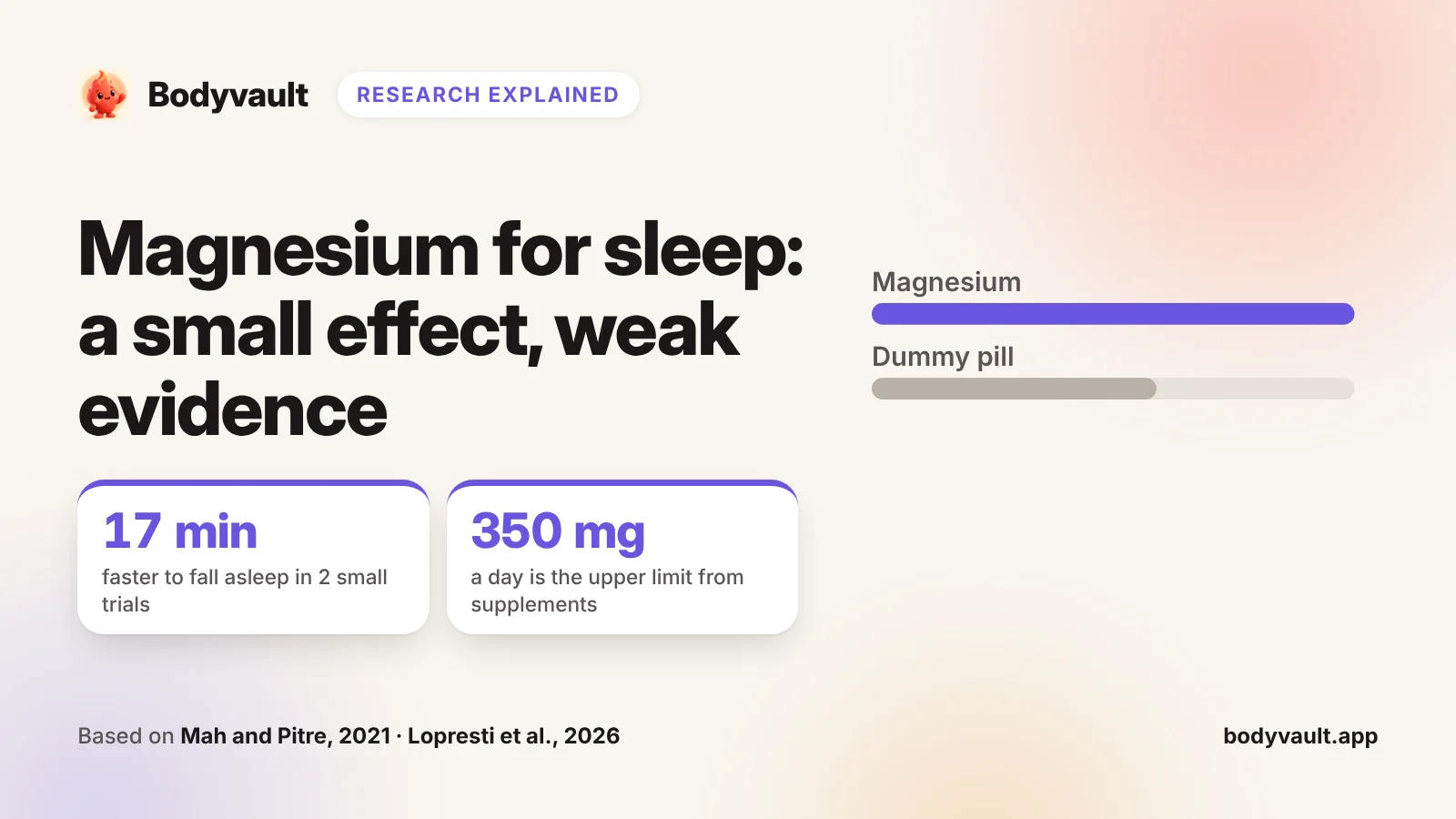
Magnesium for sleep has weak evidence: in small trials, people fell asleep about 17 minutes faster. A 2026 review of 12 trials called the results mixed and low in certainty.
The short answer
17min
Faster to fall asleep with magnesium, in 2 small trials of older adults (55 people)
16min
More total sleep in the same trials, but this was not a clear difference
12
Trials in the newest review (2026). Results were mixed, and the evidence was low or very low in certainty.
350mg
A day from supplements is the upper limit for adults and teens. More can cause diarrhoea.
Strength of evidenceWeak
Only a few small, short trials, most of them using questionnaires. Their certainty was rated low or very low. They hint at a small benefit for some people.
Key findingMagnesium may help some people fall asleep a little faster, perhaps more if they eat little magnesium. But the trials are small and short. The newest review says magnesium is not proven as a treatment for insomnia.
Why people take magnesium for sleep
Magnesium is a mineral your body needs every day. Green leafy vegetables, whole grains and nuts are rich in it. Refined foods have the least.
Lab and animal studies suggest magnesium can calm nerve cells. That is why people hope it helps sleep. But what happens in a lab doesn’t always happen in people, so trials are needed.
Insomnia means trouble falling asleep or staying asleep. Studies measure sleep with diaries, questionnaires, wrist sensors or a sleep test that records brain waves (EEG).
| Group | India (ICMR-NIN 2020) | US and Canada (IOM 1997) |
|---|---|---|
| Men | 440 mg | 400 mg (ages 19–30), 420 mg (31 and over) |
| Women | 370 mg | 310 mg (ages 19–30), 320 mg (31 and over) |
Does magnesium for sleep work? The 2021 review
This review was a meta-analysis: a study that pooled the results of earlier studies. It found only three trials. One had 46 adults aged 60 to 75 with insomnia. One had 12 healthy volunteers, and one had 100 adults over 51 who slept poorly.
The 17-minute result came from just two trials with 55 people. The likely range was 7 to 27 minutes. The authors said it is not clear whether 17 minutes matters much in daily life.
Magnesium compared with a dummy pill: minutes of difference
- Time to fall asleep17 min faster
- Total sleep time16 min longer (not clear)
Sleep questionnaires gave mixed results. In one trial, insomnia scores improved more with magnesium. In another, scores improved by about the same amount with the dummy pill. In one trial, all the people reported soft stools, a known side effect of magnesium.
What newer research shows
A 2025 trial in Germany tested magnesium glycinate, also sold as bisglycinate. It included 155 healthy adults aged 18 to 65 who had slept poorly for more than 4 weeks. Most of them (80%) were women. They took 250 mg of magnesium or a dummy pill, 30 to 60 minutes before bed, for 4 weeks.
Insomnia was scored from 0 to 28, where a higher score means worse sleep. Scores started at about 15.5. After 4 weeks, they fell by 3.9 points with magnesium and by 2.3 points with the dummy pill. The gap was small, but just big enough to be a clear difference.
Other measures did not clearly differ, such as a sleep quality rating, tiredness, stress and mood. People who said they ate less magnesium-rich food seemed to improve more. That hint came from one untested question, so it needs checking. Side effects were rare: 2 reports with magnesium and 7 with the dummy pill.
All the results were people’s own ratings. Each day’s capsules also held about 1.5 g of glycine, a building block of protein that may help sleep on its own.
The newest review, from 2026, looked at 12 trials of magnesium for sleep. The trials used different forms, doses and lengths, and they measured sleep in different ways. Results were mixed, and the certainty was low or very low. The authors concluded that magnesium is not proven as a routine treatment for insomnia, though some people may gain a small benefit.
One author of that review runs a research company that is paid by supplement makers. He also worked on the 2025 trial.
Best magnesium for sleep: which form?
No trial has compared magnesium forms head to head for sleep. The trials used magnesium oxide, magnesium citrate and magnesium glycinate. The authors of the 2025 trial said the forms still need to be compared.
So there is no proven “best magnesium for sleep”. The authors of the glycinate trial say it is the largest so far. But its effect was small, and its glycine may have helped too.
Check the label for elemental magnesium, which is the amount of magnesium itself. In the 2025 trial, each 893 mg capsule of magnesium bisglycinate held only 125 mg of magnesium.
Magnesium for sleep dosage: how much, and when?
The four trials described here used 250 to 729 mg of magnesium a day. Two of them used more than the upper limit for supplements.
US and Canadian experts, the Institute of Medicine (IOM), set that limit in 1997. It is 350 mg a day from supplements and medicines, for everyone aged 9 and over. It is 65 mg for ages 1 to 3 and 110 mg for ages 4 to 8. Babies should get magnesium from food only.
The limit is based on diarrhoea, the first sign of too much. In one study, 18 of 50 adults taking 470 mg a day as magnesium oxide got diarrhoea. Magnesium in food does not count toward the limit, because it has not been shown to cause harm.
If your kidneys don’t work well, magnesium can build up in your blood. Don’t take magnesium supplements if you have kidney disease, unless your doctor advises it.
When should you take it? The 2025 trial used magnesium 30 to 60 minutes before bed. The older trials split it into two or three doses a day. None of these trials compared different times.
Claims and evidence
ClaimMagnesium is a proven sleep aid.
EvidenceA 2026 review of 12 trials found mixed results, with low or very low certainty. It said magnesium is not proven as a routine treatment for insomnia.
ClaimMagnesium glycinate is the best magnesium for sleep.
EvidenceNo trial has compared forms head to head. The glycinate trial found a small effect, and its capsules also contained glycine.
ClaimA bigger dose works better.
EvidenceThe sleep trials did not compare doses. Above 350 mg a day from supplements, diarrhoea becomes more likely.
ClaimMagnesium works the same for everyone.
EvidenceIn the 2025 trial, people who ate less magnesium-rich food seemed to improve more. This hint needs checking.
What this means for you
What this means for you
- Start with food. Green leafy vegetables, whole grains and nuts are rich in magnesium. Adults need about 310 to 440 mg a day, depending on sex, age and which standard you follow.
- If you try a supplement, keep it at or below 350 mg of elemental magnesium a day, and check the label.
- Give it a few weeks, as the trials did. If your sleep doesn’t change, it may not be helping you.
- If you have had trouble sleeping for a long time, talk to a doctor. Magnesium is not a proven insomnia treatment.
- Ask a doctor or pharmacist first if you have kidney disease, take medicines, or are pregnant or breastfeeding. Supplement quality varies, so choose a trusted brand.
What the research can’t tell you yet
- Small, short trials. The trials we could check had 12 to 155 people and lasted 20 days to 8 weeks.
- Mostly self-reported. Many results came from people’s own ratings, not sleep lab tests.
- Who was studied. The 2021 review studied older adults, and the 2025 trial was mostly women.
- Who benefits. We don’t know if people low in magnesium gain more. So far there is only a hint.
- Forms, doses and timing. None of these have been compared head to head.
How Bodyvault uses this research
Bodyvault’s magnesium evidence card rates magnesium as weak and says claims for sleep have limited evidence. It suggests 200 to 350 mg a day from supplements. It also warns that more than 350 mg a day can cause loose stools, the same limit the IOM set. In Bodyvault Pro, magnesium from supplements you mark as taken is added to the magnesium in your food log, next to your daily target.
Share or cite this explainer
Bodyvault (2026). Magnesium for sleep: does it actually work? https://bodyvault.app/blog/magnesium-for-sleep
The charts on this page may be reused with a link back to it. The underlying data belong to the studies cited below.
Questions
What is the best magnesium for sleep?
No form has been proven best, because no trial has compared them for sleep. Trials used oxide, citrate and glycinate. The glycinate trial found a small benefit, but its capsules also contained glycine.
How many mg of magnesium for sleep?
The trials described here used 250 to 729 mg a day. For supplements, the upper limit for adults is 350 mg a day, because more can cause diarrhoea. Check the label for elemental magnesium.
When should I take magnesium for sleep?
The newest trial used it 30 to 60 minutes before bed. Older trials split it into two or three doses a day. None of these trials compared times, so choose a time that suits you.
Melatonin or magnesium for sleep?
None of the studies here compared them. Melatonin has its own research and doses, which we cover in our melatonin explainer. If poor sleep goes on for weeks, talk to a doctor.
Is it safe to take magnesium every night?
For most healthy adults, up to 350 mg a day from supplements is within the upper limit. Diarrhoea is the first sign of too much. People with kidney disease should only take it if a doctor advises.
Sources
- Mah J, Pitre T (2021). Oral magnesium supplementation for insomnia in older adults: a systematic review & meta-analysis. BMC Complement Med Ther 21(1):125.
- Lopresti AL et al. (2026). Magnesium supplementation for sleep in adults: a systematic review of randomized controlled trials. J Diet Suppl 23(5):553–581.
- Schuster J et al. (2025). Magnesium bisglycinate supplementation in healthy adults reporting poor sleep: a randomized, placebo-controlled trial. Nat Sci Sleep 17:2027–2040.
- Institute of Medicine (1997). Dietary reference intakes for calcium, phosphorus, magnesium, vitamin D, and fluoride. Chapter 6: Magnesium. Washington (DC): National Academies Press.
- ICMR-National Institute of Nutrition (2020). Nutrient requirements for Indians: recommended dietary allowances and estimated average requirements (brief note). Hyderabad: ICMR-NIN.
General information about fitness and nutrition, not medical advice. If you have a health condition, are pregnant or take medication, talk to your doctor before changing your diet or training.