
Research explained
How much melatonin should you take? What studies show
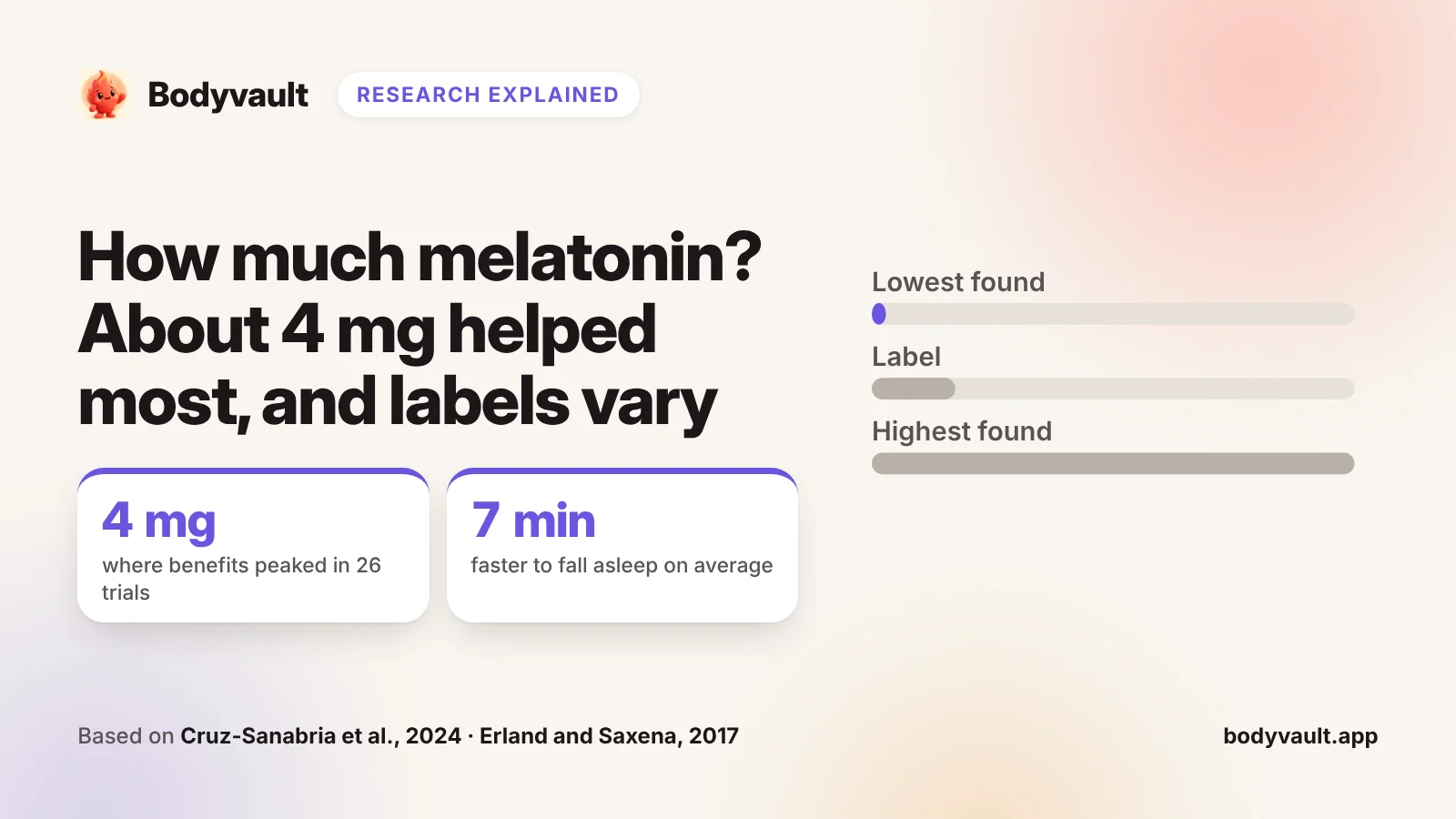
How much melatonin should you take? In a 2024 review of 26 trials, sleep improved most at about 4 mg a day, taken around 3 hours before bed. But melatonin helps only a little: in earlier trials, people fell asleep about 7 minutes faster on average.
The short answer
7min
Faster to fall asleep with melatonin than with a dummy pill, across 19 trials with 1,683 people
4mg
The dose where the benefits peaked, in a 2024 review of 26 trials
+478%
The most melatonin found in a product, compared with its label. The least was 83% below.
45min
Time for your body to clear half of a regular melatonin dose, on average
Strength of evidenceGood, for a small effect
Several reviews agree that melatonin helps a little. Most trials were short, and the best dose comes from one 2024 review.
Key findingMelatonin helps you fall asleep a little faster: by minutes, not hours. More isn’t better. Benefits peaked at about 4 mg, and doses of 10 mg or more brought more drowsiness, headaches and dizziness. Labels can be far off, so you may get more or less than you think.
What is melatonin, and how long does it last?
Melatonin is a hormone made mainly by the pineal gland in your brain. It helps run your body clock, which tells you when to sleep. Most supplements are made in a lab.
A regular melatonin tablet acts fast and leaves fast. Its level in your blood peaks about 50 minutes after you swallow it. Your body then clears half of it in about 45 minutes, on average. Only about 15% of a swallowed dose reaches your blood.
Several things change how your body handles melatonin. They include age, caffeine, smoking, the contraceptive pill, food and some medicines, such as the antidepressant fluvoxamine.
Rules differ by country. In the US and Canada, you can buy melatonin over the counter. In the UK, it is a prescription-only medicine. There it is mainly used for short-term sleep problems in people aged 55 and over.
How much melatonin should I take?
A 2024 review pooled 26 trials in healthy volunteers and in people with insomnia, which means ongoing trouble falling or staying asleep. As the dose went up, people fell asleep faster and slept longer, up to about 4 mg a day. The benefit peaked there.
Timing mattered too. The review’s models suggest taking it earlier, about 3 hours before bedtime. The usual habit is 2 mg half an hour before bed. Whether people had insomnia also changed how much it helped.
How sleep was measured matters. On sleep tests that use equipment, melatonin cut the time to fall asleep by 5.5 minutes and didn’t clearly add sleep. In sleep diaries, people reported about 12 more minutes of sleep.
Is that a lot? In earlier reviews that the authors cite, sleeping pills cut the time to fall asleep by about 10–20 minutes. Melatonin’s effect is smaller. But the authors note it has mild side effects and little sign that people get used to it.
How much melatonin is too much?
A 2022 review looked for trials of high doses, 10 mg or more, in adults over 30. It found 79 trials with 3,861 people, many with other illnesses. More than a third of the trials (37%) didn’t report side effects at all. Only 4 were good enough to pool.
In those 4 trials, high doses didn’t clearly raise serious side effects. But milder ones, such as drowsiness, headaches and dizziness, were about 40% more common than with a dummy pill. Long-term safety is unknown.
So is 20 mg too much? It’s 5 times the dose where benefits peaked, so it’s unlikely to help more, and it may bring more side effects. Talk to a doctor before taking high doses.
You also may not get the dose on the label. In 2017, researchers in Canada tested 31 melatonin products from 16 brands. The melatonin ranged from 83% below to 478% above the label. A chewable tablet labelled 1.5 mg held almost 9 mg. More than 7 in 10 products were more than 10% off their label. And 8 contained serotonin, a brain chemical that wasn’t meant to be there.
Melatonin side effects, and who should be careful
In trials, melatonin had few side effects. At high doses, drowsiness, headaches and dizziness were more common. Some people need extra care:
- Pregnancy. The NHS says melatonin isn’t usually recommended in pregnancy, because little is known about its effect on babies. If you are breastfeeding, ask your doctor.
- Medicines. Some medicines, such as fluvoxamine, change how your body handles melatonin. Ask a pharmacist.
- Diabetes. The 2017 lab study notes that higher doses could cause problems for people with diabetes or prediabetes, when blood sugar is higher than normal.
- Children. Few trials have studied children, so ask a doctor before giving melatonin to a child.
Wondering about melatonin vs magnesium for sleep? See our explainer on magnesium for sleep. Ashwagandha is sold for sleep too; its benefits and risks are in ashwagandha side effects and benefits. And if poor sleep goes on for weeks, see a doctor. Treatments that change sleep habits are often tried first.
Claims and evidence
ClaimTaking more melatonin works better.
EvidenceBenefits peaked at about 4 mg a day in a review of 26 trials. Doses of 10 mg or more brought more drowsiness, headaches and dizziness.
ClaimMelatonin knocks you out like a sleeping pill.
EvidenceOn average, people fell asleep about 7 minutes faster. Earlier reviews found sleeping pills cut that time by about 10–20 minutes.
ClaimThe label tells you exactly what you’re taking.
EvidenceIn 31 products, melatonin ranged from 83% below to 478% above the label.
ClaimYour body gets used to melatonin, so it stops working.
EvidenceIn 19 trials, the effect didn’t fade with longer use. Longer trials showed bigger effects.
What this means for you
What this means for you
- Melatonin helps a little. The research points to modest doses, up to about 4 mg, taken a few hours before bed rather than right before.
- Talk to a doctor or pharmacist first if you are pregnant or breastfeeding, take medicines or have a health condition. In the UK, melatonin needs a prescription.
- Choose products tested by an independent lab. Labels can be far off.
- Work on your sleep schedule too. Try the sleep calculator and our guide to fixing your sleep schedule.
- If poor sleep lasts for weeks or affects your days, see a doctor.
What the research can’t tell you yet
- Short trials. Most lasted days to weeks, so long-term safety is unknown.
- Children. Few trials included children.
- Dose evidence. The best dose comes from one 2024 review, and high-dose safety from only 4 good trials.
- Old label data. The label study tested products from one Canadian city in 2017.
How Bodyvault uses this research
Melatonin isn’t in Bodyvault’s supplement evidence catalogue, so the app doesn’t suggest a dose. You can still add it by name and set reminders; the free plan covers up to 5 supplements. Bodyvault also reads your sleep from Apple Health or Health Connect.
Share or cite this explainer
Bodyvault (2026). How much melatonin should you take? What studies show. https://bodyvault.app/blog/how-much-melatonin
The charts on this page may be reused with a link back to it. The underlying data belong to the studies cited below.
Questions
How much melatonin should I take?
In a 2024 review of 26 trials, benefits peaked at about 4 mg a day, taken about 3 hours before bed. Ask a doctor or pharmacist first. In the UK, melatonin needs a prescription.
Is 20 mg of melatonin too much?
It’s 5 times the dose where benefits peaked, so it’s unlikely to help more. In trials of 10 mg or more, drowsiness, headaches and dizziness were more common, though serious side effects didn’t clearly rise. Talk to a doctor before taking high doses.
How long does melatonin last?
A regular tablet peaks in your blood about 50 minutes after you take it. Your body then clears half of it in about 45 minutes, on average.
Is melatonin bad for you?
In short trials, it had few side effects, mostly drowsiness, headaches and dizziness, which were more common at high doses. Long-term safety isn’t known. It isn’t usually recommended in pregnancy, and some medicines interact with it, so check with a doctor or pharmacist.
Does melatonin stop working over time?
Not in the trials so far. In 19 trials, the effect didn’t fade with longer use, and longer trials showed slightly bigger effects.
Sources
- Ferracioli-Oda E, Qawasmi A, Bloch MH (2013). Meta-analysis: melatonin for the treatment of primary sleep disorders. PLoS One 8(5):e63773.
- Cruz-Sanabria F et al. (2024). Optimizing the time and dose of melatonin as a sleep-promoting drug: a systematic review of randomized controlled trials and dose-response meta-analysis. J Pineal Res 76(5):e12985.
- Menczel Schrire Z et al. (2022). Safety of higher doses of melatonin in adults: a systematic review and meta-analysis. J Pineal Res 72(2):e12782.
- Erland LA, Saxena PK (2017). Melatonin natural health products and supplements: presence of serotonin and significant variability of melatonin content. J Clin Sleep Med 13(2):275–281.
- Harpsøe NG et al. (2015). Clinical pharmacokinetics of melatonin: a systematic review. Eur J Clin Pharmacol 71(8):901–909.
- NHS (2023). Melatonin: about melatonin; pregnancy, breastfeeding and fertility; common questions. nhs.uk, page last reviewed 13 February 2023.
General information about fitness and nutrition, not medical advice. If you have a health condition, are pregnant or take medication, talk to your doctor before changing your diet or training.