
Research explained
Ashwagandha side effects and benefits: what studies show
Reported ashwagandha side effects include stomach upsets, sleepiness and, rarely, serious liver injury. Small trials suggest it may ease stress a little, but some people should not take it at all.
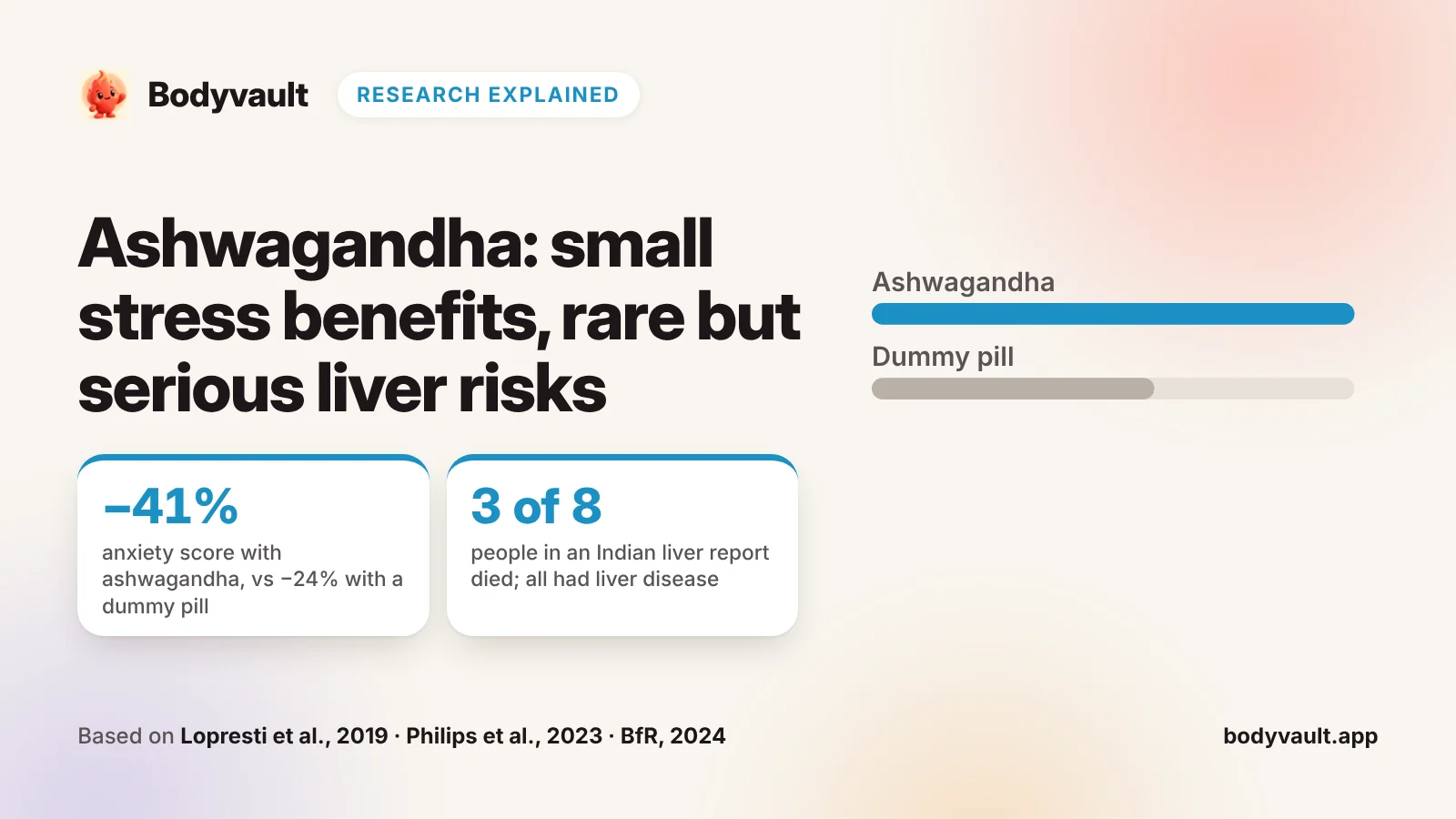
The short answer
−41%
Fall in a doctor-rated anxiety score after 60 days of ashwagandha, vs −24% with a dummy pill, in 60 adults in India
Low
How sure reviewers were about the benefits for stress and anxiety, across 12 trials
5
People in Iceland and the US whose liver injury was linked to ashwagandha. None had liver failure.
3 of 8
People in an Indian report who died after liver injury linked to ashwagandha-only products. All 3 already had liver disease.
Strength of evidenceLimited
The benefits come from small, short trials, many paid for by the makers of the extracts. The liver harm comes from case reports, which can’t show how often it happens.
Key findingAshwagandha may lower stress a little, but the trials are small and short. Rarely, it has been linked to liver injury, sometimes serious. Germany’s risk agency says children, pregnant or breastfeeding women and people with liver disease should not take it. It advises everyone else to be careful.
What is ashwagandha?
Ashwagandha is a plant used in Ayurveda, a traditional system of medicine from India. It is also called Indian ginseng or winter cherry. Supplements are mostly made from the root, and sometimes the leaves. You can buy them as powders, capsules, liquids and teas.
Shops sell ashwagandha for stress, sleep and strength. But products differ a lot. They use different parts of the plant and different ways of extracting it, so the amount of active substances varies. Trials have tested branded extracts, such as KSM-66 and Shoden.
In Europe, food supplements don’t need a safety check before they go on sale. The companies that make and sell them are responsible for their safety.
Does ashwagandha help with stress and anxiety?
This was a randomised trial: people were put into groups by chance, so the groups could be fairly compared. Morning levels of cortisol, a stress hormone, fell 23% with ashwagandha and barely changed with the dummy pill. No side effects were reported, and everyone finished.
A 2022 review pooled 12 trials with 1,002 adults aged 25 to 48. Anxiety and stress scores fell more with ashwagandha than with dummy pills. But the trials disagreed a lot, and the reviewers rated their confidence as low. The benefit on stress showed up at 300–600 mg a day.
The 2019 trial was in people with mild anxiety, not an anxiety disorder. If anxiety affects your daily life, see a doctor.
Does ashwagandha build strength or raise testosterone?
In a 2015 trial in India, 57 young men new to weight training took an ashwagandha extract or a dummy pill for 8 weeks. The extract dose was 600 mg a day. All of them trained three times a week, and 50 finished. Both groups got much stronger, as you’d expect from training. The ashwagandha group gained more.
A 2026 review looked for every trial that added ashwagandha to a weight-training programme. It could pool three, with 161 people, who took 500–600 mg a day for 8–12 weeks. The reviewers estimate it might add about 4 kg to bench-press gains. But the result didn’t hold up under stricter tests, and the leg-strength result rested on the 2015 trial. All three trials were paid for or supplied by ashwagandha makers. The reviewers rated the evidence as low certainty and said the training is what builds strength.
Testosterone is the main male sex hormone. In the 2015 trial, it rose by 96 ng/dL (a unit for blood levels) with ashwagandha and by 18 ng/dL with the dummy pill. A 2026 review pooled 23 trials with 1,706 people. Testosterone rose by about 57 ng/dL in men and didn’t clearly change in women.
The same review found that ashwagandha raised one thyroid hormone, T4, a little. It didn’t change TSH or T3, two other thyroid tests. This matters if you have a thyroid condition. Germany’s risk agency raised thyroid concerns about ashwagandha as early as 2012.
Ashwagandha side effects: what doctors have reported
The two trials above reported no serious side effects. But Germany’s Federal Institute for Risk Assessment (BfR) notes that trials of ashwagandha didn’t record side effects in a careful, standard way. Reported effects include nausea, vomiting, diarrhoea, drowsiness, headaches, dizziness and skin rashes. It may also affect your immune system, your blood sugar and hormones such as cortisol, thyroid and sex hormones.
The biggest worry is the liver. In 2020, doctors described 5 people in Iceland and the US whose liver injury was linked to ashwagandha. All had jaundice, which means yellow skin and eyes. Some also had nausea, itching or belly pain. Symptoms started days to a few months after they began taking it.
Itching and jaundice lasted 5–20 weeks. No one had liver failure. Four of the 5 had normal liver tests again within 1–5 months, and the fifth wasn’t followed up. Lab tests found ashwagandha in the products and no other toxic substances. Three of the cases came from one brand in Iceland, at 450–1,350 mg a day.
In 2023, liver doctors in India described 8 people whose liver injury was linked to products that contained only ashwagandha. These included powders, tablets, syrups, a herbal jam and a tea. Five of the 8 had been given it by a registered Ayurveda practitioner. Five also had long-term liver disease. Three of those five developed liver failure and died.
These reports are case series: doctors describing a group of patients. They can’t tell us how often ashwagandha harms the liver. But in each case, the doctors ruled out other causes. And the people had taken ashwagandha as labelled or as prescribed.
Who should avoid ashwagandha?
In 2024, the BfR reviewed reports and safety reviews from several countries. It said these groups should not take ashwagandha supplements:
- Children.
- Pregnant and breastfeeding women. In the past, ashwagandha was used to end pregnancies.
- People with liver disease.
It advises everyone else to be careful. Ashwagandha may also interact with medicines for diabetes, blood pressure and the immune system. The BfR says the data are too limited to set a safe daily amount. It adds that it and other European authorities advise against these supplements.
Denmark has gone further: it is illegal to sell products that contain ashwagandha there. The Danish food agency points to a risk review that found effects on sex hormones and reproduction.
Claims and evidence
ClaimAshwagandha is natural, so it’s safe.
EvidenceDoctors have reported liver injury linked to products that contained only ashwagandha, taken as labelled or prescribed. In India, 3 of 8 people died. All 3 already had liver disease.
ClaimAshwagandha is a testosterone booster that builds muscle.
EvidenceAcross 23 trials, testosterone rose by about 57 ng/dL in men and didn’t clearly change in women. Only a few small trials, funded or supplied by makers, tested it with weight training. The strength gain was uncertain.
ClaimAshwagandha is proven to treat anxiety.
EvidenceTrials found lower anxiety and stress scores, but reviewers rated the evidence low certainty. The best-known trial was in people with mild anxiety. If anxiety affects your daily life, see a doctor.
ClaimIf a shop sells it, it has been checked for safety.
EvidenceIn Europe, food supplements don’t need a safety check before sale. Germany’s risk agency says the data are too limited to set a safe daily amount of ashwagandha.
What this means for you
What this means for you
- Don’t take ashwagandha if you are pregnant or breastfeeding or have liver disease, and don’t give it to children. That is the advice of Germany’s risk agency.
- Talk to a doctor or pharmacist first if you have a thyroid condition or take medicines, especially for diabetes, blood pressure or the immune system.
- Stop and see a doctor promptly if your skin or eyes turn yellow, or you get itching, nausea or belly pain while taking it.
- Know what trials used: 240–600 mg a day of branded extracts, for 8–12 weeks. Products vary a lot, and no safe daily amount has been set.
- Don’t count on it for strength. Training builds strength; ashwagandha added little, if anything, in trials.
What the research can’t tell you yet
- How common liver injury is. Case series describe people who got ill. They can’t say how many users are affected.
- Long-term use. The trials lasted 8–12 weeks or less.
- Independent results. Many trials were paid for by extract makers, and most stress trials were done in India.
- Which product. Extracts differ in plant part, strength and method, so results from one may not apply to another.
How Bodyvault uses this research
Bodyvault’s evidence card grades ashwagandha C: small trials only, with safety warnings. It notes that studies used 300–600 mg of root extract a day. Its cautions cover signs of liver injury, thyroid hormones and pregnancy. In Bodyvault Pro, adding ashwagandha to your list also shows a “discuss with your doctor” card about liver and thyroid conditions. It tells you to see a doctor promptly for dark urine or yellow eyes.
Share or cite this explainer
Bodyvault (2026). Ashwagandha side effects and benefits: what studies show. https://bodyvault.app/blog/ashwagandha
The charts on this page may be reused with a link back to it. The underlying data belong to the studies cited below.
Questions
Is ashwagandha safe?
Short trials reported few side effects. But rare, sometimes serious liver injury has been reported. Germany’s risk agency says children, pregnant or breastfeeding women and people with liver disease should not take it. If you have a health condition or take medicines, talk to a doctor first.
What are the side effects of ashwagandha?
Reported side effects include nausea, vomiting, diarrhoea, drowsiness, headaches, dizziness and skin rashes. Rarely, people have had liver injury with yellow skin and eyes and itching. It may also affect thyroid and other hormones.
How much ashwagandha per day?
Trials used 240–600 mg a day of branded extracts, and a review found stress benefits at 300–600 mg a day. No safe daily amount has been set, and products differ a lot. Ask a doctor or pharmacist first.
Does ashwagandha increase testosterone?
A little, in men. Across 23 trials, testosterone rose by about 57 ng/dL in men and didn’t clearly change in women. It isn’t clear that this builds muscle.
Does ashwagandha work, and what does it do?
In small trials, it lowered stress and anxiety scores and cortisol, a stress hormone. It may also nudge testosterone and a thyroid hormone. The evidence is low certainty, and in rare cases it has been linked to liver injury.
Sources
- Lopresti AL et al. (2019). An investigation into the stress-relieving and pharmacological actions of an ashwagandha (Withania somnifera) extract: a randomized, double-blind, placebo-controlled study. Medicine (Baltimore) 98(37):e17186.
- Akhgarjand C et al. (2022). Does ashwagandha supplementation have a beneficial effect on the management of anxiety and stress? A systematic review and meta-analysis of randomized controlled trials. Phytother Res 36(11):4115–4124.
- Wankhede S et al. (2015). Examining the effect of Withania somnifera supplementation on muscle strength and recovery: a randomized controlled trial. J Int Soc Sports Nutr 12:43.
- Lee JC, Heo AS (2026). Adjunctive ashwagandha (Withania somnifera) supplementation and resistance-training adaptations in healthy adults: a systematic review and random-effects meta-analysis. Nutrients 18(17):2815.
- Fornalik M et al. (2026). Hormonal modulation with Withania somnifera: systematic review and meta-analysis of randomized-controlled trials. Planta Med 92(8):790–805.
- Björnsson HK et al. (2020). Ashwagandha-induced liver injury: a case series from Iceland and the US Drug-Induced Liver Injury Network. Liver Int 40(4):825–829.
- Philips CA et al. (2023). Ashwagandha-induced liver injury: a case series from India and literature review. Hepatol Commun 7(10):e0270.
- German Federal Institute for Risk Assessment (BfR) (2024). Ashwagandha: food supplements with potential health risks. BfR Communication 39/2024.
- Danish Veterinary and Food Administration (Fødevarestyrelsen). Ashwagandha i kosttilskud og drikkevarer (Ashwagandha in food supplements and drinks). Accessed 19 October 2026.
General information about fitness and nutrition, not medical advice. If you have a health condition, are pregnant or take medication, talk to your doctor before changing your diet or training.