
Research explained
Strength training for women: what the research shows
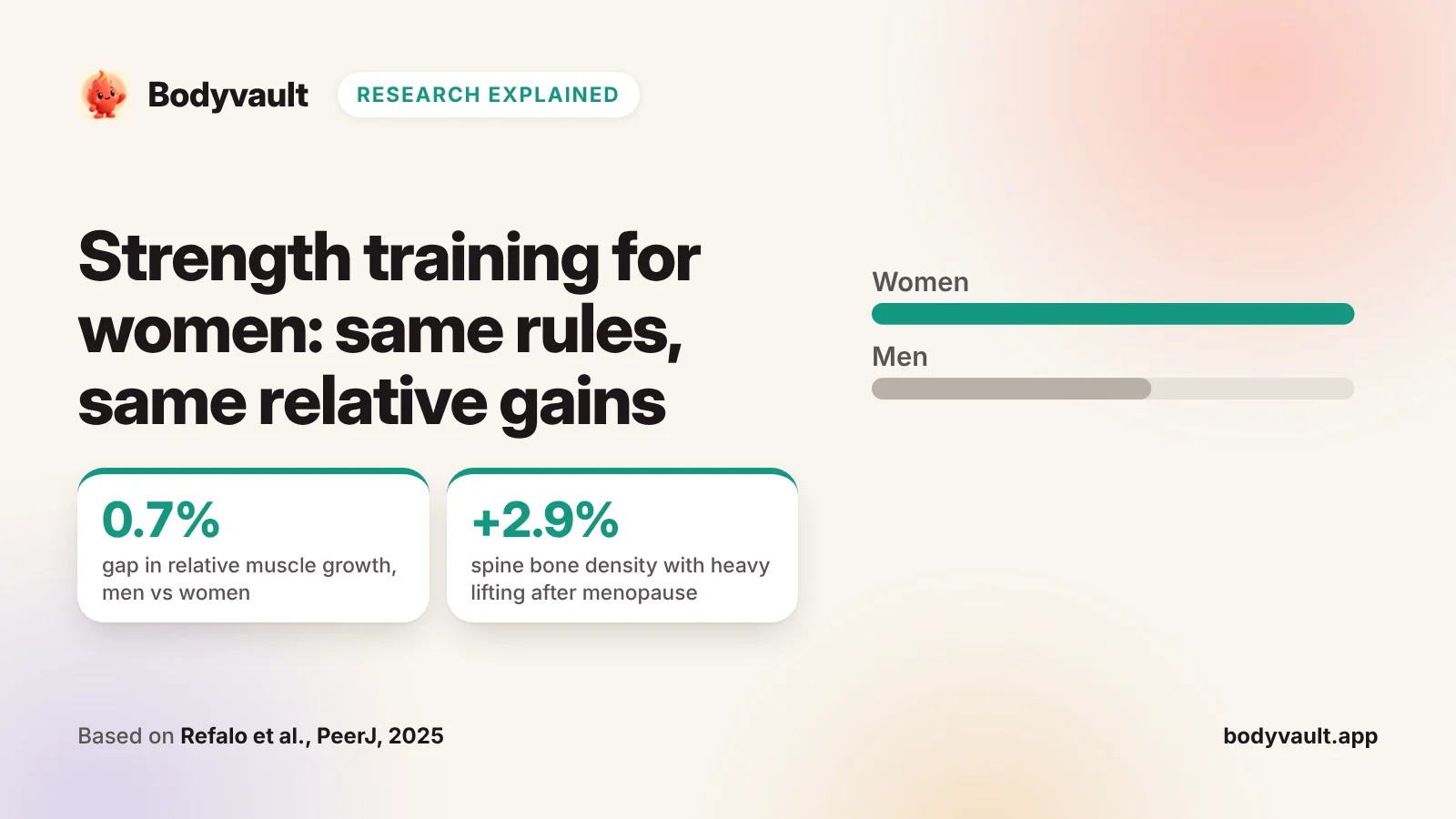
Strength training for women works the same way it does for men. Compared with their starting size, women gained muscle at the same rate as men in a review of 29 studies. After menopause, supervised heavy lifting even raised bone density.
The short answer
0.7%
Gap in muscle growth between men and women, as a share of starting size. No clear difference in 29 studies
+2.9%
Spine bone density after 8 months of supervised heavy lifting, in women with weak bones. The light-exercise group lost 1.2%
−19%
Risk of dying during a large US study for women who did regular strength training, compared with none. For men it was −11%
1 in 5
Women in that study who did any regular strength training
Strength of evidenceGood
Several reviews agree that women build muscle and strength like men, relative to their size. The bone results come from one strong trial and a large review with small average effects. The link with living longer comes from an observational study.
Key findingWomen don’t need a special kind of training. The same rules work for everyone. Train your main muscles on two or more days a week, make it a bit harder over time and use good form.
What is strength training for women?
Strength training means making your muscles work against a force. That can be free weights, machines, resistance bands or your own body weight, as in squats and push-ups. The 2026 guideline from the American College of Sports Medicine (ACSM) found that gym training, circuits, band training and home workouts all built strength.
The World Health Organization (WHO) advises adults to train all the major muscles on 2 or more days a week. From age 65, it advises varied activity with balance and strength work on 3 or more days a week.
There is no separate women’s version. In the studies below, women and men did the same programmes. Questions about training and your menstrual cycle are covered in our explainer on working out on your period.
Do women gain muscle like men?
A 2025 review pooled 29 studies where men and women aged 18 to 45 did the same programme. Most programmes lasted about 11 weeks. The researchers measured muscle growth in two ways.
Absolute growth is how much muscle you add. Relative growth is that gain as a share of the muscle you started with. Here is a made-up example. If a man’s thigh muscle grows from 100 to 110 units, that is 10 units, or 10%. If a woman’s grows from 70 to 77 units, that is 7 units, but also 10%.
That is close to what the review found. Men added slightly more muscle in total, because most started with bigger muscles. Only 2 of 68 results showed women starting with bigger muscles. But the percentage gain was the same: the gap was 0.7%, too small to be sure of.
Difference in percentage muscle growth, men minus women
- All muscles (68 results)0.7% (−1.5 to 2.9)
- Lower body1.0% (−2.0 to 4.2)
- Upper body0.6% (−3.0 to 4.2)
- People new to lifting0.7% (−1.8 to 3.1)
- People who already lifted0.9% (−3.5 to 5.4)
Do women gain strength like men?
A 2020 review compared strength gains, again as a share of where people started. Women gained upper-body strength faster than men, in 17 studies. Leg strength rose at about the same pace, in 23 studies. Muscle growth was again about the same, in 10 studies.
The authors aren’t sure why women gained upper-body strength faster. It could be down to the nerves, the muscles, learning the movement, or simply the short length of the studies.
Strength training for women over 40, 50 and 60
Osteoporosis, when bones become weak and break easily, is a major health problem for women after menopause. Bone density means how dense and strong your bones are. Two strong studies show that exercise can help it.
The LIFTMOR trial put 101 women into two groups by chance. They were 65 on average, past menopause, and had low bone density. One group did heavy lifting plus impact work, such as jumps, for 30 minutes twice a week for 8 months, with close supervision. They lifted 5 sets of 5 reps at more than 85% of the most they could lift once. The other group did light exercise at home.
The lifting group gained bone in the spine and held steady at the hip, while the home group lost bone. Lifters also stood slightly taller and did better on every physical test. There was only one minor problem in the whole trial: a lower-back spasm.
A 2020 review pooled 75 studies with 5,300 women past menopause. Exercise improved bone density at the spine and hip, but only a little on average. Programmes varied a lot, so the authors couldn’t say which type works best. Mixing jumping with lifting tended to do well.
Bone density with exercise after menopause: effect sizes
- Lower spine0.37 (0.25 to 0.50)
- Femoral neck (top of the thigh bone)0.33 (0.23 to 0.43)
- Whole hip0.40 (0.28 to 0.51)
If you have osteoporosis or have broken a bone easily, you can still train, but start carefully. A 2022 UK expert consensus advises:
- Strength exercises on 2 to 3 days a week. Build up to the heaviest weight you can lift 8 to 12 times, for up to 3 sets.
- Starting lighter and learning good form first.
- Avoiding a lot of forward bending of the spine, especially while holding a weight.
- After a spine fracture or several fractures, keeping impact to the level of brisk walking, with advice from a physiotherapist at the start.
Exercise rarely caused harm in these studies. Across 62 bone trials, 5.8% of people who exercised broke a bone during the study, compared with 9.6% of those who didn’t. LIFTMOR used close supervision, so start with a coach or physiotherapist if your bones are weak. For keeping muscle as you age, read our explainer on sarcopenia.
Benefits of strength training for women beyond muscle
A large US study followed 412,413 adults between 1997 and 2019. People said what exercise they did, and researchers tracked deaths. This kind of study shows a link. It can’t prove that one thing causes the other.
Women who did regular strength training had a 19% lower risk of dying during the study than women who did none. For men, it was 11%. Women seemed to get as much benefit from one session a week as men got from three. Yet only about 1 in 5 women (19.9%) did any regular strength training.
Claims and evidence
ClaimLifting weights makes women bulky.
EvidenceIn 29 studies, women added slightly less muscle in total than men on the same programme, because most started with smaller muscles. As a share of starting size, growth was the same.
ClaimWomen should only lift light weights for lots of reps.
EvidenceWomen gained strength as fast as men, and faster in the upper body. After menopause, heavy sets of 5 reps raised spine bone density in a supervised trial.
ClaimHeavy lifting is too risky if your bones are weak.
EvidenceIn the LIFTMOR trial, women with low bone density lifted heavy under supervision with only one minor problem. UK experts advise building up gradually, not avoiding lifting.
ClaimWomen need a completely different programme from men.
EvidenceWomen and men did the same programmes in these studies and made similar progress relative to their size. The 2025 review’s authors say training can be planned the same way for both.
What this means for you
What this means for you
- Aim for strength training on 2 or more days a week, working all your main muscles, as the WHO advises.
- Use weights, machines, bands or your body weight. Make it a little harder over time with more reps or more weight.
- Follow the same principles as anyone else. For how much to do, see how many sets per muscle per week.
- After menopause, lifting and impact work can help your bones. If you have osteoporosis or have broken a bone easily, start with a physiotherapist or qualified coach.
- If you are pregnant, have recently given birth or have a health condition, check with your doctor before you start.
What the research can’t tell you yet
- Age. The muscle studies included women aged 18 to 45. Fewer studies looked at women over 50, apart from bone research.
- Experience. Most studies used people new to lifting. Only 6 of the 29 muscle studies used people who already trained.
- Length. Most programmes lasted a few months. LIFTMOR lasted 8 months, with close expert supervision that most people don’t have.
- Cause and effect. The link between strength training and living longer comes from an observational study, where people reported their own exercise.
How Bodyvault uses this research
Bodyvault builds training plans the same way for women and men. Its plan generator, part of Bodyvault Pro, uses your goal, experience, days, time and equipment, and it doesn’t ask for your sex. If you set Bodyvault’s cycle tracking to perimenopause or menopause, its training card reminds you to keep lifting. It also suggests eating 1.0–1.2 g of protein per kg of body weight a day or more.
Share or cite this explainer
Bodyvault (2026). Strength training for women: what the research shows. https://bodyvault.app/blog/strength-training-for-women
The charts on this page may be reused with a link back to it. The underlying data belong to the studies cited below.
Questions
What is strength training for women?
It is any exercise that makes your muscles work against a force, such as free weights, machines, bands or your own body weight. It works the same way for women as for men. Women gained muscle at the same rate as men, relative to their size.
What is considered strength training for women?
Lifting weights, using weight machines, resistance bands and body-weight moves such as squats and push-ups all count. Home workouts and circuits built strength too. The WHO advises working all the major muscles on 2 or more days a week.
Is strength training good for women over 50?
Yes. After menopause, exercise improved bone density a little on average in 75 studies. In one trial, supervised heavy lifting raised spine bone density by 2.9% in 8 months. If you have osteoporosis or a past fracture, start with supervision.
How often should women do strength training?
The WHO advises 2 or more days a week for all the major muscles. From age 65, it advises balance and strength work on 3 or more days a week. In one large study, even one session a week was linked with a lower risk of dying for women.
Will lifting weights make women bulky?
On the same programmes, women added slightly less muscle in total than men, because most started with smaller muscles. As a share of starting size, growth was the same. How much you grow depends on how much and how hard you train.
Sources
- Refalo MC et al. (2025). Sex differences in absolute and relative changes in muscle size following resistance training in healthy adults: a systematic review with Bayesian meta-analysis. PeerJ 13:e19042.
- Roberts BM, Nuckols G, Krieger JW (2020). Sex differences in resistance training: a systematic review and meta-analysis. J Strength Cond Res 34(5):1448–1460.
- Watson SL et al. (2018). High-intensity resistance and impact training improves bone mineral density and physical function in postmenopausal women with osteopenia and osteoporosis: the LIFTMOR randomized controlled trial. J Bone Miner Res 33(2):211–220.
- Shojaa M et al. (2020). Effect of exercise training on bone mineral density in post-menopausal women: a systematic review and meta-analysis of intervention studies. Front Physiol 11:652.
- Brooke-Wavell K et al. (2022). Strong, steady and straight: UK consensus statement on physical activity and exercise for osteoporosis. Br J Sports Med 56(15):837–846.
- Ji H et al. (2024). Sex differences in association of physical activity with all-cause and cardiovascular mortality. J Am Coll Cardiol 83(8):783–793.
- Bull FC et al. (2020). World Health Organization 2020 guidelines on physical activity and sedentary behaviour. Br J Sports Med 54(24):1451–1462.
- Currier BS et al. (2026). American College of Sports Medicine position stand. Resistance training prescription for muscle function, hypertrophy, and physical performance in healthy adults: an overview of reviews. Med Sci Sports Exerc 58(4):851–872.
General information about fitness and nutrition, not medical advice. If you have a health condition, are pregnant or take medication, talk to your doctor before changing your diet or training.