
Research explained
What is a good VO2 max for your age?
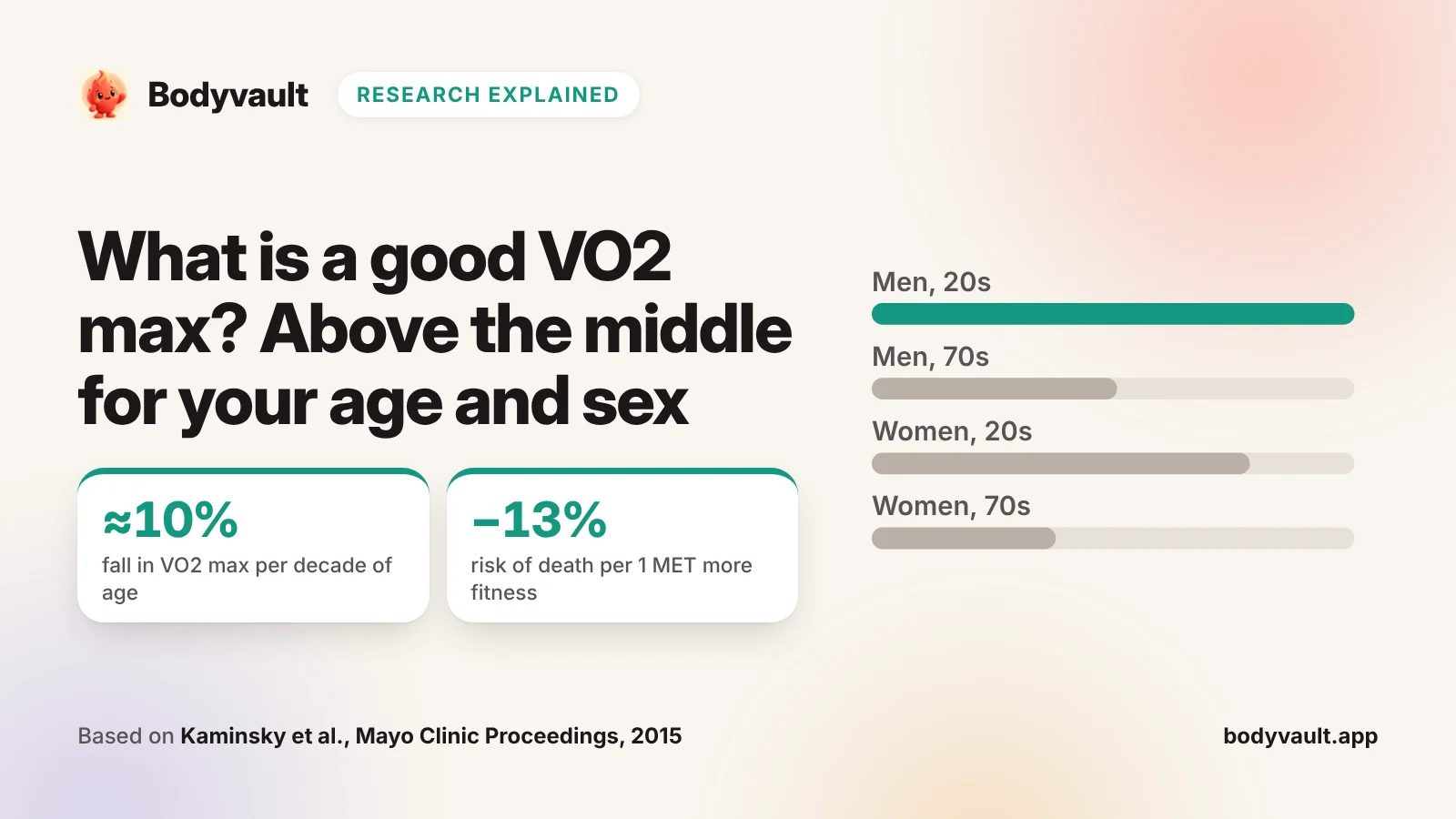
What is a good VO2 max? One above the middle for people of your age and sex. In US lab tests, the middle value for men fell from 48.0 ml/kg/min in their 20s to 24.4 in their 70s. For women, it fell from 37.6 to 18.3.
The short answer
≈10%
How much the middle VO2 max falls with each decade of age, in 7,783 US lab tests
−13%
Lower risk of dying during the studies for each small step up in fitness, across 33 studies of healthy adults
5×
Risk of dying for the least fit quarter of patients, compared with the fittest 2%
−6.25
How far Apple Watch read below a lab test, in ml/kg/min, on average, in 35 young adults
Strength of evidenceGood
Many large studies link higher fitness with a longer life. They show a link, not proof. The age charts come from US lab tests, and newer values are a little lower.
Key findingA good VO2 max is one above the middle for your age and sex. The biggest health links come from moving out of the least fit group, and fitness can be raised at any age.
What is VO2 max?
VO2 max is the most oxygen your body can use during hard exercise. It is a good measure of fitness. It shows how well your heart, lungs and muscles work together when you push hard.
It is given in millilitres of oxygen per kilogram of body weight per minute (ml/kg/min). Researchers also use METs. One MET is the oxygen you use sitting still: 3.5 ml/kg/min. So a VO2 max of 35 is 10 METs.
The best way to measure it is a lab test. You run or cycle harder and harder while a mask measures your breathing. Field tests and watches can only estimate it. Our VO2 max calculator gives three such estimates.
Your genes matter too. A 2024 review notes that nearly half of the differences in fitness between people come from genes. The rest depends mainly on how active you are.
What is a good VO2 max?
There is no single number. VO2 max falls with age, and women’s values are lower than men’s at every age. So “good” means good for people of your age and sex.
The main US reference values come from the FRIEND registry. It holds 7,783 lab treadmill tests of adults aged 20 to 79 without known heart disease, from 8 labs. The middle value for men fell from 48.0 in their 20s to 24.4 in their 70s. For women, it fell from 37.6 to 18.3. That is about 10% less with each decade.
Researchers rank fitness against people of the same age and sex. Picture 100 people like you lined up from least to most fit. Then:
- The bottom quarter counts as low fitness in research.
- Above the middle is better than average. That is a good VO2 max.
- The top quarter counts as high fitness for your age.
VO2 max by age: the middle and the top quarter
- Men, top quarter starts
- Men, middle
- Women, top quarter starts
- Women, middle
For example, take a 45-year-old woman with a VO2 max of 30. She is above the middle for her age (26.7) but below the top quarter (32.4). The full VO2 max by age and sex table is on our calculator page.
Treat these numbers as a rough guide. A larger 2022 update from 34 US labs found treadmill values 1.5 to 4.6 points lower than these. So if you sit a little below a line, you may be closer to average than it looks.
Why VO2 max matters: fitness and a long life
This was a cohort study: a study that followed a large group of people over time. It shows a link. It can’t prove that fitness itself caused the longer lives, because healthier people may simply be able to exercise harder.
The researchers then allowed for age, sex and other health problems. The gap between below-average and above-average fitness was about as big as the gap for smoking or for diabetes. There was no top limit either: the elite group still did better than the high group. When people were split by age, that extra edge showed only in those aged 70 or over.
Raised risk of dying during the study, in one model of 122,007 patients
- Low vs elite fitness5.04 (4.10–6.20)
- Below vs above average fitness1.41 (1.34–1.49)
- Smoking1.41 (1.36–1.46)
- Diabetes1.40 (1.34–1.46)
- Narrowed heart arteries1.29 (1.24–1.35)
Pooled studies point the same way. A 2009 meta-analysis pooled 33 studies of healthy adults. It looked at steps of 1 MET (3.5 ml/kg/min). Each step up in fitness went with a 13% lower risk of dying during the studies, and a 15% lower risk of heart disease events. People below 7.9 METs (about 28 ml/kg/min) had 1.7 times the risk of death of people at 10.9 METs (about 38) or more.
A 2024 review of reviews combined 26 meta-analyses, covering 199 studies and more than 20.9 million records. High fitness went with a 41% to 53% lower risk of early death than low fitness. Each 1 MET step went with an 11% to 17% lower risk. The review rated how sure we can be as very low to moderate, mainly because most of the people studied were men.
Risk for each 1 MET (3.5 ml/kg/min) of extra fitness
- Death, 2009 meta-analysis0.87 (0.84–0.90)
- Heart disease events, 20090.85 (0.82–0.88)
- Death, 2024 review (one estimate)0.89 (0.86–0.92)
- Death, 2024 review (another estimate)0.83 (0.78–0.88)
- New heart failure, 2024 review0.82 (0.79–0.84)
How accurate is Apple Watch VO2 max?
Apple Watch estimates VO2 max and calls it Cardio Fitness. It uses your heart rate during outdoor walks, runs or hikes on fairly flat ground. It also uses GPS, your age, sex, height and weight.
A 2026 study checked the Apple Watch Series 10 against a lab test. It tested 40 healthy adults in Ireland and analysed 35 of them. Most were young, with an average age of 23, and very fit.
- On average, the watch read 6.25 ml/kg/min lower than the lab test.
- For one person, it could be anywhere from 18 points too low to 6 points too high.
- It put only 5 of the 35 people (14%) in the right fitness band. Half were two or more bands out.
- The gap was bigger in women (8.6 points low) than in men (3.8 points low), but these groups were small.
An earlier study by the same team, in 30 people, found much the same. The watch read about 6 points low.
Apple Watch minus lab test (ml/kg/min)
- Everyone (35 people)−6.25 (−18.2 to +5.7)
- Men (17)−3.82 (−12.9 to +5.3)
- Women (18)−8.55 (−21.4 to +4.3)
So one watch reading isn’t a lab result, and it may place you in the wrong part of an age chart. The watch may still help you follow your own trend over months. But no independent study has yet checked how well it tracks change.
How to increase VO2 max
Regular cardio raises VO2 max. A 2015 meta-analysis pooled 28 trials with 723 healthy adults aged 18 to 45. Compared with doing nothing, steady endurance training raised VO2 max by 4.9 ml/kg/min. Interval training raised it by 5.5. Intervals are short bursts of hard effort with easy breaks in between.
Those gains are about 1.4 to 1.6 METs (our calculation). In the studies above, people who were 1 MET fitter had a lower risk. That doesn’t prove that raising your own fitness lowers your risk. But it is a sensible goal.
Gains were bigger in longer programmes and in people who started less fit. The 2024 review adds that brisk walking for about 150 minutes a week can raise fitness a lot in people who are unfit. It also found the biggest health links when people moved from unfit to fit.
To plan your week, see our zone 2 training explainer and how much exercise you need each week.
Claims and evidence
ClaimThere is one good VO2 max number for everyone.
EvidenceIt depends on age and sex. In US lab tests, the middle value for men fell from 48.0 in their 20s to 24.4 in their 70s.
ClaimPast a certain level, more fitness doesn’t help.
EvidenceIn 122,007 patients, the fittest 2% still did better than the next group, and no upper limit was seen. By age, that edge showed in people aged 70 or older.
ClaimYour Apple Watch VO2 max is as good as a lab test.
EvidenceIn 35 young adults, it read 6.25 ml/kg/min low on average and put only 14% in the right fitness band.
ClaimVO2 max is all down to your genes.
EvidenceGenes explain nearly half of the differences between people. In 28 trials, training raised VO2 max by about 5 ml/kg/min.
What this means for you
What this means for you
- Compare your VO2 max with people of your own age and sex, not with athletes or one fixed target.
- If you are in the bottom quarter for your age, moving up is the most worthwhile change. Regular brisk walking is a good start.
- Mix steady cardio with some harder intervals. Both raise VO2 max.
- Read your watch’s VO2 max as a rough estimate. Look at the trend over months, not one reading.
- New to hard exercise, or have a heart condition, chest pain or dizziness? Talk to a doctor before intervals or a max test.
What the research can’t tell you yet
- Links, not proof. The fitness studies followed people over time. Healthier people may simply be fitter, so the studies can’t prove that fitness causes a longer life.
- Who was studied. Most of the survival studies were of men, and the age charts come from US labs.
- Estimates, not measurements. The study of 122,007 patients estimated fitness from treadmill speed and slope, not from breathing.
- Watches. The Apple Watch study had 35 young, mostly fit adults, one watch model and one test each.
- Older people. Few people over 70 were tested for the age charts.
How Bodyvault uses this research
Bodyvault reads the VO2 max estimate your watch saves to Apple Health or Health Connect. The app’s Heart section shows your latest value with a six-month trend. The detail view labels it a watch estimate and suggests you compare it only with your own history. Bodyvault doesn’t turn your VO2 max into a risk of dying.
Share or cite this explainer
Bodyvault (2026). What is a good VO2 max for your age? https://bodyvault.app/blog/what-is-a-good-vo2-max
The charts on this page may be reused with a link back to it. The underlying data belong to the studies cited below.
Questions
What is VO2 max?
It is the most oxygen your body can use during hard exercise, in millilitres per kilogram per minute. It is one of the best measures of fitness.
What’s a good VO2 max?
Anything above the middle for your age and sex. In US lab tests, the middle was 42.4 for men and 30.2 for women in their 30s, and 32.6 and 23.4 in their 50s. Our calculator page has the full table.
How do you measure VO2 max?
A lab test with a breathing mask on a treadmill or bike is the most accurate. Field tests, such as a 12-minute run, and watches only estimate it.
How can I improve my VO2 max?
Do regular cardio, with some harder intervals. In 28 trials of healthy adults, training raised VO2 max by about 5 ml/kg/min compared with doing nothing. People who start less fit tend to gain the most.
Is Apple Watch VO2 max accurate?
Not as an exact number. In 35 young adults, it read about 6 ml/kg/min lower than a lab test on average, with big differences between people. Treat it as a rough guide to your own trend.
Sources
- Kaminsky LA, Arena R, Myers J (2015). Reference standards for cardiorespiratory fitness measured with cardiopulmonary exercise testing: data from the Fitness Registry and the Importance of Exercise National Database. Mayo Clin Proc 90(11):1515–1523.
- Kaminsky LA et al. (2022). Updated reference standards for cardiorespiratory fitness measured with cardiopulmonary exercise testing: data from FRIEND. Mayo Clin Proc 97(2):285–293.
- Mandsager K et al. (2018). Association of cardiorespiratory fitness with long-term mortality among adults undergoing exercise treadmill testing. JAMA Netw Open 1(6):e183605.
- Kodama S et al. (2009). Cardiorespiratory fitness as a quantitative predictor of all-cause mortality and cardiovascular events in healthy men and women: a meta-analysis. JAMA 301(19):2024–2035.
- Lang JJ et al. (2024). Cardiorespiratory fitness is a strong and consistent predictor of morbidity and mortality among adults: an overview of meta-analyses representing over 20.9 million observations from 199 unique cohort studies. Br J Sports Med 58(10):556–566.
- Lambe R et al. (2026). Accuracy of VO2 max estimates from Apple Watch Series 10. Mayo Clin Proc Digit Health 4(2):100357.
- Lambe R, O’Grady B, Baldwin M, Doherty C (2025). Investigating the accuracy of Apple Watch VO2 max measurements: a validation study. PLoS One 20(5):e0323741.
- Milanović Z, Sporiš G, Weston M (2015). Effectiveness of high-intensity interval training (HIT) and continuous endurance training for VO2max improvements: a systematic review and meta-analysis of controlled trials. Sports Med 45(10):1469–1481.
General information about fitness and nutrition, not medical advice. If you have a health condition, are pregnant or take medication, talk to your doctor before changing your diet or training.