
Research explained
Max heart rate: is 220 minus your age right?
Your max heart rate is the fastest your heart can beat when you exercise as hard as you can. The 220 − age formula was never tested in a study. Any age formula can be about 10 beats a minute off for one person.
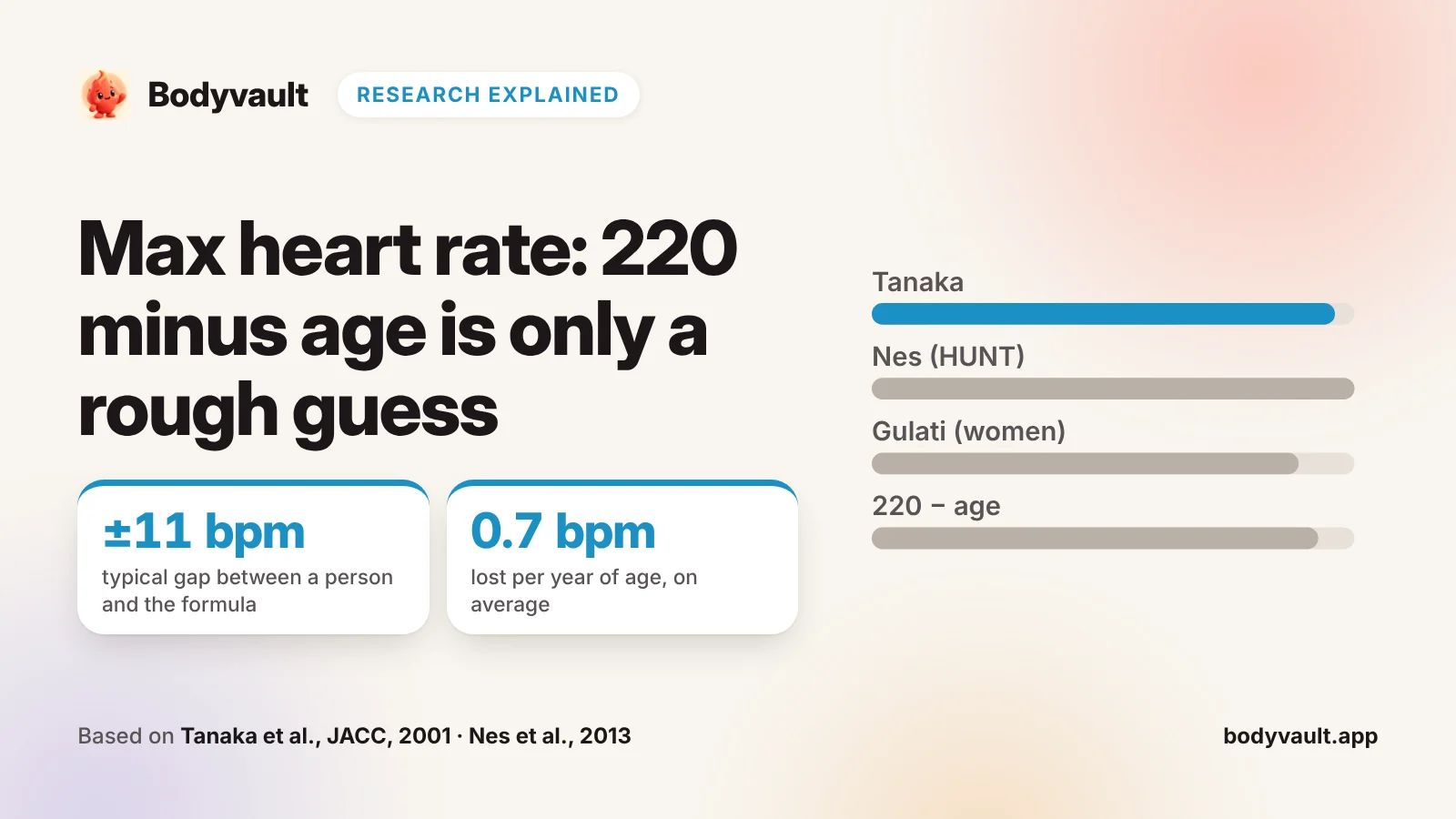
The short answer
≈35
Data points behind 220 − age. In 1971 a line was drawn by eye through them, and no study tested it
0.7bpm
How much max heart rate falls each year, on average, in 18,712 people
±11bpm
How far a typical person sat from the formula, in a study of 3,320 adults
±2bpm
How close a measured max is, if you truly go all out
Strength of evidenceGood
Large studies agree on how max heart rate falls with age on average. But for one person, any formula is only a rough guess.
Key findingUse a formula as a starting point, not a fact. Your real max can be 10 or more beats away from it. If you have seen a higher heart rate in a hard race, trust that number.
What is max heart rate?
Your max heart rate is the fastest your heart can beat when you exercise as hard as you can. It is counted in beats per minute (bpm). You can’t push past it by trying harder.
It matters because many watches and apps use it to set your heart rate zones. If the max is wrong, every zone is wrong too.
Max heart rate falls as you get older. A large pooled study of 18,712 people found it dropped by about 0.7 beats a minute for every year of age. Men and women fell at the same rate. So did active and inactive people.
Being fitter doesn’t raise it. In a study of 3,320 Norwegian adults, max heart rate fell with age in the same way in fit and less fit people.
Why does max heart rate decrease with age?
Your heart has a built-in pacemaker. It is a small patch of cells that sets each beat. With age, this pacemaker runs more slowly.
A lab study tested 30 healthy men: 15 aged 57 to 76 and 15 aged 18 to 30. The researchers used a drug to block the nerves that speed the heart up and slow it down. This showed the heart’s own built-in rate. It was 58 beats a minute in the older men and 83 in the young men. Their max heart rates were 162 and 191.
The slower pacemaker, plus a weaker response to adrenaline-like signals, explained 83% of the gap in max heart rate. So the fall is a normal part of ageing. It isn’t a sign that you are getting less fit, and training doesn’t stop it.
Where 220 minus age came from
The 220 − age formula is everywhere: in gyms, textbooks and fitness apps. Yet nobody tested it in a study made for it. In 2002, two exercise scientists traced where it came from.
The 1971 authors didn’t fit a line with statistics. They only wrote that 220 − age “defines a line not far from many of the data points”. When the 2002 team fitted a proper line, the points sat a typical 21 beats away from it.
The team also asked two famous scientists often credited with the formula, Martti Karvonen and Per-Olof Åstrand. Both said they had never published research behind it.
- 1938
The first formula
Sid Robinson’s data give 212 − 0.77 × age.
- 1957
Karvonen’s reserve method
Effort is set as a share of the gap between resting and max heart rate.
- 1971
220 − age appears
A line drawn by eye through about 35 data points.
- 2001
The Tanaka formula
208 − 0.7 × age, from 18,712 people.
- 2010
A formula for women
206 − 0.88 × age, from 5,437 women.
- 2013
The HUNT study
211 − 0.64 × age, from 3,320 adults who reached a true max.
Max heart rate by age: four formulas
Since 1971, researchers have measured max heart rate in large groups. The 2002 review found 43 published formulas. When it averaged 30 of them from healthy people, it got about 209 − 0.73 × age.
Three newer formulas stand out:
- Tanaka (2001): 208 − 0.7 × age. It pooled 351 studies with 18,712 healthy people. A lab check in 514 more people gave almost the same line. It worked the same for men and women.
- Nes (2013): 211 − 0.64 × age. This study tested 3,320 healthy adults in Norway. It only counted people who truly reached their max. Older formulas guessed too low for people over 30.
- Gulati (2010): 206 − 0.88 × age, for women. It comes from 5,437 women who did a treadmill test. There is more on this below.
Compared with Tanaka, 220 − age gives higher numbers before 40 and lower numbers after 40. The gap grows with age. At 70, 220 − age says 150, while Tanaka says 159.
| Age | Tanaka | Nes (HUNT) | Gulati (women) | 220 − age |
|---|---|---|---|---|
| 20 | 194 bpm | 198 bpm | 188 bpm | 200 bpm |
| 30 | 187 bpm | 192 bpm | 180 bpm | 190 bpm |
| 40 | 180 bpm | 185 bpm | 171 bpm | 180 bpm |
| 50 | 173 bpm | 179 bpm | 162 bpm | 170 bpm |
| 60 | 166 bpm | 173 bpm | 153 bpm | 160 bpm |
| 70 | 159 bpm | 166 bpm | 144 bpm | 150 bpm |
Max heart rate by age: four formulas
- Tanaka
- Nes (HUNT)
- Gulati (women)
- 220 − age
How much people differ from any formula
A formula gives an age-predicted max heart rate: the average for people of your age. But people of the same age differ a lot. In the HUNT study, the typical gap between a person’s real max and the formula was 10.8 beats a minute.
Take a 40-year-old. The HUNT formula says 185. But about 1 in 3 people that age will have a real max below 175 or above 196. About 1 in 20 will be more than 20 beats away.
Max heart rate at age 40: the formula and the real spread
- About 2 in 3 people175–196 bpm
- About 19 in 20 people164–207 bpm
The 2002 review found the same problem across many formulas. Most were more than 10 beats out for a typical person, and even the best was 6.4 beats out. The authors judged that up to 8 beats is fine for training zones, so most formulas miss that mark.
How to figure out your max heart rate
There are three ways, from easiest to most accurate.
Use a formula
Try 208 − 0.7 × age. At 40, that gives 180 bpm. Our heart rate zone calculator does the sum and lets you pick another formula.
Look at your highest heart rate
Check the top heart rate your watch or chest strap recorded near the end of a hard race. Unless that reading was a glitch, your real max is at least this high.
Do a supervised test
In a lab test, you work harder and harder while staff watch your heart. If you truly go all out, the result is within about 2 beats of your real max.
Don’t try an all-out effort on your own if you have heart symptoms, are new to hard exercise or are pregnant. Talk to a doctor first. Some medicines, such as beta blockers, lower heart rate, so formulas and zones may not fit you. Never change a medicine to change your heart rate.
Max heart rate for women
Most early formulas came mainly from men. A US study tested 5,437 women with an average age of 52 on a treadmill in 1992. Their peak heart rate fell faster with age: 206 − 0.88 × age. By that formula, a 50-year-old woman’s max is 162, compared with 170 from 220 − age.
But two other large studies found no difference between men and women. Tanaka’s pooled data gave the same line for both. The HUNT study found that women’s max was, if anything, higher than older formulas said.
So the evidence is mixed. The women’s formula may suit some women better, but a measured max beats any formula.
The US women were followed for 16 years. Those whose peak heart rate fell well below the women’s formula were more likely to die in that time. Doctors use this check in clinic exercise tests. It shows a link, not a cause.
Heart rate reserve: the Karvonen method
Many apps set zones as a share of your max heart rate. The Karvonen method also uses your resting heart rate. Your heart rate reserve is the gap between the two.
The sum is: target = resting + share × (max − resting). Say your max is 180 and your resting heart rate is 60, so your reserve is 120 beats. For 60% effort, the target is 60 + 0.6 × 120 = 132 bpm. Using 60% of max gives only 108 bpm.
The method comes from a 1957 Finnish study led by Martti Karvonen. We couldn’t read the original paper. A 2017 history of his work says he found that fitness improved once training reached about 60% of the reserve.
A 1997 lab study of 63 adults on exercise bikes shows why the method works. A share of their heart rate reserve matched the same share of their oxygen reserve almost exactly. It didn’t match a share of VO2 max as well. VO2 max is the most oxygen your body can use during hard exercise.
The same effort, two scales: % of reserve and % of max
- Same effort as % of max
- If the two scales were equal
Is there a max heart rate to burn fat?
Some gym charts show a “fat-burning zone” at an easy effort. At easy efforts, a bigger share of the energy you burn comes from fat. But that doesn’t mean you lose more fat over weeks and months.
Our zone 2 training explainer looks at what trials found when they compared easy and harder training. The calculator shows five zones, from 50–60% up to 90–100% of your max or your reserve.
Claims and evidence
Claim220 minus your age is a tested formula.
EvidenceIt came from a line drawn by eye through about 35 data points in 1971. No study was set up to test it.
ClaimA higher max heart rate means you are fitter.
EvidenceMax heart rate depends mostly on age. In 18,712 people, active and inactive people shared the same line.
ClaimRegular training stops your max heart rate from falling.
EvidenceIt falls with age whatever your activity level. A lab study linked the fall mainly to the heart’s built-in pacemaker slowing down.
ClaimWomen and men need different formulas.
EvidenceStudies disagree. One study of 5,437 women found a faster fall with age, but two large studies found no difference between women and men.
What this means for you
What this means for you
- Treat any age formula as a rough guess. Your real max can be 10 or more beats higher or lower.
- If your watch has recorded a higher heart rate during a hard race, use that as your max.
- Add your resting heart rate to get heart rate reserve zones. They take your own resting heart rate into account.
- Check your zones against how hard the effort feels. Easy should feel easy enough to talk.
- If you get chest pain, dizziness or faintness during exercise, stop and see a doctor. If you take medicines that change heart rate, ask your doctor how to judge effort.
What the research can’t tell you yet
- Who was studied. Most formulas come from healthy adults in the US and Europe. They may fit other groups less well.
- Treadmill or bike. Max heart rate depends on the type of exercise, so a treadmill max may not match your cycling max.
- Women. Only one large study found a different line for women, and others disagree.
- Why it falls. The pacemaker study had only 30 men.
- The 1957 study. We couldn’t read Karvonen’s original paper, so we rely on later accounts of it.
How Bodyvault uses this research
Bodyvault uses the heart rate zones you set in Apple’s Workout app when your iPhone or Apple Watch provides them. Otherwise it works out your zones. Your max is the higher of two numbers: the Tanaka estimate (208 − 0.7 × age), or the highest heart rate in your workouts over the last 180 days. The five zones start at 50, 60, 70, 80 and 90% of your heart rate reserve. For resting heart rate, it uses your typical value from the last 14 days. Without your age or any workouts, it shows no zones rather than guessing.
Share or cite this explainer
Bodyvault (2026). Max heart rate: is 220 minus your age right? https://bodyvault.app/blog/max-heart-rate
The charts on this page may be reused with a link back to it. The underlying data belong to the studies cited below.
Questions
What is a max heart rate?
It is the fastest your heart can beat during all-out exercise, in beats per minute. It falls by about 0.7 beats a year as you age. Being fitter doesn’t raise it.
How do I find my max heart rate?
The quickest way is a formula such as 208 − 0.7 × age, which gives 180 bpm at 40. Your highest heart rate in a hard race is a better guide. A supervised lab test is the most accurate.
Why does max heart rate decrease with age?
The heart’s built-in pacemaker slows down with age. In a lab study of 30 healthy men, this explained most of the 29-beat gap between older and young men. It happens to active and inactive people alike.
What is the max heart rate for women?
One study of 5,437 women suggested 206 − 0.88 × age, which gives 162 bpm at 50. Other large studies found that the same formula works for women and men. So a measured max is best.
Is 220 minus age accurate?
It is simple, but nobody ever tested it properly. Compared with newer formulas, it guesses high for young adults and low for older adults. Like any age formula, it can be 10 or more beats off for one person.
Sources
- Robergs RA, Landwehr R (2002). The surprising history of the “HRmax = 220 − age” equation. J Exerc Physiol Online 5(2):1–10.
- Tanaka H, Monahan KD, Seals DR (2001). Age-predicted maximal heart rate revisited. J Am Coll Cardiol 37(1):153–156.
- Nes BM et al. (2013). Age-predicted maximal heart rate in healthy subjects: the HUNT Fitness Study. Scand J Med Sci Sports 23(6):697–704.
- Gulati M et al. (2010). Heart rate response to exercise stress testing in asymptomatic women: the St. James Women Take Heart Project. Circulation 122(2):130–137.
- Christou DD, Seals DR (2008). Decreased maximal heart rate with aging is related to reduced β-adrenergic responsiveness but is largely explained by a reduction in intrinsic heart rate. J Appl Physiol 105(1):24–29.
- Karvonen MJ, Kentala E, Mustala O (1957). The effects of training on heart rate; a longitudinal study. Ann Med Exp Biol Fenn 35(3):307–315.
- Swain DP, Leutholtz BC (1997). Heart rate reserve is equivalent to %VO2 reserve, not to %VO2max. Med Sci Sports Exerc 29(3):410–414.
- Ignaszewski M et al. (2017). The science of exercise prescription: Martti Karvonen and his contributions. BC Med J 59(1):38–41.
General information about fitness and nutrition, not medical advice. If you have a health condition, are pregnant or take medication, talk to your doctor before changing your diet or training.