
Research explained
What is a good resting heart rate? What studies show
What is a good resting heart rate? For adults, 60 to 100 beats a minute is the usual normal range, and in 92,457 people wearing trackers the average was 65.5. Within that range, lower tended to go with better health, and your own steady normal matters most.
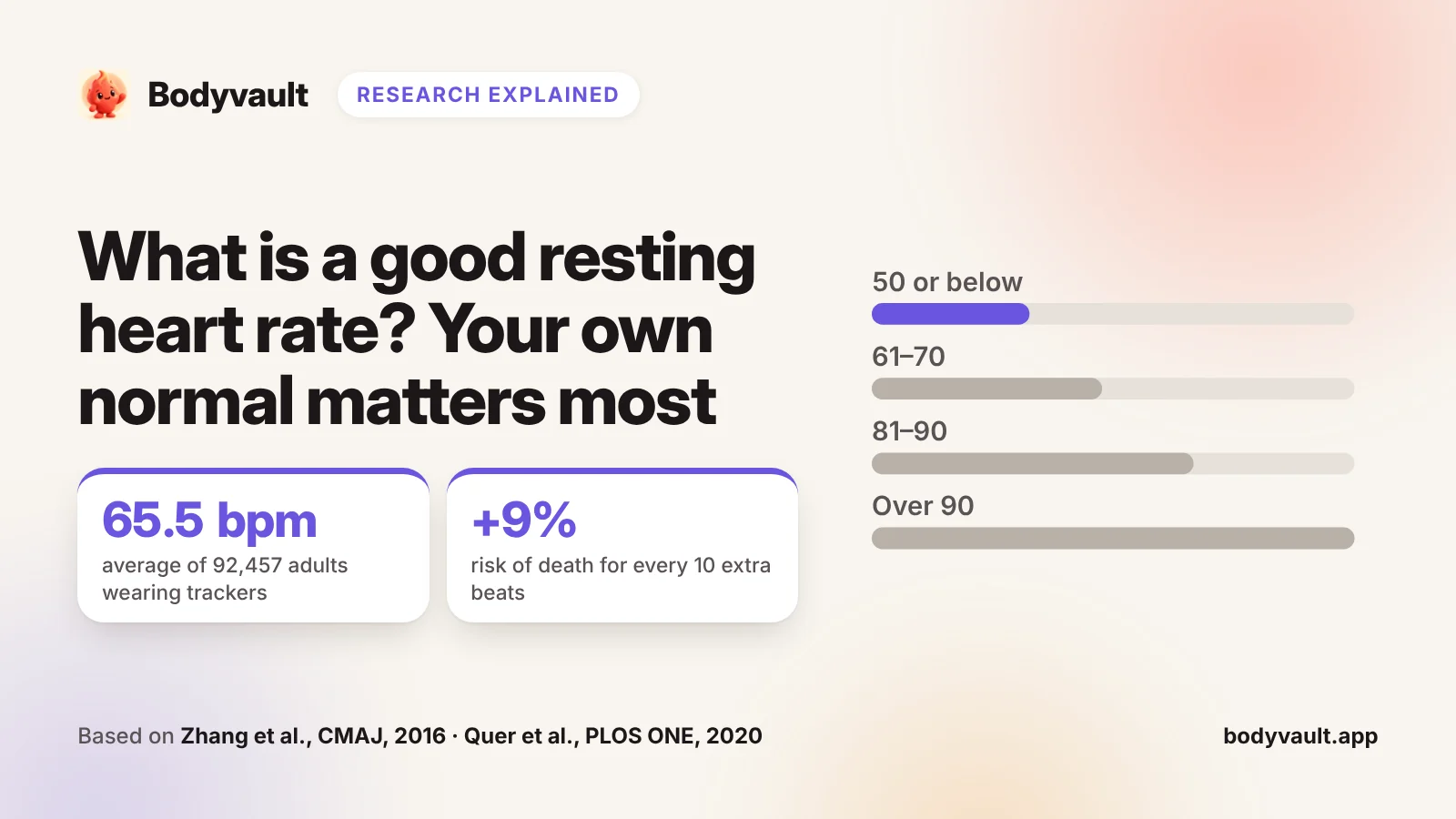
The short answer
60–100bpm
The usual normal range for adults at rest
65.5bpm
Average daily resting heart rate of 92,457 adults wearing a tracker
+9%
Higher risk of dying during the studies for every 10 extra beats, across 46 studies
−3.3bpm
Average drop in resting heart rate with regular exercise, in 191 trials
Strength of evidenceGood
Large studies agree that a lower resting heart rate goes with better health. They show a link, not proof, and one reading tells you little.
Key findingYour own normal matters more than any chart. A rise of several beats above your usual that lasts for days is worth noticing.
What is resting heart rate?
Resting heart rate is how many times your heart beats in a minute when you are completely at rest. A good time to check it is just after you wake up, before you get out of bed.
To measure it yourself, rest for at least 10 minutes. Find your pulse on the inside of your wrist, below the base of your thumb. Count the beats for a full minute, or for 30 seconds and double it. Watches and rings estimate it for you, often from calm moments or sleep.
What is a good resting heart rate?
For adults, doctors usually call 60 to 100 beats a minute normal. Well-trained athletes often sit lower, at 40 to 60. These ranges come from MedlinePlus, a health site run by the US National Library of Medicine.
Real-world data show how wide “normal” is. A 2020 study looked at 92,457 US adults who wore a Fitbit tracker for most of two years. Their average resting heart rate was 65.5. Among men, 95% averaged between 50 and 80. Among women, 95% averaged between 53 and 82. A few people sat as low as 40 or as high as 109.
Resting heart rate: where most adults sit
- Usual normal range for adults60–100 bpm
- Well-trained athletes40–60 bpm
- Men wearing a tracker (95%)50–80 bpm
- Women wearing a tracker (95%)53–82 bpm
So what is good? Within the normal range, a lower rate generally went with better health in large studies, as the next section shows. But your own steady normal matters more than where you sit on a chart. In the tracker study, age, sex, weight and sleep together explained only a tenth of the differences between people.
Resting heart rate by age, and for women
Resting heart rate changes little with age. In the tracker study, it rose a little until about age 50 and then fell slightly. Women averaged a little higher than men at every age. Their resting heart rate also moved more from day to day in the years when they had periods.
| Resting heart rate | What the research and doctors say |
|---|---|
| 40–60 bpm | Common in well-trained athletes (MedlinePlus). |
| 50–82 bpm | Where 95% of 92,457 tracker users averaged: 50–80 for men, 53–82 for women (Quer, 2020). |
| 60–100 bpm | The usual normal range for adults at rest (MedlinePlus). |
| Over 80 bpm | Went with a 45% higher risk of dying during the studies than the lowest group, across 46 studies (Zhang, 2016). |
| Over 90–100 bpm | The usual cut-off for a fast resting heart rate (Zhang, 2016). Talk to a doctor if yours stays this high. |
Is a lower resting heart rate better?
A 2016 meta-analysis pooled 46 studies that followed people over time. More than 1.2 million people were in the studies of death from any cause. They were followed for 3 to 40 years.
For every 10 extra beats a minute, the risk of dying during the studies was 9% higher. People above 80 beats had a 45% higher risk than the lowest group in each study. People at 60 to 80 had a 12% higher risk. For women above 80, the risk was 39% higher.
These studies can’t prove that a high resting heart rate causes harm. Fitness could explain part of the link, because fitter people tend to have lower heart rates. A Danish study tested this.
Fitter men did have lower resting heart rates. But the researchers also allowed for fitness, activity, smoking, blood pressure and more. Each extra 10 beats still went with a 16% higher risk. So resting heart rate seems to tell us something beyond fitness. It is still a link, not proof.
What changes your resting heart rate?
Your resting heart rate isn’t fixed. In the tracker study, a person’s number usually moved by only about 3 beats within a week. But about 1 in 5 people had at least one week when it swung by 10 beats or more. Many things push it up or down:
- Fitness. Regular cardio lowers it over a few months (see the next section).
- Sleep. In the tracker study, people who slept 7 to 7.5 hours a night had the lowest resting heart rates.
- Alcohol. In 4,098 Finnish workers, heart rate in the first 3 hours of sleep rose after drinking. Even a small amount raised it a little. More on this in alcohol and sleep.
- Illness. A fast pulse can be a sign of an infection or of not drinking enough. Studies have seen resting heart rate rise before an infection was found. See resting heart rate when sick.
- Stress, smoking and medicines. All three can change it. Some heart and blood pressure medicines, such as beta blockers, lower it. Never stop or change a medicine to change your heart rate.
- Time of year and your cycle. On average, it was about 2 beats higher in early January than at the end of July. Women’s resting heart rate also moved with the monthly cycle.
How to lower your resting heart rate
Regular exercise lowers it. A 2018 meta-analysis pooled 191 trials with 12,952 healthy people. A typical programme lasted 12 weeks, with 3 sessions a week. Compared with people who didn’t exercise, resting heart rate fell by 3.3 beats a minute on average. It fell by 4.3 in men and 3.4 in women.
Endurance training, or steady cardio, lowered it by about 3 to 6 beats, depending on the group. Yoga lowered it by about 5. Strength training alone didn’t clearly lower it overall. People who started with a higher resting heart rate saw the biggest drops, and older people saw smaller ones.
Sleep and alcohol may matter too. People who slept 7 to 7.5 hours had the lowest resting heart rates in the tracker study. In the Finnish study, alcohol raised heart rate during sleep. No trial has shown that lowering your resting heart rate, on its own, helps you live longer.
When to see a doctor
A resting heart rate outside 60 to 100 isn’t always a problem. Many fit people sit below 60. But talk to a doctor if:
- Your resting heart rate stays above 100, or keeps rising for no clear reason.
- It is below 60 and you aren’t very fit, or you feel dizzy, weak or faint.
- Your pulse feels uneven, or you often feel your heart racing, pounding or fluttering.
Get emergency help straight away if a racing or pounding heart comes with chest pain, shortness of breath or fainting. A watch can’t diagnose a heart problem. Don’t start, stop or change a medicine because of a heart rate reading.
Claims and evidence
ClaimAnything from 60 to 100 is equally good.
EvidenceIt is the usual normal range. But within it, risk rose steadily with heart rate: about 9% for every 10 beats in 46 studies.
ClaimA resting heart rate under 60 is always a problem.
EvidenceWell-trained athletes often sit at 40 to 60. A low rate needs a doctor’s check when it comes with dizziness or fainting.
ClaimResting heart rate is just a sign of fitness.
EvidenceIn 2,798 Danish men, a higher rate still went with higher risk after allowing for measured fitness.
ClaimYou can’t change your resting heart rate.
EvidenceIn 191 trials, regular exercise lowered it by about 3 beats a minute, and by more in people who started high.
What this means for you
What this means for you
- Learn your own normal. Check your resting heart rate at the same time each morning, or follow your watch’s trend.
- Look for changes of several beats that last for days, not single readings. Poor sleep, alcohol, stress, illness and hard training can all raise it.
- To lower it over time, do regular cardio or yoga, sleep well and keep alcohol low.
- Don’t compare yourself with athletes. A resting heart rate of 70 is common and normal.
- See a doctor if it stays above 100, if it is low and you feel faint, or if your pulse is uneven.
What the research can’t tell you yet
- Cause and effect. The risk studies followed people over time. They show that a higher resting heart rate goes with higher risk, not that lowering it makes you live longer.
- One reading. Resting heart rate is easily pushed up or down on the day. The Danish study, for example, used a single heart tracing.
- Who was studied. The Danish study had only men. The tracker study only had people who owned a tracker.
- Missing studies. The 46-study review found signs that some small studies went unpublished. Allowing for that, the risk for each 10 beats shrank from 9% to 4%.
- Watch numbers. The tracker study used Fitbit’s own method for resting heart rate. Other devices may work it out differently, so their numbers may not match.
How Bodyvault uses this research
Bodyvault reads your resting heart rate from Apple Health or Health Connect. It compares it with your own usual level over the past 60 days, not with a population chart. The app’s Coach checks your last three days. If your resting heart rate sits clearly above your usual, Coach points it out and suggests resting if you also feel unwell. In Bodyvault Pro, resting heart rate makes up 20% of the Readiness score, again compared with your own usual level.
Share or cite this explainer
Bodyvault (2026). What is a good resting heart rate? What studies show. https://bodyvault.app/blog/resting-heart-rate
The charts on this page may be reused with a link back to it. The underlying data belong to the studies cited below.
Questions
What is a normal resting heart rate?
For adults, 60 to 100 beats a minute is the usual normal range. Well-trained athletes often sit at 40 to 60. In 92,457 adults wearing trackers, the average was 65.5.
What is a good resting heart rate by age?
It changes little with age. In a large tracker study, it rose slightly until about 50 and then fell. Your own steady level matters more than your age.
What is a good resting heart rate for women?
Women average a little higher than men. In the tracker study, 95% of women averaged 53 to 82 beats a minute, compared with 50 to 80 for men. A woman’s rate also moves with her monthly cycle.
How can I lower my resting heart rate?
Regular cardio or yoga can lower it. In 191 trials, exercise lowered resting heart rate by about 3 beats a minute, often within about 3 months. Good sleep and less alcohol may help too.
When should I worry about my resting heart rate?
See a doctor if it stays above 100 at rest or your pulse is uneven. Also see one if it is low and you feel dizzy or faint. Get emergency help if a racing heart comes with chest pain, shortness of breath or fainting.
Sources
- Zhang D, Shen X, Qi X (2016). Resting heart rate and all-cause and cardiovascular mortality in the general population: a meta-analysis. CMAJ 188(3):E53–E63.
- Jensen MT et al. (2013). Elevated resting heart rate, physical fitness and all-cause mortality: a 16-year follow-up in the Copenhagen Male Study. Heart 99(12):882–887.
- Quer G et al. (2020). Inter- and intraindividual variability in daily resting heart rate and its associations with age, sex, sleep, BMI, and time of year: retrospective, longitudinal cohort study of 92,457 adults. PLoS One 15(2):e0227709.
- Reimers AK, Knapp G, Reimers CD (2018). Effects of exercise on the resting heart rate: a systematic review and meta-analysis of interventional studies. J Clin Med 7(12):503.
- Pietilä J et al. (2018). Acute effect of alcohol intake on cardiovascular autonomic regulation during the first hours of sleep in a large real-world sample of Finnish employees: observational study. JMIR Ment Health 5(1):e23.
- MedlinePlus, US National Library of Medicine (2025). Pulse. Medical Encyclopedia, reviewed 1 January 2025.
- NHS (2026). Heart palpitations. Page last reviewed 17 March 2026.
General information about fitness and nutrition, not medical advice. If you have a health condition, are pregnant or take medication, talk to your doctor before changing your diet or training.