
Research explained
Resting heart rate when sick: can a watch spot illness?
Your resting heart rate when sick often rises a few beats a minute, sometimes days before you feel ill. A watch can spot that rise, but an alert is a hint, not a diagnosis, because stress, alcohol and travel set off alerts too.
The short answer
+7bpm
Typical rise in resting heart rate early in COVID-19, in Fitbit users whose data changed
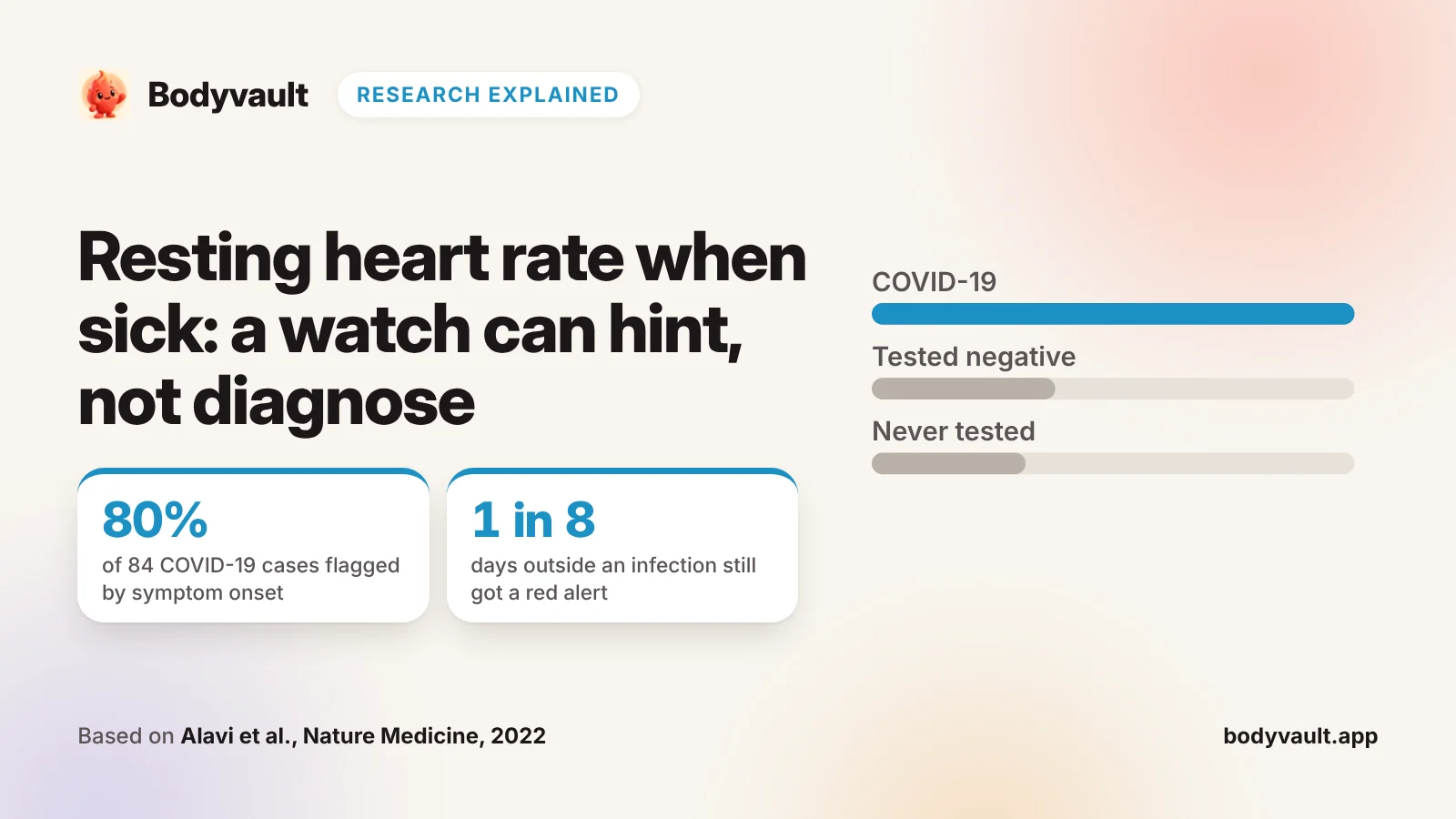
80%
Of 84 people with COVID-19 got a watch alert by the time symptoms began (or by a positive test)
3days
Typical head start before symptoms in the same study
1 in 8
Days outside a COVID-19 infection that still got a red alert in that study
Strength of evidenceModerate
Several studies agree that resting heart rate rises around an infection. But most were small, looked back at old data and studied COVID-19. Alerts also fire for many other reasons.
Key findingA resting heart rate that stays a few beats above your normal for two nights can be an early sign. Your body may be fighting something. It can also be stress, alcohol, travel or a hard week of training. Treat it as a reason to rest and check how you feel, not as a test result.
Resting heart rate when sick: what happens?
Your resting heart rate is how many times your heart beats in a minute when you are completely at rest. In 200,000 Fitbit users, the average was about 66 beats a minute. For each person, it is fairly steady. In one study, the typical person’s usual night-time level drifted by only about 3 beats a minute over three months.
When you catch an infection, your body works harder to fight it. A fever pushes your heart rate up too. Two of the studies in this article quote an older study of young men with an infection. Their heart rate rose about 8.5 beats a minute for each 1 °C of fever.
Illness changes your day as well. In smartwatch users with COVID-19, people took fewer steps and tended to sleep longer once their heart rate went up. So a watch can see a pattern: a higher resting heart rate, less movement and more sleep.
The key word is your. A resting heart rate that is normal for one person can be high for another. That is why these studies compare each night with the same person’s usual level. In a large flu study, this personal approach worked better than one cut-off for everyone. Our explainer on what a good resting heart rate is covers the normal range.
Can a watch spot illness before you feel it?
This was a cohort study: a study that followed a large group of people over time. It shows a link. It can’t prove that a watch can diagnose anything. The alerts worked about as well on Fitbit (77%) as on Apple Watch (83%).
An earlier study from the same Stanford team looked back at the data of 32 Fitbit users with COVID-19. In 26 of them, heart rate, steps or sleep changed. Of 25 people with a known start date for symptoms, 22 showed a change by that day. For 4 people, it came at least 9 days earlier.
A 2022 review gathered 12 studies of watches, rings and other wearables. It was a careful review of all the studies on one question. Early warning before symptoms ranged from 20% to 88% of cases. A higher heart rate was the most common sign, along with higher skin temperature and breathing rate.
There was a trade-off, though. The most accurate methods in the review picked up the infection 3 to 7 days after symptoms began. The earlier a method tried to warn, the more cases it missed.
A Fitbit study of 2,745 people with COVID-19 found the same trade-off. It used breathing rate, heart rate and HRV, the tiny changes in time between one heartbeat and the next. Breathing rate changed the most. With false alarms kept to about 1 day in 10, it flagged 21% of people the day before symptoms and 43% the day after.
Why false alarms are the big problem
A resting heart rate can rise for many reasons besides an infection. In the live-alert study, people noted what was going on when an alert came. In people without COVID-19, stress, hard exercise and alcohol were the things most often noted. Travel, the winter holidays and vaccines could set off alerts too.
Across all the days outside a COVID-19 infection, about 1 day in 8 still got a red alert (our calculation from the study’s numbers). The winter holidays had 1.4 times as many red alerts as other times of year. Even so, 73% of people who got alerts said the number was fine. They could usually link an alert to something in their life.
Other studies saw false alarms too. In the earlier Stanford study, healthy people got about 2 alarms every 3 months (0.66 a month). In the Fitbit study, the method wrongly flagged about 1 day in 25 in 300 healthy users. The authors worked out that, during New York’s COVID-19 peak in April 2020, only about 1 in 7 alerts would have been a true case.
A watch alert also can’t tell you which illness you have. Both Stanford studies and the Fitbit study saw the same signs with flu and other infections.
Flu season shows up in the data
A 2020 study looked at whole populations instead of single people. It used data from 47,249 Fitbit users in five US states over two years. Each week, it counted how many people had a resting heart rate above their own usual while not sleeping less than usual. Short sleep can raise heart rate by itself.
Adding these counts made flu estimates match official US flu numbers more closely in all five states, by 6% to 33%. But the changes in the Fitbit data came in the same week as the rise in flu, or a week later. They didn’t come first.
So this kind of data can help health services track flu in an area. It tells you little about one person. The authors also noted that holidays, very hot or cold weather and too little water can raise resting heart rate.
Can Apple Watch detect fever or temperature?
Not in the way a thermometer does. Apple Watch Series 8 and later, all Ultra models and the SE 3 measure skin temperature at the wrist while you sleep. After about 5 nights, the Health app shows each night as a change from your usual level. Apple says the feature is not a thermometer, can’t take a reading on demand and is not meant for diagnosis.
Apple also lists what can change your wrist temperature: illness, but also alcohol, exercise, what you eat, your bedroom and your menstrual cycle. Apple also uses it to estimate when you ovulated: see Apple Watch ovulation tracking. A 2026 review of Apple Watch accuracy found no studies yet that had checked its wrist temperature against a reference method.
Skin temperature can still help as part of a bigger picture. In a study of 63,153 people wearing an Oura ring, adding finger temperature to heart rate and breathing made COVID-19 detection more accurate. The rise was clearer during sleep than during the day. In another ring study, 38 of 50 people with COVID-19 (76%) had a temperature rise in the days before symptoms.
Many infections don’t cause a fever at all. In the Fitbit study of 2,745 people with COVID-19, only 59% of men and 52% of women reported a fever.
Can the Apple Watch detect AFib?
AFib (atrial fibrillation) is a common heart rhythm problem. The heart’s upper chambers beat out of rhythm, so the pulse becomes irregular. It matters because it goes with about five times the risk of stroke. It can also come and go, and some people feel nothing.
This was a very large study with one group and no comparison group. Alerts were rare: about 1 in 200 people got one (our calculation). They were far more common in older people.
Only 450 of the 2,161 people with an alert sent back a patch with usable data. They wore it, on average, 13 days after the alert. A third of them (34%) had AFib on the patch. That doesn’t mean the other alerts were wrong. AFib often comes and goes, so it may have stopped by then.
The fairest test came when a new alert arrived while someone was wearing the patch. That happened for 86 people, and 72 of them (84%) had AFib on the patch at that moment. Most single irregular readings that weren’t AFib showed other kinds of extra heartbeats.
The study couldn’t count how many people with AFib the watch missed, because people without an alert didn’t wear patches. The watch was built to avoid false alarms, and it may miss short bouts. The authors say an alert should not be used to diagnose AFib, and no alert doesn’t rule it out.
Newer Apple Watch models also have an ECG app. A 2026 review pooled 11 studies of it with 3,144 people. The ECG app caught 79% of real AFib and correctly called 91% of normal rhythms normal. But in several studies, 15% to 25% of readings could not be read either way.
How often AFib alerts and ECG readings were right
- Alert matched AFib on a patch worn at the same time84% (76–92)
- AFib found on a patch worn about 13 days after an alert34% (29–39)
- ECG app: real AFib it caught79% (61–90)
- ECG app: normal rhythms it called normal91% (81–96)
If you get an AFib alert, don’t ignore it and don’t panic. Book a visit with your doctor. In the Apple Heart Study, 57% of people who answered a survey 90 days after their alert had contacted a doctor outside the study.
Claims and evidence
ClaimA watch can tell you if you have COVID-19 or the flu.
EvidenceWatches picked up signs of infection, but the same rise in heart rate came with flu and other illnesses. They could not tell which one you had.
ClaimIf your resting heart rate is up, you’re getting sick.
EvidenceIn 3,318 people, stress, hard exercise, alcohol and travel could set off alerts too. People without COVID-19 still had about one alert day every three weeks.
ClaimNo alert means you’re fine.
Evidence17 of 84 people with COVID-19 got no alert in time (our calculation). The Apple Heart Study authors say that no alert does not rule out a heart rhythm problem.
ClaimApple Watch can take your temperature like a thermometer.
EvidenceApple says it is not a thermometer. It measures your wrist while you sleep and shows the change from your usual level.
What this means for you
What this means for you
- Learn your normal. Look at your resting heart rate over weeks, not one morning.
- If it stays a few beats above usual for two nights, check the simple things first. Think of alcohol, a hard workout, stress, travel or not drinking enough.
- If you also feel unwell, take an easy day, sleep more and drink fluids. Leave hard training until you feel better.
- If you think you have an infection, use a proper test and follow local health advice. A watch can’t tell you.
- If your watch gives an AFib alert, see a doctor. Get urgent help for chest pain, fainting or trouble breathing, and see a doctor if a fever lasts more than 3 days.
What the research can’t tell you yet
- Small numbers. Most COVID-19 studies here had only 32 to 84 people with the infection. One Fitbit study had 2,745.
- Mostly one illness. Most studies were about COVID-19 in 2020 and 2021.
- Looking back. Most methods were tested on old data. Only one study here sent live alerts to people.
- Who was studied. Volunteers who already owned a watch or ring, mostly in the US. In the big ring study, 82% were white.
- Missing nights. People often take their watch off or charge it when they are ill, so alerts can’t work.
- AFib. The Apple Heart Study couldn’t count missed cases. Only about 1 in 5 people with an alert sent back a patch, and Apple paid for the study.
How Bodyvault uses this research
Bodyvault’s early strain signal checks your resting heart rate, HRV, breathing rate, wrist temperature, blood oxygen and sleep against your own last two months. When two or more are clearly off two nights running, it suggests an easier day, more sleep and fluids, and asks how you feel. It calls this a wellness signal, not a diagnosis, and it doesn’t read AFib alerts or ECGs. If you log chest pain, trouble breathing or days of fever, it tells you to contact a doctor. In Bodyvault Pro, the signal also limits your Readiness score that day.
Share or cite this explainer
Bodyvault (2026). Resting heart rate when sick: can a watch spot illness? https://bodyvault.app/blog/resting-heart-rate-when-sick
The charts on this page may be reused with a link back to it. The underlying data belong to the studies cited below.
Questions
Does your resting heart rate go up when you’re sick?
Often, yes. In Fitbit users with COVID-19, resting heart rate rose by about 7 beats a minute as the illness began, often a few days before symptoms. A fever pushes it up too.
Can the Apple Watch detect AFib?
It can flag signs of it. In the Apple Heart Study, alerts that came while people wore a heart monitor patch matched AFib 84% of the time. But the watch can miss AFib, and an alert is not a diagnosis, so see a doctor if you get one.
Does Apple Watch detect AFib on its own?
It checks your pulse rhythm in the background while you are still, and can alert you if it looks irregular. Newer models also have an ECG app. Across 11 studies, the ECG app caught 79% of AFib and correctly cleared 91% of normal rhythms.
Can Apple Watch detect a fever?
Not directly. Apple says its wrist temperature feature is not a thermometer and can’t take a reading on demand. It shows how each night compares with your usual, and a rise can come from illness, alcohol, a warm room or your cycle.
Can Apple Watch measure your temperature?
Series 8 and later, all Ultra models and the SE 3 measure skin temperature at the wrist every 5 seconds while you sleep. You see it as a change from your usual level after about 5 nights. A 2026 review found no studies yet that had checked how accurate it is.
Sources
- Alavi A et al. (2022). Real-time alerting system for COVID-19 and other stress events using wearable data. Nat Med 28(1):175–184.
- Mishra T et al. (2020). Pre-symptomatic detection of COVID-19 from smartwatch data. Nat Biomed Eng 4(12):1208–1220.
- Mitratza M et al. (2022). The performance of wearable sensors in the detection of SARS-CoV-2 infection: a systematic review. Lancet Digit Health 4(5):e370–e383.
- Natarajan A, Su HW, Heneghan C (2020). Assessment of physiological signs associated with COVID-19 measured using wearable devices. NPJ Digit Med 3:156.
- Radin JM et al. (2020). Harnessing wearable device data to improve state-level real-time surveillance of influenza-like illness in the USA: a population-based study. Lancet Digit Health 2(2):e85–e93.
- Mason AE et al. (2022). Detection of COVID-19 using multimodal data from a wearable device: results from the first TemPredict Study. Sci Rep 12(1):3463.
- Perez MV et al. (2019). Large-scale assessment of a smartwatch to identify atrial fibrillation. N Engl J Med 381(20):1909–1917.
- Lambe R et al. (2026). The accuracy of Apple Watch measurements: a living systematic review and meta-analysis. npj Digit Med 9(1):63.
- Apple Support (2026). Track your nightly wrist temperature changes with Apple Watch. Product page, published 14 September 2026.
General information about fitness and nutrition, not medical advice. If you have a health condition, are pregnant or take medication, talk to your doctor before changing your diet or training.