
Research explained
Apple Watch ovulation tracking: how accurate is it?
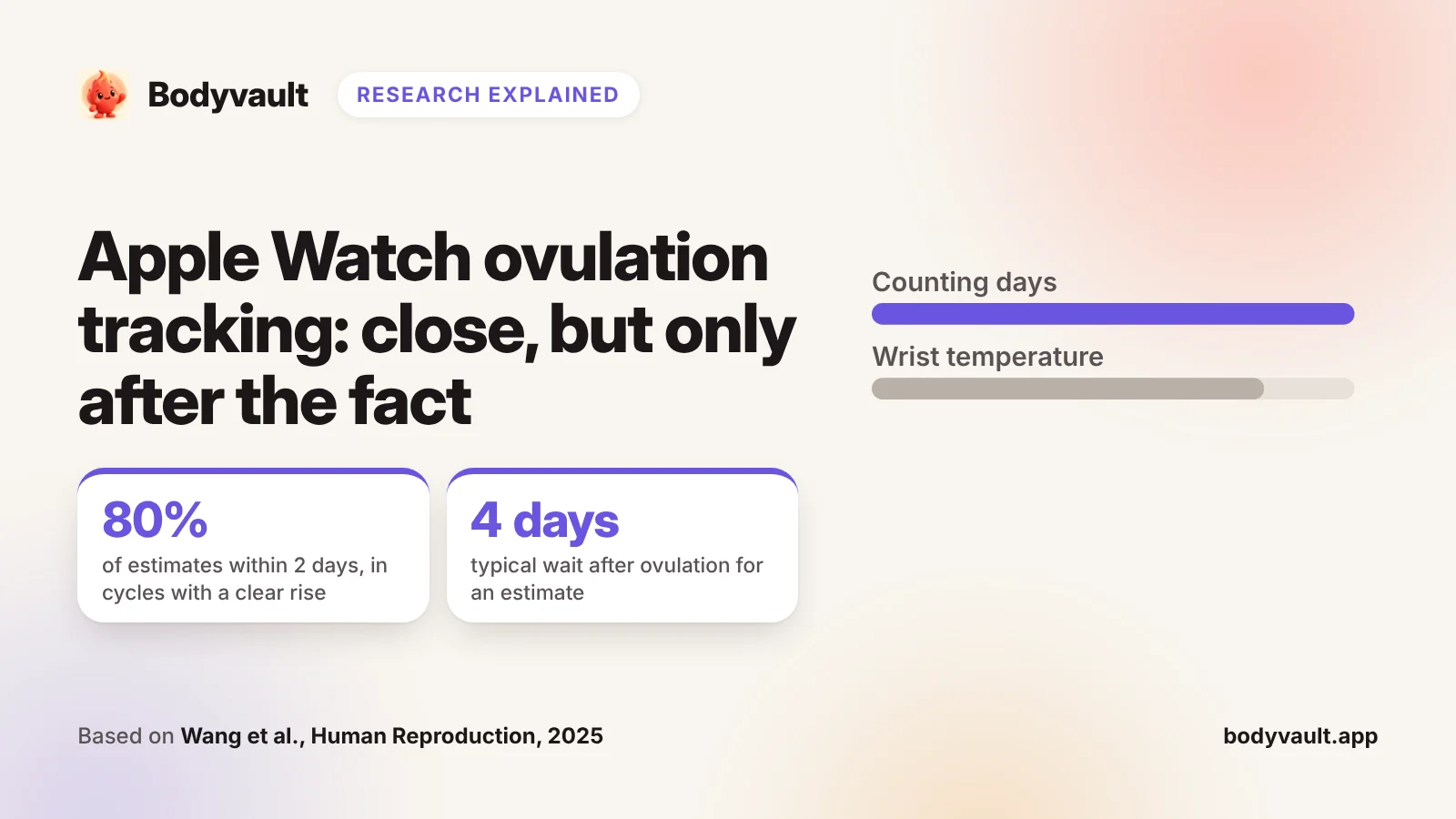
Apple Watch ovulation tracking looks back at your overnight wrist temperature to estimate when you ovulated, usually a few days after it happened. In Apple’s own study, most estimates were within 2 days, but it can’t predict fertile days and it isn’t birth control.
The short answer
80%
Of estimates made during the cycle were within 2 days of ovulation, when there was a clear temperature rise
1.2days
Average error once the cycle had ended, in those cycles
4days
Typical wait after ovulation before an estimate appeared
13%
Of 612,613 real cycles were the “textbook” 28 days long
Strength of evidenceModerate
Three studies agree that wrist temperature rises after ovulation. But device makers were involved in all of them, and they checked ovulation with home urine tests, not scans.
Key findingWrist temperature rises after ovulation, not before it. So Apple Watch can estimate when you probably ovulated, a few days later. It can’t tell you in advance, it can be wrong, and it isn’t birth control.
How wrist temperature shows ovulation
Ovulation is when an ovary releases an egg, part-way between one period and the next. After it, your body makes more of a hormone called progesterone. That makes your temperature at rest go up a little, by about 0.2 °C or more.
The classic way to see this is basal body temperature (BBT). You take your temperature by mouth every morning, before you get out of bed. A wrist sensor does a similar job while you sleep. Apple Watch Series 8 and later check your wrist every 5 seconds overnight. After about 5 nights, they show each night as a change from your usual.
The catch is timing. The rise comes after ovulation, so it only tells you looking back. In a study of 136 women who wore a wrist sensor in bed, a clear rise showed up in 82% of cycles. In 86% of those cycles, it came on or after the day of ovulation.
Some people look for the lowest point as a sign that ovulation is close. In that study, it fell in the 6 days up to ovulation in only 41% of cycles. The pattern still showed through after alcohol, a big meal, sex, coffee or exercise before bed.
Ovulation isn’t always on day 14
A common belief is that ovulation happens on day 14. Real cycles vary much more. A study of 612,613 cycles from 124,648 users of a cycle-tracking app found that only 13% were exactly 28 days long. The average cycle was 29.3 days.
The first part of the cycle, from your period to ovulation, changes the most. So counting days only gives a rough guess. That is the gap wrist temperature tries to fill.
Apple Watch ovulation tracking: what Apple’s study found
This was a cohort study: a study that followed a group of people over time. Apple paid for it, and half of the 10 authors work for Apple. Ovulation day was set as the day after a positive LH test. LH is a hormone that surges about 1 to 1.5 days before ovulation.
A “clear rise” means a rise of at least 0.2 °C. In those cycles, the watch gave an estimate about 8 times in 10. Counting every cycle, it gave one about 7 times in 10, and the average error during the cycle grew to about 1.9 days.
Next-period predictions were close too. About 88% came within 3 days of the real start, against 84% when counting days alone.
Does it work with irregular cycles?
Mostly, yes, though a little less well. The study split people into two groups. In one, every cycle was 23 to 35 days long. In the other, at least one cycle was shorter or longer. The estimates were slightly less exact for the second group.
Average error in days, regular vs irregular cycles
- Ovulation, cycle going · regular1.53 (1.35–1.70)
- Ovulation, cycle going · irregular1.71 (1.42–2.01)
- Ovulation, cycle ended · regular1.17 (1.05–1.30)
- Ovulation, cycle ended · irregular1.32 (1.13–1.53)
- Next period · regular1.49 (1.36–1.63)
- Next period · irregular1.97 (1.13–2.24)
The study left out people using hormonal birth control and people who were breastfeeding. It didn’t look separately at conditions such as PCOS (polycystic ovary syndrome) or thyroid problems. Fevers were rare, in 4% of cycles, so we don’t know how much illness throws the estimate off.
Can it be wrong?
Yes, in two ways. First, it can miss: even in cycles with a clear rise, about 1 in 5 had no estimate. Second, it can give an estimate when there was nothing to find. The researchers fed in only random sensor “noise”, with no real rise. The method still gave an estimate in 8% of ongoing cycles and 15% of finished ones.
The authors say the estimate “should not be used in isolation”. Their urine-test method can be wrong at times too. In PCOS, for example, a hormone surge isn’t always followed by ovulation.
Wrist sensor or morning thermometer?
A Swiss study compared the two in 57 women over 193 cycles. Each night they wore a wrist sensor, and each morning they took their temperature by mouth. Urine tests showed which cycles had ovulation.
The wrist sensor found the rise in far more cycles with ovulation. But it also showed a “rise” in 17 of the 23 cycles where urine tests found no ovulation. On average, the first rise came 4.4 days after ovulation on the wrist and 2.7 days after with the thermometer.
Apple’s study found something similar. When fed morning mouth readings instead, Apple’s method gave estimates in fewer cycles than with the wrist (64% and 69%).
One thing is still missing. A 2026 review of Apple Watch accuracy found no studies yet that had checked the watch’s sensor against a reference method.
Claims and evidence
ClaimApple Watch can tell you your fertile days in advance.
EvidenceWrist temperature rises after ovulation. Apple’s estimate typically came 4 days later, and in another study the first wrist rise came 4.4 days after.
ClaimEveryone ovulates on day 14.
EvidenceOnly 13% of 612,613 cycles were 28 days long. In 31–35-day cycles, ovulation came after about 19.5 days on average.
ClaimIf your watch shows an ovulation estimate, you definitely ovulated.
EvidenceApple’s method gave estimates from sensor noise alone in 8% to 15% of cycles. A wrist sensor showed false rises in 17 of 23 cycles without ovulation.
ClaimA morning thermometer is always more accurate than a wrist sensor.
EvidenceIn 57 women, the wrist sensor caught the rise in 62% of cycles with ovulation, against 23% for a mouth thermometer. But it also gave more false rises.
What this means for you
What this means for you
- Use it to learn your own pattern and to plan for your next period. Give it several cycles, and wear your watch snugly in bed: Apple says a loose fit can affect the readings.
- Don’t use it as birth control or to decide when sex is “safe”. To avoid or plan a pregnancy, talk to a doctor or nurse about methods tested for that.
- Expect estimates a few days after the fact. A missing estimate is common: it happened in about 1 in 5 cycles with a clear rise.
- Illness, alcohol and a warm bedroom can also raise your wrist temperature, so read single nights with care.
- See a doctor if your periods stop and you’re not pregnant, if they become very irregular, or if they are very heavy.
What the research can’t tell you yet
- Company links. Apple paid for its study. The wrist-sensor studies were run with Ava, and the 600,000-cycle study by Natural Cycles.
- No scans. Ovulation was judged with home urine tests, not ultrasound scans, so some cycles may be mislabelled.
- Who was studied. People not using hormones. We don’t know how well it works with PCOS or thyroid problems, or while breastfeeding.
- The sensor itself. No study has yet checked Apple Watch wrist temperature against a reference method.
- After the fact. Temperature only shows ovulation once it has happened.
How Bodyvault uses this research
Bodyvault’s Cycle feature estimates your phase from the period dates you log and says plainly that it isn’t a contraceptive. It doesn’t use wrist temperature and never shows fertile windows or “safe days”. It can import periods and ovulation-test results from Apple Health, and suggests seeing a doctor after 90 days without a period. In Bodyvault Pro, your Readiness score compares wrist temperature after ovulation with the same phase of past cycles. That way, the normal rise doesn’t count against you.
Share or cite this explainer
Bodyvault (2026). Apple Watch ovulation tracking: how accurate is it? https://bodyvault.app/blog/apple-watch-ovulation-tracking
The charts on this page may be reused with a link back to it. The underlying data belong to the studies cited below.
Questions
Can Apple Watch detect ovulation?
It can estimate it afterwards. Watches with a temperature sensor (Series 8 and later, Ultra and SE 3) use overnight wrist temperature, which rises after ovulation. In Apple’s study, 80% of estimates in cycles with a clear rise were within 2 days. But about 1 in 5 of those cycles had no estimate.
How accurate is Apple Watch ovulation tracking?
In cycles with a clear rise, estimates made during the cycle were off by about 1.6 days on average. Once the cycle had ended, they were off by 1.2 days. Counting every cycle, the error during the cycle grew to about 1.9 days. Apple funded the study, and ovulation was checked with home urine tests.
Does Apple Watch use temperature to track ovulation?
Yes. It checks your wrist every 5 seconds while you sleep and compares each night with your usual. Your temperature at rest usually rises by about 0.2 °C or more after ovulation. That rise is what makes an estimate possible.
Can I use Apple Watch ovulation tracking as birth control?
No. The estimate comes days after ovulation and can be wrong. The study’s authors say it should not be used on its own. Talk to a doctor or nurse about methods tested for preventing pregnancy.
Is wrist temperature as good as basal body temperature?
In a study of 57 women, a wrist sensor caught the rise in more cycles with ovulation than a morning mouth thermometer: 62% against 23%. But it also showed more false rises in cycles without ovulation.
Sources
- Wang Y et al. (2025). Performance of algorithms using wrist temperature for retrospective ovulation day estimate and next menses start day prediction: a prospective cohort study. Hum Reprod 40(3):469–478.
- Shilaih M et al. (2018). Modern fertility awareness methods: wrist wearables capture the changes in temperature associated with the menstrual cycle. Biosci Rep 38(6):BSR20171279.
- Zhu TY et al. (2021). The accuracy of wrist skin temperature in detecting ovulation compared to basal body temperature: prospective comparative diagnostic accuracy study. J Med Internet Res 23(6):e20710.
- Bull JR et al. (2019). Real-world menstrual cycle characteristics of more than 600,000 menstrual cycles. npj Digit Med 2:83.
- Lambe R et al. (2026). The accuracy of Apple Watch measurements: a living systematic review and meta-analysis. npj Digit Med 9(1):63.
- Apple Support (2026). Track your nightly wrist temperature changes with Apple Watch. Product page, published 14 September 2026.
General information about fitness and nutrition, not medical advice. If you have a health condition, are pregnant or take medication, talk to your doctor before changing your diet or training.