
Research explained
How much exercise per week do you really need?
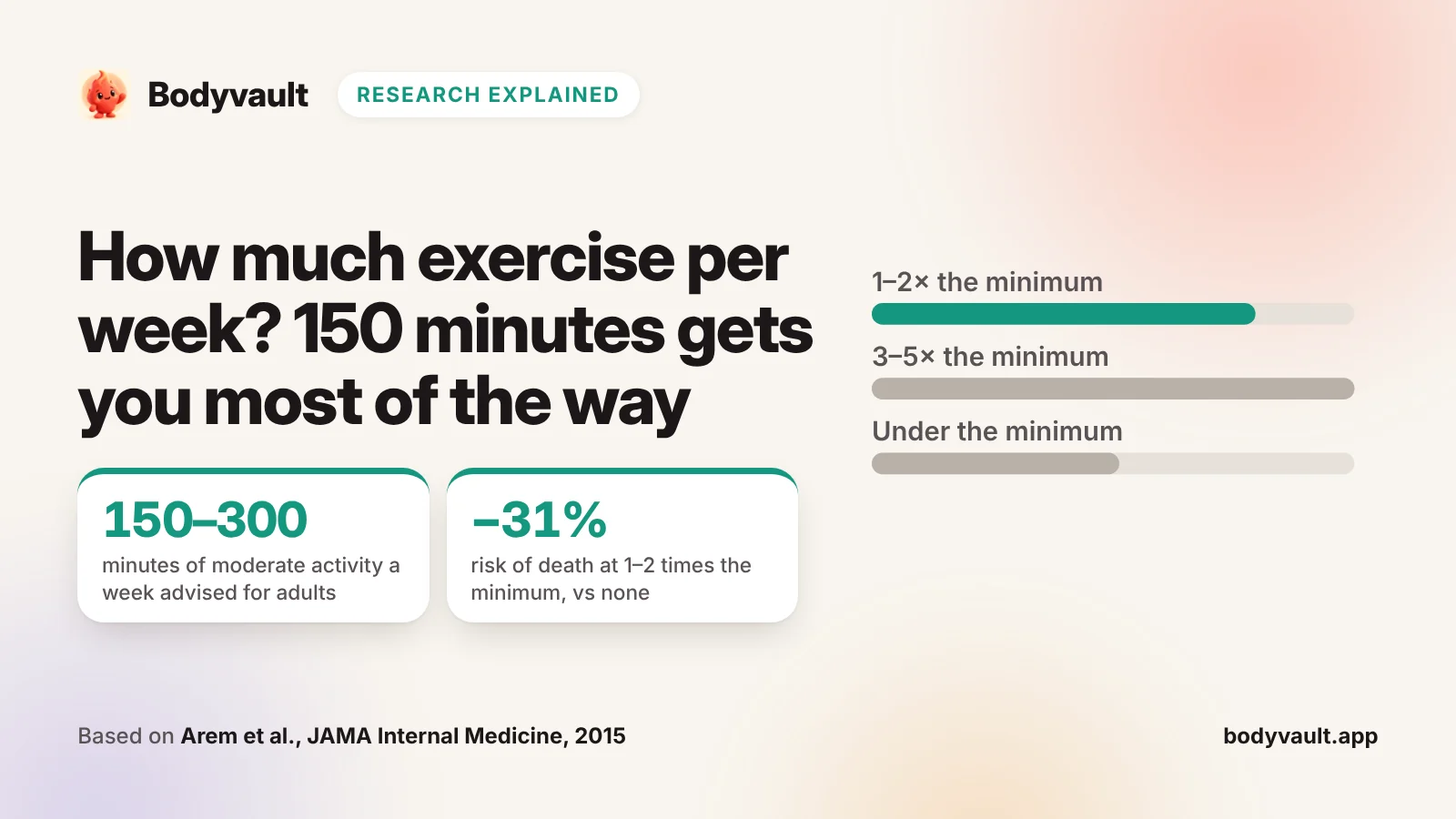
How much exercise per week do adults need? About 150–300 minutes of moderate activity, like brisk walking, or 75–150 minutes of hard activity. Add muscle-strengthening on two days a week. Any amount is better than none, and short bursts count.
The short answer
150–300 min
Moderate activity a week advised for adults, or 75–150 minutes of hard activity
2+ days
Muscle-strengthening a week, working all the main muscle groups
−31%
Risk of dying during a 14-year study at 1–2 times the minimum, compared with no exercise
−30%
Risk of dying for “weekend warriors” who fit all their exercise into one or two sessions, compared with inactive people
Strength of evidenceGood
Many large studies agree, and two expert panels built their advice on them. But most of these studies watched people over time. They show links, not proof that exercise causes every difference.
Key findingAim for 150 minutes of moderate activity a week, or 75 of hard activity, plus two strength sessions. But the biggest gain comes from going from nothing to something, and you can fit it in however suits your week.
How much exercise per week do the guidelines advise?
How much exercise does an adult need? Two big sets of advice agree on the numbers. The World Health Organization (WHO) published its guidelines in 2020, and the US government published its own in 2018. Both were written by panels of experts after reviewing the research.
Moderate activity makes you breathe faster, but you can still talk. Brisk walking is the classic example. Hard activity, also called vigorous, leaves you able to say only a few words before you need a breath. Running is a good example. On a 0–10 scale of effort, moderate is about 5 or 6, and hard starts at 7 or 8.
One minute of hard activity counts about the same as two minutes of moderate activity. So 30 minutes of brisk walking is roughly equal to 15 minutes of running. You can mix the two in the same week. Easy, steady cardio is one way to build your minutes: read zone 2 training.
| Who | Aerobic activity | Strength and balance |
|---|---|---|
| Adults 18–64 | 150–300 min of moderate or 75–150 min of hard activity a week, or a mix | Muscle-strengthening on 2 or more days a week |
| Adults 65 and over | The same as other adults | Also varied balance and strength work on 3 or more days a week |
| Children and teens 5–17 | An average of 60 min a day of moderate to hard activity | Hard activity and muscle- and bone-strengthening on at least 3 days a week |
| Pregnancy and after birth | At least 150 min of moderate activity a week | A mix of aerobic and muscle-strengthening activity |
WHO also advises everyone to sit less. Read sedentary lifestyle for what long sitting does and how much movement offsets it.
How much exercise per day is that?
Spread over a week, 150 minutes is about 21 minutes a day. Another way to reach it is 30 minutes on five days. For hard activity, 75 minutes a week is about 11 minutes a day. We worked these out by dividing by seven.
Children and teens aged 5 to 17 need more: an average of 60 minutes a day across the week. In 2020, WHO changed this from “every day” to “on average”, because studies measured average activity.
You don’t have to do it all at once. Both guidelines dropped the old rule that only bouts of 10 minutes or more counted. A brisk walk to the shops, a game of football and fast stair climbing all add up. Activity at work, at home and on the way to places counts too.
Does walking count towards 150 minutes?
Yes, if it is brisk. The US guidelines class walking at 2.5 to 4 miles an hour as moderate activity. That is about 4 to 6.4 km/h. Slow walking, at about 3.2 km/h or less, counts as light activity.
Light activity still helps, especially when it replaces sitting. But the guidelines’ minutes are for moderate or hard effort. A simple check is the talk test: on a brisk walk you can talk, but you can’t sing. To find the heart rates that match each effort, try the heart rate zone calculator.
Steps are another way to track walking. Read how many steps a day for what step studies show.
Does strength training count towards 150 minutes?
Not in the guidelines. Muscle-strengthening is a separate target, on top of the 150 minutes. Adults are advised to do it on two or more days a week. It should work the legs, hips, back, belly, chest, shoulders and arms.
Weights, resistance bands and body-weight moves like push-ups and squats all count. Few people reach both targets. In 2016, only 26% of US men and 19% of US women said they did enough aerobic and strength exercise.
Is 150 minutes of exercise a week good, and is more better?
Yes, 150 minutes is good, and more brings a bit more. A 2015 study pooled six studies of 661,137 adults in the US and Europe. It followed them for about 14 years. People reported how much exercise they did in their free time.
Compared with people who did none, those who did less than the minimum had a 20% lower risk of dying during the study. At one to two times the minimum, the risk was 31% lower. The benefit levelled off at three to five times the minimum, at 39% lower.
So the step from nothing to the minimum mattered most. Going far beyond it added only a little. Three to five times the minimum is about 450 to 750 minutes of moderate activity a week (our calculation). Even people who did ten times the minimum showed no sign of harm.
WHO says more than 300 minutes a week may bring extra benefits. It rates this advice as less certain, because studies can’t yet show where the extra benefit starts to fade.
Strength training: the part most people skip
A 2022 review pooled 16 studies that followed adults over time. People who did muscle-strengthening had a 10–17% lower risk of dying and of several diseases. That was after allowing for their aerobic exercise.
Risk with muscle-strengthening, compared with none
- Death from any cause0.85 (0.79–0.93)
- Heart disease0.83 (0.73–0.93)
- Cancer (all types)0.88 (0.80–0.97)
- Diabetes0.83 (0.77–0.89)
- Lung cancer0.90 (0.83–0.98)
- Death, strength plus aerobic vs neither0.60 (0.54–0.67)
The lowest risk came at about 30 to 60 minutes of strength training a week. Above that, the benefit seemed to shrink, but the authors say the effect of larger amounts is unclear. People who did both strength and aerobic exercise had a 40% lower risk of dying than people who did neither.
The certainty of this evidence is low. There were few studies, most were from the US, and people reported their own training. The guidelines advise strength work mainly for healthy muscles and bones, which these studies didn’t measure.
Short bursts in daily life count too
What if you don’t exercise at all? A 2022 study looked at 25,241 adults in the UK who said they did no exercise in their free time. Their average age was 62. They wore an activity tracker on the wrist for a week, and the researchers followed them for about 7 years.
The trackers picked up short bursts of hard effort in daily life, like hurrying up stairs or walking very fast. Each lasted a minute or two. Researchers call this vigorous intermittent lifestyle physical activity, or VILPA. Some people call it “exercise snacks”.
The typical person had three bursts a day, adding up to about 4 minutes. Compared with people who had none, three bursts a day went with a 39% lower risk of dying during the study. The risk of dying from heart disease was 49% lower.
This kind of study shows a link. It can’t prove that the bursts caused the lower risk. For example, people who are unwell may move less briskly. Still, the result fits the guidelines’ message that every bit of activity counts.
What is a weekend warrior? Fitting exercise into one or two days
A weekend warrior is someone who gets all their weekly exercise in one or two sessions. Is that as good as spreading it out? Two large studies suggest it can be.
A 2017 study pooled health surveys of 63,591 adults aged 40 and over in England and Scotland. Weekend warriors did at least 150 minutes of moderate or 75 minutes of hard activity in one or two sessions. Compared with inactive people, their risk of dying during the study was 30% lower. For regularly active people, who exercised three or more times a week, it was 35% lower.
Risk of dying by exercise pattern, compared with inactive people
- Weekend warriors: any cause0.70 (0.60–0.82)
- Regularly active: any cause0.65 (0.58–0.73)
- Weekend warriors: heart disease0.60 (0.45–0.82)
- Regularly active: heart disease0.59 (0.48–0.73)
A 2023 study used wrist trackers worn for a week by 89,573 UK adults. About four in ten were weekend warriors: they reached 150 minutes, with at least half of it on one or two days. Their risks of heart attack, heart failure and stroke were lower than inactive people’s. So was their risk of atrial fibrillation, a type of irregular heartbeat. The drop was about the same as for people who spread their activity out.
Heart problems by activity pattern, compared with inactive people
- Heart attack: weekend warriors0.73 (0.67–0.80)
- Heart attack: spread out0.65 (0.57–0.74)
- Heart failure: weekend warriors0.62 (0.56–0.68)
- Heart failure: spread out0.64 (0.56–0.73)
- Atrial fibrillation: weekend warriors0.78 (0.74–0.83)
- Atrial fibrillation: spread out0.81 (0.74–0.88)
- Stroke: weekend warriors0.79 (0.71–0.88)
- Stroke: spread out0.83 (0.72–0.97)
Both studies watched people over time, so they show links, not proof. If you go from little exercise to long weekend sessions, build up gradually. Both guidelines say that increasing activity slowly keeps the risk of injury low.
Claims and evidence
ClaimExercise only counts if you do at least 10 minutes at a time.
EvidenceBoth the WHO (2020) and US (2018) guidelines dropped this rule. Bouts of any length count towards your weekly total.
ClaimIf you can’t reach 150 minutes, there’s no point.
EvidenceIn 661,137 adults, doing less than the minimum went with a 20% lower risk of dying than doing none. People who do the least gain the most from doing a little more.
ClaimExercising only at the weekend is pointless.
EvidencePeople who did all their exercise in one or two sessions had a 30% lower risk of dying than inactive people. For people active three or more times a week, it was 35% lower.
ClaimCardio is all you need.
EvidenceStrength training was linked to a 10–17% lower risk of dying and of several diseases, on top of aerobic exercise. Doing both went with a 40% lower risk of dying than doing neither.
What this means for you
What this means for you
- Count your week, not your day. Thirty minutes of brisk walking on five days reaches 150 minutes. One minute of hard activity counts about the same as two of moderate.
- Add strength work on two days a week, for all the main muscle groups. Body-weight moves at home count.
- Use short bursts. Take the stairs quickly or walk fast for a minute or two. Every bit adds up.
- If weekdays are busy, longer sessions at the weekend still count. Build up gradually rather than all at once.
- Most healthy adults don’t need a check-up before moderate exercise like brisk walking. Talk to a doctor first if you are pregnant, have a heart or other long-term condition, or take regular medicines. Stop and get help if you have chest pain, feel faint or get unusually out of breath.
What the research can’t tell you yet
- Cause and effect. Apart from the guidelines, these studies watched people over time. People who are already unwell move less, which can make exercise look more helpful than it is.
- Self-reported exercise. Many studies asked people once how much they exercised. People often remember this wrongly.
- Who was studied. Most data come from middle-aged and older adults in richer countries, and many studies had mostly white volunteers.
- Strength training. The evidence on how much strength training is best is low in certainty.
- Where the benefit fades. WHO says studies can’t yet show where extra exercise stops adding benefit.
How Bodyvault uses this research
Bodyvault doesn’t count your weekly guideline minutes for you. It reads your steps from Apple Health or Health Connect, and shows your time in each heart-rate zone after a workout. Its daily Load score adds up heart-rate effort and strength sets: one Load Unit is about a minute of moderate effort. Its workout plans, part of Bodyvault Pro, use 2 to 6 training days a week.
Share or cite this explainer
Bodyvault (2026). How much exercise per week do you really need? https://bodyvault.app/blog/how-much-exercise-per-week
The charts on this page may be reused with a link back to it. The underlying data belong to the studies cited below.
Questions
How much exercise should you get in a week?
Adults are advised to get 150–300 minutes of moderate activity, like brisk walking, or 75–150 minutes of hard activity, like running. Add muscle-strengthening on two or more days. Doing less than that still helps.
How much exercise should you get in a day?
For adults, 150 minutes a week works out at about 21 minutes a day, or 30 minutes on five days. Children and teens aged 5 to 17 need an average of 60 minutes a day.
Does walking count towards 150 minutes of exercise?
Yes, if it is brisk: about 4 to 6.4 km/h, a pace where you can talk but not sing. Slow walking counts as light activity. It still helps, but it isn’t part of the 150 minutes.
Does strength training count towards 150 minutes?
No. The guidelines treat it as a separate target: muscle-strengthening on two or more days a week, on top of your 150 minutes of aerobic activity.
Is 150 minutes of exercise a week good?
Yes. In a study of 661,137 adults, doing one to two times that amount went with a 31% lower risk of dying than doing none. Doing three to five times as much added a little more benefit.
Sources
- Bull FC et al. (2020). World Health Organization 2020 guidelines on physical activity and sedentary behaviour. Br J Sports Med 54(24):1451–1462.
- Piercy KL et al. (2018). The Physical Activity Guidelines for Americans. JAMA 320(19):2020–2028.
- Arem H et al. (2015). Leisure time physical activity and mortality: a detailed pooled analysis of the dose-response relationship. JAMA Intern Med 175(6):959–967.
- Momma H et al. (2022). Muscle-strengthening activities are associated with lower risk and mortality in major non-communicable diseases: a systematic review and meta-analysis of cohort studies. Br J Sports Med 56(13):755–763.
- Stamatakis E et al. (2022). Association of wearable device-measured vigorous intermittent lifestyle physical activity with mortality. Nat Med 28(12):2521–2529.
- O’Donovan G et al. (2017). Association of “weekend warrior” and other leisure time physical activity patterns with risks for all-cause, cardiovascular disease, and cancer mortality. JAMA Intern Med 177(3):335–342.
- Khurshid S et al. (2023). Accelerometer-derived “weekend warrior” physical activity and incident cardiovascular disease. JAMA 330(3):247–252.
General information about fitness and nutrition, not medical advice. If you have a health condition, are pregnant or take medication, talk to your doctor before changing your diet or training.