
Research explained
Sedentary lifestyle: how bad is sitting all day?
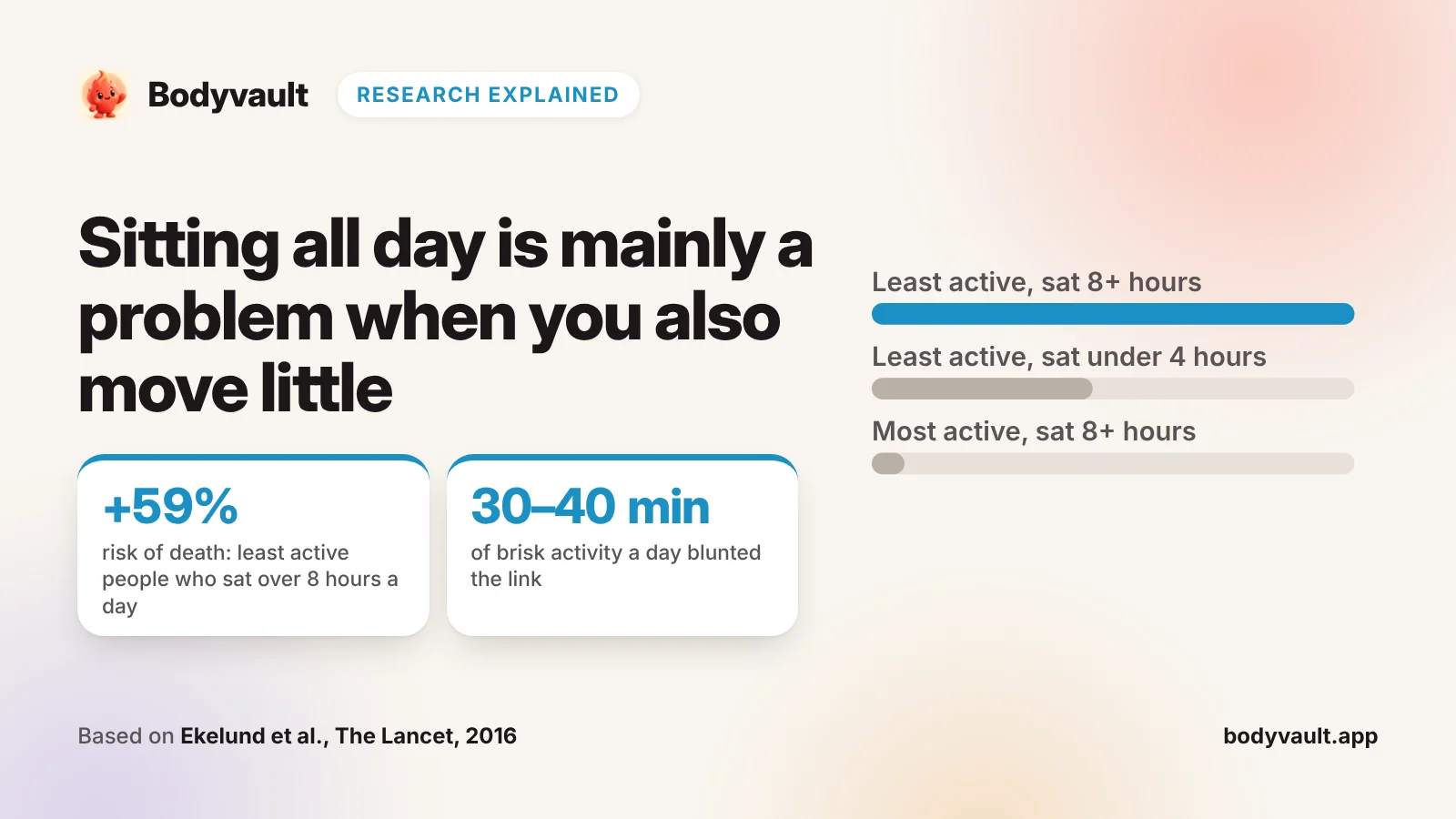
A sedentary lifestyle means spending most of your waking day sitting or lying down. Long sitting is linked to dying earlier, mainly in people who move little. In people who did about 30–40 minutes of brisk activity a day, long sitting was no longer clearly linked to a higher risk.
The short answer
+59%
Risk of dying for people who sat over 8 hours a day and moved least, compared with active people who sat under 4 hours
+4%
For very active people who sat over 8 hours a day: no clear difference
30–40 min
Brisk activity a day that weakened the link between sitting and dying, in people who wore trackers
−39%
Smaller rise in blood sugar after meals when 3-minute walks broke up sitting, in adults with type 2 diabetes
Strength of evidenceGood
Large studies of more than a million people agree on the pattern. But they watched people over time, so they show links, not proof. The blood sugar result comes from a small trial over single days.
Key findingSitting a lot is mainly a problem when you also move little. Moving more is the best fix, and short breaks in long sitting also help your blood sugar.
What is a sedentary lifestyle?
Sedentary means sitting or lying down while awake, and using very little energy. Desk work, driving and watching TV are typical examples. Sleep doesn’t count.
Scientists measure energy use in METs. One MET is the energy you use sitting quietly. Sedentary behaviour is anything at 1.5 METs or less while sitting or lying. Brisk walking, by contrast, is moderate activity, at 3 to 6 METs.
A sedentary lifestyle isn’t the same as being inactive. Inactive means not getting the advised amount of exercise. You can run every morning and still sit at a desk for 10 hours. That is a sedentary job inside an active life.
In studies where people wore activity trackers, middle-aged and older adults were sedentary for 8.5 to 10.5 hours a day on average.
The World Health Organization (WHO) advises everyone to sit less, and to swap sitting for movement of any kind, even light. It found too little evidence to set a safe number of sitting hours. WHO chose the word “sedentary” rather than “sitting” on purpose. People who use a wheelchair can cut sedentary time by moving their upper body while seated.
Is sitting all day bad for you?
It depends on how much you move. A 2016 review pooled the data of 13 studies with more than a million adults. They were followed for 2 to 18 years, and 84,609 of them died. People reported how long they sat and how active they were.
Among people who moved least, risk was higher whether they sat a lot or not. Even sitting under 4 hours a day went with a 27% higher risk if they were inactive. In the most active quarter of people, sitting over 8 hours a day made no clear difference.
How active was “most active”? About 60 to 75 minutes a day of moderate activity, like brisk walking. That is about three times the WHO minimum of roughly 21 minutes a day (our calculation).
TV time stood out. Watching 3 hours or more a day went with a higher risk at every level of activity except the highest. Even in the most active people, 5 hours or more of TV a day went with a 16% higher risk.
What activity trackers show
What people report about their own sitting can be wrong. So a 2019 review pooled 8 studies where 36,383 adults wore activity trackers on the hip. They were 62 on average, and most were women. The researchers followed them for about 6 years.
Risk rose slowly from about 7½ to 9 hours of sedentary time a day. Above about 9½ hours it climbed faster. Compared with the least sedentary people, 10 hours went with a 48% higher risk, and 12 hours with nearly three times the risk.
Moving more, at any effort, went with lower risk. Even light activity, like slow walking or chores, counted. Going from the least active quarter to the next meant about an hour more of light activity a day. That step went with a 40% lower risk of dying.
Steps are an easy way to track this kind of movement. Read how many steps a day for what step studies show.
How to counteract sitting all day
So how much activity does it take to reduce the effects of sitting all day? A 2020 study answered this with trackers. It pooled 9 studies of 44,370 adults aged 40 and over, who were followed for about 6 years.
Risk of dying by daily activity and sedentary time
- Most active third, middle sitting1.16 (0.87–1.54)
- Most active third, most sitting1.40 (0.87–2.26)
- Middle third, least sitting1.05 (0.83–1.33)
- Middle third, middle sitting1.31 (1.02–1.67)
- Middle third, most sitting1.68 (1.22–2.30)
- Least active third, least sitting1.65 (1.25–2.19)
- Least active third, middle sitting1.65 (1.24–2.21)
- Least active third, most sitting2.63 (1.93–3.57)
The most active third did about 30 to 40 minutes of brisk activity a day. In them, long sitting was no longer clearly linked to a higher risk of dying. The least active third did only about 2 minutes a day. In them, long sitting went with more than double the risk.
Thirty to 40 minutes a day adds up to about 210 to 280 minutes a week (our calculation). That is near the top of WHO’s range of 150–300 minutes. It is less than the 60–75 minutes a day suggested by the 2016 study. The authors think trackers pick up movement that questionnaires miss, which may explain the gap.
WHO’s advice matches this. If you sit a lot, aim to do more than the minimum of 150 minutes a week. For the full weekly targets, read how much exercise per week.
Breaking up sitting: what short walks do
Getting up often may help too, especially for blood sugar. A 2016 trial studied 24 inactive adults with type 2 diabetes who were overweight. Their average age was 62. Each person did three 8-hour test days, in random order, with the same meals.
On one day they sat the whole time. On another, they walked slowly for 3 minutes every 30 minutes. On the third, they did 3 minutes of simple moves every 30 minutes: half-squats, calf raises, buttock squeezes and knee raises.
Both kinds of break cut the rise in blood sugar over the day by about 39%. Insulin, the hormone that moves sugar from the blood into your cells, also rose less. Only the simple moves lowered blood fats.
This was a small trial over single days. It shows what happens in the short term, not long-term health. For more on walking and blood sugar, read walking after eating.
Claims and evidence
ClaimSitting is the new smoking, and exercise can’t undo it.
EvidenceIn more than a million adults, very active people who sat over 8 hours a day had no clear extra risk of dying. In tracker data, 30–40 minutes of brisk activity a day weakened the link.
ClaimIf you exercise, it doesn’t matter how much TV you watch.
EvidenceEven in the most active people, watching 5 hours or more of TV a day went with a 16% higher risk of dying.
ClaimOnly hard exercise counts.
EvidenceIn tracker studies, light activity like slow walking or chores also went with lower risk. About an hour more of light activity a day went with a 40% lower risk of dying.
ClaimA few minutes of walking can’t make a difference.
EvidenceIn a small trial, 24 adults with type 2 diabetes sat for 8 hours a day. Walking for 3 minutes every 30 minutes cut their rise in blood sugar by about 39%.
What this means for you
What this means for you
- If you have a sedentary job, aim for about 30–40 minutes of brisk activity a day. That is near the top of the advised 150–300 minutes a week.
- Swap some sitting for light movement. Walk while you take calls, use the stairs or do some chores.
- Break up long sitting. In the trial above, 3 minutes of walking, squats or calf raises every 30 minutes helped.
- Keep an eye on TV hours. Long TV evenings were linked to higher risk even in active people.
- If you have diabetes or take medicine to lower your blood sugar, follow your care team’s advice on activity. If you get chest pain, feel faint or get unusually out of breath when active, stop and see a doctor.
What the research can’t tell you yet
- Cause and effect. The sitting studies watched people over time. People who are already unwell may sit more, which can make sitting look worse than it is.
- A safe number of hours. There isn’t one yet. WHO found too little evidence to set a limit, or to say how often to take breaks.
- Who was studied. Most people were aged 40 or over and lived in the US or Europe.
- How it was measured. The 2016 study relied on what people reported. Hip trackers can’t tell sitting from standing still.
- Short trials. The breaks study had 24 people with type 2 diabetes, over single days.
How Bodyvault uses this research
With nudges turned on, Bodyvault can remind you to move when you’ve taken fewer than 100 steps in about an hour. You can set the time from 30 to 120 minutes. It waits 90 minutes after a workout, because sitting after training is recovery. The reminder suggests a 5-minute walk or a few stairs, and nudges stay off until you turn them on.
Share or cite this explainer
Bodyvault (2026). Sedentary lifestyle: how bad is sitting all day? https://bodyvault.app/blog/sedentary-lifestyle
The charts on this page may be reused with a link back to it. The underlying data belong to the studies cited below.
Questions
What does a sedentary lifestyle mean?
It means you spend most of your waking day sitting or lying down, using very little energy. Desk work, driving and TV are common examples. It isn’t the same as being inactive, which means not getting enough exercise.
Is sitting all day bad for you?
Long sitting is linked to a higher risk of dying early, mainly in people who move little. In very active people, long sitting showed no clear extra risk. These studies show links, not proof.
How do you counteract sitting all day?
Do about 30–40 minutes of brisk activity a day, swap some sitting for light movement, and get up often. In tracker studies, people who did 30–40 minutes a day had no clear extra risk from long sitting.
What does sitting all day do to your body?
In a study of people with type 2 diabetes, long sitting let blood sugar and insulin rise more after meals. Over years, a lot of sitting is linked to heart disease, type 2 diabetes, some cancers and dying earlier.
How many hours of sitting is too much?
No one knows a safe limit. In tracker studies, risk rose faster above about 9½ hours of sedentary time a day. WHO found too little evidence to set a number.
Sources
- Ekelund U et al. (2016). Does physical activity attenuate, or even eliminate, the detrimental association of sitting time with mortality? A harmonised meta-analysis of data from more than 1 million men and women. Lancet 388(10051):1302–1310.
- Ekelund U et al. (2019). Dose-response associations between accelerometry measured physical activity and sedentary time and all cause mortality: systematic review and harmonised meta-analysis. BMJ 366:l4570.
- Ekelund U et al. (2020). Joint associations of accelerometer-measured physical activity and sedentary time with all-cause mortality: a harmonised meta-analysis in more than 44 000 middle-aged and older individuals. Br J Sports Med 54(24):1499–1506.
- Dempsey PC et al. (2016). Benefits for type 2 diabetes of interrupting prolonged sitting with brief bouts of light walking or simple resistance activities. Diabetes Care 39(6):964–972.
- Bull FC et al. (2020). World Health Organization 2020 guidelines on physical activity and sedentary behaviour. Br J Sports Med 54(24):1451–1462.
General information about fitness and nutrition, not medical advice. If you have a health condition, are pregnant or take medication, talk to your doctor before changing your diet or training.