
Research explained
PCOS exercise and diet: what the 2023 guideline says
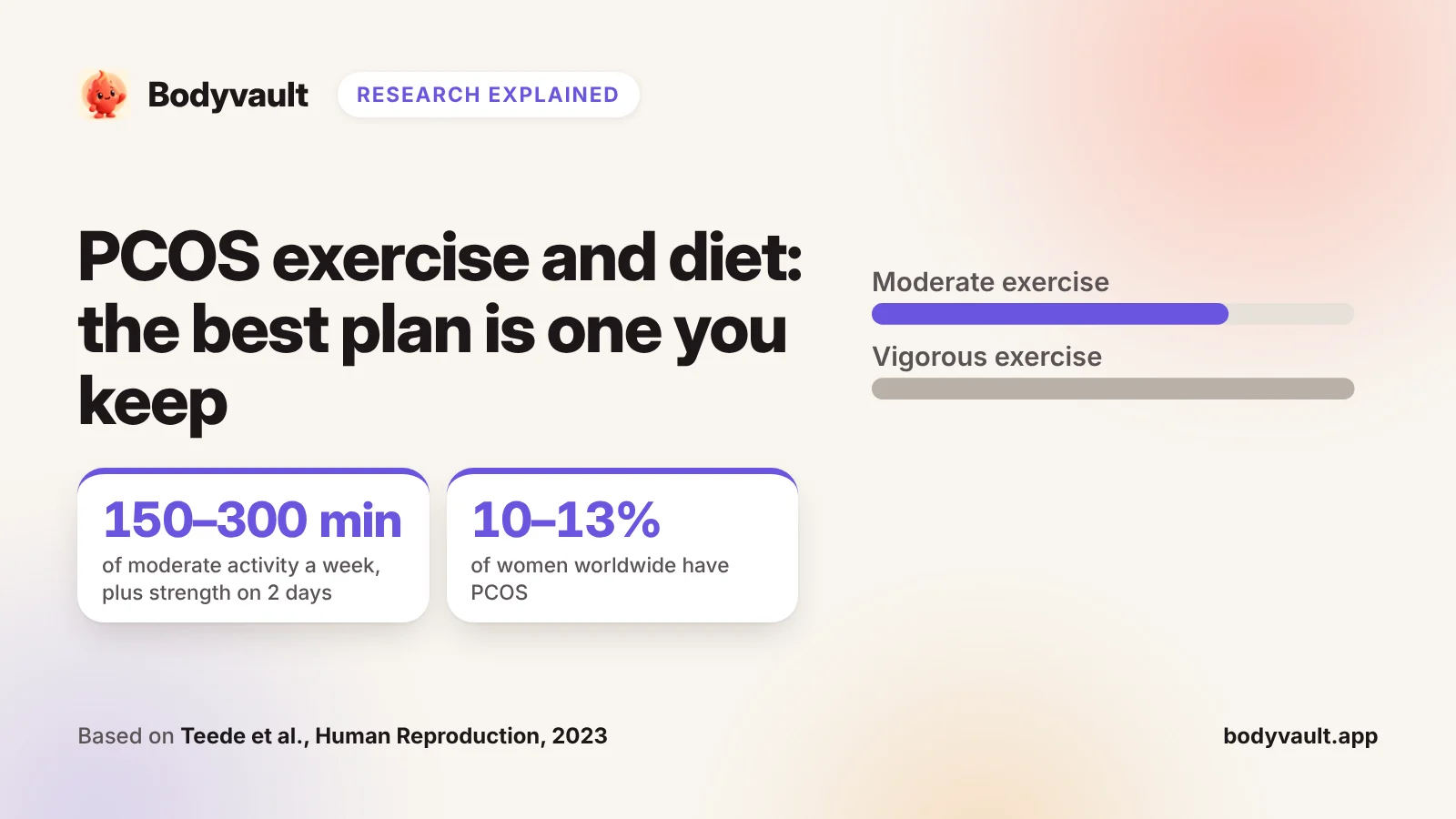
For PCOS exercise and diet, the 2023 international guideline found no single best workout or diet. As for all adults, it advises 150–300 minutes of moderate exercise a week plus strength work on 2 days.
The short answer
10–13%
Of women worldwide have PCOS, according to the 2023 international guideline
150–300 min
Of moderate activity a week, or 75–150 minutes of vigorous activity: the guideline’s target
2 days
A week of strength exercise, on days that aren’t back to back
+3.8 ml/kg/min
More fitness (VO2 max) with exercise than without it, across 18 trials in PCOS
Strength of evidenceModerate
Many small trials show that exercise improves fitness and some metabolic markers in PCOS. But the trials are small and short, their quality is low, and no single exercise or diet has been shown to be best.
Key findingFor PCOS, the best exercise and diet are the ones you can keep doing. The 2023 guideline advises the same activity as for all adults, plus strength work twice a week, and healthy eating without strict rules. Healthy habits help even if your weight doesn’t change.
What is PCOS?
Polycystic ovary syndrome (PCOS) is a common hormone condition. It affects 10–13% of women worldwide. It can affect periods and ovulation, hormones, blood sugar and mood.
A doctor diagnoses it. Adults need two of these three:
- Irregular periods or problems with ovulation.
- Higher levels of male-type hormones (androgens), shown by symptoms or a blood test.
- Ovaries that look polycystic on an ultrasound scan, or a high AMH blood test instead.
Other causes must be ruled out first. Teenagers need both of the first two.
Insulin resistance is a key feature of PCOS. It is when the body stops responding well to insulin, the hormone that moves sugar from the blood into your cells. Healthy habits are a core part of care.
PCOS exercise and diet: what the 2023 guideline recommends
| Who | Aim for | Plus |
|---|---|---|
| Adults 18–64, for health | 150–300 minutes of moderate or 75–150 minutes of vigorous activity a week | Muscle strengthening on 2 days that aren’t back to back |
| Adults, for modest weight loss or to stop weight coming back | At least 250 minutes of moderate or 150 minutes of vigorous activity a week | Muscle strengthening, ideally on 2 days that aren’t back to back |
| Teenagers | At least 60 minutes of moderate to vigorous activity a day | Muscle- and bone-strengthening activities at least 3 times a week |
All kinds of movement count: walking or cycling to get around, housework, games, sport and planned exercise. The guideline also says to sit less, and that some activity is better than none. Aim for bouts of at least 10 minutes, building to 30 minutes on most days.
Does exercise help with PCOS?
Yes, by modest amounts. A 2019 review pooled 18 trials with 758 women with PCOS. Most compared regular exercise with no exercise or usual care.
Exercise raised fitness by 3.84 ml/kg/min of VO2 max, the most oxygen your body can use during hard exercise. It trimmed waists by 2.62 cm and body fat by about 1.4 percentage points. It also lowered fasting insulin and HOMA-IR, a score of insulin resistance, by small amounts. How that score is worked out is in HOMA-IR explained.
Trials were small, and some results shifted when single trials were added or removed. So treat these numbers as a rough guide.
What is the best exercise for PCOS?
The guideline found no evidence that one type of exercise, or level of effort, is better than another. So pick what you enjoy and can keep up, and add strength training twice a week.
A 2020 review hints that harder exercise may do a little more. It pooled 19 studies with 777 women aged 18 to 45, in programmes of 6 to 26 weeks.
The authors suggest at least 120 minutes of vigorous exercise a week. But the guideline, which weighed all the evidence, found no type of exercise or level of effort proven to be better. If you enjoy intervals or running, they are a good option. If you prefer walking, that counts too.
What is the best diet for weight loss with PCOS?
There’s no special PCOS diet. The guideline found no evidence that any one type of diet is better for weight, hormones, periods or mood. Any diet that follows healthy-eating advice will help. It should suit your tastes and culture, and avoid very strict rules.
If you want to lose weight, a calorie deficit suited to you can help, as for anyone. The guideline says healthy habits and weight management, with good support, seem to work as well in PCOS as in other people. Our explainer on the best diet for weight loss compares the options.
A 2019 Cochrane review pooled 15 trials of diet, exercise or behaviour programmes in 498 women with PCOS. Compared with little or no treatment, the programmes led to about 1.7 kg more weight loss. They also lowered a blood marker of male-type hormones a little. But no trial checked live births or miscarriage, and none reported whether periods became regular.
The guideline asks doctors to watch for eating disorders in PCOS, whatever a person’s weight. It also says weight stigma is common, healthy habits help even without weight loss, and doctors should ask before weighing you. If eating or dieting feels out of control, talk to a doctor.
Claims and evidence
ClaimThere is a special PCOS diet, such as keto or cutting out dairy.
EvidenceThe 2023 guideline found no evidence that any one type of diet is better. A healthy diet you can keep is what matters.
ClaimOnly intense workouts help PCOS.
EvidenceNo type of exercise or level of effort has been shown to be better. Vigorous exercise went with bigger gains in one review, but moderate activity helps too.
ClaimExercise only helps if you lose weight.
EvidenceThe guideline says healthy habits help even without weight loss. In trials, exercise improved fitness, waist size and insulin.
ClaimDiet and exercise will fix your periods and fertility.
EvidenceNo trial in the 2019 Cochrane review measured live births or miscarriage, or reported whether periods became regular. See a doctor about periods and fertility.
What this means for you
What this means for you
- Build up to 150–300 minutes of moderate activity a week, or 75–150 minutes of vigorous activity. Some is better than none.
- Do strength exercise on 2 days a week that aren’t back to back.
- Sit less, and move in ways you enjoy: walking, cycling, dance, sport and housework all count.
- Eat in a healthy, flexible way that suits your food and culture, and avoid very strict diets.
- See a doctor for diagnosis and treatment, if your periods are absent or irregular, or if you plan a pregnancy. Don’t start or stop any medicine without your doctor.
What the research can’t tell you yet
- Small, short trials. Most exercise trials lasted 6 to 26 weeks, with small groups.
- Low quality. The guideline and the reviews rate most of the evidence as low to moderate, or lower.
- Periods and fertility. Trials of healthy habits haven’t measured births, miscarriage or regular periods well.
- Which exercise is best. Few studies compare types of exercise directly.
How Bodyvault uses this research
Bodyvault has an “Irregular / PCOS” cycle mode that logs your periods and symptoms without making confident predictions. Its cycle tips, part of Bodyvault Pro, remind you of the guideline target: 150–300 minutes of activity a week and 2 strength sessions. In line with the guideline, there’s no special PCOS diet or workout plan.
Share or cite this explainer
Bodyvault (2026). PCOS exercise and diet: what the 2023 guideline says. https://bodyvault.app/blog/pcos-exercise
The charts on this page may be reused with a link back to it. The underlying data belong to the studies cited below.
Questions
What is the best exercise for PCOS?
The one you enjoy and can keep doing. The 2023 guideline found no type of exercise or level of effort proven to be better. Mix activity like walking, cycling or running with strength training twice a week.
How much exercise should I do with PCOS?
The guideline advises adults to aim for 150–300 minutes of moderate or 75–150 minutes of vigorous activity a week, plus muscle strengthening on 2 days. For modest weight loss, aim for at least 250 minutes of moderate activity.
What is the best diet for weight loss with PCOS?
There isn’t one best diet. Pick a healthy diet you can keep. If you want to lose weight, a calorie deficit suited to you works as well in PCOS as for others. Avoid very strict diets.
Can exercise help PCOS without weight loss?
Yes. The guideline says healthy habits have benefits even without weight loss. In trials, exercise improved fitness, waist size, insulin and some blood fats.
Can diet and exercise cure PCOS?
No study shows a cure. Changes to exercise and diet can improve fitness, weight and some hormone and blood markers. For diagnosis, periods, fertility or medicines, see a doctor.
Sources
- Teede HJ et al. (2023). Recommendations from the 2023 International Evidence-based Guideline for the Assessment and Management of Polycystic Ovary Syndrome. Hum Reprod 38(9):1655–1679.
- Kite C et al. (2019). Exercise, or exercise and diet for the management of polycystic ovary syndrome: a systematic review and meta-analysis. Syst Rev 8(1):51.
- Patten RK et al. (2020). Exercise interventions in polycystic ovary syndrome: a systematic review and meta-analysis. Front Physiol 11:606.
- Lim SS et al. (2019). Lifestyle changes in women with polycystic ovary syndrome. Cochrane Database Syst Rev 3(3):CD007506.
General information about fitness and nutrition, not medical advice. If you have a health condition, are pregnant or take medication, talk to your doctor before changing your diet or training.