
Research explained
What is the best diet for weight loss? Low-carb vs low-fat
What is the best diet for weight loss? The one you can stick with. In large trials, low-carb and low-fat diets led to about the same weight loss. The people who kept to their diet lost the most, whichever diet it was.
The short answer
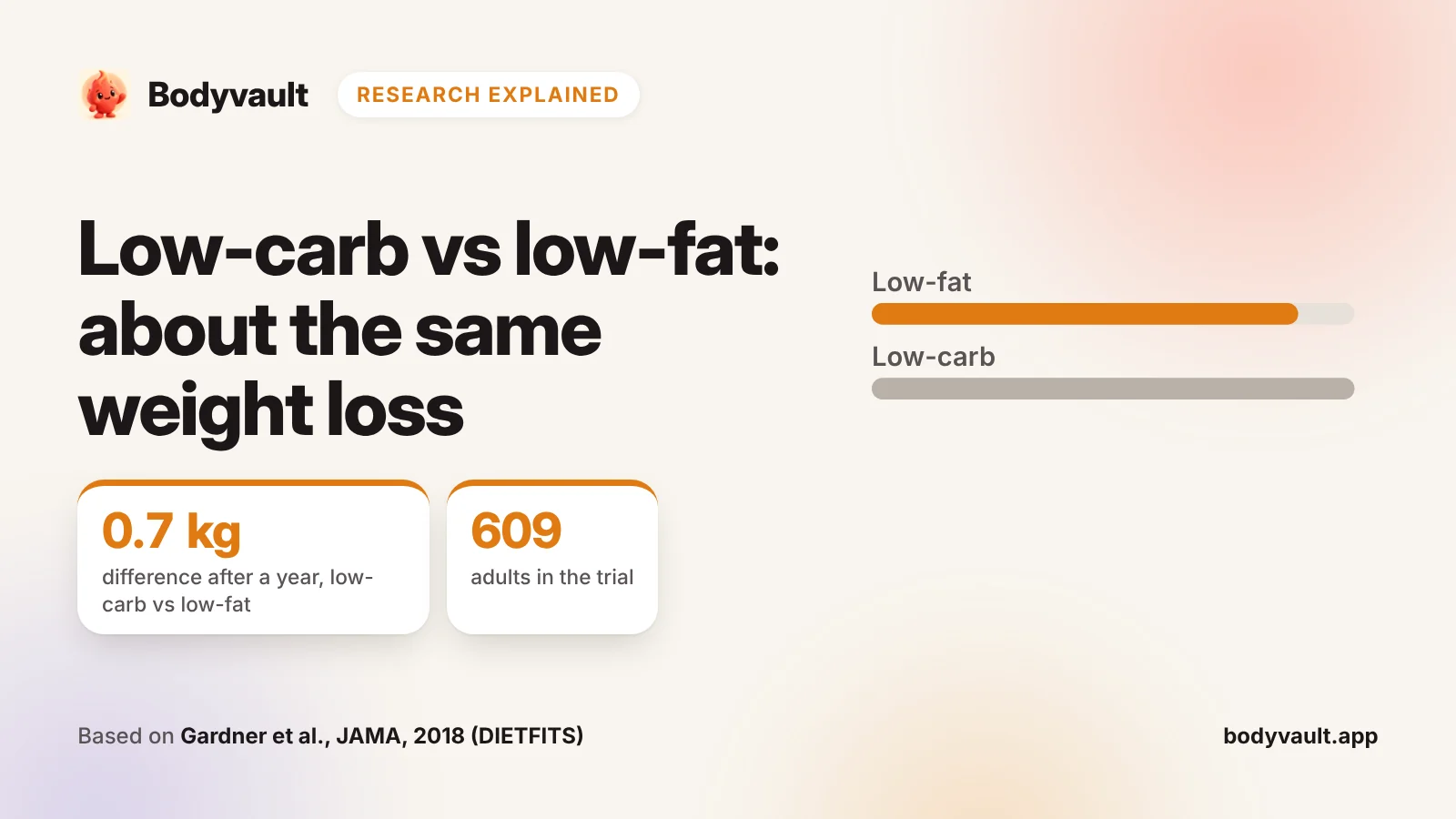
0.7kg
Difference in weight loss after a year between healthy low-carb and low-fat diets, in 609 adults: not a clear difference
4.6 / 4.4kg
Weight lost at 6 months on low-carb and low-fat diets, compared with usual eating, across 121 trials
≈40kg
Spread of results within each diet group, from losing about 30 kg to gaining about 10 kg
4 in 10
People who dropped out within a year in a trial of four popular diets
Strength of evidenceGood
Large year-long trials and a review of 121 trials agree that no diet type clearly wins. But few trials last more than a year, and most didn’t measure how well people kept to their diet.
Key findingThere is no single best diet for weight loss. Low-carb, low-fat and in-between diets give similar average results. Pick the one you can keep up, built on whole foods, and let the calories you cut do the work.
What makes a diet low-carb or low-fat?
Food gives you energy (calories) from three main nutrients: carbohydrates (carbs), fat and protein. Carbs are in rice, roti, bread, fruit and sugar. Fat is in oil, ghee, butter, nuts and fatty meat. Protein is in dal, paneer, eggs, fish and meat.
A low-carb diet gets a smaller share of its calories from carbs, and a low-fat diet a smaller share from fat. In a large 2020 review, low-carb meant 40% of calories or less from carbs, as in the Atkins and Zone diets. Low-fat meant 20% or less from fat, as in the Ornish diet. In-between diets, such as DASH and the Mediterranean diet, get about 55–60% of their calories from carbs.
Low-carb vs low-fat: the DIETFITS trial
This was a randomised controlled trial: people were put into groups by chance, so the groups could be fairly compared. For the first 8 weeks, people cut fat or carbs to just 20 grams a day. Then they slowly added some back, until they reached a level they felt they could keep for life.
Both groups were told to eat lots of vegetables, cut added sugar and refined flour, and cook whole foods at home. Neither was told to count calories. Even so, both groups said they ate about 430–530 kcal a day less after a year (our calculation from their food records).
The researchers also tested two popular ideas about which diet suits whom. One was your genes. The other was how much insulin your body releases after a sugary drink. Insulin is the hormone that moves sugar from your blood into your cells. Neither predicted who did better on which diet. The bigger differences were between people. In each group, results ran from losing about 30 kg to gaining about 10 kg.
The diets did differ in blood fats. LDL cholesterol, the “bad” kind, rose on low-carb and did better on low-fat. HDL cholesterol and triglycerides, two other blood fats, did better on low-carb.
Four popular diets, one year
An earlier trial in Boston put 160 adults into one of four popular diets by chance. The diets were Atkins (low-carb), Zone (balanced), Weight Watchers (calorie cutting) and Ornish (low-fat). All had overweight or obesity and a health risk, such as high blood pressure or high blood sugar. They tried their hardest for 2 months, then chose for themselves how strictly to follow the diet.
The key finding was about sticking with it. How closely people said they followed their diet was clearly linked with how much they lost. Which diet they were given was not. About 4 in 10 people quit before the year was out (our calculation: 93 of 160 finished).
What 121 trials show
A 2020 review in the BMJ pooled 121 trials with 21,942 adults with overweight or obesity. It was a network meta-analysis: a study that pooled many trials and compared many diets at once, even pairs never tested head to head.
After 6 months, compared with people’s usual diet, low-carb diets led to 4.6 kg of weight loss and low-fat diets 4.4 kg. In-between diets did slightly less. Among named diets, Atkins did best with 5.5 kg, then Zone with 4.1 kg and DASH with 3.6 kg. But even Atkins beat Zone by only about 1.4 kg.
By 12 months, all the diets had lost some of their effect, and most benefits for blood pressure and cholesterol had faded. The authors concluded that people can choose the diet they prefer. Most trials didn’t report how well people kept to their diets.
Why calories still matter
Why do such different diets give similar results? A 2011 paper in The Lancet looked at studies where scientists controlled every bite people ate. Swapping carbs for fat, at the same calories, changed the energy people burned by less than about 100 kcal a day. That is roughly 10 grams of body fat a day.
The authors concluded that all diets that cut calories have a similar effect on fat loss in the short run. Some diets may help because they make you less hungry, so they are easier to stick with.
Best diet for weight loss if you’re vegetarian
A vegetarian diet works at least as well as other diets, and maybe a little better in the short term. A 2016 review pooled 12 trials with 1,151 adults. People put on vegetarian diets lost about 2 kg more than people on other diets, in trials that typically lasted about 18 weeks.
Most of that came from vegan diets, with no animal foods at all, at about 2.5 kg more. Lacto-ovo-vegetarian diets, with milk and eggs, showed about 1.5 kg more, but that wasn’t a clear difference. The extra loss shrank to about 1.1 kg in trials of a year or more.
None of these trials tested Indian meals. But a dal, roti and sabzi plate can lean either way. Fewer rotis or less rice, with more dal, paneer, curd and vegetables, makes it lower in carbs. Less oil and ghee makes it lower in fat. Either can work if your total calories come down.
Claims and evidence
ClaimLow-carb is the best way to lose weight.
EvidenceIn 609 adults over a year, healthy low-carb eating lost only 0.7 kg more than healthy low-fat eating, not a clear difference. Across 121 trials, the two were close at 6 months.
ClaimYour genes or insulin show which diet will work for you.
EvidenceIn DIETFITS, neither a gene pattern nor insulin response predicted who did better on low-carb or low-fat.
ClaimCalories don’t matter if you eat the right foods.
EvidenceIn tightly controlled studies, swapping carbs for fat at the same calories changed energy burned by less than about 100 kcal a day. Both DIETFITS groups lost weight while eating about 430–530 kcal a day less, by their own reports.
ClaimThe diet you choose matters more than sticking with it.
EvidenceIn a trial of four popular diets, weight loss went with how closely people kept to their diet. It didn’t go with which diet they had.
What this means for you
What this means for you
- Choose a way of eating you like and can keep for years, not weeks. That matters more than its label.
- Whatever you choose, build it on whole foods: lots of vegetables, and little added sugar or refined flour. Both DIETFITS diets did this. Why factory-made foods make it easy to eat more is in what are ultra-processed foods.
- Use a calorie target as your guide. Start with the calorie deficit calculator and adjust from your weight trend.
- Expect your result to differ from the average. In each DIETFITS group, people ranged from losing 30 kg to gaining 10 kg.
- If you have diabetes, heart disease or high cholesterol, or take medicines for them, talk to your doctor first. This matters most before a big change such as very low-carb eating.
What the research can’t tell you yet
- The long run. Few trials last more than a year, and weight loss shrank between 6 and 12 months.
- How well people kept to the diet. Most trials didn’t report it, and food diaries are often wrong.
- Who was studied. Mostly adults with overweight or obesity in the US and other rich countries. None of these trials tested Indian diets.
- Your own best diet. Results varied hugely between people on the same diet, and no test yet predicts who will do best on which.
How Bodyvault uses this research
Bodyvault doesn’t push one diet. Its meal plans come in many styles, including vegetarian, Jain, high-protein and low-carb, with North Indian, South Indian or mixed dishes. Whichever you pick, the plan sizes each day’s portions to the same calorie and protein targets. That fits the research: choose the eating style you can keep, and let the calorie target do the work.
Share or cite this explainer
Bodyvault (2026). What is the best diet for weight loss? Low-carb vs low-fat. https://bodyvault.app/blog/best-diet-for-weight-loss
The charts on this page may be reused with a link back to it. The underlying data belong to the studies cited below.
Questions
What is the best diet for weight loss?
The one you can stick with. In large trials and a review of 121 trials, low-carb, low-fat and in-between diets led to similar weight loss. People who kept to their diet lost the most.
Is low-carb or low-fat better for weight loss?
Neither clearly wins. In a year-long trial of 609 adults, healthy low-carb eating lost 6.0 kg and healthy low-fat eating 5.3 kg, not a clear difference. Low-fat did better for LDL cholesterol, and low-carb for HDL cholesterol and triglycerides.
What is the best diet for weight loss for vegetarians?
A balanced vegetarian diet with a calorie target works well. In 12 trials, vegetarian diets led to about 2 kg more weight loss than other diets over about 4 months, mostly with vegan diets. Get enough protein from dal, paneer, curd, soya, or eggs if you eat them.
Do my genes decide which diet works for me?
Not in the evidence so far. DIETFITS tested a gene pattern and insulin response in 609 adults. Neither predicted who did better on low-carb or low-fat.
How much weight can I lose on a diet in a year?
In trials, average losses were modest: about 2 to 6 kg after a year, with big differences between people. Losses at 6 months were often bigger and shrank by 12 months.
Sources
- Gardner CD, Trepanowski JF, Del Gobbo LC, et al. (2018). Effect of low-fat vs low-carbohydrate diet on 12-month weight loss in overweight adults and the association with genotype pattern or insulin secretion: the DIETFITS randomized clinical trial. JAMA 319(7):667–679.
- Dansinger ML, Gleason JA, Griffith JL, Selker HP, Schaefer EJ (2005). Comparison of the Atkins, Ornish, Weight Watchers, and Zone diets for weight loss and heart disease risk reduction: a randomized trial. JAMA 293(1):43–53.
- Ge L, Sadeghirad B, Ball GDC, et al. (2020). Comparison of dietary macronutrient patterns of 14 popular named dietary programmes for weight and cardiovascular risk factor reduction in adults: systematic review and network meta-analysis of randomised trials. BMJ 369:m696.
- Huang RY, Huang CC, Hu FB, Chavarro JE (2016). Vegetarian diets and weight reduction: a meta-analysis of randomized controlled trials. J Gen Intern Med 31(1):109–116.
- Hall KD, Sacks G, Chandramohan D, et al. (2011). Quantification of the effect of energy imbalance on bodyweight. Lancet 378(9793):826–837.
General information about fitness and nutrition, not medical advice. If you have a health condition, are pregnant or take medication, talk to your doctor before changing your diet or training.