
Research explained
Intermittent fasting for weight loss: does it beat dieting?
Intermittent fasting weight loss is real, but not special. In trials, fasting worked about as well as cutting calories every day, not better, and more people gave up on the strictest kind.
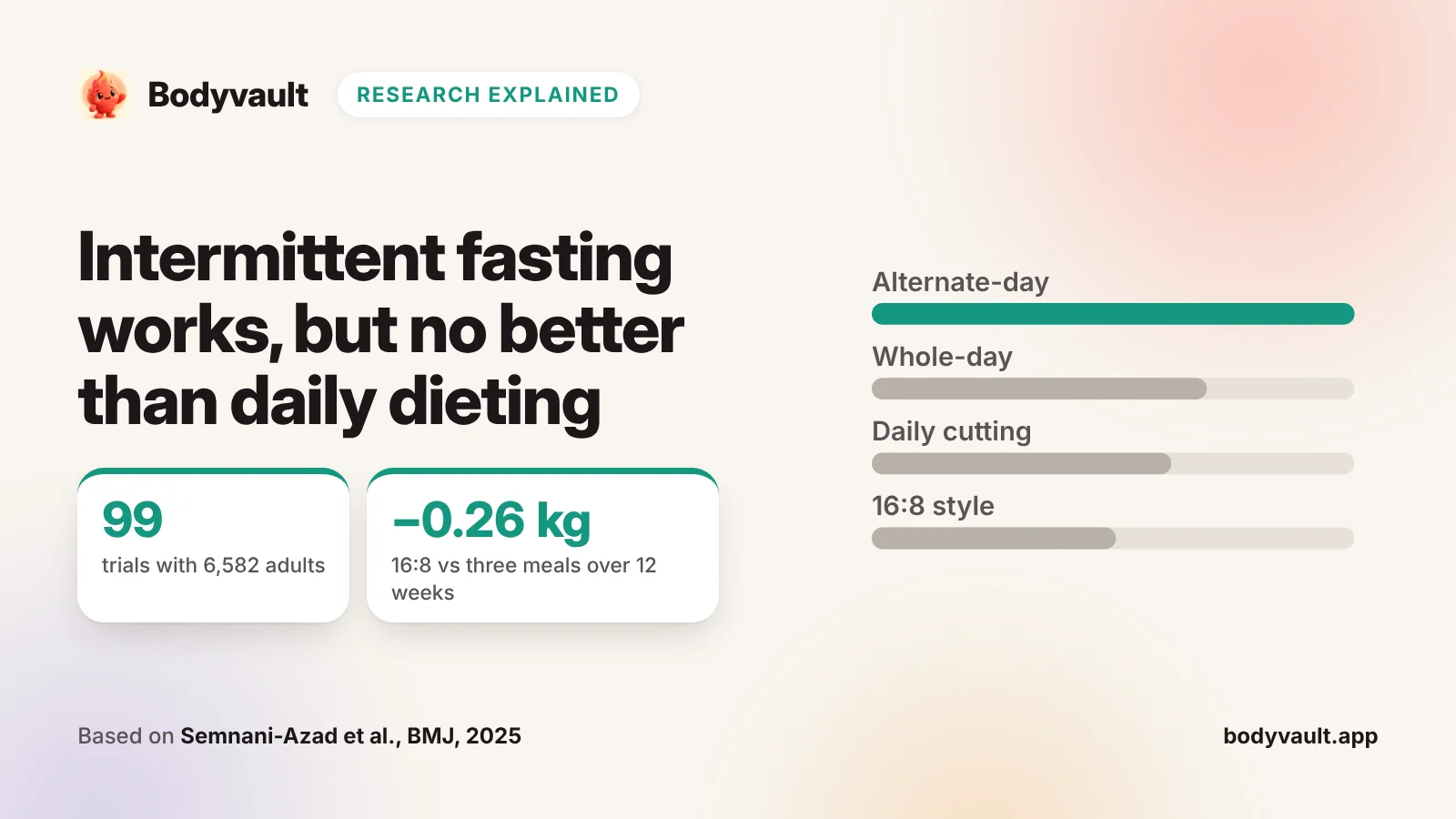
The short answer
0.26kg
Extra weight lost with 16:8 eating than with three meals a day over 12 weeks, in 116 adults: not a clear difference
1.8kg
Extra loss when an 8-hour eating window was added to calorie cutting for a year: not a clear difference
38%
Dropped out of alternate-day fasting in a year-long trial, compared with 29% of daily calorie cutting
99
Trials pooled in a 2025 review: in those of 24 weeks or longer, no fasting method beat daily calorie cutting
Strength of evidenceGood
Many randomised trials point the same way. But most lasted only about 12 weeks, and few followed people for a year or more.
Key findingIntermittent fasting helps some people eat less, and eating less is what drives the weight loss. When calories were matched, a fasting schedule gave no clear extra benefit. Choose it only if the schedule suits your life.
What is intermittent fasting?
Intermittent fasting means going without food, or with very little, for set periods, then eating normally in between. There are three main types:
- Time-restricted eating, such as 16:8 (some people write it 16/8 or 8/16). You fast for 16 hours and eat within an 8-hour window, for example from noon to 8 pm.
- Alternate-day fasting. You fast, or eat very little, every other day, and eat normally on the days in between.
- Whole-day fasting, such as 5:2. You eat normally on 5 days a week and fast on the other 2.
In the trials below, “daily calorie cutting” means eating a bit less every day, the usual way to diet.
How does intermittent fasting work?
Mostly by helping you eat less. With fewer hours to eat, or some days with very little food, many people take in fewer calories overall. Claims that fasting burns fat in some special way come mainly from studies in animals. A 2025 review said those effects haven’t been shown in people.
Does 16:8 intermittent fasting work on its own?
This 2020 trial, called TREAT, tested 16:8 the way many people try it: just the eating window, with no other changes. Both groups lost a little weight, and the gap between them was tiny. The researchers chose a noon-to-8 pm window because skipping breakfast seemed easier for most people than skipping dinner.
Fifty people also had detailed body scans. In that group, people on 16:8 lost 1.70 kg, and about 65% of it, 1.10 kg, was lean mass, which includes muscle. Lean mass is usually about 20–30% of the weight people lose. They also moved less: about 2,500 fewer steps a day, measured with a ring tracker. The researchers advise eating enough protein when you eat within a short window.
Fasting plus calorie cutting
What if you cut calories and also eat within a window? A 2022 trial in China tested this for a year. It put 139 adults with obesity into two groups by chance. Both aimed for 1,500–1,800 kcal a day for men or 1,200–1,500 for women. One group also ate only between 8 am and 4 pm.
The window group lost 8.0 kg and the calorie-only group 6.3 kg. That 1.8 kg gap was not a clear difference. Waist size, body fat, blood pressure and blood tests told the same story. When calories were the same, the eating window added little.
Alternate-day fasting: harder to stick with
A 2017 trial in Chicago compared alternate-day fasting with daily calorie cutting for a year. It included 100 adults with obesity who were otherwise healthy, and 86 of them were women. On fast days, the fasting group ate a quarter of their usual calories as one lunch. On the days between, they ate a quarter more than usual. The daily group ate three-quarters of their usual calories every day.
Compared with a group that made no changes, both diets led to about the same weight loss. It was about 7% of body weight at 6 months and 5–6% at a year. But more people gave up on fasting. Many in the fasting group ate more than planned on fast days and less on the others. In practice, they drifted towards cutting a little every day.
After a year, LDL cholesterol, the “bad” kind, was also higher with fasting than with daily cutting, by 11.5 mg/dL. Fasting didn’t improve blood pressure, blood sugar or other heart risk markers more than daily cutting did.
Intermittent fasting weight loss: what 99 trials show
The biggest review so far, published in the medical journal BMJ in 2025, pooled 99 trials with 6,582 adults. Most trials were short: half lasted 12 weeks or less, and only five lasted a year or more. Compared with eating freely, every method helped people lose some weight.
Weight change compared with eating freely, by method
- Alternate-day fasting−3.4 kg
- Whole-day fasting, such as 5:2−2.4 kg
- Daily calorie cutting−2.1 kg
- Time-restricted eating, such as 16:8−1.7 kg
Only alternate-day fasting beat daily calorie cutting, by 1.3 kg. The authors called that trivial, because it is below the 2 kg they counted as a difference that matters. And it showed up only in the shorter trials.
People mostly kept to their plans in short trials. But in most of the year-long trials, people didn’t stick to their plans well. In one, the share of people keeping to whole-day fasting fell from 74% at 6 weeks to 22% at a year.
Is intermittent fasting healthy?
In the trials, side effects were mostly mild: hunger, constipation, nausea, diarrhoea and dizziness. But it isn’t for everyone, and most trials left out people at higher risk. Talk to your doctor before you try it if any of these apply to you:
- You are pregnant, breastfeeding or under 18.
- You have had an eating disorder, such as anorexia or bulimia.
- You have diabetes or take medicine that lowers blood sugar. Fasting can make your blood sugar drop too low. One trial in the 2025 review reported a person whose blood sugar fell too low and who had a fall.
- You have another long-term health condition or take regular medicines.
The TREAT results are also a reminder to look after your muscle. If you eat in a short window, make sure each meal has a good amount of protein. Our guide on how much protein per day explains how much.
Many people also fast for faith, for example during Navratri, Ekadashi or Ramadan. These fasts have their own meaning and rules, and these trials didn’t study them. If you fast for religious reasons and have a health condition, ask your doctor how to do it safely. For food ideas, see Navratri fasting food and calories.
Claims and evidence
ClaimIntermittent fasting burns more fat than normal dieting.
EvidenceWhen calories were matched, adding an 8-hour eating window gave no clear extra loss over a year. Across 99 trials, fasting methods did about as well as daily calorie cutting.
Claim16:8 works even if you eat whatever you like.
EvidenceIn TREAT, people who ate freely from noon to 8 pm lost 0.94 kg in 12 weeks. People eating three meals lost about the same: 0.68 kg.
ClaimFasting every other day is easier than dieting every day.
EvidenceIn a year-long trial, 38% dropped out of alternate-day fasting, compared with 29% of daily calorie cutting. Many fasters drifted into cutting a little every day.
ClaimFasting protects your muscle.
EvidenceIn TREAT’s body scans, about 65% of the weight lost on 16:8 was lean mass, far more than the usual 20–30%.
What this means for you
What this means for you
- Try intermittent fasting only if the schedule suits you. It is one way to eat less, not a better way to lose weight.
- Calories still count. A short eating window doesn’t help if you eat more inside it. Start with the calorie deficit calculator.
- Get enough protein at each meal, especially if you only eat two meals a day.
- If cutting a little every day suits you better, it works just as well. Pick what you can keep up.
- If you are pregnant, have had an eating disorder, or take medicine for diabetes, don’t fast without advice from your doctor.
What the research can’t tell you yet
- The long run. Most trials lasted about 12 weeks. Only five of the 99 lasted a year or more.
- The best window. Trials used different hours, from 8 am–4 pm to noon–8 pm. Which works best, if any, is unclear. See also is eating late at night bad?
- Who was studied. Mostly adults with overweight or obesity, many in the US, the UK and China. The 2025 review listed no trials from India.
- Muscle. The lean-mass loss in TREAT came from 50 people over 12 weeks, and needs checking in bigger studies.
How Bodyvault uses this research
Bodyvault’s meal plans include two 16:8 options: lunch and dinner, or lunch, a snack and dinner, all between noon and 8 pm. Like every plan, they are sized to your own daily calorie and protein targets, so the window is a choice, not a shortcut. Plans also point out a main meal that is light on protein. And you can mark the weekdays you keep vegetarian, so those days’ meals have no meat or fish.
Share or cite this explainer
Bodyvault (2026). Intermittent fasting for weight loss: does it beat dieting? https://bodyvault.app/blog/intermittent-fasting-weight-loss
The charts on this page may be reused with a link back to it. The underlying data belong to the studies cited below.
Questions
Does intermittent fasting work?
Yes, for weight loss, about as well as cutting calories every day. In a 2025 review of 99 trials, every fasting method beat eating freely. But in trials of 24 weeks or longer, none beat daily calorie cutting.
Is intermittent fasting healthy?
In trials, side effects were mostly mild, such as hunger, constipation and dizziness. It isn’t suitable in pregnancy, after an eating disorder, or with diabetes medicines unless your doctor agrees. One trial also found more muscle loss with 16:8.
How does intermittent fasting work?
Mainly by helping you eat less. When trials matched calories, an eating window added no clear extra weight loss. Special fat-burning effects seen in animals haven’t been shown in people.
What is intermittent fasting 16/8?
You eat within an 8-hour window, such as noon to 8 pm, and fast for the other 16 hours. Some people write it 8/16. In a 12-week trial, 16:8 on its own gave no clear extra weight loss over three meals a day.
What is intermittent fasting?
It means going without food, or with very little, for set periods. The main types are time-restricted eating (such as 16:8), alternate-day fasting and whole-day fasting (such as 5:2).
Sources
- Lowe DA, Wu N, Rohdin-Bibby L, et al. (2020). Effects of time-restricted eating on weight loss and other metabolic parameters in women and men with overweight and obesity: the TREAT randomized clinical trial. JAMA Intern Med 180(11):1491–1499.
- Liu D, Huang Y, Huang C, et al. (2022). Calorie restriction with or without time-restricted eating in weight loss. N Engl J Med 386(16):1495–1504.
- Trepanowski JF, Kroeger CM, Barnosky A, et al. (2017). Effect of alternate-day fasting on weight loss, weight maintenance, and cardioprotection among metabolically healthy obese adults: a randomized clinical trial. JAMA Intern Med 177(7):930–938.
- Semnani-Azad Z, Khan TA, Chiavaroli L, et al. (2025). Intermittent fasting strategies and their effects on body weight and other cardiometabolic risk factors: systematic review and network meta-analysis of randomised clinical trials. BMJ 389:e082007.
General information about fitness and nutrition, not medical advice. If you have a health condition, are pregnant or take medication, talk to your doctor before changing your diet or training.