
Research explained
Is eating late at night bad? What meal-timing studies show
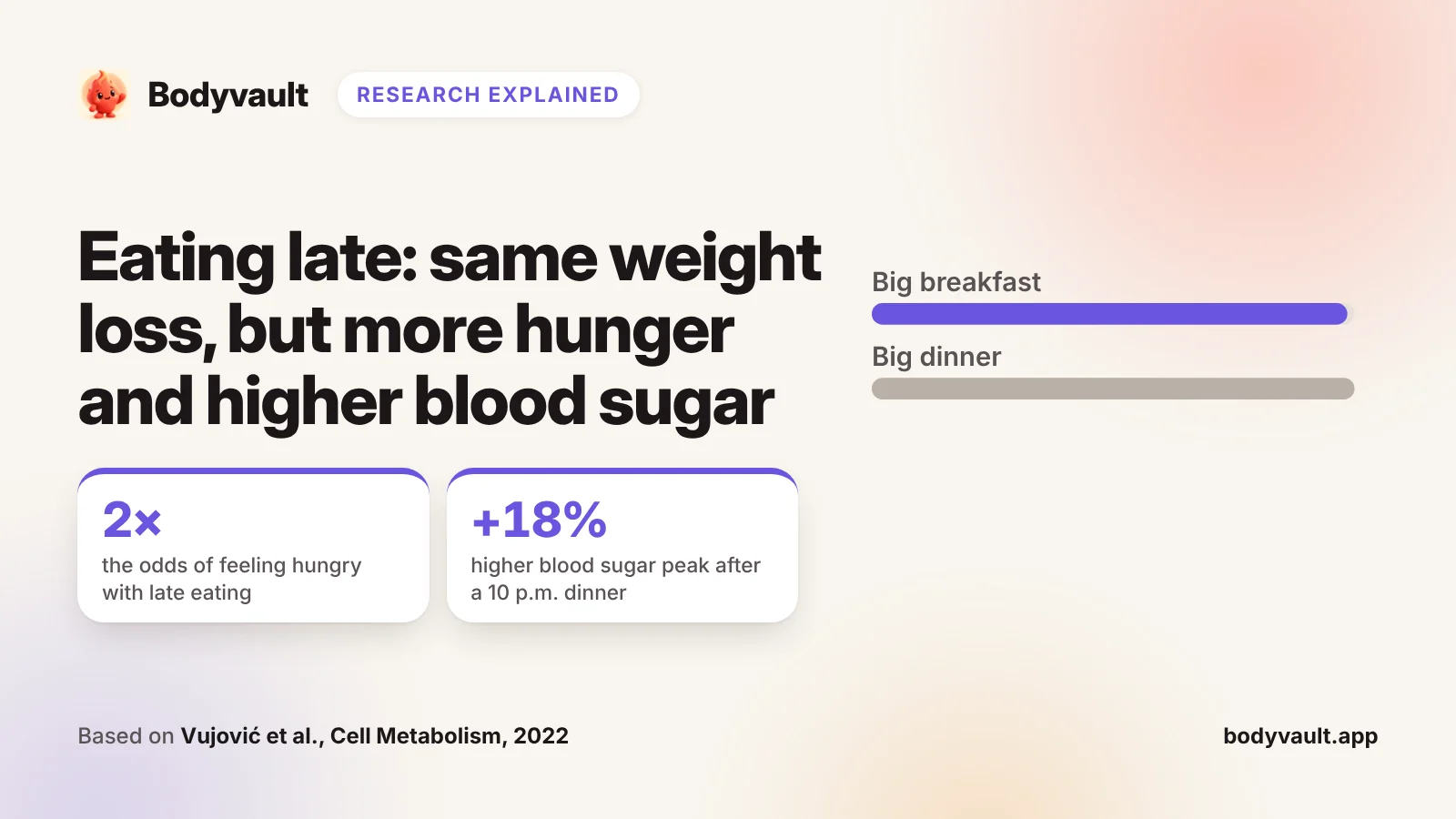
Is eating late at night bad? Not for weight on its own: with the same calories, a big dinner and a big breakfast led to the same weight loss. But eating late made people hungrier, and a 10 p.m. dinner raised blood sugar more than a 6 p.m. one.
The short answer
2×
The odds of feeling hungry when the same meals were eaten about 4 hours later, in 16 adults
−3.3kg
Weight lost in 4 weeks with a big breakfast, against −3.4 kg with a big dinner and the same calories
+18%
Higher peak in blood sugar after a 10 p.m. dinner than after a 6 p.m. one, in 20 healthy young adults
6.9h
Sleep on early-eating and on late-eating days in a lab trial (6.87 and 6.85 hours): no real difference
Strength of evidenceModerate
Small, short trials and one observational study. Late eating changed hunger and blood sugar, but trials that kept calories the same found no clear effect on weight.
Key findingFor weight, how much you eat matters more than when. But eating late can make you hungrier and push blood sugar higher at night. When you can, eat more of your food earlier and leave a few hours between dinner and bed.
What counts as eating late?
There is no fixed cut-off. Studies compare meals eaten earlier or later in someone’s day, such as dinner at 6 p.m. against dinner at 10 p.m. If you often eat dinner at 9 or 10 p.m., these studies are about you.
Researchers think late meals may clash with your body clock (circadian rhythm). This inner clock prepares your body for sleep at night, so food that arrives late meets a body that is winding down.
Is eating late at night bad? A careful lab test
For someone who wakes at 7 a.m. and sleeps at 11 p.m., the early schedule meant meals at about 8:00 a.m., 12:10 p.m. and 4:20 p.m. The late schedule meant 12:10 p.m., 4:20 p.m. and 8:30 p.m. (our calculation). The last meal came 2½ hours before bed.
Late eating also lowered leptin, a hormone that helps you feel full, by 16% during waking hours. People burned about 60 fewer calories while awake, about 5% less. Genes in their fat tissue shifted towards storing fat. Their sleep did not change.
These are short-term changes. The study kept weight steady on purpose, so it can’t show weight gain.
Can eating late at night cause weight gain?
A study in Spain followed 420 adults through a 20-week weight-loss programme. In Spain, lunch is the main meal. People who ate lunch after 3 p.m. lost 7.7 kg on average, against 9.9 kg for those who ate it before 3 p.m. Both groups ate about the same calories and slept about as long.
Dinner time made no clear difference, even though half the group ate dinner after 9:30 p.m. This was an observational study. It shows a link. It can’t prove that one thing causes the other.
Trials can test this more fairly. In a 2022 trial in Scotland, 30 adults with overweight or obesity ate the same calories in two ways, for 4 weeks each. One way had a big breakfast and a small dinner; the other, a small breakfast and a big dinner. They lost the same weight and burned the same calories. But with the big breakfast, they felt less hungry.
A 2023 review pooled 9 trials with 485 adults on weight-loss diets. Eating more of the day’s food earlier gave about 1.2 kg more weight loss over 5 to 16 weeks. But the trials disagreed a lot, and the result was no longer clear when one trial was left out. So any effect is small.
Does eating late at night affect sleep or blood sugar?
In a 2020 trial, 20 healthy young adults ate the same dinner at 6 p.m. one night and at 10 p.m. on another. Lights went out at 11 p.m. both times. After the late dinner, blood sugar peaked 18% higher and stayed higher for 4 hours. About 10% less of the dinner’s fat was burned by the next morning.
Sleep was the same after both dinners. It was measured with a full overnight sleep test, which records brain waves, breathing and more. That matches the 2022 lab trial above. But people whose acid reflux made late dinners hard were left out, so the results may not apply to them.
Does eating late at night cause diabetes? There is no proof of that. These were short changes in people without diabetes. In the 2023 review, eating earlier gave small extra drops in LDL (“bad”) cholesterol and in a score of insulin resistance. Insulin resistance is when the body stops responding well to insulin, the hormone that moves sugar from the blood into your cells.
What about breakfast?
Health bodies in the UK, US, Australia and elsewhere have advised eating breakfast to help control weight. A 2019 review of 13 trials tested this in adults in high-income countries. People told to eat breakfast ate about 260 calories a day more. After about 7 weeks, they weighed 0.44 kg more than people who skipped it.
The trials were short and open to bias, so the evidence is weak. The fair conclusion is that breakfast is optional. Eat it if it helps you, for example by keeping hunger down later in the day.
Claims and evidence
ClaimCalories eaten at night turn into fat.
EvidenceWhen 30 adults ate the same calories with a big breakfast or a big dinner, they lost the same weight (3.33 kg and 3.38 kg) and burned the same calories.
ClaimEating late ruins your sleep.
EvidenceIn two lab trials, measured sleep didn’t change with later meals, even with dinner 1 hour before bed. One trial left out people with reflux.
ClaimSkipping breakfast makes you gain weight.
EvidenceIn 13 trials, breakfast eaters ate about 260 calories a day more and weighed slightly more.
ClaimMeal timing makes no difference at all.
EvidenceLate meals raised hunger in one trial and blood sugar in another. Eating earlier gave a small, uncertain extra weight loss across 9 trials.
What this means for you
What this means for you
- For weight, total food matters most. A late dinner is fine if it fits within what you eat in a day.
- If you get hungry at night, try a bigger breakfast or lunch. In a trial, a big breakfast made people less hungry.
- When you can, leave a few hours between dinner and bed, and keep late snacks small.
- A short walk after dinner can lower the rise in blood sugar. See walking after eating.
- If you have diabetes or take medicine that lowers blood sugar, plan your meal times with your care team.
What the research can’t tell you yet
- Tiny, short trials. The trials had 16 to 30 people and lasted from one night to 4 weeks per diet.
- Healthy people. The blood sugar trial was in healthy young adults. People with diabetes may respond differently.
- Links, not proof. The Spanish study was observational, and there lunch, not dinner, was the main meal.
- The long term. These studies didn’t test whether late dinners over many years lead to weight gain, diabetes or heart disease.
How Bodyvault uses this research
If you log your meals, Bodyvault’s Coach counts the nights in the past week with a meal at or after 9 p.m. When that happens on 3 or more nights, it suggests finishing dinner 2–3 hours before bed. Its “Your data shows” cards can also check, once you have enough data, whether late-meal days go with different sleep for you. For more on eating windows, see intermittent fasting and weight loss.
Share or cite this explainer
Bodyvault (2026). Is eating late at night bad? What meal-timing studies show. https://bodyvault.app/blog/eating-late-at-night
The charts on this page may be reused with a link back to it. The underlying data belong to the studies cited below.
Questions
Why is eating late at night bad?
It isn’t always bad. In trials, late meals made people hungrier and raised blood sugar more after dinner. But weight loss was the same when total calories were the same.
Does eating late at night make you gain weight?
Not by itself, in trials that kept calories equal. But late eating made people hungrier, which may make it easier to eat more. One study in Spain linked a late main meal with less weight loss.
Does eating late at night affect sleep?
In two lab trials of healthy adults, measured sleep didn’t change after late meals. If you have heartburn or reflux, ask your doctor whether an earlier dinner would suit you better.
Does eating late at night cause diabetes?
There is no proof of that. A 10 p.m. dinner raised blood sugar more than a 6 p.m. one in healthy young adults, but only over one night. If you have diabetes, follow your care team’s advice on meal times.
Is eating late at night bad for weight loss?
Not if your total calories stay the same: a big dinner and a big breakfast gave the same weight loss in a 4-week trial. Eating earlier gave about 1 kg extra in a review of 9 trials, but that result was uncertain.
Sources
- Vujović N et al. (2022). Late isocaloric eating increases hunger, decreases energy expenditure, and modifies metabolic pathways in adults with overweight and obesity. Cell Metab 34(10):1486–1498.e7.
- Garaulet M et al. (2013). Timing of food intake predicts weight loss effectiveness. Int J Obes 37(4):604–611.
- Sievert K et al. (2019). Effect of breakfast on weight and energy intake: systematic review and meta-analysis of randomised controlled trials. BMJ 364:l42.
- Ruddick-Collins LC et al. (2022). Timing of daily calorie loading affects appetite and hunger responses without changes in energy metabolism in healthy subjects with obesity. Cell Metab 34(10):1472–1485.e6.
- Young IE et al. (2023). Distribution of energy intake across the day and weight loss: a systematic review and meta-analysis. Obes Rev 24(3):e13537.
- Gu C et al. (2020). Metabolic effects of late dinner in healthy volunteers: a randomized crossover clinical trial. J Clin Endocrinol Metab 105(8):2789–2802.
General information about fitness and nutrition, not medical advice. If you have a health condition, are pregnant or take medication, talk to your doctor before changing your diet or training.