
Research explained
How much protein per day should you eat?
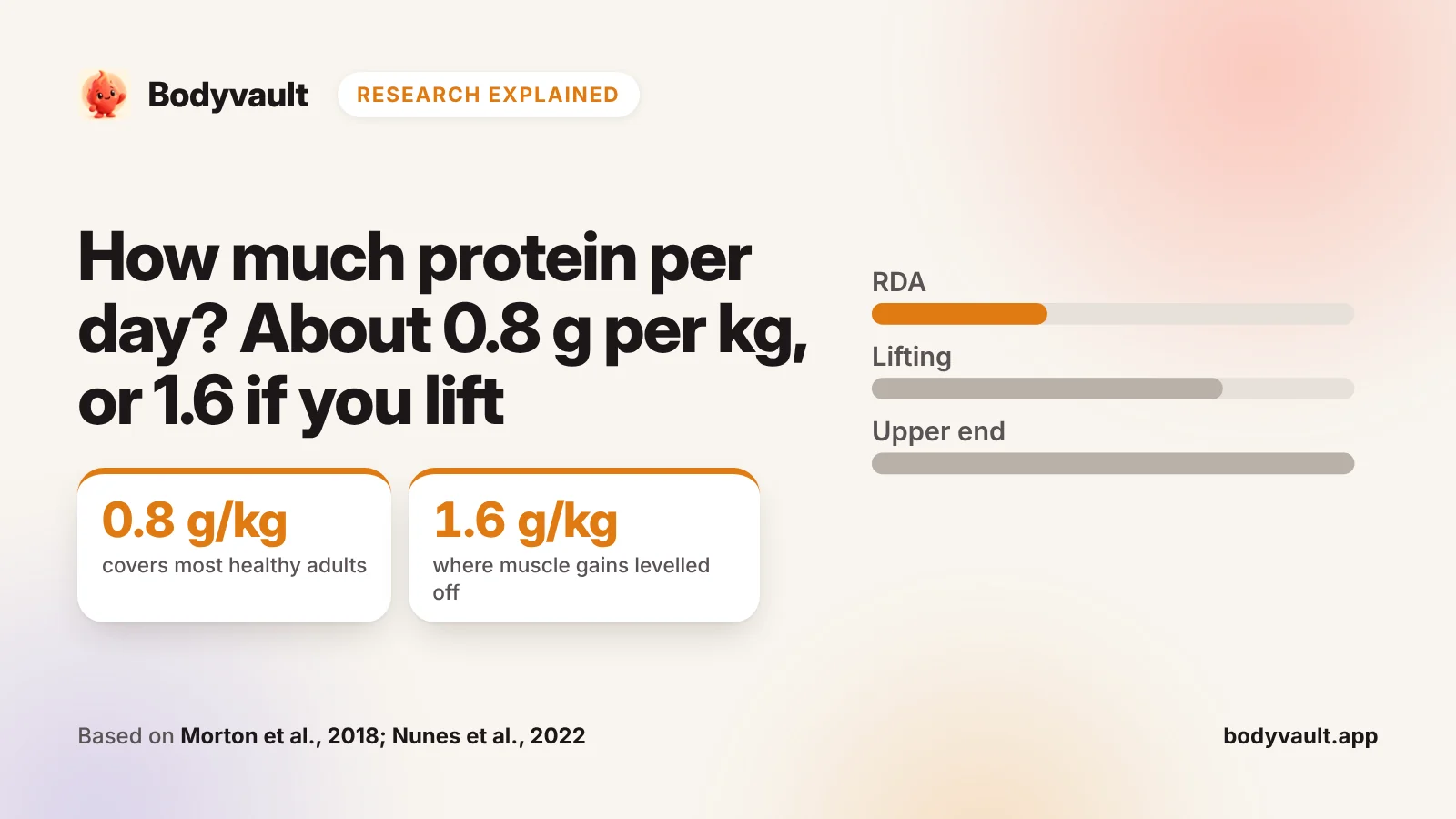
How much protein per day should you eat? Most healthy adults need about 0.8 g per kg of body weight: 56 g if you weigh 70 kg. If you lift weights, more helps, and gains levelled off at about 1.6 g per kg in a review of 49 trials.
The short answer
0.8g/kg
Protein a day covers the needs of nearly all healthy adults. India’s figure is 0.83.
1.6g/kg
A day is where extra muscle from weight training levelled off, in a review of 49 trials.
1.4–2.0g/kg
A day is what sports nutrition experts advise for most people who exercise.
1.2–1.6g/kg
A day is a common target while losing weight, from a 2015 review.
Strength of evidenceGood
Dozens of trials agree that more protein adds a little muscle when you lift weights. The best amount is less certain. Most trials lasted about three months, and most studied young adults.
Key findingStart with your weight. Most adults need about 0.8 g of protein per kg a day. If you lift weights or are losing weight, aim for about 1.2–1.6 g per kg. Up to 2.2 g makes sure you get the most from training. More than that adds little.
How much protein per day should you eat?
Protein is one of the three main nutrients in food, with carbohydrate and fat. Your body uses it to build and repair muscle, skin, bone and much more. Protein is made of 20 building blocks called amino acids. Nine of them must come from food.
Protein advice is usually given in grams per kilogram of body weight (g/kg). So if you weigh 70 kg and eat 1 g/kg, you eat 70 g of protein a day.
The RDA (recommended dietary allowance) is the amount that covers the needs of nearly all healthy adults. In the US, it is 0.8 g per kg a day. India’s RDA is 0.83 g per kg. That is about 54 g a day for a 65 kg man and 46 g for a 55 kg woman. If most of your protein comes from cereals like rice or wheat, India’s experts advise 1 g per kg.
The RDA is a floor, not a muscle-building target. Lifting weights, losing weight and older age all raise the amount that helps. The chart shows the main advice side by side.
How much protein per day: the main advice
- RDA, healthy adults0.8 (India 0.83)
- Adults over 651.0–1.2
- Losing weight1.2–1.6
- People who exercise1.4–2.0
- Where muscle gains levelled off1.6 (1.0–2.2)
- Lean, trained and dieting2.3–3.1
| Body weight | 0.8 g/kg | 1.2 g/kg | 1.6 g/kg | 2.2 g/kg |
|---|---|---|---|---|
| 50 kg | 40 g | 60 g | 80 g | 110 g |
| 60 kg | 48 g | 72 g | 96 g | 132 g |
| 70 kg | 56 g | 84 g | 112 g | 154 g |
| 80 kg | 64 g | 96 g | 128 g | 176 g |
| 90 kg | 72 g | 108 g | 144 g | 198 g |
| 100 kg | 80 g | 120 g | 160 g | 220 g |
To work out your own number, use the protein calculator.
How much protein per day for muscle gain?
This 2022 study was a meta-analysis: a study that pools the results of many earlier studies. Lean mass is everything in your body except fat. It includes muscle, but also bone, organs and water.
In adults under 65 who lifted weights, the extra protein helped most at 1.6 g per kg a day or more. In adults 65 and over, 1.2–1.59 g per kg helped, but that result leaned on one large study. No trial gave older adults 1.6 g per kg or more.
A 2018 review of 49 trials found a similar number. On top of training, protein added 0.30 kg of lean mass. It also added 2.49 kg to people’s one-rep max: the most weight you can lift once with good form. Gains levelled off at about 1.6 g per kg a day. But the likely range was wide, from 1.0 to 2.2. So the authors suggest up to 2.2 g per kg if you want to be sure of getting all the gains.
A third review, of 105 trials, looked at the pattern. The more protein a group ate, the more lean mass it tended to gain. But once intake passed about 1.3 g per kg, each extra step added only about a third as much (our calculation).
Do you need more protein if you don’t lift weights?
Probably not, if you are a healthy adult who isn’t dieting. A 2020 review pooled 18 trials in healthy adults. The higher-protein groups ate about 1.3 g per kg a day, against the RDA of 0.8. When people neither dieted nor lifted weights, the extra protein made no clear difference to their lean mass. When they ate less to lose weight, or lifted weights, it helped.
Extra lean mass from eating more than the RDA
- Not dieting or lifting+0.08 kg, no clear difference
- Eating less to lose weight+0.36 kg
- Eating less and lifting+0.65 kg
- Lifting weights+0.77 kg
Older adults are the exception. Experts in the PROT-AGE group advise people over 65 to eat at least 1.0–1.2 g per kg a day. They advise 1.2 g or more for those who exercise, and 1.2–1.5 g for most older people who are ill.
How much protein per day to lose weight?
When you eat less, your body can lose some muscle along with fat. More protein helps you keep it. In the 2020 review, people who ate more than the RDA while dieting kept about 0.36 kg more lean mass.
A 2015 review suggests 1.2–1.6 g per kg a day while losing weight, with about 25–30 g of protein at each meal. In short, careful studies, higher-protein diets led to more fat loss. In longer studies the results were mixed, mostly because people didn’t stick to their diets.
Protein may also help with hunger. A 2016 meta-analysis pooled 5 careful studies. After higher-protein meals or snacks, people felt clearly fuller over the next 2–4 hours. But the 2015 review found that this didn’t make people eat less at their next meal. So protein can make a diet easier, but it is not magic.
To build muscle while you lose fat, see body recomposition.
How much protein per day does a woman need?
Per kg of body weight, the advice is the same for women and men. India’s RDA is 0.83 g per kg for both. Women often weigh less, so they need fewer grams. For a 55 kg woman, the RDA is about 46 g a day. The sports nutrition advice of 1.4–2.0 g per kg applies to active women too.
Needs rise during pregnancy and breastfeeding. India’s nutrition institute adds 9.5 g a day in the middle three months of pregnancy and 22 g in the last three. They add about 17 g a day in the first six months of breastfeeding. If you are pregnant, ask your doctor or midwife about your diet.
Many protein trials studied only men. But in the 105-trial review, about half the people were women (our calculation).
How much protein per day is too much?
For healthy people, high protein looks safe in the studies we have. A 2018 review pooled 28 trials in 1,358 adults without kidney disease. Many had overweight, and some had type 2 diabetes. Over 4 days to 2 years, kidney function changed the same way on higher- and lower-protein diets.
Higher-protein diets
- About 1.81 g per kg a day
- Kidney function changed the same as in the other groups
- A sign of kidney damage rose in 1 of 8 trials that checked
Normal or lower-protein diets
- About 0.93 g per kg a day
- 28 trials and 1,358 adults without kidney disease
- Trials lasted 4 days to 2 years
Kidney function here means how fast your kidneys filter your blood. After the higher-protein diets, it was a tiny bit higher. The authors see this as the kidneys’ normal response to more protein, not as damage. But the evidence was of low quality.
The sports nutrition panel describes small trials in trained people. Some ate 4.4 g per kg a day for 8 weeks. Others averaged 3.3 g per kg for a year. The trials found no harm in kidney or liver tests. The US Institute of Medicine’s range, quoted by the panel, is 10–35% of your calories from protein. On 2,000 calories (kcal) a day, 35% is 175 g of protein (our calculation).
If you have kidney disease, talk to your doctor before eating more protein. People with kidney failure often need less protein, not more. Older adults with severe kidney disease may need to limit it, unless they are on dialysis (a treatment where a machine cleans the blood).
Can you get enough protein from food?
Yes, for most people. India’s 2024 dietary guidelines say most athletes can get enough protein from food alone. They call protein powders unnecessary for normal healthy life. The chart shows how much protein different foods give, before cooking.
A bowl of cooked dal is mostly water, so it holds less protein than you might think. For paneer, curd, eggs and soya, see protein in paneer. To compare powders, see whey vs plant protein. Your daily total matters most. For how to split it across meals, see how much protein per meal.
Claims and evidence
ClaimThe more protein you eat, the more muscle you build.
EvidenceGains levelled off at about 1.6 g per kg a day in a review of 49 trials. Above 1.3 g per kg, each extra 0.1 g went with about a third as much extra lean mass.
ClaimExtra protein builds muscle even if you don’t train.
EvidenceIn adults who neither dieted nor lifted weights, eating more than the RDA made no clear difference to lean mass. One review did see small gains without weights, but many of its trials were weight-loss diets.
ClaimHigh-protein diets damage healthy kidneys.
Evidence28 trials tested adults without kidney disease. About 1.8 g per kg a day changed kidney function no differently from about 0.9 g. People who already have kidney disease should follow their doctor’s advice.
ClaimWomen need less protein per kg than men.
EvidenceIndia’s RDA is the same for both: 0.83 g per kg a day. Women often need fewer grams only because they tend to weigh less.
What this means for you
What this means for you
- Work out your number from your body weight. About 0.8 g per kg a day covers most adults. The protein calculator does the maths.
- If you lift weights, aim for about 1.6 g per kg a day. Up to 2.2 g makes sure you get the most from training.
- If you’re losing weight, aim for about 1.2–1.6 g per kg and keep lifting weights. It helps you keep muscle and may help you feel full.
- If you’re over 65, aim for at least 1.0–1.2 g per kg, and more if you’re active.
- If you have kidney disease or diabetes, are pregnant or take medicines, check your protein target with a doctor or dietitian first.
What the research can’t tell you yet
- The long term. Most trials lasted about two to three months. We don’t know as much about years of high or low protein.
- Muscle itself. Most trials measured lean mass, which includes water and organs as well as muscle.
- Who was studied. Few trials tested older adults at high intakes. Most gave animal protein, such as milk or whey.
- Kidney safety. The kidney trials were short and of low quality. They don’t apply to people who already have kidney disease.
- Industry links. Several authors have had funding from the dairy, meat or food industries.
How Bodyvault uses this research
Bodyvault sets your daily protein target from your body weight and goal. It starts at 1.6 g per kg for general health or endurance. It uses 1.8 g for building muscle or strength, and 2.0 g when you’re losing fat. You can change it anywhere from 0.8 to 3.0 g per kg. Say you’re trying to lose fat, but your protein and your workouts both fall well short for a few weeks. Then Coach warns you, because that mix tends to cost muscle.
Share or cite this explainer
Bodyvault (2026). How much protein per day should you eat? https://bodyvault.app/blog/how-much-protein-per-day
The charts on this page may be reused with a link back to it. The underlying data belong to the studies cited below.
Questions
How much protein per day do I need?
Most healthy adults need about 0.8 g per kg of body weight a day. That is 56 g if you weigh 70 kg. If you lift weights or are losing weight, aim for about 1.2–1.6 g per kg.
How much protein per day for muscle gain?
About 1.6 g per kg a day. That is where gains levelled off on average in a review of 49 trials. Up to 2.2 g per kg makes sure you get the most from training.
How much protein per day to lose weight?
About 1.2–1.6 g per kg a day, with 25–30 g at each meal, according to a 2015 review. Lifting weights at the same time helps you keep muscle. Lean, trained people who diet may need 2.3–3.1 g per kg.
How much protein per day does a woman need?
The same per kg as a man. India’s RDA is 0.83 g per kg a day, about 46 g for a 55 kg woman. Needs rise in pregnancy and while breastfeeding, so ask your doctor or midwife.
How much protein per day is too much?
For healthy adults, about 1.8 g per kg a day did not harm kidney function in 28 trials. Small trials of up to 3.3 g per kg for a year found no harm either. If you have kidney disease, ask your doctor before eating more protein.
Sources
- Nunes EA et al. (2022). Systematic review and meta-analysis of protein intake to support muscle mass and function in healthy adults. J Cachexia Sarcopenia Muscle 13(2):795–810.
- Morton RW et al. (2018). A systematic review, meta-analysis and meta-regression of the effect of protein supplementation on resistance training-induced gains in muscle mass and strength in healthy adults. Br J Sports Med 52(6):376–384.
- Tagawa R et al. (2021). Dose-response relationship between protein intake and muscle mass increase: a systematic review and meta-analysis of randomized controlled trials. Nutr Rev 79(1):66–75.
- Hudson JL et al. (2020). Protein intake greater than the RDA differentially influences whole-body lean mass responses to purposeful catabolic and anabolic stressors: a systematic review and meta-analysis. Adv Nutr 11(3):548–558.
- Jäger R et al. (2017). International Society of Sports Nutrition position stand: protein and exercise. J Int Soc Sports Nutr 14:20.
- Devries MC et al. (2018). Changes in kidney function do not differ between healthy adults consuming higher- compared with lower- or normal-protein diets: a systematic review and meta-analysis. J Nutr 148(11):1760–1775.
- Leidy HJ et al. (2015). The role of protein in weight loss and maintenance. Am J Clin Nutr 101(6):1320S–1329S.
- Dhillon J et al. (2016). The effects of increased protein intake on fullness: a meta-analysis and its limitations. J Acad Nutr Diet 116(6):968–983.
- Bauer J et al. (2013). Evidence-based recommendations for optimal dietary protein intake in older people: a position paper from the PROT-AGE Study Group. J Am Med Dir Assoc 14(8):542–559.
- ICMR-NIN (2020). A brief note on Nutrient Requirements for Indians: Recommended Dietary Allowances and Estimated Average Requirements.
- ICMR-NIN (2024). Dietary Guidelines for Indians, revised edition.
General information about fitness and nutrition, not medical advice. If you have a health condition, are pregnant or take medication, talk to your doctor before changing your diet or training.