
Research explained
Body recomposition: can you build muscle in a deficit?
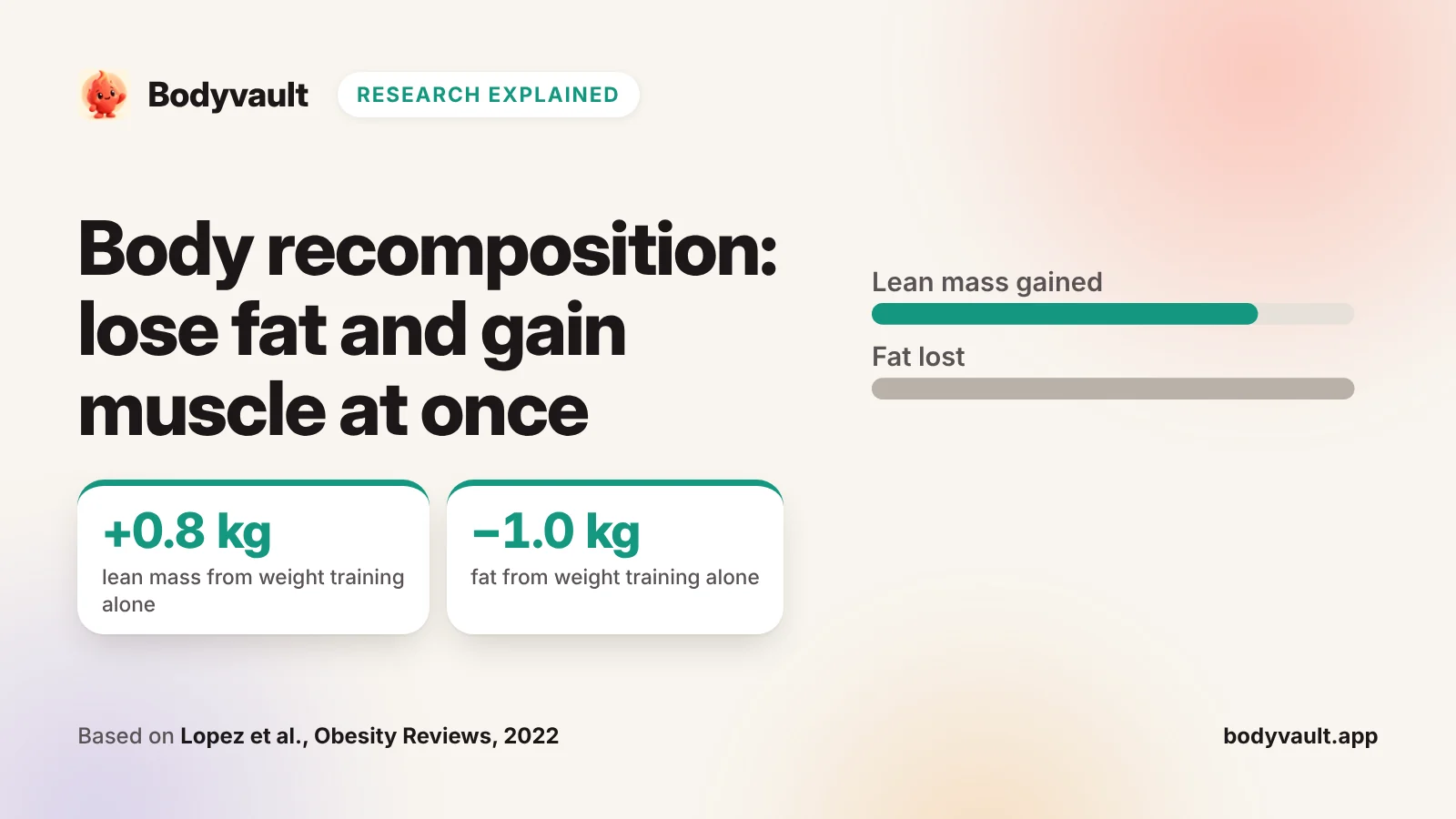
Body recomposition means losing fat and gaining muscle at the same time, and it is real. In over 30 trials, people with overweight who just lifted weights gained about 0.8 kg of lean mass, which includes muscle. They also lost about 1 kg of fat. But a big calorie deficit, eating far less than you burn, makes gaining muscle much harder.
The short answer
+0.8kg
Lean mass gained with weight training alone, by people with overweight (34 trials)
−5.1kg
Fat lost with weight training plus eating less, while lean mass held steady
500kcal
A daily calorie gap at which gains in lean mass stopped, on average
2.4g/kg
Protein a day that let young men gain lean mass during a big calorie gap
Strength of evidenceModerate
Many trials show that beginners and people with overweight can gain muscle while losing fat. But most trials were small and short, and many had flaws. The best calorie gap and protein amount rest on fewer studies.
Key findingBody recomposition is real, especially if you are new to weights or carry extra fat. Lift weights and eat about 1.6–2.2 g of protein per kg of body weight a day. Keep any calorie gap small: about 500 calories (kcal) a day or less.
What is body recomposition?
Body recomposition means changing what your body is made of. You lose fat and gain muscle at the same time. Your weight may barely change, even as your shape does.
Scientists split body weight into fat mass and lean mass. Lean mass is everything except fat: muscle, bone, organs and water. Most studies measure it with a body scan.
How does body recomposition work? Building muscle needs a reason and the right materials. Lifting weights is the reason, and protein provides the building blocks. Losing fat needs an energy gap, also called a calorie deficit: you eat fewer calories than you burn.
You can have all three at once. But a big gap leaves less energy for building. In short studies, eating too little lowered the hormones and the muscle-building process that help muscle grow.
Is body recomposition real?
Yes, it is real. This 2022 meta-analysis (a study that pools the results of many earlier studies) looked at people with overweight or obesity. Those who lifted weights, without dieting, gained lean mass and lost fat at the same time.
With both, people lost about 5 kg of fat and kept their lean mass. Young adults gained the most lean mass from weight-training programmes: about 1.4 kg.
Can you build muscle in a calorie deficit?
Yes, but less than when you eat enough. A 2022 meta-analysis looked at trials where people lifted weights for 3 weeks or more while eating less than they burned. It compared them with people who trained and ate enough.
Training while eating less
- Strength rose about as much
- Lean mass rose less, or not at all
- With a gap of about 500 kcal a day, lean-mass gains stopped on average
Training and eating enough
- Strength rose
- Lean mass rose
- The clearest way to build muscle
So keep the gap small if building muscle is your goal. For example, if you burn 2,400 kcal a day, a 500 kcal gap means eating about 1,900 (our calculation). To find out how much you burn, use the calorie deficit calculator.
How much protein for body recomposition?
This was a trial where people were put into groups by chance, so the groups could be fairly compared. It pushed the men hard. Even so, the men who ate twice as much protein gained lean mass while losing more fat.
Bigger reviews point the same way. In 24 weight-loss trials with 1,063 adults, diets higher in protein, with the same calories, took off a little more fat. People also kept a little more lean mass.
A 2020 review found the same. People who ate more than the basic daily protein advice (0.8 g per kg) while dieting kept about 0.36 kg more lean mass. When they also lifted weights, the difference was about 0.65 kg, but this rests on very little data.
How much protein, then? In a review of 49 trials, muscle gains levelled off at about 1.6 g per kg a day. Its authors suggest up to 2.2 g to get the most from training. A 2015 review suggests 1.2–1.6 g per kg while losing weight, with 25–30 g at each meal. For lean, trained people who are dieting, a sports nutrition panel suggests 2.3–3.1 g per kg. See how much protein per day, or use the protein calculator.
How long does body recomposition take?
Think in months, not weeks. In the 114-trial review, programmes lasted about 15 weeks on average. Over that time, weight training alone added about 0.8 kg of lean mass. Programmes that also cut calories showed results over 12 to 48 weeks.
Most of this research is in beginners and people with overweight. There is much less on lean, experienced lifters. For them, experts suggest more protein while dieting to hold on to muscle.
Don’t judge by the scale alone. Your weight may stay flat while you recompose. Keep track of your strength, your waist and how your clothes fit.
Body recomposition for women
Women recompose too. In the 114-trial review, weight-training programmes in women added about 0.6 kg of lean mass and took off about 1.0 kg of fat. Their body fat fell by 2.4 percentage points: for example, from 35% to 32.6% (our calculation).
Many protein trials, like the 4-week trial above, studied only men. So the protein advice for women rests on fewer studies, but it is the same per kg. If you are pregnant or breastfeeding, talk to your doctor or midwife before you cut calories.
Claims and evidence
ClaimYou can’t build muscle and lose fat at the same time.
EvidenceIn over 30 trials of people with overweight, weight training alone added about 0.8 kg of lean mass. Fat fell by about 1 kg.
ClaimThe bigger the calorie deficit, the faster you’ll recompose.
EvidenceBigger gaps take off more fat. But on average, a gap of about 500 kcal a day stopped gains in lean mass.
ClaimEating less will make you weaker.
EvidenceStrength gains were about the same with or without a calorie deficit, as long as people kept training.
ClaimExtra protein only matters for bodybuilders.
EvidenceIn 24 weight-loss trials of everyday adults, higher-protein diets kept 0.43 kg more lean mass and took off 0.87 kg more fat.
What this means for you
What this means for you
- Lift weights on most weeks. In the trials, people trained 1 to 5 times a week.
- Keep your calorie gap small, about 500 kcal a day or less, if you want to build muscle. The calorie deficit calculator can help you set it.
- Eat about 1.6–2.2 g of protein per kg a day, spread over your meals. See how much protein per meal.
- Track your strength, waist and photos, not just your weight. Your weight may barely move.
- If you have a health condition, are pregnant, or have had problems with eating, talk to a doctor before you cut calories.
What the research can’t tell you yet
- The long term. Programmes lasted about 15 weeks on average. The protein trial lasted only 4 weeks.
- Who was studied. Most people were beginners or had overweight. Lean, experienced lifters have been studied less, and the protein trial included only young men.
- Trial quality. In the 114-trial review, most studies of lean mass had flaws in how they were run, such as how people were put into groups.
- The 500 kcal figure. It is an average across studies, not a rule for each person. We could read only the summary of that review.
- Muscle itself. Lean mass includes water and organs as well as muscle.
How Bodyvault uses this research
Bodyvault has a Recomposition goal for losing fat while building muscle slowly. It sets your calories 5% below what you burn in a day and your protein at 2.0 g per kg. The ‘Lose fat, keep muscle’ goal uses a 15% gap with the same protein. Say you’re on one of these goals, but your protein and your workouts both fall well short for a few weeks. Then Coach warns you that this mix tends to cost muscle.
Share or cite this explainer
Bodyvault (2026). Body recomposition: can you build muscle in a deficit? https://bodyvault.app/blog/body-recomposition
The charts on this page may be reused with a link back to it. The underlying data belong to the studies cited below.
Questions
What is body recomposition?
It means losing fat and gaining muscle at the same time. Your weight may barely change, but what your body is made of does. It works best with weight training, enough protein and a small calorie gap.
How long does body recomposition take?
Expect months, not weeks. In trials lasting about 15 weeks on average, weight training added about 0.8 kg of lean mass in people with overweight. Track your strength and waist as well as your weight.
Is body recomposition real?
Yes. In over 30 trials of people with overweight, weight training alone added lean mass and took off fat at the same time. There is much less research on lean, experienced lifters.
How much protein for body recomposition?
About 1.6–2.2 g per kg of body weight a day. In a 4-week trial with a big calorie gap, young men eating 2.4 g per kg gained 1.2 kg of lean mass. Men eating 1.2 g barely changed.
What calorie deficit is best for body recomposition?
A small one. On average, a gap of about 500 kcal a day was enough to stop gains in lean mass. A smaller gap gives you a better chance of building muscle while you lose fat.
Sources
- Lopez P et al. (2022). Resistance training effectiveness on body composition and body weight outcomes in individuals with overweight and obesity across the lifespan: a systematic review and meta-analysis. Obes Rev 23(5):e13428.
- Murphy C, Koehler K (2022). Energy deficiency impairs resistance training gains in lean mass but not strength: a meta-analysis and meta-regression. Scand J Med Sci Sports 32(1):125–137.
- Longland TM et al. (2016). Higher compared with lower dietary protein during an energy deficit combined with intense exercise promotes greater lean mass gain and fat mass loss: a randomized trial. Am J Clin Nutr 103(3):738–746.
- Wycherley TP et al. (2012). Effects of energy-restricted high-protein, low-fat compared with standard-protein, low-fat diets: a meta-analysis of randomized controlled trials. Am J Clin Nutr 96(6):1281–1298.
- Hudson JL et al. (2020). Protein intake greater than the RDA differentially influences whole-body lean mass responses to purposeful catabolic and anabolic stressors: a systematic review and meta-analysis. Adv Nutr 11(3):548–558.
- Leidy HJ et al. (2015). The role of protein in weight loss and maintenance. Am J Clin Nutr 101(6):1320S–1329S.
- Morton RW et al. (2018). A systematic review, meta-analysis and meta-regression of the effect of protein supplementation on resistance training-induced gains in muscle mass and strength in healthy adults. Br J Sports Med 52(6):376–384.
- Jäger R et al. (2017). International Society of Sports Nutrition position stand: protein and exercise. J Int Soc Sports Nutr 14:20.
General information about fitness and nutrition, not medical advice. If you have a health condition, are pregnant or take medication, talk to your doctor before changing your diet or training.