
Research explained
What is a normal blood pressure? What the guidelines say
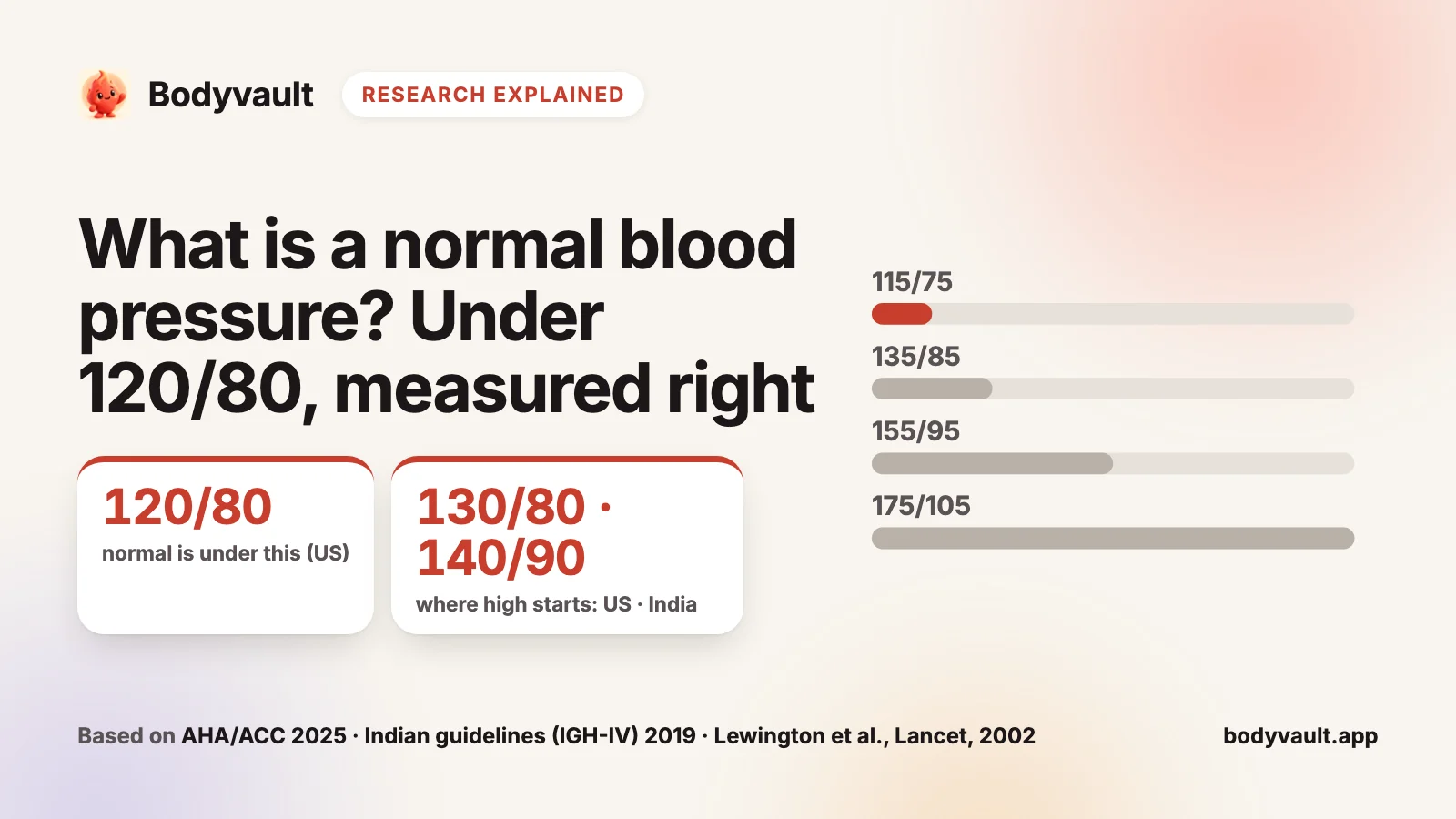
What is a normal blood pressure? In US guidelines, under 120/80 is normal and 130/80 or more is high. Indian guidelines draw the line for high at 140/90. One reading isn’t enough, though. Guidelines go by an average of home readings over 3 to 7 days, taken the right way.
The short answer
120/80
Normal in US guidelines means both numbers are under this, in mmHg
130/80
Where US guidelines start high blood pressure
140/90
Where Indian guidelines start it, for clinic readings
135/85
The home average that matches 140/90 at a clinic
Strength of evidenceStrong
Studies of a million adults and trials of over 340,000 people agree. Lower blood pressure goes with less heart disease and stroke, and bringing it down helps.
Key findingOne reading tells you little. Guidelines use the average of 2 readings in the morning and 2 at bedtime, for 3 to 7 days, taken with a validated upper-arm cuff.
What do the two numbers mean?
A blood pressure reading has two numbers, such as 128/82. They are measured in millimetres of mercury, written mmHg. The top number, called systolic, is the pressure in your arteries when your heart beats. The bottom number, called diastolic, is the pressure while your heart rests between beats.
Both numbers matter, and a reading counts as high if either one is high. For people over 50, the top number tells more about the risk of heart disease, says the American Heart Association. It also says that measuring is the only way to know if you have high blood pressure.
What is a normal blood pressure?
The US guideline comes from the American Heart Association, the American College of Cardiology and 11 other groups. It sorts adults into four groups. Its latest version came out in 2025 and kept the groups it set in 2017.
| Category | Top number (systolic) | Bottom number (diastolic) |
|---|---|---|
| Normal | Under 120 | and under 80 |
| Elevated | 120–129 | and under 80 |
| Stage 1 high blood pressure | 130–139 | or 80–89 |
| Stage 2 high blood pressure | 140 or more | or 90 or more |
If your two numbers fall in different rows, the higher row counts. So a reading of 125/85 counts as stage 1, because 85 is in the stage 1 row. The groups use the average of at least 2 careful readings on at least 2 separate days. They don’t apply in pregnancy, which has its own limits.
India and many other countries use 140/90
India’s guideline is the fourth edition of the Indian guidelines on hypertension, from 2019. It defines high blood pressure as 140/90 or more. It notes that European and many other guidelines use the same line, while the US moved it down to 130/80.
So the same reading can count as high in one country and not in another. A reading of 132/84 is stage 1 in the US guideline, but below the Indian line. Either way, the next section shows why it is worth bringing down.
Normal blood pressure by age
For adults, the lines are the same at every age, so a blood pressure chart by age would show the same range in every row. In a study of a million adults, higher blood pressure went with higher risk at every age from 40 to 89. In relative terms, the link was about half as strong at 80 to 89 as at 40 to 49. In actual numbers of extra deaths, though, it was bigger in old age.
Is lower blood pressure better?
Mostly, yes. A 2002 study pooled data on about one million adults from 61 studies. The risk of dying from heart disease or stroke rose steadily from 115/75 upward. In middle age, each 20 points higher on the top number went with about twice the risk.
Those studies show a link, not proof. Trials answer the next question: does bringing blood pressure down help? A 2021 analysis pooled 48 trials of blood pressure medicines.
The benefit held even for people whose blood pressure wasn’t high to begin with. Lower isn’t better without limit, though. If you often feel dizzy or faint, especially when you stand up, see a doctor. They can check whether your blood pressure is too low.
How to measure your blood pressure at home
Home readings can tell you more than one reading at a clinic. In several studies, home blood pressure was more closely linked with heart risk than clinic readings. The US guideline sets out this routine:
Use a validated upper-arm cuff
Check your monitor on a list of tested devices, such as validatebp.org or STRIDE BP. Use the cuff size that fits your arm.
Get ready
Don’t smoke, have caffeine or exercise in the 30 minutes before. Empty your bladder first.
Sit the right way
Sit for at least 5 minutes with your back supported, feet flat and legs uncrossed. Rest your arm on a table at heart level, with the cuff on bare skin just above your elbow.
Take 2 readings, a minute apart
Do this in the morning before medicines and food, and again at bedtime. Don’t talk or use your phone while you measure.
Repeat for 3 to 7 days
Write the readings down, or use a monitor that stores them. Share them with your doctor, who works out the average.
India’s guideline gives the same routine for 7 days. It says to leave out the first day and average the other 12 readings, because first-day readings are sometimes higher.
Most monitors on sale haven’t been properly tested for accuracy, a 2023 review found. A regulator letting a monitor be sold isn’t the same as it passing an accuracy test. The US list is validatebp.org. India has no list of its own, so a worldwide list such as STRIDE BP is the place to check.
Home readings have their own lines
Readings at home tend to be lower than at a clinic, says India’s guideline. So a home average has slightly lower lines. The US guideline gives this guide:
| At a clinic | Matching home average |
|---|---|
| 120/80 | 120/80 |
| 130/80 | 130/80 |
| 140/90 | 135/85 |
| 160/100 | 145/90 |
India’s guideline also counts a home average above 135/85 as high. The US guideline says to use these figures with care, because most of the data came from Europe, Australia and Asia.
Why one reading isn’t enough
Blood pressure goes up and down a lot on its own, and the first reading is often the highest. In a US study, 35% of adults whose first reading was 140–159/90–99 were under 140/90 on the average of three readings.
Some people’s readings are high only at a clinic. Doctors call this white-coat high blood pressure. For others, readings are high only at home, which is called masked high blood pressure. India’s guideline puts white-coat high blood pressure at 10–15% and masked at 5–10%. Home readings help tell them apart.
Small slips change the number
How you sit and which cuff you use can move a reading by more than the gap between two groups. Two US trials measured this.
Other slips push readings up too. A review of 328 studies found that caffeine, smoking, a full bladder, cold, crossed legs and talking all raised readings. That is why the routine above avoids them.
Wrist monitors, phones and watches
Upper-arm cuffs are the standard. Wrist monitors read too high or too low if your wrist isn’t at heart level. India’s guideline says finger and wrist monitors are inaccurate and doesn’t recommend them.
Watches, rings and phones don’t measure blood pressure with a cuff. The 2025 US guideline says these cuffless devices can’t be recommended for clinical use until their problems are solved.
Some watches send an alert about possible high blood pressure. In Apple’s own study, the Apple Watch alert caught 41% of people who had undiagnosed high blood pressure, and missed the other 59%. It also wrongly alerted about 8% of people who didn’t have it.
So an alert is a reason to measure with a cuff, and no alert isn’t a reason to skip it.
How to lower your blood pressure
Trials show that everyday changes lower blood pressure. This chart shows the average drop in the top number in each set of trials.
- Salt. In 34 trials, eating about 4.4 g less salt a day lowered blood pressure by about 4/2 mmHg on average, and more in people with high blood pressure. Bigger cuts lowered it more. India’s guideline advises under 5 g a day, while Indian studies found people eating about 9 to 14 g. Pickles, papads, chips, packaged namkeen and many breads are high in salt. More on this in ultra-processed foods.
- Exercise. Every kind of exercise lowered it in 270 trials. Aerobic exercise, such as brisk walking or cycling, lowered the top number by about 4.5. Strength training gave about the same, and isometric holds the most. India’s guideline says 30 to 45 minutes of brisk walking or swimming, 3 or 4 times a week, can lower it by 7 to 8. See how much exercise per week.
- Weight. In 25 trials, blood pressure fell by about 1 point for every kilogram lost.
- Food. The DASH diet is rich in fruit, vegetables, whole grains and low-fat dairy, with less saturated fat. It lowered blood pressure by about 3/2.5 mmHg in 30 trials, in people with and without high blood pressure.
- Alcohol. In people who had more than 2 drinks a day, cutting down lowered blood pressure. Heavy drinkers who halved their intake saw drops of about 5.5/4. For people who had 2 drinks a day or fewer, cutting down made no clear difference. A drink in these studies was 12 g of alcohol.
Many people with high blood pressure also need medicines, and a doctor decides on those. Don’t start, stop or change a medicine because of a reading.
When to see a doctor or get help
Call emergency services straight away if a reading over 180/120 comes with any of these: chest pain, shortness of breath, back pain, numbness, weakness, a change in vision or trouble speaking. Doctors call this a hypertensive emergency.
If a reading is over 180/120 and you have none of those symptoms, wait a minute and measure again. If it’s still that high, contact your doctor. This is called severe high blood pressure.
See a doctor about your blood pressure if:
- Your home average over several days is 130/80 or more, the US line, or above 135/85, the Indian line.
- You often feel dizzy or faint, especially when you stand up.
- You’re pregnant. Tell your maternity team about readings of 140/90 or more. A reading of 160/110 or more needs care urgently.
Only a doctor can confirm high blood pressure. A watch alert or a single high reading is a reason to check, not a diagnosis.
Claims and evidence
ClaimIf I feel fine, my blood pressure is fine.
EvidenceMeasuring it is the only way to know if you have high blood pressure, says the American Heart Association.
ClaimOne high reading means I have high blood pressure.
EvidenceThe first reading is often the highest. In a US study, 35% of people with a high first reading were under 140/90 on the average of three.
ClaimA wrist monitor or a watch is as good as a cuff.
EvidenceGuidelines recommend a validated upper-arm cuff. India’s guideline doesn’t recommend wrist or finger monitors, and the US guideline doesn’t yet recommend cuffless devices.
ClaimNo watch alert means my blood pressure is normal.
EvidenceIn Apple’s own study, the alert missed 59% of people who had undiagnosed high blood pressure.
ClaimOnly salt matters.
EvidenceExercise, weight loss, the DASH diet and less alcohol all lowered blood pressure in trials, some by as much as cutting salt.
What this means for you
What this means for you
- Know the lines. Under 120/80 is normal in US guidelines. High starts at 130/80 in the US and at 140/90 in India.
- Measure at home the right way: a validated upper-arm cuff, 5 minutes’ rest, your arm on a table, and 2 readings in the morning and at bedtime for 3 to 7 days.
- Go by the average, not one reading.
- To lower it, eat less salt, move more, keep alcohol low, lose weight if you need to, and eat plenty of fruit and vegetables.
- Get emergency help for a reading over 180/120 with chest pain, shortness of breath, numbness, weakness, vision changes or trouble speaking.
What the research can’t tell you yet
- Cause and effect for risk. The million-adult study followed people over time, so it shows a link. The trials that show lowering it helps were trials of medicines.
- Home lines. The home figures come mostly from studies outside the US that followed people, not from trials.
- Lifestyle trials. They differ in length, dose and who took part, so their numbers can’t be added up or compared directly. The alcohol trials were short, a median of 4 weeks, and few included women.
- Watch alerts. The accuracy figures for Apple Watch alerts come from the maker’s own study. No other watch’s alerts were covered.
- Where the trials were done. The trials on arm position and cuff size were each done in one US city.
How Bodyvault uses this research
On Android, Bodyvault reads standard Bluetooth blood pressure monitors and saves each reading to Health Connect. It doesn’t keep a blood pressure history of its own yet. From the next app update, a “What this means” card under each reading explains the numbers, with the sources on this page. It never puts a single reading in a group, because the guidelines go by an average over days. On iPhone, Bodyvault doesn’t read blood pressure from Apple Health yet. It shows Apple Watch hypertension notifications from the last 90 days, and the next update links them to the same explainer. It never estimates blood pressure itself.
Share or cite this explainer
Bodyvault (2026). What is a normal blood pressure? What the guidelines say. https://bodyvault.app/blog/normal-blood-pressure
The charts on this page may be reused with a link back to it. The underlying data belong to the studies cited below.
Questions
What is a normal blood pressure range?
In US guidelines, a normal reading is under 120/80 mmHg. High blood pressure starts at 130/80 in the US, and at 140/90 in India and many other countries.
What is a normal blood pressure by age?
For adults, the lines are the same at every age. In a study of a million adults, higher blood pressure went with higher risk at every age from 40 to 89.
Is 130/80 high blood pressure?
In US guidelines, yes: 130/80 is stage 1 high blood pressure. In Indian guidelines, high blood pressure starts at 140/90. Either way, check your home average and talk to a doctor.
How do I measure blood pressure at home?
Use a validated upper-arm cuff that fits your arm. Rest for 5 minutes with your back supported and your arm on a table at heart level. Take 2 readings a minute apart in the morning and at bedtime, for 3 to 7 days, and use the average.
When is high blood pressure an emergency?
Call emergency services if a reading over 180/120 comes with chest pain, shortness of breath, back pain, numbness, weakness, a change in vision or trouble speaking. Without those symptoms, measure again after a minute. Contact your doctor if it’s still that high.
Sources
- Jones DW et al. (2025). 2025 AHA/ACC and multisociety guideline for the prevention, detection, evaluation and management of high blood pressure in adults: a report of the American College of Cardiology/American Heart Association Joint Committee on Clinical Practice Guidelines. Hypertension 82(10):e212–e316.
- American Heart Association (2025). Understanding blood pressure readings. Last reviewed 14 August 2025.
- Shah SN et al. (2020). Indian guidelines on hypertension-IV (2019). J Hum Hypertens 34(11):745–758.
- Muntner P et al. (2019). Measurement of blood pressure in humans: a scientific statement from the American Heart Association. Hypertension 73(5):e35–e66.
- Picone DS et al. (2023). How to find and use validated blood pressure measuring devices. J Hum Hypertens 37(2):108–114.
- Liu H et al. (2024). Arm position and blood pressure readings: the ARMS crossover randomized clinical trial. JAMA Intern Med 184(12):1436–1442.
- Ishigami J et al. (2023). Effects of cuff size on the accuracy of blood pressure readings: the Cuff(SZ) randomized crossover trial. JAMA Intern Med 183(10):1061–1068.
- Kallioinen N et al. (2017). Sources of inaccuracy in the measurement of adult patients’ resting blood pressure in clinical settings: a systematic review. J Hypertens 35(3):421–441.
- Lewington S et al. (2002). Age-specific relevance of usual blood pressure to vascular mortality: a meta-analysis of individual data for one million adults in 61 prospective studies. Lancet 360(9349):1903–1913.
- Blood Pressure Lowering Treatment Trialists’ Collaboration (2021). Pharmacological blood pressure lowering for primary and secondary prevention of cardiovascular disease across different levels of blood pressure: an individual participant-level data meta-analysis. Lancet 397(10285):1625–1636.
- He FJ, Li J, MacGregor GA (2013). Effect of longer term modest salt reduction on blood pressure: Cochrane systematic review and meta-analysis of randomised trials. BMJ 346:f1325.
- Edwards JJ et al. (2023). Exercise training and resting blood pressure: a large-scale pairwise and network meta-analysis of randomised controlled trials. Br J Sports Med 57(20):1317–1326.
- Neter JE et al. (2003). Influence of weight reduction on blood pressure: a meta-analysis of randomized controlled trials. Hypertension 42(5):878–884.
- Filippou CD et al. (2020). Dietary Approaches to Stop Hypertension (DASH) diet and blood pressure reduction in adults with and without hypertension: a systematic review and meta-analysis of randomized controlled trials. Adv Nutr 11(5):1150–1160.
- Roerecke M et al. (2017). The effect of a reduction in alcohol consumption on blood pressure: a systematic review and meta-analysis. Lancet Public Health 2(2):e108–e120.
- Cohen JB et al. (2026). Impact of a smartwatch hypertension notification feature for population screening. JAMA 335(11):1001–1003.
General information about fitness and nutrition, not medical advice. If you have a health condition, are pregnant or take medication, talk to your doctor before changing your diet or training.