
Research explained
Lengthened partials vs full reps: which builds more muscle?
Lengthened partials are half reps done in the stretched part of a lift, such as the bottom half of a biceps curl. In the newest and biggest trials, they built about as much muscle as full reps. Both did better than half reps near the top of the lift.
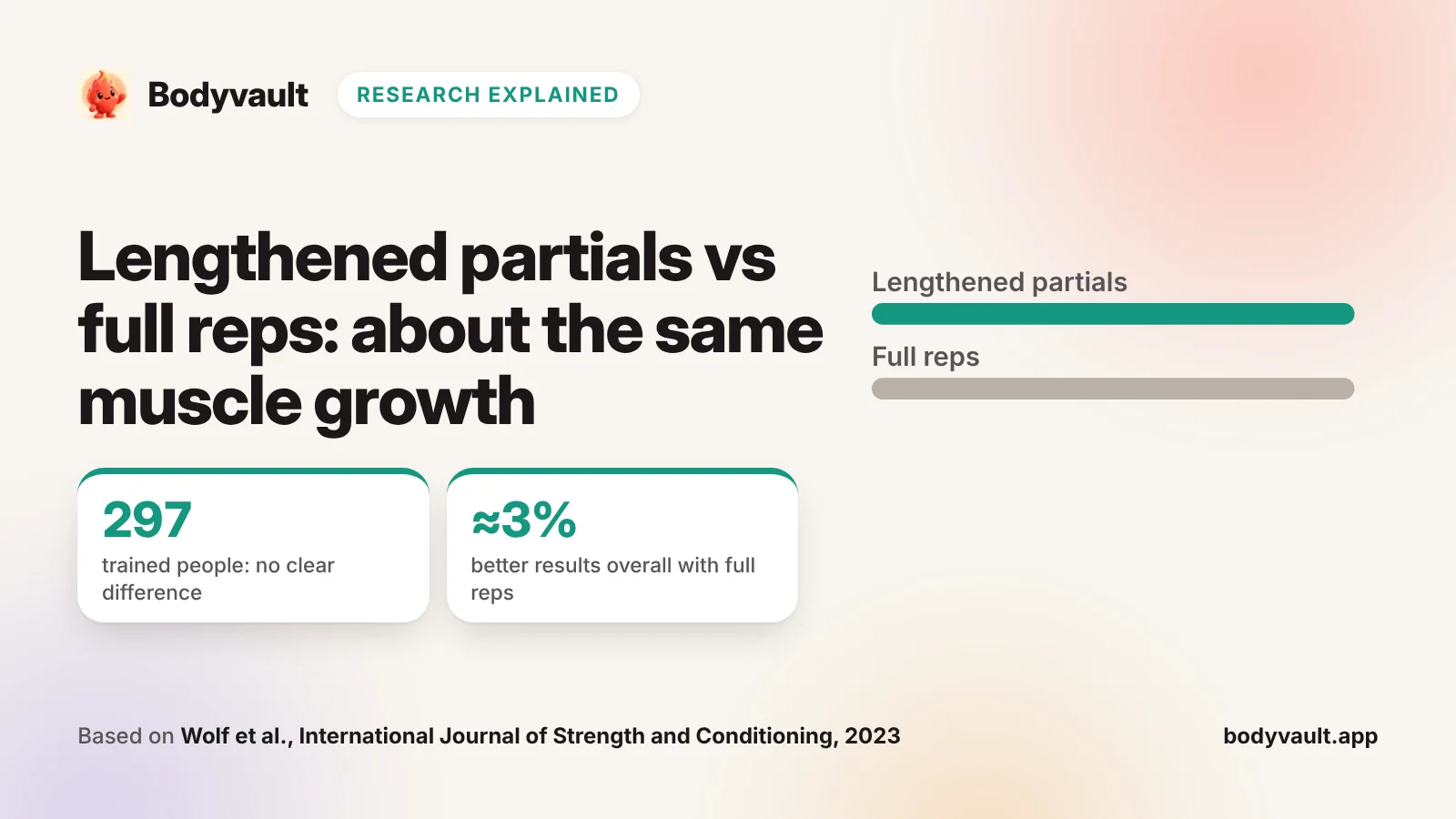
The short answer
297people
In the largest trial, lengthened partials and full reps gave practically the same growth
≈3%
Better results overall with full reps in a 2023 review, a gap too small to be sure of
1–2%
Extra growth, at most, from training muscles more stretched, in a 2025 review
+1.8mm
Biceps growth in trained lifters, with lengthened partials and with full reps
Strength of evidenceModerate
Reviews and new trials agree that the difference is small. But the trials were short, the results for partials rest on few studies, and the biggest trial measured muscle with a tape measure.
Key findingMake sure your sets train the stretched part of each lift. Full reps do this, and so do lengthened partials. Half reps near the top only, where the muscle is short, built less.
What are lengthened partials?
Range of motion is how far a joint moves during a rep. A full rep uses the whole range. A partial rep uses only part of it, often about half.
Which half matters. At one end of a lift the muscle is stretched, or long. At the other end it is squeezed, or short. A lengthened partial is a half rep in the stretched part. People also call it a long-length partial.
Lengthened partials (stretched half)
- Biceps curl: the bottom half, arm nearly straight
- Leg extension: the half with the knee more bent
- Squat: the bottom half of the squat
Shortened partials (squeezed half)
- Biceps curl: the top half, elbow bent
- Leg extension: the half with the leg nearly straight
- Squat: the top half, a quarter or half squat
Are full reps better than partial reps?
Only a little, and it depends on the partials. Reviews have pooled the trials that compared full and partial reps, and their answers have changed over time.
The chart shows effect sizes, a way to compare results across studies. About 0.2 counts as small. If a line crosses 0, there was no clear difference.
Full reps against partial reps
- All results0.12 (−0.02 to 0.26)
- Strength0.14 (−0.01 to 0.29)
- Power0.19 (0.01 to 0.37)
- Muscle size0.04 (−0.17 to 0.25)
- Muscle: partials in the squeezed half0.08 (−0.24 to 0.42)
- Muscle: partials in the stretched half−0.28 (−0.81 to 0.16)
An earlier review, from 2021, found full reps clearly better for strength and leg muscle. But its muscle result rested on just 4 leg studies. It also didn’t ask which half of the movement the partials used. Most older studies tested partials in the squeezed half.
| Review | Studies | What it found |
|---|---|---|
| Pallarés et al. (2021) | 16 | Full reps clearly better for strength and leg muscle |
| Wolf et al. (2023) | 24 | Full reps a tiny bit better overall; stretched-half partials about as good for muscle |
| Kassiano et al. (2023) | 11 | Full reps and stretched-half partials beat squeezed-half partials for several muscles |
| ACSM advice (2026) | 137 reviews | Full range of motion helps strength; not enough data to judge muscle growth |
Which half of the rep matters?
The stretched half seems to matter most. A 2023 review of 11 studies looked at each muscle. Full reps and stretched-half partials grew the front thigh, biceps and a muscle under the biceps more than squeezed-half partials did.
One trial shows this clearly. Forty-five untrained women were put into five groups by chance. They did leg extensions with full reps, the bent-knee half, the straight-leg half, a mix of both halves, or no training. The bent-knee group grew their thigh more than the full-rep group at three of the four spots measured. The straight-leg group grew no more than the no-training group at two of the four spots.
What do the newest trials show?
Newer and bigger studies found almost no difference between lengthened partials and full reps. In a 2025 trial, 25 trained lifters did lengthened partials with one arm and full reps with the other, chosen by chance. They trained twice a week for 8 weeks, with every set to failure.
Trained lifters: arm muscle growth, full reps minus lengthened partials
- Biceps, site 1−0.23 mm (−1.4 to 0.94)
- Biceps, site 2−0.08 mm (−1.1 to 0.90)
- Triceps, site 10.40 mm (−1.1 to 1.9)
- Triceps, site 20.82 mm (−0.44 to 2.1)
Biceps thickness grew about 1.8 mm with both methods at one site (our calculation from the study’s table). Strength in a 10-rep pulldown test also rose about the same.
The largest trial so far, published in 2025, took place in 15 gyms in the USA. It included 297 people who had trained there for at least 6 months. They trained twice a week for 12 weeks, with one hard set per exercise. One group did lengthened partials on arm and leg exercises; the other did full reps. Arm and thigh muscle grew about the same, and so did strength.
That trial estimated muscle size with a tape measure and skinfold callipers, which are less precise than scans. Its authors call the two methods “practically equivalent”.
A 2025 review of 12 studies asked the same question in another way. It compared training a muscle more stretched with training it less stretched. The extra growth was about 1–2% at most, which the authors judged too small to matter.
Extra growth from training muscles more stretched
- Near end of the muscle+0.57% (−1.92 to 3.24)
- Middle of the muscle+1.22% (−0.77 to 3.22)
- Far end of the muscle+1.88% (−0.44 to 4.34)
Do partial reps help strength?
Strength gains were bigger in the range you trained. In the 2023 review, strength results leaned towards whichever method matched the test. In the leg extension trial, women gained most strength in the half they trained. The 2026 advice from the American College of Sports Medicine links full range of motion to more strength.
So if you want a strong full squat, train the full squat. Lengthened partials are mainly a muscle-building tool.
Claims and evidence
ClaimPartial reps are cheating and don’t build muscle.
EvidenceHalf reps in the stretched part built about as much muscle as full reps, in 25 trained lifters and in 297 gym members.
ClaimLengthened partials build far more muscle than full reps.
EvidenceThe newest review found about 1–2% more growth at most from training muscles more stretched. The biggest trials found no clear difference.
ClaimAny half rep is as good as a full rep.
EvidenceHalf reps near the top often built less. In one trial, straight-leg leg extensions grew the thigh no more than no training at two of four spots.
ClaimRange of motion doesn’t matter for strength.
EvidenceStrength gains were bigger in the range people trained. Expert advice from 2026 links full range of motion with more strength.
What this means for you
What this means for you
- Use full reps as your default. They train the stretched part and build strength through the whole movement.
- Lengthened partials are a fine swap if you prefer them, or if part of a movement is uncomfortable.
- Don’t do only the top half of a lift. Those reps built the least muscle.
- Whichever you use, take your sets close to failure, as the trials did.
- If a movement hurts, stop and get advice from a physiotherapist or doctor.
What the research can’t tell you yet
- Few trials. Only a handful of studies tested partials in the stretched half, and the newest ones lasted 8 to 12 weeks.
- Rough measures. Reviews guessed muscle length from joint angles. The biggest trial used tape measures, not scans.
- Who was studied. Mostly young adults, and mostly arms and thighs. Few women took part in the trial of trained lifters.
- The long term. No study has compared the two methods over a year or more.
How Bodyvault uses this research
Bodyvault doesn’t record range of motion. A set of lengthened partials logs like any other set. It counts towards your weekly sets per muscle: one set for the main muscle and half a set for helpers. Its estimated one-rep max uses only weight and reps, so partial reps can make it read higher than your full-range strength. You can add a note to the workout to remember which sets were partials.
Share or cite this explainer
Bodyvault (2026). Lengthened partials vs full reps: which builds more muscle? https://bodyvault.app/blog/lengthened-partials
The charts on this page may be reused with a link back to it. The underlying data belong to the studies cited below.
Questions
Do partial reps build muscle?
Yes, if they are in the stretched part of the lift. Lengthened partials built about as much muscle as full reps in recent trials. Partials near the top, where the muscle is short, often built less.
Are partial reps effective?
For muscle growth, lengthened partials work about as well as full reps. For strength in a full movement, full reps work better, because strength gains matched the range people trained.
What are lengthened partials?
They are half reps in the part of a lift where the muscle is stretched. Examples are the bottom half of a curl or of a squat. People also call them long-length partials.
Should I do lengthened partials or full reps?
Full reps are a good default. Use lengthened partials if you prefer them or if part of a movement is uncomfortable. Both train the stretched position, which seems to matter most.
Are partial reps good?
Lengthened partials are a good tool for muscle growth. Top-half partials are the least useful. For most people, full reps remain the simplest choice.
Sources
- Wolf M, Androulakis-Korakakis P, Fisher J, Schoenfeld B, Steele J (2023). Partial vs full range of motion resistance training: a systematic review and meta-analysis. Int J Strength Cond 3(1).
- Pallarés JG et al. (2021). Effects of range of motion on resistance training adaptations: a systematic review and meta-analysis. Scand J Med Sci Sports 31(10):1866–1881.
- Kassiano W et al. (2023). Which ROMs lead to Rome? A systematic review of the effects of range of motion on muscle hypertrophy. J Strength Cond Res 37(5):1135–1144.
- Pedrosa GF et al. (2022). Partial range of motion training elicits favorable improvements in muscular adaptations when carried out at long muscle lengths. Eur J Sport Sci 22(8):1250–1260.
- Currier BS et al. (2026). American College of Sports Medicine position stand. Resistance training prescription for muscle function, hypertrophy, and physical performance in healthy adults: an overview of reviews. Med Sci Sports Exerc 58(4):851–872.
- Varovic D, Wolf M, Schoenfeld BJ, Steele J, Grgic J, Mikulic P (2025). Does muscle length influence regional hypertrophy? A systematic review and meta-analysis. Int J Sports Med 46(14):1027–1036.
- Gschneidner D, Carlson L, Steele J, Fisher JP (2025). The effects of lengthened-partial range of motion resistance training of the limbs on arm and thigh muscle area: a multi-site randomised trial. J Sports Sci 43(23):2963–2976.
- Gschneidner D et al. (2024). Preprint of the above (SportRxiv 485, version 2), the source of the details on who took part and how muscle was measured.
- Wolf M et al. (2025). Lengthened partial repetitions elicit similar muscular adaptations as full range of motion repetitions during resistance training in trained individuals. PeerJ 13:e18904.
General information about fitness and nutrition, not medical advice. If you have a health condition, are pregnant or take medication, talk to your doctor before changing your diet or training.