
Research explained
How many reps for muscle gain? Heavy vs light weights
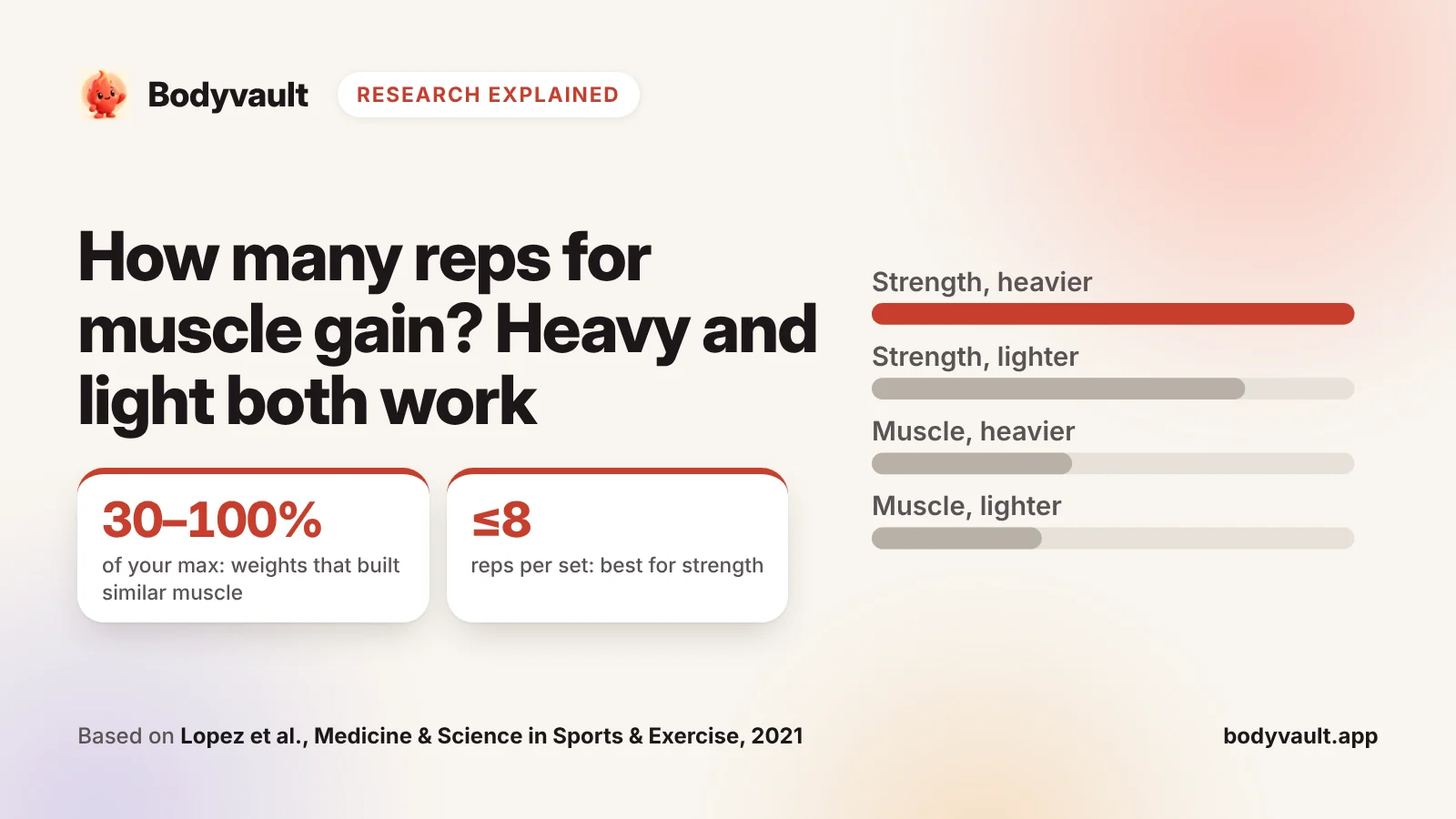
How many reps for muscle gain? Fewer rules than you might think. In studies, heavy and light weights built about the same muscle when each set ended close to failure. Heavy sets of about 8 reps or fewer built more strength.
The short answer
30–100%
Of your one-rep max: the range of weights that built similar muscle, in a 2026 expert review
≤8reps
Heavy sets like these built the most strength
½
Very light sets, at 20% of max, built about half as much muscle as heavier sets in one trial
28studies
In the main review: 747 adults, with every set taken to failure
Strength of evidenceGood
Several reviews agree: for muscle, the weight matters little if sets are hard, and heavy weights build more strength. But most studies were short, about 9 weeks, and in young people new to lifting.
Key findingFor muscle, how hard each set is matters more than the number of reps. Pick a weight you can lift about 6 to 15 times and end each set close to failure. Add heavier sets of about 3 to 8 reps if you also want to get stronger.
What do heavy and light mean?
Your one-rep max is the most weight you can lift once with good form. Studies often describe a weight as a share of it, such as 80%. They also use the rep max: your 10-rep max is the most weight you can lift 10 times.
Failure is the point in a set when you can’t do another full rep. The lighter the weight, the more reps it takes to get there. Here is how many reps people can usually do at each weight, from a 2024 study of 7,289 people.
| Weight (% of your max) | Average reps to failure |
|---|---|
| 90% | about 5 |
| 80% | about 10 |
| 70% | about 15 |
| 60% | about 20 |
| 50% | about 26 |
| 40% | about 36 |
| 30% | about 50 |
In the studies below, heavy usually meant 8 reps or fewer per set, or more than 60–80% of your max. Light meant more than 15 reps per set, or 60% of your max or less. See the full one rep max chart for every step.
How many reps for muscle gain: heavy or light?
Either works. Scientists call muscle growth hypertrophy, so this is also the question of how many reps for hypertrophy. The best evidence comes from studies that took every set to failure, so that heavy and light sets were equally hard.
This was a meta-analysis: a study that pooled the results of many earlier studies. It could compare all three weights at once. The chart shows effect sizes, a way to compare results across studies. About 0.2 counts as small and 0.5 as medium. If a line crosses 0, there was no clear difference.
Heavier against lighter weights, all sets to failure
- Muscle: heavy vs light0.12 (−0.06 to 0.29)
- Muscle: medium vs light0.20 (−0.04 to 0.44)
- Muscle: heavy vs medium−0.09 (−0.33 to 0.16)
- Strength: heavy vs light0.60 (0.38 to 0.82)
- Strength: medium vs light0.34 (0.05 to 0.62)
- Strength: heavy vs medium0.26 (−0.02 to 0.54)
An earlier review of 21 studies found the same. Every set went to failure, and programmes lasted at least 6 weeks. Light weights (60% of max or less) built as much muscle as heavier ones. Heavy weights built more one-rep max strength.
A bigger 2023 review pooled 119 studies on muscle and 178 on strength, with almost half women. It compared 12 ways of training with no exercise at all. Every way built muscle and strength. For muscle, weights above and below 80% of max did about the same. For strength, heavier was better.
The 2026 advice from the American College of Sports Medicine (ACSM) agrees. Its experts looked at 137 reviews of trials. They found that muscle growth didn’t depend on the weight used, anywhere from 30% to 100% of max. They also found that more weekly sets helped growth: see how many sets per muscle per week.
How many reps for muscular strength?
Fewer, with heavier weights. In the 28-study review, heavy weights built clearly more strength than light ones. The ACSM experts linked weights of 80% of max or more to bigger strength gains, and heavier was better still.
Part of the reason is practice. A strength test is one heavy rep, so people who train heavy practise something close to the test. In the 21-study review, strength measured by pushing against something that doesn’t move showed no clear difference. That fits the idea that part of the gain is skill at the lift itself.
Heavy didn’t beat medium clearly, though. Sets of 9–15 reps still built good strength. So a mix works well for most people.
How light is too light?
There seems to be a lower limit. In a 12-week trial, 30 men trained one arm and one leg at just 20% of their max, in 3 sets to failure. The other arm and leg used 40%, 60% or 80%, with the total weight lifted matched.
So 20% of max built only about half as much muscle. From 40% upwards, growth was about the same. Light weights also only work if you push the set hard. Stopping a light set far from failure builds less, as our explainer on training to failure shows.
Blood flow restriction: light weights with a cuff
Blood flow restriction (BFR) is a way to make light weights work harder. A tight cuff goes around the top of your arm or thigh. It slows the blood flowing into the muscle and traps blood flowing out. The muscle tires fast, even with a light weight.
A 2018 review compared light-weight BFR training (less than 50% of max) with heavy training (more than 65%). Muscle growth was about the same. Heavy training built more strength, however the cuff was set. The 2026 ACSM review also found no extra growth from BFR.
| Part of the session | Typical setting |
|---|---|
| Weight | 20–40% of your max |
| Reps | 4 sets of 30, 15, 15 and 15 reps, or sets to failure |
| Rest | 30–60 seconds between sets |
| Cuff | At 40–80% of the pressure that would fully stop blood flow in that limb |
| How often | 2–3 times a week |
Experts say BFR is most useful for people who can’t lift heavy, for example after an injury or surgery. The cuff pressure should be set for each person and each limb. Badly set pressures have left people with numb limbs.
Safety first. BFR isn’t for everyone. Don’t try it if you are pregnant, have had a blood clot or have a blood clotting or circulation problem. If you have high blood pressure or a heart condition, talk to a doctor first. Learn it from a trained coach or physiotherapist with a proper cuff, and stop if you feel numb, dizzy or faint.
Claims and evidence
ClaimYou need 8–12 reps to build muscle.
EvidenceLight, medium and heavy weights built about the same muscle when sets went to failure, in 28 studies of 747 adults.
ClaimLight weights only tone, they don’t build muscle.
EvidenceIn a review of 21 studies, weights of 60% of max or less built as much muscle as heavier ones. Every set went to failure.
ClaimAny weight works, however light.
EvidenceIn one trial, 20% of max built about half as much thigh muscle as 40–80% of max.
ClaimStrength and muscle need the same training.
EvidenceIn a review of 178 strength studies, heavier weights built clearly more strength. In 119 muscle studies, they gave no clear extra growth.
What this means for you
What this means for you
- For muscle, choose a weight you can lift about 6–15 times. It is easier to judge failure there than in very long sets.
- Take most sets close to failure, whatever the weight. Light sets need the most effort to work.
- For strength, add some heavy sets of about 3–8 reps on your main lifts.
- Light weights are fine for sore joints or home workouts. Just don’t go below about 30–40% of your max.
- Only try blood flow restriction with expert help and the right cuff. Skip it if you are pregnant or have clotting, circulation or blood pressure problems, unless a doctor says it is safe.
What the research can’t tell you yet
- Experienced lifters. Most studies used young people new to lifting. None in the main review included highly trained lifters.
- The long term. Most studies lasted 6 to 12 weeks. Small differences could add up over years.
- Light sets that stop early. Almost every study took sets to failure. Easy light sets weren’t tested here.
- Older adults and women. Most data came from young men, though the largest review was almost half women.
How Bodyvault uses this research
Plans built with Bodyvault Pro set rep ranges by goal. For muscle-building goals, main lifts use 6–10 reps, other compound lifts 8–12, and moves like curls 10–15. Sets end 1–2 reps short of failure. Strength plans use heavier sets: 3–6 reps on the main lift and 6–8 on other compound lifts. Bodyvault has no blood flow restriction feature.
Share or cite this explainer
Bodyvault (2026). How many reps for muscle gain? Heavy vs light weights. https://bodyvault.app/blog/how-many-reps-to-build-muscle
The charts on this page may be reused with a link back to it. The underlying data belong to the studies cited below.
Questions
How many reps should I do to build muscle?
Anything from about 5 reps to 30 or more per set can build muscle, if the set ends close to failure. A middle range of about 6–15 reps suits most people. Very light sets take many reps and feel harder.
How many reps for strength?
Heavier sets of about 8 reps or fewer build the most strength. In reviews, weights of 80% of your max or more did best for strength.
How many reps and sets to gain muscle?
About 6–15 reps per set, close to failure, and about 10 or more hard sets per muscle each week. Our weekly sets explainer has the details.
Are light weights a waste of time?
No. Light weights built about as much muscle as heavy ones when sets went close to failure. Very light weights, around 20% of your max, built less in one trial.
Is blood flow restriction training safe?
For healthy people it looks safe when done properly, with a cuff set to the right pressure. Don’t try it if you are pregnant or have had a blood clot. Talk to a doctor first if you have high blood pressure, or a heart or circulation problem.
Sources
- Lopez P et al. (2021). Resistance training load effects on muscle hypertrophy and strength gain: systematic review and network meta-analysis. Med Sci Sports Exerc 53(6):1206–1216.
- Schoenfeld BJ, Grgic J, Ogborn D, Krieger JW (2017). Strength and hypertrophy adaptations between low- vs. high-load resistance training: a systematic review and meta-analysis. J Strength Cond Res 31(12):3508–3523.
- Currier BS et al. (2023). Resistance training prescription for muscle strength and hypertrophy in healthy adults: a systematic review and Bayesian network meta-analysis. Br J Sports Med 57(18):1211–1220.
- Currier BS et al. (2026). American College of Sports Medicine position stand. Resistance training prescription for muscle function, hypertrophy, and physical performance in healthy adults: an overview of reviews. Med Sci Sports Exerc 58(4):851–872.
- Lasevicius T et al. (2018). Effects of different intensities of resistance training with equated volume load on muscle strength and hypertrophy. Eur J Sport Sci 18(6):772–780.
- Lixandrão ME et al. (2018). Magnitude of muscle strength and mass adaptations between high-load resistance training versus low-load resistance training associated with blood-flow restriction: a systematic review and meta-analysis. Sports Med 48(2):361–378.
- Patterson SD et al. (2019). Blood flow restriction exercise: considerations of methodology, application, and safety. Front Physiol 10:533.
- Nuzzo JL, Pinto MD, Nosaka K, Steele J (2024). Maximal number of repetitions at percentages of the one repetition maximum: a meta-regression and moderator analysis of sex, age, training status, and exercise. Sports Med 54(2):303–321.
General information about fitness and nutrition, not medical advice. If you have a health condition, are pregnant or take medication, talk to your doctor before changing your diet or training.