
Research explained
One rep max chart: how many reps at each percentage?
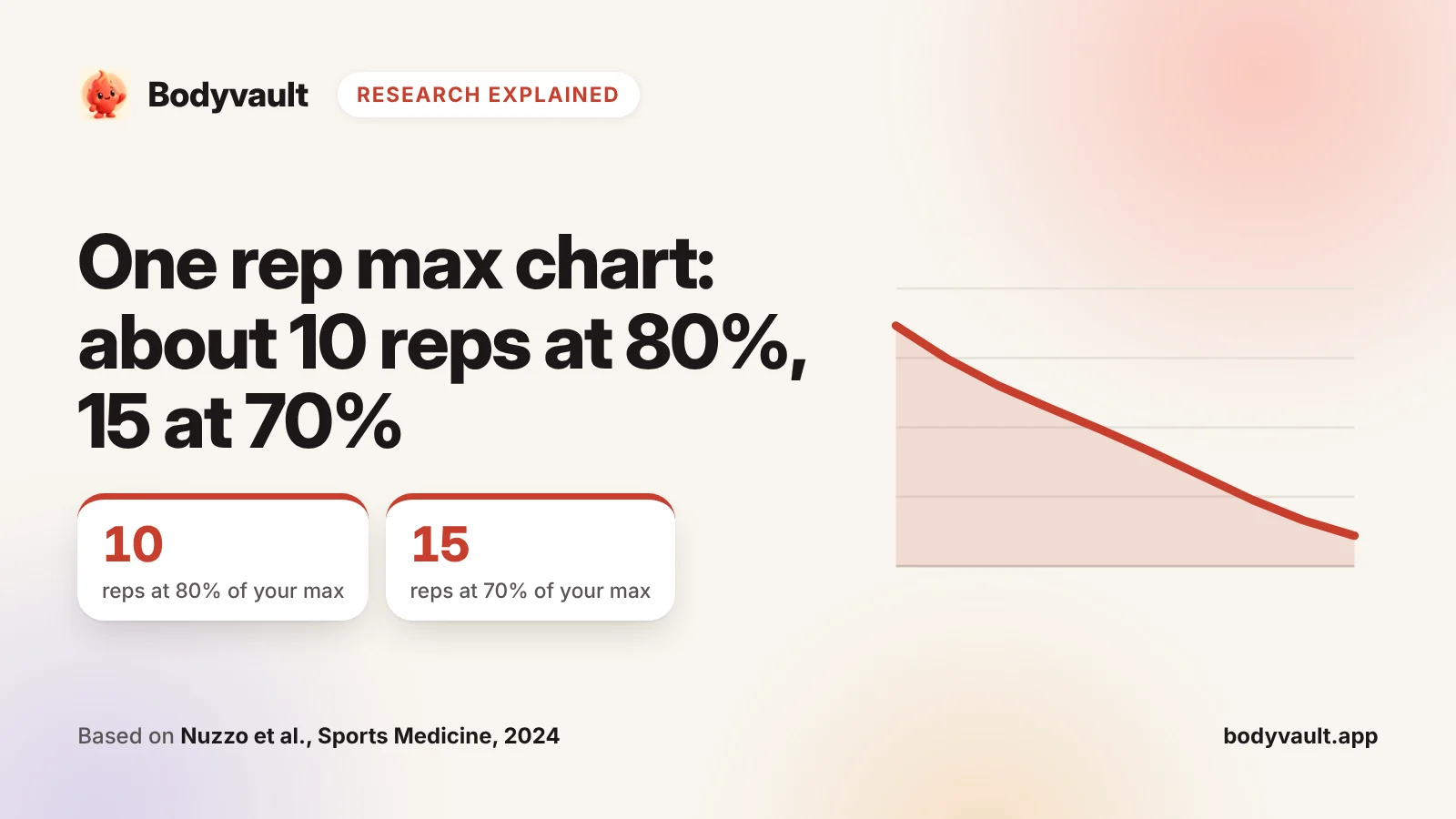
This one rep max chart shows how many reps people can usually do at each share of their max. In a 2024 study of 7,289 people, the average was about 10 reps at 80% and 15 reps at 70%. But people differ a lot, especially with lighter weights.
The short answer
10reps
Average reps to failure at 80% of your one-rep max
15reps
Average at 70%, where the old textbook table said 11
7–12reps
What most people managed at 80% (our calculation)
≈4%
Typical difference between two real one-rep max tests
Strength of evidenceGood
A large study that pooled 269 earlier studies gives the averages well. But people vary a lot. Most people tested were healthy young adults, and the bench press and leg press were tested most.
Key findingUse the chart as a starting point, then adjust. Doing more reps than the chart says is common, especially with lighter weights and leg exercises.
What is a one rep max?
Your one rep max (often written 1 rep max, or 1RM) is the most weight you can lift once with good form. Many plans set weights as a share of it, such as 80%. A rep max is the same idea for more reps: your 5-rep max is the most you can lift 5 times.
A real 1RM test is very repeatable. A review of 32 studies with 1,595 people found two tests usually came out within about 4% of each other. That held for women and men, young and older adults, and beginners and trained lifters.
The one rep max chart
For years, gym books used a small table of reps at each share of your max. In 2024, researchers checked it against 952 tests of 7,289 people from 269 studies. Most groups were healthy, male and under 59, and 60% already lifted weights. The new numbers are higher at lighter weights.
Reps to failure at each share of your max
- 2024 study of 269 studies
- Old textbook table
| % of your max | Average reps | Most people (our calculation) | Old textbook |
|---|---|---|---|
| 95% | 3 | 2–5 | 2 |
| 90% | 5 | 3–7 | 4 |
| 85% | 7 | 5–9 | 6 |
| 80% | 10 | 7–12 | 8 |
| 75% | 12 | 9–15 | 10 |
| 70% | 15 | 11–18 | 11 |
| 65% | 17 | 13–21 | 15 |
| 60% | 20 | 15–24 | – |
| 55% | 22 | 17–27 | – |
| 50% | 26 | 20–32 | – |
| 40% | 36 | 28–43 | – |
| 30% | 50 | 40–61 | – |
This is a rep max chart for most exercises. The researchers found no clear differences by sex, age or training experience, so it suits most people. The bench press and leg press had their own tables, because they differed most.
Why your reps may not match the chart
People differ, and they differ more with lighter weights. At 80% of max, the typical spread between people was about 2.5 reps either side of the average. At 60%, it was about 4.4 reps.
Average reps and the range for most people
- 90% of max5 (3–7)
- 80% of max10 (7–12)
- 70% of max15 (11–18)
- 60% of max20 (15–24)
- 50% of max26 (20–32)
The exercise matters too. People managed far more reps on the leg press than on the bench press at the same share of their max.
Bench press examples: how many reps of 185 to bench 225?
These questions ask how many reps at one weight match a bigger single. Work out the share first: 185 lb is 82% of 225 lb. Then read the bench press table.
| Question | Share of your max | Bench press average | Epley and Brzycki formulas |
|---|---|---|---|
| 185 lb for a 225 lb max | 82% | about 7–8 reps | about 6–7 reps |
| 225 lb for a 315 lb max | 71% | about 13 reps | about 11–12 reps |
| 135 lb for a 225 lb max | 60% | about 19 reps | about 15–20 reps |
So if you can bench 185 lb (about 84 kg) 7 or 8 times, you may be close to a 225 lb (102 kg) single. Treat it as a guess, not a promise. At 80% of max, bench press reps varied by about 2 either side of the average.
How to work out your 1 rep max
You don’t have to test a true max. You can estimate it from a set to failure, or close to it. A formula turns the weight and reps into a one-rep max. Epley’s formula is the most common: weight × (1 + reps ÷ 30).
Warm up
Do a few lighter sets of the lift first.
Pick a heavy weight
Choose one you can lift about 3–6 times with good form.
Do one hard set
Stop when you can’t do another good rep. Count the reps.
Use the formula
For 100 kg × 5: 100 × (1 + 5 ÷ 30) = about 117 kg. Or let the one-rep max calculator do it.
Our calculator averages Epley with a second formula, Brzycki. For 100 kg × 5, Epley gives 116.7 kg, Brzycki gives 112.5 kg, and the average is 114.6 kg. The calculator warns you above 10 reps, where every formula gets less accurate.
Its training-load table uses Brzycki: about 8 reps at 80%, 12 at 70% and 15 at 60%. That is close to the old textbook table. In the 2024 study, people did a few more reps than that on average below 80%, so don’t worry if you can.
How accurate is an estimated max?
Estimates work best from heavy sets with few reps. A lab study tested 70 adults aged 18 to 69 on the bench press and leg press. Each person did a real 1-rep, 5-rep, 10-rep and 20-rep max. A 5-rep max predicted the real max best.
| Reps in the test set | Bench press | Leg press |
|---|---|---|
| 5 | 0.993 | 0.974 |
| 10 | 0.976 | 0.933 |
| 20 | 0.955 | 0.915 |
The study built its own formulas. From a 5-rep max, their typical error was about 3 kg on the bench press and 16 kg on the leg press. The authors advise using no more than 10 reps in these formulas.
A study of 103 young women found the same. Formulas were more accurate when women did fewer than 10 reps. That held before and after 12 weeks of training, even though their bench press max rose 28% on average.
Claims and evidence
ClaimThe classic chart is right: about 11 reps at 70% of your max.
EvidenceIn 269 studies, the average was about 15 reps at 70%. The classic textbook table gives fewer reps than people really did at lighter weights.
ClaimThe chart tells you exactly how many reps you can do.
EvidenceAt 80% of max, most people did between 7 and 12 reps. At lighter weights the spread was even wider.
ClaimA 1RM estimate from any set is accurate.
EvidenceEstimates from 5-rep sets matched the real max best. Sets of more than 10 reps were less accurate.
ClaimYou need to test your true max to train well.
EvidenceA heavy set of 3–6 reps gives a good estimate. A real max test is reliable, but it needs care, warm-ups and a spotter.
What this means for you
What this means for you
- Use about 80% of your max for sets of about 10, and 70% for sets of about 15, as a starting point.
- If you can do more reps than the chart says, that is normal. Raise the weight a little next time.
- Estimate your max from heavy sets of 3–6 reps, not from sets of 15 or more.
- Expect more reps on leg exercises like the leg press than on the bench press at the same share of max.
- If you test a true max, warm up well, use a spotter or safety bars, and never push through pain.
What the research can’t tell you yet
- Many exercises. Most data came from the bench press and leg press. There were few for lifts like the overhead press, pulldown, row or calf raise.
- Older adults and patients. Most people tested were healthy and aged 20 to 40.
- Your own numbers. These are averages. Your reps at a given weight can be several reps either side.
- Rep speed. Most studies used normal lifting speeds. Very slow reps may allow fewer reps. Whether slow lowering builds more muscle is in eccentric vs concentric.
How Bodyvault uses this research
Bodyvault estimates your one-rep max from the sets you log, using Epley’s formula. It adds any reps in reserve you logged. It skips sets that add up to more than 10 reps, where estimates get less accurate. The Train tab charts the estimate for your main lifts, with the change over 4 weeks. You can see strength rise without testing a true max.
Share or cite this explainer
Bodyvault (2026). One rep max chart: how many reps at each percentage? https://bodyvault.app/blog/one-rep-max-chart
The charts on this page may be reused with a link back to it. The underlying data belong to the studies cited below.
Questions
What is one rep max?
Your one rep max (1RM) is the most weight you can lift once with good form. Plans often set weights as a share of it, such as 80%.
How do I work out my 1 rep max?
Lift a weight you can manage 3–6 times, then use Epley’s formula: weight × (1 + reps ÷ 30). For 100 kg × 5, that gives about 117 kg. The one-rep max calculator does it for you.
How many reps of 185 to bench 225?
About 7–8 reps, on average. 185 lb is 82% of 225 lb. In the 2024 bench press data, lifters managed about 9 reps at 80% and 6 at 85% (our calculation from their table).
How many reps of 225 to bench 315?
About 13 reps, on average, because 225 lb is 71% of 315 lb. Many people will be about 3 reps either side.
How do I calculate my 5 rep max?
Your 5-rep max is about 86–90% of your one-rep max, depending on the method (our calculation). To go the other way, multiply your 5-rep max by about 1.15 to estimate your one-rep max.
Sources
- Nuzzo JL, Pinto MD, Nosaka K, Steele J (2024). Maximal number of repetitions at percentages of the one repetition maximum: a meta-regression and moderator analysis of sex, age, training status, and exercise. Sports Med 54(2):303–321.
- Reynolds JM, Gordon TJ, Robergs RA (2006). Prediction of one repetition maximum strength from multiple repetition maximum testing and anthropometry. J Strength Cond Res 20(3):584–592.
- Mayhew JL, Johnson BD, Lamonte MJ, Lauber D, Kemmler W (2008). Accuracy of prediction equations for determining one repetition maximum bench press in women before and after resistance training. J Strength Cond Res 22(5):1570–1577.
- Grgic J, Lazinica B, Schoenfeld BJ, Pedisic Z (2020). Test-retest reliability of the one-repetition maximum (1RM) strength assessment: a systematic review. Sports Med Open 6(1):31.
- Brzycki M (1993). Strength testing: predicting a one-rep max from reps-to-fatigue. JOPERD 64(1):88–90. (The Brzycki formula.)
- Lin TY et al. (2021). The effects of barbell resistance exercise on information processing speed and conflict-related ERP in older adults: a crossover randomized controlled trial. Sci Rep 11:9137. (Its Table 1 lists the Epley formula.)
General information about fitness and nutrition, not medical advice. If you have a health condition, are pregnant or take medication, talk to your doctor before changing your diet or training.