
Research explained
Eccentric vs concentric: which builds more muscle?
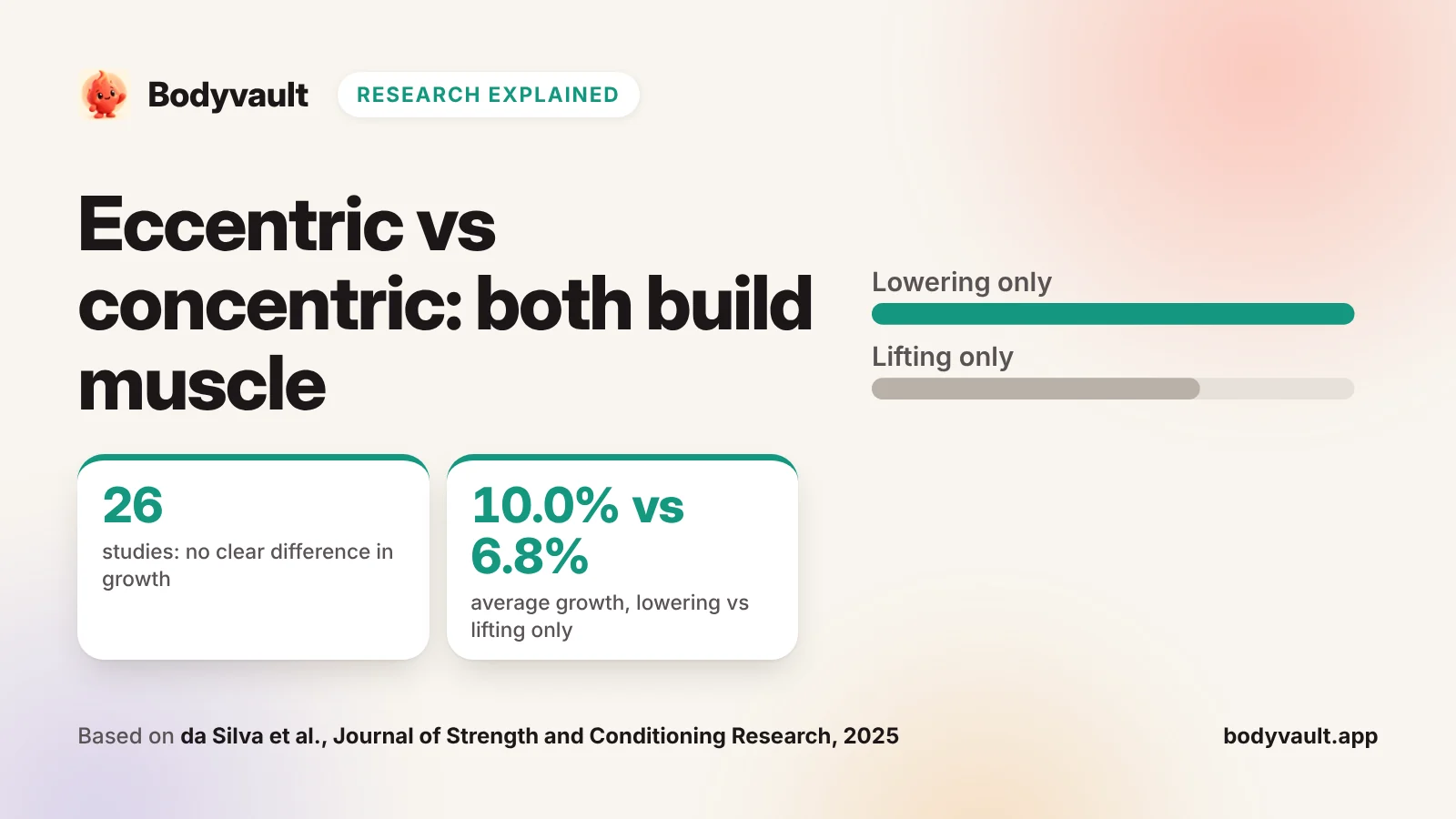
In eccentric vs concentric research, both lowering a weight and lifting it built muscle. Lowering-only training sometimes grew a little more, but the newest review of 26 studies found no clear difference. A normal rep already trains both.
The short answer
26
Studies in a 2025 review. Lowering-only and lifting-only training grew muscle about the same
10.0%
Average muscle growth with lowering-only training in 15 studies, vs 6.8% for lifting only. Not a clear difference
0.5–8s
Rep lengths that grew muscle about equally, in the 2026 guideline from the American College of Sports Medicine (ACSM)
≈3.5s
Slow reps grew muscle about as well as reps of about 1 second, in 14 studies
Strength of evidenceModerate
Many small trials agree that both lowering and lifting build muscle. Whether lowering-only training builds more is unclear. The newest review rated the certainty of its evidence as very low.
Key findingYou don’t need to choose. Lift with control, lower with control, and train hard enough. Slow lowering is fine, but it isn’t magic.
What do eccentric and concentric mean?
Think of a biceps curl with a dumbbell. When you lift the weight, your biceps gets shorter as it works. That is a concentric action. When you lower the weight, the muscle gets longer while it works to control the weight. That is an eccentric action. Holding the weight still is called an isometric action.
The lowering part of a rep is often called the negative. Your muscles can control more weight when lowering than they can lift. That is why eccentric training often uses heavier weights.
Eccentric training means putting extra stress on the lowering part. Studies that compare the two often use lowering-only training, sometimes on special machines. In the gym, people do slow negatives, lowering the weight very slowly.
Time under tension is the total time your muscles hold a weight during a set. Slow reps add time under tension.
Do eccentrics build more muscle?
A 2017 review pooled 15 trials in healthy adults, each lasting at least 6 weeks. Each trial compared lowering-only training with lifting-only training and kept everything else the same.
Lowering-only training grew muscle a bit more on average. But the difference wasn’t clear, so it could be down to chance. The authors advise doing both.
The 2025 review is the biggest so far. Overall, it found no clear difference. Lowering-only training looked better in a few smaller analyses: for arm muscles, in programmes of 8 weeks or less, and on special machines. Smaller analyses like these are less reliable.
Lowering-only vs lifting-only training: muscle growth
- 2017 review (15 trials)0.25 (−0.03 to 0.52)
- 2025 review (26 trials)0.29 (−0.13 to 0.70)
The 2026 ACSM guideline reviewed 137 reviews. It counts lowering-focused training as one of only two things that added muscle growth. The other was doing more sets. But only one of the four reviews it looked at found a clear benefit, so the evidence is mixed.
What about strength?
A 2009 review of 20 trials looked at strength as well as size. In trials where the lowering group handled heavier weights, it gained more strength. Its muscles also grew more in girth, the distance around a muscle. The authors think the heavier weights explain most of this.
The strength gains were also specific. People got best at the kind of movement they trained, such as lowering. The 2026 ACSM guideline found that the type of muscle action didn’t change strength overall. In one review, lowering-focused training on flywheel machines did help strength. On these machines, you slow down a spinning wheel on the way back.
Do slow negatives and time under tension matter?
A 2025 review pooled 14 studies that changed only the speed of each rep. Slow reps took about 3.5 seconds and fast reps about 1 second. In 9 of the studies, it was the lowering part that was slowed down.
Slow vs fast reps: muscle growth
- Growth with fast reps (about 1 s)0.43 (0.29 to 0.58)
- Growth with slow reps (about 3.5 s)0.34 (0.22 to 0.47)
- Difference: fast minus slow0.09 (−0.04 to 0.22)
Both speeds built muscle, and the gap between them was tiny. If anything, it leaned slightly towards faster reps. The 2026 ACSM guideline agrees. Reps lasting 0.5 seconds and 8 seconds grew muscle about the same. Time under tension didn’t change growth or strength.
So you don’t need to count seconds. Lower the weight under control, so you aren’t just dropping it. Then lift it with good form.
Claims and evidence
ClaimEccentrics build far more muscle than normal lifting.
EvidenceIn a 2025 review of 26 studies, lowering-only and lifting-only training grew muscle about the same. A 2017 review found 10.0% vs 6.8% growth, but the gap could be due to chance.
ClaimSlow negatives are the key to muscle growth.
EvidenceIn 14 studies, slow reps of about 3.5 seconds grew muscle about the same as reps of about 1 second.
ClaimMore time under tension means more growth.
EvidenceThe 2026 ACSM guideline found that time under tension didn’t change muscle growth or strength. Reps from 0.5 to 8 seconds long worked about equally.
ClaimThe lowering part doesn’t matter, so you can let the weight drop.
EvidenceBoth parts of a rep build muscle, and the 2017 review’s authors advise doing both. Lowering under control means you train the lowering part too.
What this means for you
What this means for you
- Do normal reps: lift with control and lower with control. That way you train both actions.
- Pick a rep speed you can repeat with good form. Reps of about 1 to 3.5 seconds all built muscle in studies.
- Lowering-focused training is optional. If you enjoy it, use it alongside normal sets.
- Doing enough hard sets matters more than rep speed. See how many sets per muscle per week.
- If a movement hurts, stop. If you have a joint problem or an injury, ask a physiotherapist before trying heavy lowering work.
What the research can’t tell you yet
- Small trials. Most studies were small, and results varied a lot between them. The newest review rated its evidence as very low certainty.
- Special machines. Some lowering-only studies used lab machines that don’t match gym lifting.
- Short studies. Most lasted weeks to a few months, not years.
- Summaries only. Four of these five reviews are behind a paywall, so we could read only their summaries.
How Bodyvault uses this research
Bodyvault doesn’t set a rep speed or track time under tension. Its plans set your sets, a rep range, how many reps to keep in reserve and your rest time. Many of the step-by-step guides in its exercise library tell you to lower the weight slowly or under control.
Share or cite this explainer
Bodyvault (2026). Eccentric vs concentric: which builds more muscle? https://bodyvault.app/blog/eccentric-vs-concentric
The charts on this page may be reused with a link back to it. The underlying data belong to the studies cited below.
Questions
Which builds more muscle, eccentric or concentric?
Neither clearly wins. A 2025 review of 26 studies found no clear difference between lowering-only and lifting-only training. Normal reps include both, so you get the benefits of each.
What is eccentric training?
Eccentric training puts extra stress on the lowering part of a lift, when your muscle lengthens under load. Slow negatives are one example. It works, but normal reps work too.
What is an eccentric contraction?
An eccentric contraction is when a muscle works while it gets longer, like your biceps when you lower a dumbbell. A concentric contraction is when it works while it gets shorter, like when you lift the dumbbell.
Are slow negatives better for muscle growth?
Not in studies so far. In a 2025 review of 14 studies, slow reps of about 3.5 seconds grew muscle about as well as reps of about 1 second. Lower the weight under control, but you don’t need to count.
Does time under tension matter for muscle growth?
Not much on its own. The 2026 ACSM guideline found that time under tension didn’t change growth or strength. Doing enough hard sets matters more.
Sources
- da Silva LSL et al. (2025). Comparison between eccentric vs. concentric muscle actions on hypertrophy: a systematic review and meta-analysis. J Strength Cond Res 39(1):115–134.
- Schoenfeld BJ et al. (2017). Hypertrophic effects of concentric vs. eccentric muscle actions: a systematic review and meta-analysis. J Strength Cond Res 31(9):2599–2608.
- Enes A et al. (2025). How slow should you go? A systematic review with meta-analysis of the effect of resistance training repetition tempo on muscle hypertrophy. J Strength Cond Res 39(12):1331–1339.
- Roig M et al. (2009). The effects of eccentric versus concentric resistance training on muscle strength and mass in healthy adults: a systematic review with meta-analysis. Br J Sports Med 43(8):556–568.
- Currier BS et al. (2026). American College of Sports Medicine position stand. Resistance training prescription for muscle function, hypertrophy, and physical performance in healthy adults: an overview of reviews. Med Sci Sports Exerc 58(4):851–872.
General information about fitness and nutrition, not medical advice. If you have a health condition, are pregnant or take medication, talk to your doctor before changing your diet or training.