
Research explained
Sauna benefits: does it really help your heart?
The best-known sauna benefits come from Finland, where men who used a sauna 4–7 times a week were less likely to die of heart problems. That is a link, not proof, but a small trial also found that a sauna after exercise lowered blood pressure.
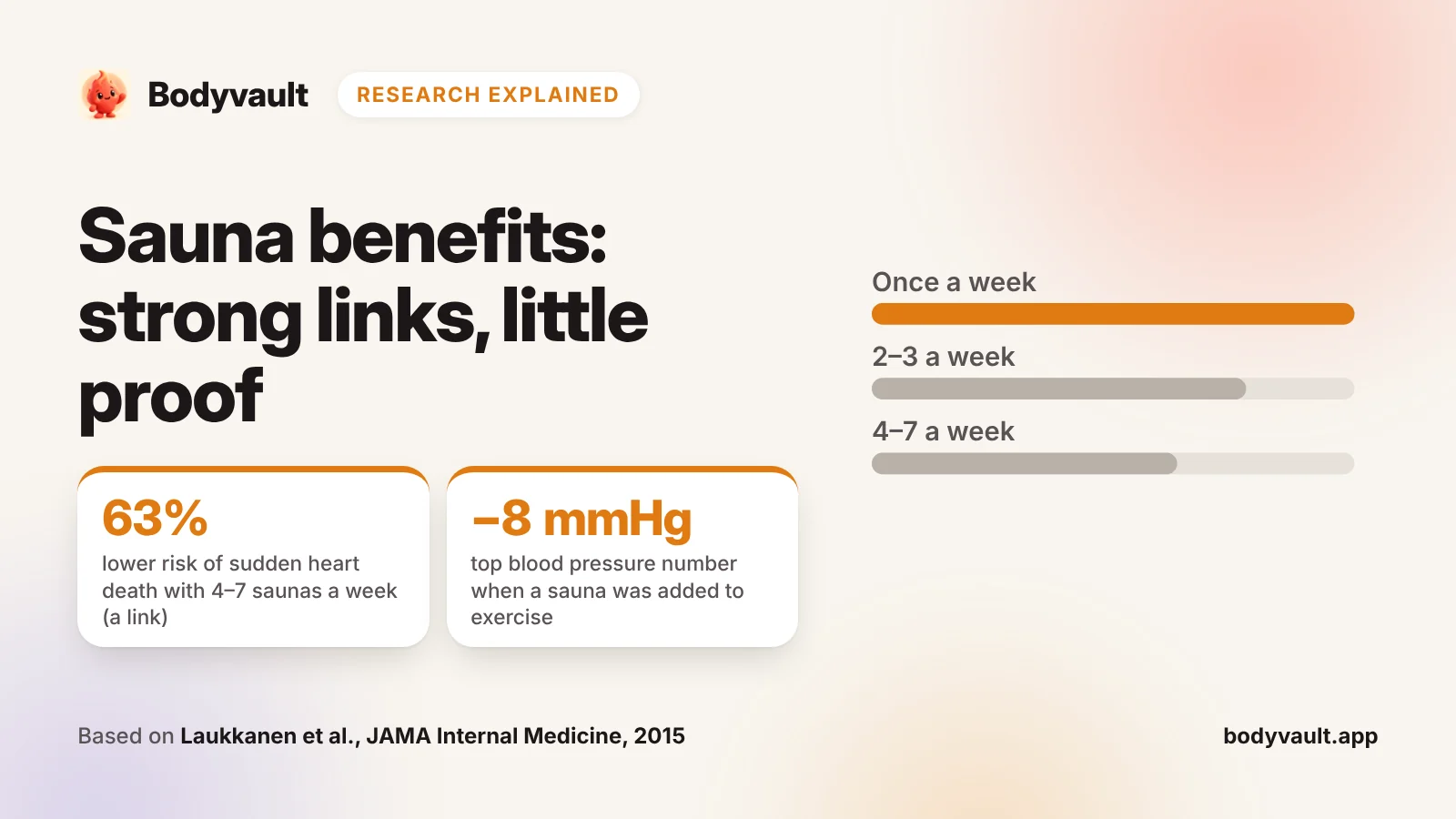
The short answer
63%
Lower risk of sudden heart death in Finnish men using a sauna 4–7 times a week, compared with once (a link, not proof)
−8mmHg
Bigger drop in the top blood pressure number (in mmHg) when a 15-minute sauna followed exercise for 8 weeks
20.7years
How long researchers followed 2,315 men in Finland (the median)
40
Studies in a review of regular sauna use. Most reported benefits, but most were small
Strength of evidenceLimited
The heart findings come from studies that followed Finnish adults over time. They show links, not proof. Trials of sauna use are small and short.
Key findingRegular saunas look safe for most healthy adults and may help blood pressure a little. But the big heart numbers come from Finnish studies that can’t prove the sauna was the cause. A sauna adds to exercise; it doesn’t replace it.
What a sauna does to your body
A traditional Finnish sauna is a hot, dry room. At head height it is about 80–100 °C, and the air is dry. People often stay in for 5–20 minutes, then cool off. In studies, infrared saunas were cooler, about 60 °C.
The heat makes your heart pump more blood, and your blood vessels widen. You sweat a lot. Many people also find a sauna relaxing.
Most of the long-term heart research used hot Finnish saunas. Infrared saunas have far less evidence, so the results below may not apply to them.
Sauna benefits for heart health: the Finnish studies
In the 1980s, researchers asked 2,315 men in Eastern Finland, aged 42–60, how often they used a sauna. Then they followed the men for about 20 years. This kind of study shows a link. It can’t prove that one thing causes the other.
Men who used a sauna more often were less likely to die during the study.
The researchers then allowed for heart risk factors, such as blood pressure, smoking, cholesterol, diabetes and alcohol. The links held. Compared with once a week, 4–7 sessions went with a 63% lower risk of sudden heart death. They also went with a 40% lower risk of dying from any cause. Sessions longer than 19 minutes went with a lower risk of sudden heart death than sessions under 11 minutes.
Risk of sudden heart death in Finnish men
- 2–3 saunas a week0.78, no clear difference
- 4–7 saunas a week0.37 (63% lower)
- Sessions of 11–19 minutes0.93, no clear difference
- Sessions over 19 minutes0.48 (52% lower)
Why might this be a link and not a cause? Men who were healthier, fitter or better off may have used saunas more. Their habits were asked only once, at the start. And men who already felt unwell may have skipped the sauna.
Does the link hold for women?
A later study from the same part of Finland followed 1,688 adults aged 53–74 for 15 years. About half were women. Overall, people who used a sauna 4–7 times a week had far fewer deaths from heart and blood vessel disease.
But in women on their own, the link was unclear. Women who used a sauna 2–3 times a week had about the same risk as women who used it once. None of the 73 women in the 4–7 times group died of heart disease, so the study couldn’t measure their risk.
The people who used saunas most were also more active, and drank more alcohol. The researchers allowed for this, but this kind of study can’t rule out every difference.
Sauna benefits after working out
Trials, where people are put into groups by chance, give stronger evidence than studies that just follow people. A 2022 trial in Finland tested a sauna after exercise.
It included 47 inactive adults aged 30–64 with at least one heart risk factor, such as high cholesterol or high blood pressure. Most were women. For 8 weeks, they were put by chance into three groups:
- Exercise 3 times a week, with strength work and cycling.
- The same exercise, then 15 minutes in a sauna. The sauna started at 65 °C and got 5 °C hotter every two weeks.
- No change.
Blood pressure has two numbers. The top one is the pressure when your heart beats, measured in mmHg. In this trial it started at about 134 on average.
Exercise alone raised fitness, as you’d expect. Adding the sauna lowered the top blood pressure number by 8 mmHg more than exercise alone. Fitness rose a little more, and cholesterol fell a little more. Everyone in the sauna group finished every 15-minute session.
This is promising, but the trial was small and short. No group used the sauna without exercise, so we can’t say what the sauna does on its own. For fitness, regular exercise still comes first. See how much exercise per week.
Other sauna health claims
A 2018 review gathered 40 studies of regular dry saunas, with 3,855 people in total. Most reported benefits, for example in people with heart failure, long-term pain or lung problems. But only 13 were trials with groups set by chance, and most were small.
Much of the heart research came from one group in Japan, testing infrared saunas in hospital patients. There wasn’t enough evidence to say whether Finnish or infrared saunas work better.
The same 2,315 Finnish men were also less likely to get dementia if they used saunas often. With 4–7 sessions a week, the risk was 66% lower. Again, that is a link.
What about “detox”? Sweat does carry some metals and chemicals out of the body. But in sauna detox studies, people mostly felt better on questionnaires. Their lab tests improved much less.
Sauna and ice bath. Some people switch between a sauna and a cold plunge. None of the studies above tested that routine. For soreness after exercise, a review of 99 studies found that warm and cold water in turns helped a little. Warm water on its own, at 36 °C or more, showed no clear effect. For more, see ice bath benefits.
Claims and evidence
ClaimSaunas are proven to protect your heart.
EvidenceNot proven. The big numbers come from Finnish studies that followed people over time. They show links, and in women the link was unclear.
ClaimA sauna can replace exercise.
EvidenceNo study shows that. In the 8-week trial, the sauna was added on top of exercise. No group used the sauna alone, so we can’t tell what it does without exercise.
ClaimSaunas detox your body.
EvidenceSweat does carry some metals and chemicals out. But in detox studies, people mostly felt better on questionnaires, while their lab tests improved much less.
ClaimInfrared saunas have the same proof.
EvidenceMost long-term heart data come from hot Finnish saunas. Infrared studies are mostly small and in hospital patients, and many came from one research group.
What this means for you
What this means for you
- If you’re healthy and enjoy saunas, sessions of 5–20 minutes are typical. Leave sooner if you feel dizzy, sick or faint.
- Drink water, and don’t drink alcohol before or during a sauna. In Finland and Sweden, half or more of sauna deaths involved alcohol, and many people were alone.
- Talk to a doctor first if you have heart disease, chest pain, or very high or very low blood pressure, or if you are pregnant. If you take medicine for your heart or blood pressure, ask if a sauna is safe for you.
- Men who are trying for a baby may want to skip saunas. In one small study, sperm counts fell after 3 months of saunas, then returned to normal 6 months after stopping.
- Keep exercising. A sauna may add a little to exercise, but it can’t replace it.
What the research can’t tell you yet
- Who was studied. The heart-death studies took place in Finland, where saunas are part of daily life. Most people in them were middle-aged or older men.
- Links, not proof. Sauna habits were asked once, and frequent users may differ in other ways.
- Small, short trials. The blood pressure trial had 47 people for 8 weeks.
- Other kinds of heat. The Finnish results may not apply to infrared saunas, steam rooms or hot tubs.
How Bodyvault uses this research
Bodyvault’s daily check-in can ask “Sauna or hot bath yesterday?”. After at least 5 days with a sauna and 5 without, the “Your data shows” screen compares sauna days with other days. It looks at your sleep, heart readings and readiness the next day. It labels these as patterns in your own data, not proof of cause, and Bodyvault makes no heart-health claims about saunas.
Share or cite this explainer
Bodyvault (2026). Sauna benefits: does it really help your heart? https://bodyvault.app/blog/sauna-benefits
The charts on this page may be reused with a link back to it. The underlying data belong to the studies cited below.
Questions
What are sauna benefits?
Studies link regular sauna use with fewer heart deaths in Finland. A small trial found lower blood pressure when a sauna followed exercise. Many people also find it relaxing. The heart findings are links, not proof.
Is a sauna good after working out?
It may add a little. In an 8-week trial, a 15-minute sauna after exercise lowered the top blood pressure number by 8 mmHg more than exercise alone. Drink water, and leave if you feel dizzy.
Is a sauna good for your heart?
Finnish studies found that people who used saunas often had fewer heart deaths. These studies show a link, not proof. If you have heart disease or chest pain, talk to a doctor before using a sauna.
Is a dry sauna or an infrared sauna better?
We can’t say. Most long-term heart data come from hot, dry Finnish saunas, and a 2018 review found too little evidence to compare the two types.
Should I use a sauna and an ice bath?
None of the studies here tested that routine. For soreness, warm and cold water in turns helped a little. If you lift to build muscle, skip cold water right after strength training.
Sources
- Laukkanen T et al. (2015). Association between sauna bathing and fatal cardiovascular and all-cause mortality events. JAMA Intern Med 175(4):542–548.
- Laukkanen T et al. (2018). Sauna bathing is associated with reduced cardiovascular mortality and improves risk prediction in men and women: a prospective cohort study. BMC Med 16(1):219.
- Lee E et al. (2022). Effects of regular sauna bathing in conjunction with exercise on cardiovascular function: a multi-arm, randomized controlled trial. Am J Physiol Regul Integr Comp Physiol 323(3):R289–R299.
- Hussain J, Cohen M (2018). Clinical effects of regular dry sauna bathing: a systematic review. Evid Based Complement Alternat Med 2018:1857413.
- Dupuy O et al. (2018). An evidence-based approach for choosing post-exercise recovery techniques to reduce markers of muscle damage, soreness, fatigue, and inflammation: a systematic review with meta-analysis. Front Physiol 9:403.
General information about fitness and nutrition, not medical advice. If you have a health condition, are pregnant or take medication, talk to your doctor before changing your diet or training.