
Research explained
Prakriti test: what a dosha quiz can and can’t tell you
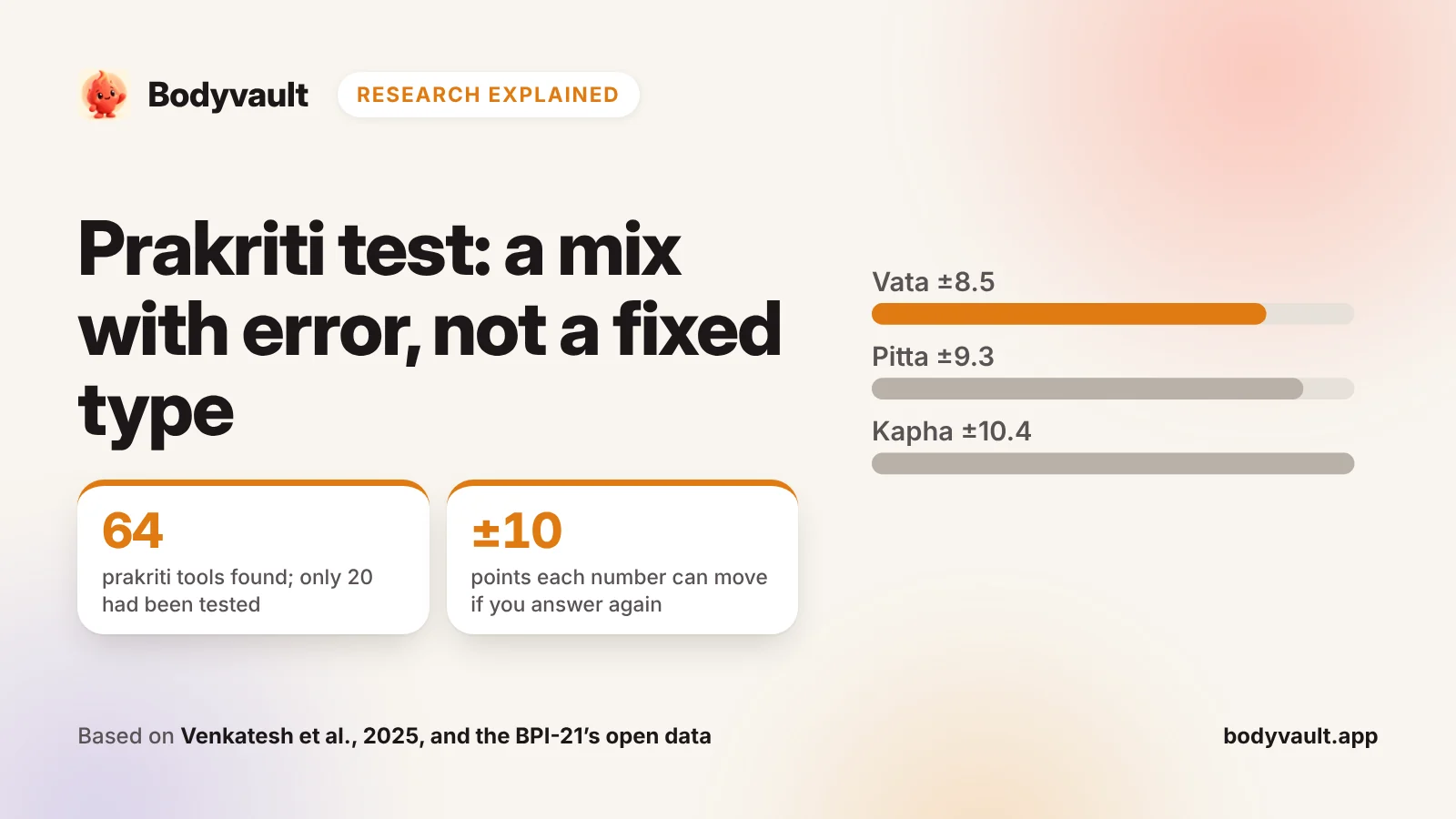
A prakriti test shows how your answers line up with Ayurveda’s three doshas: vata, pitta and kapha. It is not a medical test. The best-tested questions repeat well, but each number can still move by about 10 points, and studies linking prakriti to the body are mostly small.
The short answer
64
Ways of assessing prakriti found in a 2025 review. Only 20 had been tested at all.
0.28
How well 15 Ayurvedic doctors agreed on the same 20 people, on a scale where 1 is perfect
0.83–0.90
How well BPI-21 answers repeated a month later, in 116 people
±10points
About how far each percentage could move if you answered again (our calculation)
Strength of evidenceLimited
Most studies are small. Many pick extreme types and run many tests. The clearest link, with body size, is partly built into the questions.
Key findingA prakriti test describes your answers. It doesn’t measure your body, and it doesn’t diagnose anything. Read it as a mix of three numbers that could each move by about 10 points.
What is a prakriti test?
Ayurveda is India’s traditional system of medicine. It describes three doshas: vata, pitta and kapha. In Ayurveda, each person is born with their own mix of the three. That mix is called prakriti. A classical text, the Charaka Samhita, says it is set at conception.
In Ayurveda, each dosha has its own qualities. Kapha is described as slow, stable and heavy. Pitta is described as hot and sharp. Vata is described as light, quick and changeable.
Prakriti is not the same as vikriti. Prakriti is your lifelong make-up. Vikriti is how you are right now. In one review, only 8 of 19 questionnaires asked about lifelong traits. So our questions ask how you have usually been for most of your adult life, not this week.
A prakriti test asks about things like your skin, appetite, sleep, mood and how you handle stress. Each answer points to one dosha. Your result is the share of your answers that went to each one.
What a prakriti test isn’t
- Not a medical test. It doesn’t diagnose, predict or treat anything.
- Not a reading of your body. No watch, ring or pulse device has been shown to detect a dosha.
- Not fixed. Your answers can change, and so can your numbers.
- Not a ranking. No mix is better than another.
Why prakriti is hard to measure
In 2025, a review looked for every published way of assessing prakriti. It found 64 tools in 94 studies. Only 20 had been tested at all, and 19 of those only by the people who made them. None met all 9 standard steps for building a good questionnaire. The best two met 7.
Experts also disagree. In one study, 15 Ayurvedic doctors each examined the same 20 healthy people. They agreed on prakriti only a little more than chance. On the pulse, they barely agreed at all.
A structured questionnaire agreed with the doctors’ majority view better than the doctors agreed with each other. So a good questionnaire is at least as consistent as one doctor’s view. But there is no gold standard to check any tool against.
The questions we use: the BPI-21
The BPI-21 is the only self-report tool we found with a large sample, a retest and a check against an expert’s tool. Its article and data are open, so anyone can check the scoring.
It has limits. It was tested only in English, online, with a highly educated group. It works less well for people whose answers are spread out. Pitta was the least reliable part. And no one has tested whether its result predicts anything.
How the BPI-21 is scored
- Each answer gives one point to its dosha. If none of the three fits, you can skip that question.
- A result needs at least 19 of the 21 answers.
- Each dosha’s percentage is its points divided by the questions you answered. So the three always add up to 100.
- “Your answers lean kapha” means kapha is at least 3 answers ahead of the next.
- “An even mix” means all three are within 2 answers of each other.
- Anything else is “a blend” of the top two.
For example, take 14 kapha answers, 4 vata and 3 pitta. That gives 66.7% kapha, 19.0% vata and 14.3% pitta. Those answers lean kapha.
Research studies sort people into types instead. A single type has one dosha with more answers than the other two together. A balanced type has all three between 28% and 38%. Everyone else is a dual type. Bodyvault keeps these types for research only and never shows them.
Why Bodyvault shows a mix, not a type
Numbers repeat better than labels. Using the BPI’s open data, we worked out how far each percentage could move if someone answered again. Nine times out of ten, it would stay within these bands.
Labels are less steady. For 17% of people in the data, the top two doshas were only one answer apart. In a simulated retest, only about 62% kept the same one of seven type labels (our calculation). That simulation is a rough model, not a real retest.
So the app shows your three numbers as a bar, with a band of about 10 points around each. It says “leans” only when the gap is clear. In the simulation, a lean changed to a different lean only about 1% of the time.
What studies have found: body size
The most repeated finding is about body size. In 971 young men with one clear dosha, a low BMI went with vata and a high BMI with kapha. A study of 463 adults in Manipur found the same for weight and body fat, but not for height. We read only its abstract.
Part of this link is built in. Many questionnaires ask about build or weight. The BPI-21 asks how easily you lose weight (question 18). So a link with BMI partly shows that people answered in a consistent way.
What studies have found: HRV, sleep and genes
The largest study of heart rate variability (HRV) tested 379 healthy adults. At rest, HRV and heart rate didn’t differ by prakriti once the many tests were allowed for. When people were tilted upright, the vata group lost more HRV than the kapha group.
A large sleep study asked 995 people at a yoga programme about their sleep. All had a long-term illness that was under control. Higher vata scores went with taking longer to fall asleep and feeling less rested. Higher kapha scores went with longer naps. Each link explained 2% of the differences between people or less.
Studies of genes and prakriti are early work. Most are small, pick extreme types and run many tests. One used a much looser cut-off than genetic studies usually do. One small study linked a gene that breaks down some medicines to kapha. A larger study of 351 patients found no such link.
We found no study of prakriti and body clock, wrist temperature, glucose monitors or step counts. Those are some of the things Bodyvault can study.
The problems with the evidence
- Extreme types. Most studies pick people with one clearly dominant dosha, about 8 to 10% of people.
- Unblinded assessors. The people who sorted people into types often measured them too.
- Circular questions. Questionnaires ask about build, appetite and sleep, then find differences in those.
- Many tests. Dozens of measures are often tested with no correction.
- Other differences. Groups differ in BMI, sex and age, and studies rarely allow for it.
Who did the work matters too. 19 of the 20 tested tools were tested only by their own makers. A methodologist has argued that the dosha scheme mixes practical ideas with guesswork. Using it to make medical decisions, he argues, would be unsafe. We read only his abstract.
Claims and evidence
ClaimA prakriti test tells you your fixed type.
EvidenceThe numbers repeat well, but labels don’t. In a simulated retest, only about 62% of people kept the same type label (our calculation).
ClaimYour dosha is written in your genes.
EvidenceGenetic studies so far are small and used loose cut-offs. A gene finding about medicines didn’t repeat in 351 patients.
ClaimA smartwatch or a pulse reading can detect your dosha.
EvidenceDoctors reading the pulse agreed barely more than chance (0.07). No pulse device has been properly tested.
ClaimKapha types have lower HRV.
EvidenceIn the largest study, 379 people, resting HRV didn’t differ by prakriti once the many tests were allowed for.
What we won’t say
India’s rules on health advertising rule out some claims. So does plain honesty. We follow these rules in the app and on this site.
- No disease risk. We never say a type is prone to an illness.
- No remedies or products. No herbs, supplements, medicines or detoxes tied to a dosha.
- No dosha diets. No foods to avoid or to eat by type.
- No “scientifically proven”, and no “in your DNA”.
- No changes to your plan. The profile never changes your calories, protein, training, sleep or Readiness targets.
- No imbalance readings from HRV, your pulse or the camera.
- No badge saying “You are a kapha”, and no best or worst type.
How Bodyvault will study it
We want to know if people’s answers relate to the readings they share. Before looking, we wrote down 15 ideas to test. For example, do answers that lean vata go with less regular sleep? Do answers that lean kapha go with a higher BMI?
Only if you choose
Research Program members can add their profile with a separate switch. It starts off.
Two halves
Members are split into two halves by a code made from their random member ID.
Explore one half
Every two weeks, our server looks at the first half only. Those results are never shown as findings.
Publish the plan
Before we look at the second half, we register the plan: the ideas, the measures and the code.
Test once
When the second half has about 1,420 members, we test the plan on it, once.
Report it all
We will publish every result, including the ones where we find nothing.
We look for effects at least as big as a correlation of 0.10, about 1% of the differences between people. Smaller effects wouldn’t change anything a person does. Finding effects that small needs about 1,420 members in the second half, so about 2,840 in all (our calculation).
Only numbers about groups of at least 20 members leave our server. No one’s answers do. Even a positive result would describe groups, not you. Your own readings say more about you than any type.
What this means for you
- Treat your result as a picture of your answers, not a fact about your body.
- Look at all three numbers, and allow about 10 points either way.
- Answer for how you have usually been, not how you feel this week.
- Don’t change your food, training or medicines because of your dosha. Your own readings and your doctor are better guides.
How Bodyvault uses this research
The Ayurveda profile in the app is optional and for adults only. It isn’t part of setup and isn’t part of Pro. It shows your mix as a bar with a band of about 10 points, and words like “Your answers lean kapha”. Its tips are habits that help most people, whatever their mix, each with a link to our research. It changes nothing else in the app: not your targets, scores, Readiness or coaching. It stays on your phone unless you are a Research Program member and turn on its switch. The details are in our privacy policy.
The questions and their credit
Questions from the Brief Prakriti Inventory (Bhargav et al., 2025, CC BY 4.0), with wording adapted for the app. Read the article.
What we changed: we shortened or reworded some question titles and added full stops. Options appear in random order, without dosha names. We added a line asking you to answer for most of your adult life, and a “None of these fits” choice that counts as unanswered. Percentages are over the questions you answered (at least 19 of 21) instead of over all 21.
Share or cite this explainer
Bodyvault (2026). Prakriti test: what a dosha quiz can and can’t tell you. https://bodyvault.app/blog/prakriti-test
The charts on this page may be reused with a link back to it. The underlying data belong to the studies cited below.
Questions
What is a prakriti test?
A set of questions about things like your skin, appetite, sleep and mood. Each answer points to one of Ayurveda’s three doshas. Your result is the share of answers for each. It describes your answers. It isn’t a medical test.
How accurate is a prakriti test?
There is no gold standard to check one against. The BPI-21’s answers repeated well a month later (retest ICC 0.83 to 0.90). Even so, each percentage could move by about 10 points if you answered again, and type labels change more than the numbers.
Can a smartwatch tell my dosha?
No. No watch, ring or pulse device has been shown to detect a dosha. In one study, doctors reading the pulse by hand agreed barely more than chance.
Can my prakriti result change?
Yes. Ayurveda holds that prakriti is lifelong, but your answers can change, and so can your numbers. That is why the app shows a range. You can answer again after 30 days.
Should I eat or train differently because of my dosha?
Studies haven’t tested advice by dosha, so we don’t give any. Bodyvault’s tips are habits that help most people, whatever their mix. Your own readings and your doctor are better guides.
Sources
- Bhargav H, Chikkanna U, Holla B, et al. (2025). The Brief Prakriti Inventory: latent structure, reliability, and validity. Wellcome Open Research (version 2). doi:10.12688/wellcomeopenres.25166.2. CC BY 4.0.
- Holla B, Bhargav H (2025). The Brief Prakriti Inventory: data and analysis package. Zenodo. doi:10.5281/zenodo.17607907. Data CC BY 4.0, code MIT.
- Venkatesh A et al. (2025). Prakriti (constitutional typology) in Ayurveda: a critical review of Prakriti assessment tools and their scientific validity. Front Med 12:1656249.
- Gupta A, Singh V, Chandra S, Garg R (2025). Towards standardization of Prakriti evaluation: a scoping review of modern assessment tools and their psychometric properties. J Ayurveda Integr Med 16:101157.
- Kurande V et al. (2013). Interrater reliability of diagnostic methods in traditional Indian Ayurvedic medicine. Evid Based Complement Alternat Med 2013:658275.
- Rotti H et al. (2014). Determinants of prakriti, the human constitution types of Indian traditional medicine and its correlation with contemporary science. J Ayurveda Integr Med 5:167–75.
- Konjengbam H, Leona Devi Y, Meitei SY (2021). Correlation of body composition parameters and anthropometric somatotypes with Prakriti body types among the Meitei adults of Manipur. Ann Hum Biol 48:160–5. (Abstract.)
- Rani R et al. (2022). Heart rate variability during head-up tilt shows inter-individual differences among healthy individuals of extreme Prakriti types. Physiol Rep 10:e15435.
- Telles S et al. (2015). Ayurvedic doshas as predictors of sleep quality. Med Sci Monit 21:1421–7.
- Prasher B et al. (2008). Whole genome expression and biochemical correlates of extreme constitutional types defined in Ayurveda. J Transl Med 6:48.
- Govindaraj P et al. (2015). Genome-wide analysis correlates Ayurveda Prakriti. Sci Rep 5:15786.
- Ghodke Y, Joshi K, Patwardhan B (2011). Ayurveda Prakriti type and CYP2C19 gene polymorphism associated with the metabolic variability. Evid Based Complement Alternat Med 2011:249528.
- Thaker SJ et al. (2017). A prospective study to assess the association between genotype, phenotype and Prakriti in individuals on phenytoin monotherapy. J Ayurveda Integr Med 8:37–41. (Abstract.)
- Krishna GL (2025). Revisiting the tridosha paradigm of Ayurveda. Indian J Med Ethics X(3). doi:10.20529/IJME.2025.014. (Abstract.)
- Charaka Samhita, Vimana Sthana 8 (Rogabhishagjitiya Vimana), verses 95–100, Sanskrit with English translation. Charak Samhita Research, Training and Skill Development Centre (2020). doi:10.47468/CSNE.2020.e01.s03.009.
General information about fitness and nutrition, not medical advice. If you have a health condition, are pregnant or take medication, talk to your doctor before changing your diet or training.